
the Creative Commons Attribution 4.0 License.
the Creative Commons Attribution 4.0 License.
 | 08 Jan 2026
Comment on “Detailed conodont data from the Olenekian–Anisian boundary interval of the GSSP candidate section at Deşli Caira, Romania” by Golding (2025)
Marco Balini
Micha Horacek
Iuliana Lazăr
- Article
(2885 KB) - Full-text XML
- Corresponding article
- BibTeX
- EndNote


The recent publication by Golding (2025) of new conodont data from the Anisian GSSP (Global Boundary Stratotype Section and Point) candidate section Deşli Caira in northern Dobrogea (Romania) includes three significant uncertainties with regard to the presence of a fault in the outcrop, the displacement of the succession, and the exact stratigraphic position of the conodont samples. These uncertainties may become a major problem in the research aimed at the definition of a global standard for the Anisian stage, such as the GSSP. Within this general framework, these uncertainties may result in a complication in the selection of the GSSP, which has been in a pending status since 2007. We therefore believe it is necessary to formally report our disagreements with the published paper in this Comment.
Two of us (Marco Balini, hereafter MB, and Micha Horacek, hereafter MH) were invited to review the paper, and, in our reviews, we both independently asked the author to report the presence of the fault and to position the samples exactly (e.g. by exactly indicating in the figures where they were collected). Unfortunately, we discovered from the accepted version of the paper that our requests were not taken into account, even though one of us (MB, who signed his review) was acknowledged by the author for the help in improving the paper. This acknowledgement might seem like an approval to a reader, but this is not the case.
We asked the Editorial Board of the Journal of Micropaleontology (JM) to take a position and have been invited to submit our Comment.
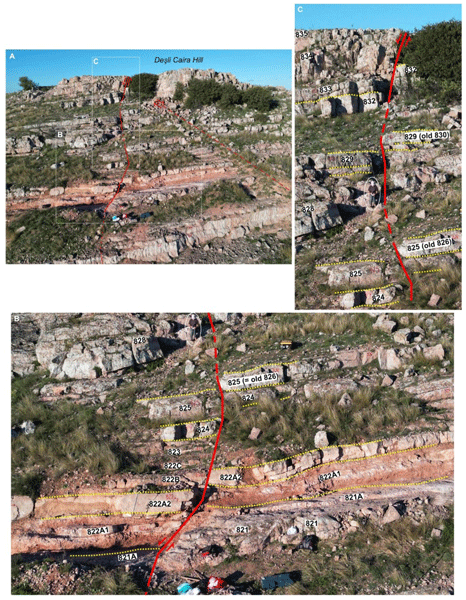
The Deşli Caira section B (showing 8xx and some 2xx sample numbers: Balini et al., 2024, fig. 6) that has been studied by Golding (2025) was proposed by Grădinaru et al. (2007) as a candidate section for the Anisian GSSP. However, since this proposal and until 2024 (Balini et al., 2024), only a synthetic log of the section has been used in several papers as a reference for range charts. From this synthetic log, the position of several sets of samples was not exactly tied to the bedding (see details in Balini et al., 2024). A small fault affecting section B was reported in the magnetostratigraphic log (Gallet et al. in Grădinaru et al., 2007, fig. 7), but the position of this fault was never described in the following literature. The fault was detected, described, and illustrated by Balini et al. (2024, fig. 4, 5B), together with a second fault, bounding the outcrop to the east. Both faults were examined by MB and MH during a joint field trip in 2024, after the submission of the Balini et al. (2024) paper. The first mentioned fault is described by an upward movement of the right (eastern) side by about 80 to 100 cm with respect to the left (western) side (Figs. 1A to C, 2). The left (western) side of the fault is regarded to be the reference, and the right (eastern) side has been corrected accordingly by Balini et al. (2024) (see Fig. 1B and C). Ignoring this fault means an assignment of samples collected on the right side of the fault to incorrect beds. As Golding (2025) did not indicate whether he collected the samples from the right or the left side of the fault, despite having been asked to do so, the assignment of his samples to the indicated beds is doubtful.
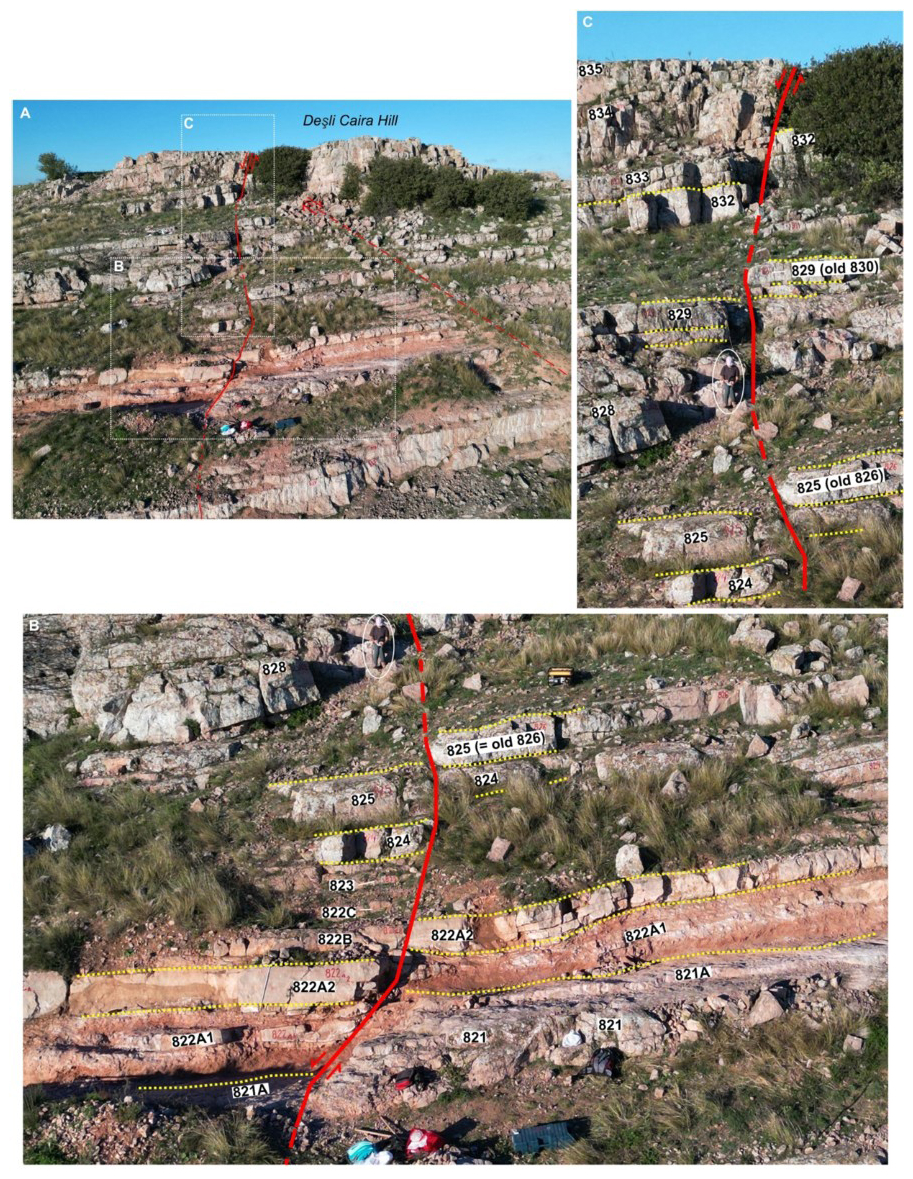
Figure 1Overview of middle and upper part of Deşli Caira section B, showing the Olenekian–Anisian boundary succession and the two faults recognized by Balini et al. (2024, fig. 4). (A) General view of the succession. (B) Detail of the middle part of the section. (C) Upper part of the section. The white ellipse identifies our colleague Alexandra Lăcătuş, who is the scale for the photo (ca. 160 cm). See the text and Balini et al. (2024) for additional explanations. The photo was taken by a drone, as was the photo in fig. 4 of Balini et al. (2024). This photo was taken at the end of the September 2024 field works, while the photo in Balini et al. (2024) was taken in June 2023.
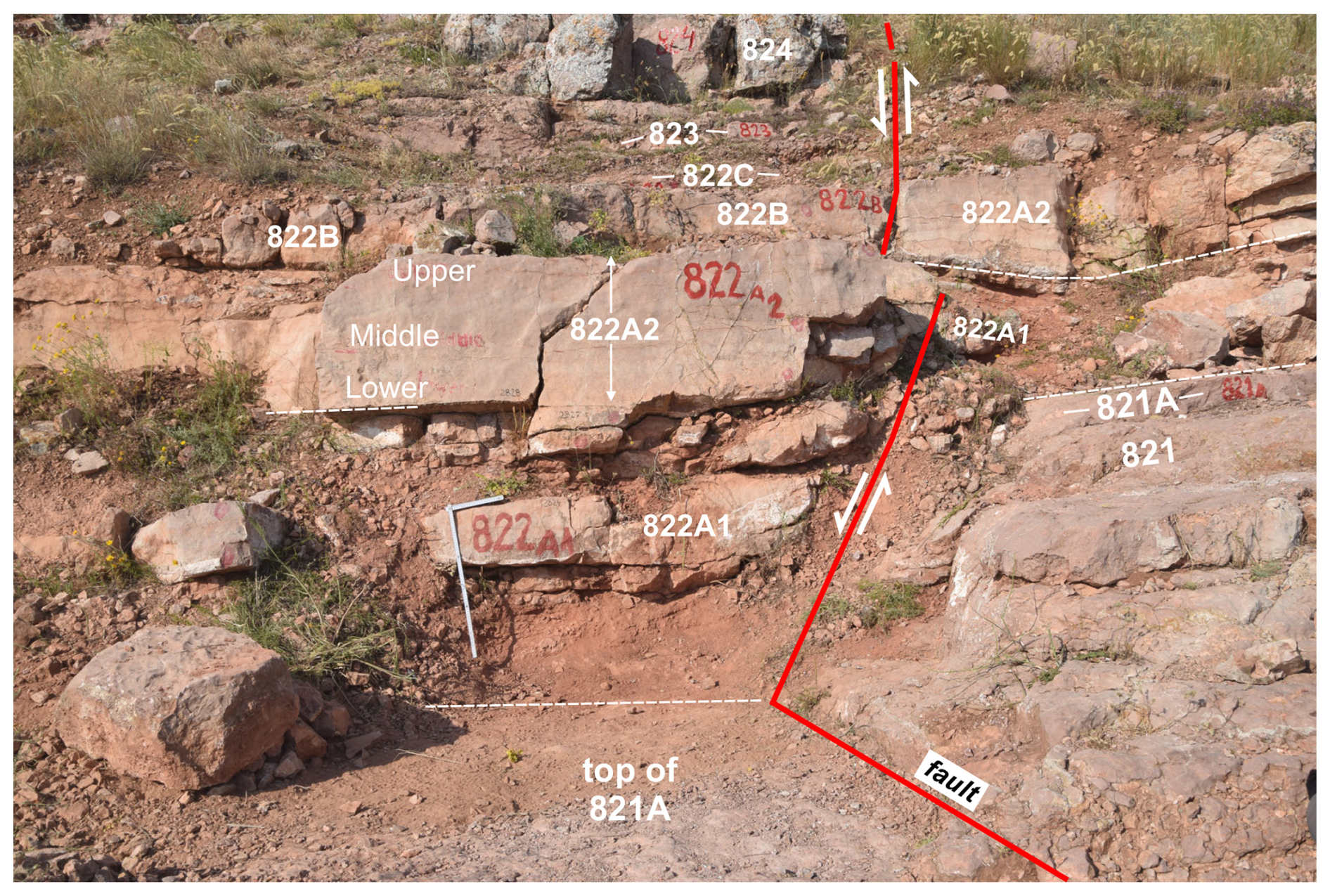
Figure 2Detail of the Olenekian–Anisian boundary interval in the central part of the Deşli Caira section B, showing the offset of the beds on the left (west) of the fault with respect to those on the right (east). The photo is the same as in Balini et al. (2024, fig. 5), with additional bed numbers.
In 2024, one of us (MB) personally informed Golding of the presence of the fault and of the resulting offset between the beds west of the fault and those on the opposite side. This information was acknowledged by Golding (2025, p. 370), but we assert that Golding's reference to this fault is ambiguous. Here, we outline the four points of disagreement:
-
See p. 367, left column. “A fault has been recognized in section B, with its trace estimated in figs. 4 and 5 of Balini et al. (2024), although its position between beds 822A2 and 822B is uncertain.”
-
See p. 368, caption of fig. 2. “Outcrop photo of the Deşli Caira section (Section B of Grădinaru et al., 2007), illustrating the new bed numbering system, and the stratigraphic levels of samples collected from the section (location of each sample within a bed is approximate).”
-
See p. 368, caption of fig. 2. “Note that Balini et al. (2024) indicate the presence of a fault within bed 822B, which appears to be a crack within the bed to the left of the arrow labelling this bed.”
-
See p. 370, right column. While describing sample 22-GWA-DC-822B, from bed 822B, it is stated that “A fault in the section with approximately 80 cm of offset may mean that this sample [22-GWA-DC-822B] is actually from bed 822A2 (Marco Balini, personal communication, 2024, see Balini et al., 2024, fig. 5B for illustration of this fault); therefore, a new sample has been collected from bed 822B to confirm the location of sample 22-GWA-DC-822B, and the results from this new sample will be reported on in the future”.
From the above statements, it seems clear to us that the author does not really accept the presence of the fault. Hence, we present our remarks, following the same numbering as used for the above statements by Golding:
-
The fault is visible and easy to walk on along the slope of Deşli Caira Hill from the middle part of the section to the top (Balini et al., 2024, fig. 4; Figs. 1 and 2). Contrarily to what is reported by Golding, the fault is also visible between beds 822A2 and 822B, as shown in Balini et al. (2024, figs. 4, 5B; Figs. 1B and 2). This issue can be solved by comparing the thickness of beds 822A2 (right of fault) and 822B (left of fault), colour, and distribution of macrofossils within the beds from one side of the fault to the other side.
-
The arrows shown in fig. 2 report only the stratigraphic levels from which the samples have been taken and not the precise point of collection of the samples. As Golding does not recognize the fault, the statement “stratigraphic levels of samples collected from the section” does not ensure that the samples are in the correct stratigraphic position and succession by considering the offset of the beds if samples were collected on both sides (or only on the right side) of the fault. As a consequence, we contend that several or perhaps even all of the samples could have been assigned by Golding to an incorrect bed.
-
We reject the statement “Note that Balini et al. (2024) indicate the presence of a fault within bed 822B, which appears to be a crack within the bed”. Balini et al. (2024) show a fault that is not limited to bed 822B but that is at least 20 m long and runs almost perpendicular to the bedding (see Balini et al. 2024, fig. 5B; Figs. 1A–C and 2). The “crack within the bed” is not a fracture, but it is part of this fault, separating two different beds, namely 822B to the left and 822A2 to the right.
-
Even if we follow Golding's view on the doubtful position of sample 22-GWA-DC-822B, we question the use of this sample in Golding (2025). The literature on the Deşli Caira section published in the past 15 years is already full of fossil determinations from samples whose precise position in the beds is not known. This is especially true for conodont samples with labels 2xx and 9xxx studied in several papers (e.g. Grădinaru et al., 2006, 2007; Orchard et al., 2007; Golding, 2021), and Golding was aware of this problem as he stated “However, their position [of the 10 samples under study, tied to beds numbered 8xx] relative to other numbering schemes (e.g. 2xx and 9xxx) of these papers is less certain, with only relative position known” (Golding, 2025, p. 367).
The selection of a GSSP is a long and complex procedure (Cowie, 1986; Remane et al., 1996) that includes a thorough examination of the candidate sections to verify the fulfilment of a long list of requirements (Salvador, 1994, pp. 90–91), including the exposure “in an area of minimal structural deformation”. The outcrop Deşli Caira section B fulfils the requirement of “minimal structural deformation” for the reasons summarized as follows:
-
There are no doubts regarding the presence of a fault in the central part of the Deşli Caira section B. There is no room for interpretations or uncertainties; the fault is visible (Figs. 1A–C and 2). However, on both sides of the fault, the section is basically structurally undeformed.
-
The displacement caused by the fault is easy to detect, and the offset is between 80 cm to 1 m (Figs. 1, 2).
-
At the Deşli Caira section B, the beds can be followed along strike for several tens of metres; therefore, there is plenty of space for undisturbed sampling. However, as the offset due to faulting is easy to detect, the sampling can be done even in the vicinity of the fault, moving from one side to the other, by simply taking into account the offset in a proper way.
One of the aims of the Balini et al. (2024) paper was to draw attention to the low stratigraphic precision of all of the datasets published since the Grădinaru et al. (2007) proposal of the Deşli Caira section B for the GSSP of the Anisian. Most of these samples were tied to a low-resolution synthetic log without detailed reference to the true bedding visible on the outcrop. Such a synthetic log is insufficient for the proposal of the GSSP, which requires the selection of precisely located events (primary and secondary). In this regard, Balini et al. (2024) represented a starting point.
Since then, we work to establish as the standard reference a bed-by-bed log with 809 to 836 numbering to be used to build a new, high-resolution integrated dataset conforming with the high standard required by the International Commission on Stratigraphy for the GSSP selection. In this regard, Golding (2025) is only of very limited use and value as the exact position of the samples was not indicated, neither with respect to the fault nor with the exact position within the individual beds, and thus remains uncertain. Therefore, high-resolution (palaeontological and/or conodont) investigations (on the centimetric scale) of the key interval (e.g. between 817 and 825) are still required and needed, and, thus, a lot of work remains to be done.
No data sets were used in this article.
No new data were used. The detailed discussion on the synthethic logs, the imprecise position of the samples taken from Deşli Caira section in the past 18 years, and the tectonic setting of the outcrop are presented in Balini et al. (2024; https://doi.org/10.54103/2039-4942/24683); for further discussion see Horacek et al., in prep.
The paper was written and reviewed by all three of the authors (MB, MH, and IL). Figures 1 and 2 were drawn by MB and reviewed by MH and IL.
The contact author has declared that none of the authors has any competing interests.
Publisher’s note: Copernicus Publications remains neutral with regard to jurisdictional claims made in the text, published maps, institutional affiliations, or any other geographical representation in this paper. While Copernicus Publications makes every effort to include appropriate place names, the final responsibility lies with the authors. Views expressed in the text are those of the authors and do not necessarily reflect the views of the publisher.
We thank the Editor, Luke Mander, and the Editor in Chief, Francesca Sangiorgi, for the opportunity to write this Comment. The paper has been improved by suggestions from an anonymous reviewer and from Spencer Lucas (Albuquerque, NM, USA).
This paper was edited by Francesca Sangiorgi and reviewed by Spencer Lucas and one anonymous referee.
Balini, M., Lăcătuş, A., Gradinăru, E., and Lazăr., I.: Aegean ammonoids from the Anisian GSSP candidate section Deşli Caira (Northern Dobrogea, Romania, Riv. It. Paleont. Strat., 130, 711–759, https://doi.org/10.54103/2039-4942/24683, 2024.
Cowie, J. W.: Guidelines for Boundary Stratotypes, Episodes, 9, 78–82, 1986.
Golding, M. L.: Early Anisian (Middle Triassic) conodonts from Romania and China, with comments on their role in the recognition and correlation of the base of the Anisian, J. Earth Sci., 32, 573–591, https://doi.org/10.1007/s12583-020-1392-9, 2021.
Golding, M. L.: Detailed conodont data from the Olenekian–Anisian boundary interval of the GSSP candidate section at Deşli Caira, Romania, J. Micropalaeontol., 44, 365–380, https://doi.org/10.5194/jm-44-365-2025, 2025.
Grădinaru, E., Kozur, H. W., Nicora, A., and Orchard, M.J.: The Chiosella timorensis lineage and correlation of the ammonoids and conodonts around the base of the Anisian in the GSSP candidate at Deşli Caira (North Dobrogea, Romania), Albertiana, 34, 34–38, 2006.
Grădinaru, E., Orchard, M. J., Nicora, A., Gallet, Y., Besse, J., Krystyn, L., Sobolev, E. S., Atudorei, N.-V., and Ivanova, D.: The global boundary stratotype section and point (GSSP) for the base of the Anisian stage: Deşli Caira Hill, North Dobrogea, Romania, Albertiana, 36, 54–71, 2007. Horacek, M., Balini, M., and Lazăr., I. News from the Olenekian–Anisian Boundary at Deşli Caira section, Albertiana, in preparation, 2025.
Orchard, M. J., Grădinaru, E., and Nicora, A.: A summary of the conodont succession around the Olenekian-Anisian boundary at Deşli Caira, North Dobrogea, Romania, in: The Global Triassic, edited by: Lucas, S. G. and Spielmann, J. A., New Mexico Museum Nat. Hist. Sci. Bulletin, 41, 341–346, 2007.
Remane, J., Bassett, M. G., Cowie, J. W., Gohrbandt, K. H., Lane, H. R., Michelsen, O., and Naiwen, W.: Revised guidelines for the establishment of global chronostratigraphic standards by the International Commission on Stratigraphy-ICS, Episodes, 19, 77–81, 1996.
Salvador, A. (Ed.): International Stratigraphic Guide, 2nd Edn., John Wiley & Sons, 214 pp., ISBN 978081377402, 1994.
- Introduction
- Deşli Caira section B: is there a fault or not?
- Suitability of Deşli Caira section B for the definition of the GSSP of the Anisian stage
- Concluding remarks
- Code availability
- Data availability
- Author contributions
- Competing interests
- Disclaimer
- Acknowledgements
- Review statement
- References
- Introduction
- Deşli Caira section B: is there a fault or not?
- Suitability of Deşli Caira section B for the definition of the GSSP of the Anisian stage
- Concluding remarks
- Code availability
- Data availability
- Author contributions
- Competing interests
- Disclaimer
- Acknowledgements
- Review statement
- References