
the Creative Commons Attribution 4.0 License.
the Creative Commons Attribution 4.0 License.
 | 26 Jan 2026
Early–Middle Ordovician chitinozoans from the Dawan Formation, Yichang area, Central China
Shouhan Wu
Xiaocong Luan
Renbin Zhan
The late Early to early Middle Ordovician is a key interval for chitinozoan macroevolution, during which chitinozoans diversified significantly, reaching their first enormous radiation later in the Darriwilian. The South China palaeoplate is one of the classical regions for Ordovician palaeontological research; however, published chitinozoan data for this interval remain insufficient. This study presents new data from the Gudongkou section, western Yichang, western Hubei Province, in the central part of the South China palaeoplate. A total of 13 genera and 31 species are recognised, including three new species: Conochitina clavatus sp. nov., Conochitina tenellensis sp. nov., and Lagenochitina yangtzensis sp. nov. Systematical remarks on some taxa are provided, including Conochitina decipiens, C. ordinaria, and the group of Sagenachitina oblonga, S. striata, S. dapingensis, and Cyathochitina? dispar. Network analysis is applied based on the data from the Dawan Formation and its contemporaneous units on the Yangtze Platform to test whether chitinozoan assemblages vary among different lithological units that represent different palaeoenvironments. The result shows that chitinozoan assemblages may have palaeogeographical significance. The chitinozoan assemblage from the Dawan Formation at the Gudongkou section seems to be a more independent community compared with those from the Meitan and Zitai formations. However, shared taxa, including the zonal species Bursachitina maotaiensis and Sagenachitina dapingensis, and some other widely distributed, characteristic taxa, such as C. decipiens and C. poumoti, are well-preserved in almost all sections. The biostratigraphical significance of the Dawan chitinozoans, discussed herein, indicates an age ranging from the latest Floian to the earliest Darriwilian, consistent with prior understanding of this formation.
- Article
(16099 KB) - Full-text XML
- BibTeX
- EndNote


The Early and Middle Ordovician represent a critical interval in chitinozoan evolutionary history, when chitinozoans underwent their first biodiversification following their first undoubted appearance in the early–middle Tremadocian (e.g. Elaouad-Debbaj, 1988; Wang et al., 2013; Liang et al., 2017); the three phosphatised specimens from the Cambrian Wuliuan Stage (Shen et al., 2013) are debated and require further study. Following their appearance, chitinozoans underwent a rapid geographical expansion and taxonomical diversification, achieving their first global acme in late the Darriwilian (Achab and Paris, 2007). However, as a classical area for Ordovician research, chitinozoan data from the Early–Middle Ordovician in South China remain poorly constrained due to insufficient systematical studies. During this interval, the Upper Yangtze Platform was dominated by deposition of the Dawan, Meitan, and Zitai formations under different palaeogeographical settings, with several small areas developing characteristic lithostratigraphical units, e.g. the Hungshihyen, Daguanshan, and Yingpan formations (Fig. 1d; Chen and Zhan, 2006; Wu et al., 2007; Liang et al., 2019a) in the provinces of northern Yunnan, southern Sichuan, and northern Chongqing, respectively. Pioneering chitinozoan studies in this region were mainly conducted by Xiaohong Chen, Xiaofeng Wang, and their colleagues. Most data are presented in a comprehensive monograph published in Chinese, which documents chitinozoan assemblages from about 10 sections spanning the Dapingian to the lower Darriwilian (Chen et al., 2009a). Some data were also published earlier or later as journal articles (Wang and Chen, 1994; Chen et al., 2002, 2003, 2009b; Chen and Zhang, 2005; Wang et al., 2005a, b). Additional early reports include brief documentation of chitinozoans from the Dawan Formation at the Huaqiao section (Changyang, Hubei; Chen, 1994) and the Meitan Formation at the Longjinpo section (Wuchuan, Guizhou; Wang and Luo, 1990). Recent contributions have expanded the known record from the Meitan and Zitai formations (Liang and Tang, 2016a; Liang et al., 2018, 2019a). Nevertheless, all available data on chitinozoan assemblages from the Upper Yangtze Platform during this crucial interval remain fragmentary, underscoring the need for more comprehensive and systematic taxonomic studies to fully elucidate the assemblages and evolutionary patterns in this region. Previous studies on chitinozoans from the Dawan Formation have primarily focused on the Global Stratotype Section and Point (GSSP) for the base of Dapingian at the Huanghuachang section (Chen et al., 2009a, b) and the Chenjiahe section, about 5 km north of the former (Wang et al., 2005a, b; Chen et al., 2009a, b). These works documented a diverse assemblage comprising 29 species of eight genera (Chen et al., 2009b), decoding the chitinozoan assemblage and establishing a preliminary framework for chitinozoan biostratigraphy in the region. To assess whether the known assemblage of this time interval is fully captured, new data from the Dawan Formation at the Gudongkou section, located approximately 60 km north of the Huanghuachang GSSP section, are presented herein. This study aims to do the following: (1) further decode the chitinozoan assemblage from the Dawan Formation based on data from Gudongkou, expanding the palaeontological record of this key interval; (2) test the chitinozoan biostratigraphical framework previously established for the Yangtze Platform, facilitating regional and global correlations for the Early–Middle Ordovician; and (3) apply network analysis to test the inter-similarities and inter-differences of chitinozoans from the Dawan and its contemporaneous lithological units. By integrating these new findings with existing data, this work will enhance our understanding of the chitinozoan biodiversity and biostratigraphy on the Upper Yangtze Platform, providing new insights into their palaeobiogeographical significance during this critical period.

Figure 1(a–c) Geographic location of the Gudongkou section in western Hubei Province. (d) General palaeogeographic distribution of the Dawan Formation and its contemporaneous sedimentary units (adapted from Wu et al., 2007) across the Yangtze Platform during the Early–Middle Ordovician. The red triangle indicates the location of the Dawan Formation at the Gudongkou section. The yellow triangles refer to localities with exposure of the Dawan Formation and its contemporaneous units, from which the chitinozoan assemblages used in the network analysis were documented. More information about these sections is presented in Table 4.
South China represents one of the world's most significant regions for Palaeozoic palaeontological research, preserving a diverse sedimentary environment from the late Precambrian to the Middle Ordovician (Chen and Rong, 1992). From northwest to southeast, the block exhibits a series of western oldlands (erosional uplifts), the Yangtze Platform (mainly shallow marine carbonate-dominated settings), the Jiangnan Slope (transitional zone), and the Zhujiang Basin (deep-water siliciclastic deposits). During the late Early to early Middle Ordovician, the upper part of the Yangtze Platform was characterised by distinct lithofacies reflecting a depth-related environmental gradient (Fig. 1d), including the near-shore settings, represented by the Hungshiyhen (mainly sandstone and silty mudstone) and the Daguanshan (siltstone, silty mudstone, and mudstone) formations; the inner-shelf environments, represented by the Meitan Formation (siltstone, silt mudstone, and muddy siltstone) and the Yingpan Formation (shales intercalated with carbonates); and the shallow outer shelf close to the Yangtze Platform margin, comprising the Dawan Formation (argillaceous carbonate with calcareous mudstone) and the Zitai Formation (purple argillaceous carbonate and carbonate). Geographically, the Dawan Formation is widely deposited and well-outcropped in the vast area of Hubei Province and in part of Sichuan Province on the Upper Yangtze Platform. It also extends to the Lower Yangtze Platform, e.g. Nanjing of Jiangsu Province and central Anhui Province. This widespread distribution makes the Dawan Formation a critical unit for regional biostratigraphical and palaeoenvironmental reconstructions.
The studied section, the Gudongkou section (31°24′38.73′′ N, 110°447′24.87′′ E), is located about 2.6 km north of Xingshan Town, northwest of Yichang City, western Hubei Province, Central China (Fig. 1). This section exposes well-developed Cambrian to Ordovician strata along the Guzhao Road near the Gudongkou water reservoir. Previous research at this locality has established it as an important stratigraphical reference section. Jianbo Liu and his colleagues from Peking University conducted extensive work on the Cambrian–Lower Ordovician sequences, focusing on both sedimentary and palaeontological investigations (Dang et al., 2009; Liu, 2009; Yuan et al., 2009; Liu et al., 2011; Liao et al., 2013; Yuan and Liu, 2013; Ding et al., 2014; Sun and Liu, 2017). Subsequent studies have further refined our understanding of this section, including investigations into the Early Ordovician acritarchs and chitinozoans (Liang and Luan, 2019; Shan et al., 2019), detailed lithofacies, and environmental analysis of the Dawan Formation (Luan et al., 2023). The section's continuous exposure and well-documented stratigraphy make it particularly suitable for high-resolution biostratigraphical studies of the Dawan Formation, complementing previous work conducted at the Huanghuachang and Chenjiahe sections.
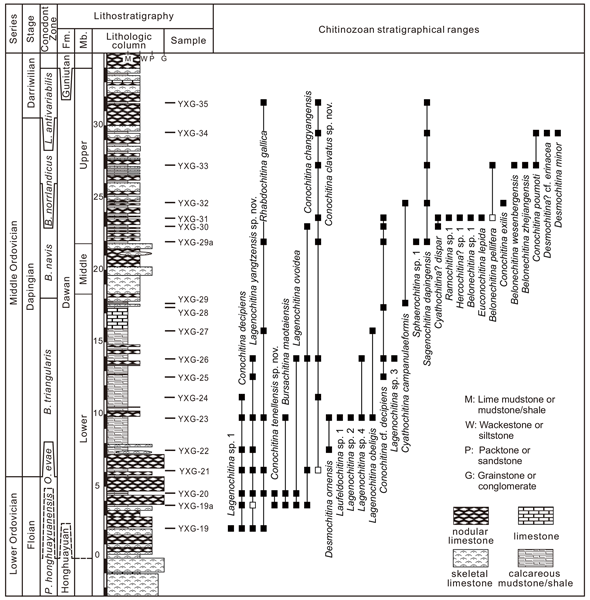
The Dawan Formation at the Gudongkou section, as in all other localities, is tripartite, comprising the Lower, Middle, and Upper members (Fig. 2). The Lower Member is mainly composed of 18 m of nodular limestone and calcareous mudstone interbedded with thin-bedded skeletal limestone. The Middle Member, about 3.5 m thick, consists of medium- to thick-bedded skeletal limestone and nodular limestone. The Upper Member is approximately 12 m in thickness and features thin-bedded nodular limestone and skeletal limestone interbedded with calcareous mudstone.

Figure 2Lithology and chitinozoan stratigraphical ranges at the Gudongkou section. The conodont biozones are based on unpublished data provided by Jianbo Liu at Peking University. Black rectangles represent certain occurrences, while the white ones represent possible occurrences due to poor preservation or limited specimens.
3.1 Sample collection
At the Gudongkou section, for this chitinozoan study, 19 samples, ranging from YXG-19 to YXG-35, were systematically collected from the calcareous mudstone horizons throughout the section; i.e. all samples were from the Lower and the Upper members' fine-grained clastic rocks, while the Middle Member's limestone was not sampled in this study (Fig. 2). Unlike the three-dimensionally preserved chitinozoans extracted from limestones in Baltica and North America (e.g. Liang et al., 2019b, 2020b), limestones or lime-dominated strata on the Yangtze Platform are not preferred for chitinozoan research, given that they are commonly regarded as barren or produce poorly preserved chitinozoans. The controlling factors of chitinozoan preservation still require further study, however, which is beyond the scope of this study.
3.2 Lab work
About 50 g of rock from each sample was processed based on the standard palynology procedures as illustrated by Paris (1981). Notably, all samples have relatively high lime. Therefore, the concentration of hydrochloric acid (HCl) used in the first step to dissolve the rocks starts at 3 %–5 % and gradually increases to 10 %, ensuring that all of the limes are fully removed while not destroying the specimens due to strong reactions. In the lab, only 38 % of hydrofluoric (HF) is applied. Thus, compared to the high-concentration HF (up to ca. 80 %) used in Estonia, the reaction with HF here in China lasted for 2 weeks or longer, depending on the environmental temperature. After the HF reaction, the washed residues were boiled with about 40 % HCl for about 10 min to half an hour to further purify the residues, which makes the following picking process easier.
In total, about 2060 individuals were picked out, and all of the specimens were observed under an Olympus infrared biological microscope (BX53). Selected specimens were examined (about 550 specimens) and photographed (about 180 specimens) under a field emission scanning electron microscope (Tescan Maia 3 GMU). All of the samples and specimens were deposited at the Nanjing Institute of Geology and Palaeontology, Chinese Academy of Sciences.
3.3 Data analyses
Network analysis (NA), a direct and efficient way to present and analyse the inter-connections of data, has been more and more frequently applied in palaeontological investigations in recent years, especially in palaeogeography and palaeoecology, and in identifying fauna communities and decoding their evolutions (e.g. Sidor et al., 2013; Huang et al., 2017; Muscente et al., 2018, 2019; Sun et al., 2022). This method is applied in this study and tries to test the relationship between sections and chitinozoan taxa (nodes) and occurrences (edges). In the NA, the average degree, graph density, and modularity are important parameters to evaluate the relationships between the nodes and edges. In short, in palaeogeographical analysis, more shared taxa lead to a higher graph density and average degree and a lower modularity. More detailed information about the principles and usage of the NA can be found in Newman (2010) and Wang and Huang (2020).
There are many ways and/or tools with which to conduct NA nowadays. In this study, R project, a free and open-source programming language, which is extensively used in data analysis, is adopted. It incorporates a diverse range of built-in layout and modularity algorithms, which enables convenient analysis under varying conditions (Wang and Huang, 2020). To improve the precision and accuracy of NA, we select a variety of widely applied distribution algorithms and modularity algorithms (Song et al., 2025). To present the results, one of the most concise layouts, the Fruchterman–Reingold algorithm, and two representative modularity algorithms, the leading eigenvector and edge betweenness, are chosen. The version of the R programming language used in this study is 4.5.0.
All 19 samples from the Dawan Formation at Gudongkou yielded relatively abundant chitinozoans, ranging from 0.23 to 6.92 specimens per gram of rock, with an average abundance of 2.26 specimens per gram. Chitinozoans are well-preserved. Although all specimens are flattened, most of the morphologies are clearly presented. Following the latest classification system (Paris et al., 1999), 31 species of 13 genera were recognised (Fig. 2, Pl. 1–5), including the South China biozonal index species Bursachitina maotaiensis (Chen in Chen et al., 2009a; Pl. 3, figs. 1–5) and Sagenachitina dapingensis Chen in Chen et al., 2009b (Pl. 5, figs. 1–11), as well as biostratigraphical markers like Belonechitina pellifera (Eisenack, 1959; Pl. 3, figs. 16–21), Belonechitina zhejiangensis Tang in Tang et al., 2007 (Pl. 3, figs. 11–13), and Conochitina decipiens Taugourdeau and de Jekhowsky, 1960 (Pl. 4, figs. 8–16). Three new taxa, Lagenochitina yangtzensis sp. nov. (Pl. 1, figs. 1–16), Conochitina clavatus sp. nov. (Pl. 2, figs. 10–16, 18), and Conochitina tenellensis sp. nov. (Pl. 2, figs. 1–7), are systematically described below.

Plate 1A new chitinozoan taxon, Lagenochitina yangtzensis sp. nov., erected from the Dawan Formation at the Gudongkou section. Specimens are from sample YXG-19 (9), sample YXG-20 (1, 11), sample YXG-21 (7, 12, 15, 16), sample YXG-22 (3, 13), sample YXG-23 (5), sample YXG-25 (8, 10, 14), and sample YXG-26 (2, 4, 6). The symbol * refers to the holotype appointed in this study. Figures (14a) and (6a) are enlargements of the holotype and paratype, respectively. The scale bar of each black-and-white line segment represents 100 µm, except for that of 6a, which represents 50 µm.

Plate 2Chitinozoans from the Dawan Formation at the Gudongkou section. (1–7) Conochitina tenellensis sp. nov., from samples YXG-19a (1, 2, 7) and YXG-20 (3–6); (8–9) Lagenochitina sp. 4, from samples YXG-23 (8) and YXG-26 (9); (10–16, 18) Conochitina clavatus sp. nov., from samples YXG-24 (18), YXG-26 (13), YXG-29A (10, 12), YXG-31 (14), YXG-33 (15), YXG-34 (16), and YXG-35 (11); (17) Conochitina clavatus? sp. nov., from sample YXG-21; (19–21), Conochitina changyangensis Chen, 1994, from samples YXG-21 (19), YXG-26 (20), and YXG-30 (21); (22) Conochitina exilis Bockelie, 1980, from sample YXG-33; (23–24, 27) Rhabdochitina gallica Taugourdeau, 1961, from samples YXG-29A (23, 27) and YXG-35 (24); (25, 26) Conochitina poumoti Combaz and Péniguel, 1972, from samples YXG-33 (25) and YXG-34 (26). The asterisks refer to the holotypes appointed in this study. The scale bar for each black-and-white line segment represents 100 µm.
Systematic descriptions of new taxa
-
Incertae sedis Group Chitinozoa Eisenack, 1931
-
Order Prosomatifera Eisenack, 1972
-
Family Conochitinidae Eisenack, 1931 emend. Paris, 1981
-
Subfamily Lagenochitininae Paris, 1981
-
Genus Lagenochitina Eisenack, 1931 emend. Paris, Grahn, Nestor and Lakova, 1999
-
Lagenochitina yangtzensis sp. nov.
Pl. 1, figs. 1–16, Pl. 5, fig. 26?
Etymology. The word “Yangtze” refers to the region where the taxa is proposed.
Diagnosis. A slender taxon of distinct lagenochitinids with a maximum diameter in the lower–middle part of a pyriform or drop-shaped chamber.
Holotype. Plate 1, fig. 14 (repository no. NIGPAS25-C01).
Paratype. Plate 1, fig. 6 (repository no. NIGPAS25-C02).
Locality and horizon. Lower Member of the Dawan Formation at Gudongkou (samples YXG-19 to YXG-26), Xingshan County, Yichang City, Hubei Province, Central China.
Materials and dimensions. The dimensions of Table 1 are based on 19 specimens measured with scanning electron microscopy (SEM) from YXG-19 to YXG-26 at the Gudongkou section.
The dimensions of the holotype are 422 µm (L, total length)–278 µm (Lc, chamber length)–87/61 µm (Dn/Dna, neck diameter)–154/123 µm (Dc/Dcb, chamber diameter).
Table 1Biometric data (µm) for Lagenochitina yangtzensis sp. nov. from the Gudongkou section. The abbreviations used are for total length (L), chamber length (Lc), chamber diameter (Dc), and neck diameter (Dn). The correction factor of flattened tests follows Paris et al. (2015), with a coefficient of 0.7 for the neck (marked by a) and 0.8 for the chamber (marked by b).

Description. Test medium to large, ranging from 238 to 501 µm, with an average value of 352 µm in length. Necks cylindrical, taking up about one-fifth to two-fifths of the total test length. The aperture could be slightly flaring or narrowed. Flexure is obvious but broad, and shoulders are usually not developed. The chamber looks pyriform or drop-shaped in flattened specimens, with flanks that are nearly parallel at the middle part of the chamber. The base is convex to flat with an inconspicuous margin. Mucron could be observed in some specimens (e.g. Pl. 1, figs. 1, 3, 15, and 16); however, sometimes it was not visible (e.g. Pl. 1, figs. 2 and 7). The largest diameter is located at the two-thirds part of the chamber. The test length is about 3 times the test diameter after applying the coefficient factor provided in Paris et al. (2015). The test surface is glabrous.
Remarks. This species shares a quite distinctive outline with the lagenochitinids. It somewhat resembles the North American index species Lagenochitina pirum (Achab, 1982), the Darriwilian taxon Lagenochitina praepirum Tang in Tang et al., 2007, and the Early Ordovician taxon Lagenochitina lata Taugourdeau and de Jekhowsky, 1960, in terms of test size and general outline. However, the largest diameter of L. lata is located at the middle part of the chamber, while Lagenochitina yangtzensis sp. nov. shares a pear-shaped chamber, usually with the largest diameter at the lower part of the chamber. L. yangtzensis sp. nov. differs from L. pirum and L. praepirum mainly by occupying a smooth test, while L. pirum is characterised by its cones or granules, which have been further demonstrated by the nomenclature author in Achab (1983), and L. praepirum is distinguished by its micro-corrugated to felt-like ornamentations on the test. Besides this, compared with L. yangtzensis sp. nov., L. pirum shares a similar test size but has a shorter neck and a larger chamber diameter, while L. praepirum shares a similar outline but with a slightly smaller test, ranging from 180 to 321 µm in length (Tang et al., 2007). Notably, there are transitional specimens between L. pirum and L. yangtzensis sp. nov. if the test ornamentation is ignored. For example, the specimen presented at the type locality of L. pirum (fig. 4 in pl. 3 in Achab, 1982) highly resembles the holotype designated for L. yangtzensis sp. nov. (Pl. 1, fig. 14) in both test outline and size. The slightly broken specimen of fig. 13 in Pl. 1 seems to share a relatively wider chamber with and, therefore, has a similar outline to the holotype of L. pirum. These two taxa share similar test outlines, and L. yangtzensis sp. nov. appearing earlier in the uppermost Floian to early Dapingian, while L. pirum is adopted as an index fossil for the early Darriwilian (Achab, 1989; Webby et al., 2004); they may have some affinities that are waiting to be recovered. Some of the smaller specimens of L. yangtzensis sp. nov. (Pl. 1, figs. 1–5) also resemble some of the Lagenochitina chongqingensis Chen in Chen et al., 2009a recovered in the Lower Ordovician at the type locality (e.g. fig. 11 in pl. 1, fig. 3 in pl. 2, and fig. 13 in pl. 24) in the general outline. However, L. chongqingensis has a significantly smaller test and generally has a shorter neck.
Occurrence. Lower and Middle members of the Dawan Formation at Gudongkou, Yichang area, Central China.
-
Subfamily Conochitininae Paris, 1981
-
Genus Conochitina Eisenack, 1931 emend. Paris, Grahn, Nestor and Lakova, 1999
-
Conochitina tenellensis sp. nov.
Pl. 2, figs. 1–7
Etymology. The Latin prefix “tenell-” means tender, referring to this taxon's slender and thin test.
Diagnosis. Slender, medium-sized conochitinids with an ogival base and a neck/chamber length of around 0.5.
Holotype. Plate 2, fig. 4 (repository no. NIGPAS25-C03).
Paratype. Plate 2, fig. 7 (repository no. NIGPAS25-C04).
Locality and horizon. Bottom part of the Dawan Formation at Gudongkou (samples YXG-19a and YXG-22), Xingshan County, Hubei Province, Central China.
Materials and dimensions. The dimensions shown in Table 2 are based on 11 specimens measured with SEM images from YXG-19a and YXG-20 at the Gudongkou section.
The dimensions of the holotype are 245 µm (L)–174 µm (Lc)–42/30 µm (Dn/Dna)–66/53 µm (Dc/Dcb).
Table 2Biometric data (µm) for Conochitina tenellensis sp. nov. from the Gudongkou section. The abbreviations used are for total length (L), chamber length (Lc), chamber diameter (Dc), and neck diameter (Dn). The correction factor of flattened tests follows Paris et al. (2015), with a coefficient of 0.7 for the neck (marked by a) and 0.8 for the chamber (marked by b).

Description. Medium-sized test from 210 to 327 µm. Test slender, with a corrected of around 4.4. Neck cylindrical, flaring slightly towards the apertural. Chamber subcylindrical (Pl. 2, figs. 1, 7) to elongated ovoid (Pl. 2, figs. 2–6), with a slightly convex flank. Flexure is obvious and wide, and the neck is well differentiated from the chamber. The chamber length is about twice that of the neck. The largest width is located in the middle part of the chamber, about 1.6 times larger than the neck width after correction. The base margin is inconspicuous, and the base is strongly convex to ogival in shape (Pl. 2, fig. 4). Due to the preservations, some of the bases seem to be flat (Pl. 2, figs. 5, 6) or truncate (Pl. 2, fig. 3). Mucron could be observed at the base (Pl. 2, figs. 3, 4). The test surface could be smooth (Pl. 2, figs. 1, 2, 6, 7) or with felt-like structures (Pl. 2, figs. 3–5). Around the base margin, some specimens develop spongy-like structures (e.g. Pl. 2, fig. 3) and could be like discontinuous concentric striae (e.g. Pl. 2, fig. 5).
Remarks. This new species has a relatively restricted biostratigraphical range at the Gudongkou section, all from the bottom part of the Dawan Formation. It co-occurred with Conochitina decipiens in two samples. However, it is distinguished from the typical C. decipiens by its shorter and slender form, and the quite distinctive ogival base. Its slender and claviform test also resembles that of some of the previous conochitinids. However, the differences are also recognisable. For instance, Conochitina redouanei Oulebsir and Paris, 1993, has a more slender form with a ratio of > 5 and a long neck that takes over half the total length. Conochitina havliceki Paris and Mergl, 1984, shares a very similar base with C. tenellensis sp. nov., but the latter has a slightly shorter test and a significantly longer chamber and lacks the minute fovea on the surface. C. havliceki reported from the contemporaneous strata, i.e. the Meitan and the Zitai formations (pl. 9, fig. 10; pl. 20, fig. 6; pl. 22, fig. 17; pl. 37, fig. 12 in Chen et al., 2009a), shows a smaller test and a shorter neck compared to the specimens reported from the type locality in Bohemia. Conochitina changyangensis Chen, 1994, differs from C. tenellensis sp. nov by having a more cylindrical chamber and a flat base. Conochitina sp. 2 reported in the Kunda Regional stage in the Baldone drill core, Latvia (Nõlvak et al., 2022), also shows a slender test and an ogival base, resembling C. tenellensis sp. nov highly. It differs from the latter by having an even slender form, with a corrective of around 6.
Occurrence. Lower Member of the Dawan Formation at Gudongkou, Yichang area, Central China.
-
Conochitina clavatus sp. nov.
Pl. 2, figs. 10–16, 18, 17?
Etymology. The Latin prefix “clavatus” means claviform, referring to the test outline of this taxon.
Diagnosis. Medium to large slender conochitinids with a claviform test outline and a diagnostic ogival base.
Holotype. Plate 2, fig. 12 (repository no. NIGPAS25-C05).
Paratype. Plate 2, fig. 16 (repository no. NIGPAS25-C06).
Locality and horizon. Almost reaches through the Dawan Formation at Gudongkou and is more certain in the Middle and Upper members of the formation (sample YXG-24 and YXG-35), Xingshan County, Yichang area, Central China.
Materials and dimensions. The dimensions of Table 3 are based on eight specimens measured with SEM from the Gudongkou section.
Table 3Biometric data (µm) for Conochitina clavatus sp. nov. from the Gudongkou section. The abbreviations used are for total length (L), chamber length (Lc), chamber diameter (Dc) and neck diameter (Dn). The correction factor of flattened tests follows Paris et al. (2015), with a coefficient of 0.7 for the neck (marked by a) and 0.8 to 1.0 for the chamber (marked by b).

The dimensions of the holotype are > 397 µm (L)–320 µm (Lc)–63/63 µm (Dn/Dna)–105/105 µm (Dc/Dcb).
Description. Claviform test, usually around 300–600 µm in length. Flexure inconspicuous; therefore, it is not easy to precisely distinguish the neck and chamber. Neck almost cylindrical and collar not preserved. Chamber claviform with an inconspicuous basal margin and a distinctive ogival base. Maximum diameter at the lower to lower–middle part of the chamber, ranging from 64 to 128 µm, about one-fifth to one-quarter of the total length. Mucron could be well-preserved in some specimens (e.g. Pl. 2, figs. 11, 12). However, sometimes, it could not be observed (e.g. Pl. 2, figs. 14–16). The surface is glabrous in general, but sometimes it could be foveolate or felt-like, for example, the ornamentations on the lower part of the chamber of fig. 16 in Pl. 2.
Remarks. The preservation of this new taxon recovered from the Dawan Formation at Gudongkou is not so good; however, the main morphological features are presented and are distinct enough for a new taxon. Despite the neck being broken, the specimen (Pl. 2, fig. 12) was designated as the holotype because of its almost three-dimensional preservation, a middle-sized test, a relatively complete chamber, and a well-preserved base with a mucron.
Conochitina clavatus sp. nov. shares a similar outline with Conochitina langei Combaz and Péniguel, 1972, but differs in terms of its diagnostic ogival base. Compared with Conochitina changyangensis Chen, 1994, which is characterised by its long conical test with a flat base, C. clavatus sp. nov. is characterised by its claviform chamber and ogival base. Conochitina tenellensis sp. nov. shows a similar ogival base but has a smaller test and a longer neck. The specimen presented in fig. 17 in Pl. 2 shows a similar outline and size to that in fig. 18 in Pl. 2; however, the diagnostic base could not be observed due to the preservation. Conochitina havliceki Paris and Mergl, 1984, also shows an ogival base but could be easily distinguished by its significantly longer neck. The nomenclature adopted for Conochitina clavatus sp. nov. resembles that for Conochitina claviformis Eisenack, 1931, based only on its claviform test outline; no further relation between the two taxa is suggested.
Occurrence. It reaches through the Dawan Formation at the Gudongkou section.
5.1 Systematical remarks
5.1.1 Morphological remarks on chitinozoans with spines
The morphological features of spines appear in the upper part of the Dawan Formation, from samples YXG-31 and YXG-33. The spines recovered in sample YXG-31 are poorly preserved. As shown in the figures (Pl. 4, figs. 1–7), most spines are broken, and only a few short, simple spines near the aperture are fully presented. Most spine roots are longitudinally arranged (Pl. 4, figs. 1–5). The test outline could be classified into two groups: one with a distinct flexure and an ovoid chamber, identified as Ramochitina sp. 1 (Pl. 4, figs. 1–2), and another characterised by a broad flexure and a rod-like chamber (Pl. 4, figs. 3–5), more identical to hercochitinids but differing by occupying an inconspicuous margin and a convex base; a name of Hercochitina? sp. 1 is proposed temporarily. The other group, presented in figs. 6 and 7 in Pl. 4, shares a rod-like test, a longer neck, and an ogival base. Moreover, the test is distinguished by evenly distributed simple spines. These are temporarily identified as Belonechitina sp. 1. Notably, the test outline of Belonechitina sp. 1 resembles Conochitina redouanei Oulebsir and Paris, 1993, highly but differs in terms of the developing spines.
The longitudinally arranged spines disappear in sample YXG-33. All of the spines are also poorly preserved, but the roots show that they are randomly arranged. Three groups are recognised, including Belonechitina zhejiangensis Tang in Tang et al., 2007 (Pl. 3, figs. 11–13), Belonechitina wesenbergensis (Eisenack, 1959; Pl. 3, figs. 14–15), and Belonechitina pellifera (Eisenack, 1959; Pl. 3, figs. 16–20). B. zhejiangensis, recognised at the Gudongkou section, highly resembles the type materials reported from the Ningkuo Formation on the Jiangnan Slope, South China, which is characterised by a tiny test with a rounded-square chamber and a long neck (ca. two-fifths to one-half of the total length). The specimens are partly filled with pyrite particles; therefore, the spines are not well-presented. However, the evenly distributed simple spines could be clearly observed on the test. B. wesenbergensis , recovered at the Gudongkou section, is identical to those short forms of the group, i.e. B. wesenbergensis brevis (Eisenack, 1972), as presented by Eisenack (1972) and Paris (1978). It differs from B. zhejiangensis by developing a slightly shorter neck and a larger chamber. B. pellifera, recovered from the Gudongkou section, highly resembles the holotype and the materials recovered at the type locality. Both share a tiny rod-like test, with a test length of around 150 µm. The largest test diameter is located in the lower part of the bulged chamber. The spines of the Gudongkou specimens are not well-preserved due to the filled pyrite particles. However, the spine remains could show that these are, most probably, simple and bushy spines, as in the type material.

Plate 3Chitinozoans from the Dawan Formation at the Gudongkou section. (1–5) Bursachitina maotaiensis Chen in Chen et al., 2009a, with specimens from sample YXG-23 (1, 4, 5), sample YXG-20 (2), and sample YXG-19a (3); (6) Sphaerochitina sp. 1, from sample YXG-29a; (7) Laufeldochitina sp. 1, from sample YXG-23; (8) Desmochitina minor Eisenack, 1931, from sample YXG-34; (9) Desmochitina ornensis Paris, 1981, from sample AFI-1045a (PZ 167485); (10) Desmochitina? cf. erinacea Eisenack, 1931, from sample YXG-34; (11–13) Belonechitina zhejiangensis Tang in Tang et al., 2007, from sample YXG-33; (14–15) Belonechitina wesenbergensis (Eisenack, 1959), from sample YXG-33; (16–21) Belonechitina pellifera (Eisenack, 1959), from sample YXG-31 (21) and YXG-33 (16–20). The scale bar for each black-and-white line segment on the left represents 100 µm.

Plate 4Chitinozoans from the Dawan Formation at the Gudongkou section. (1–2) Ramochitina sp. 1, from sample YXG-31; (3–5) Hercochitina? sp. 1, from sample YXG-31; (6–7) Belonechitina sp. 1, from sample YXG-31; (8–16) Conochitina decipiens Taugourdeau and de Jekhowsky, 1960, from sample YXG-19 (13, 16), YXG-19a (12), YXG-21 (8, 9, 11, 14, 15), and YXG-23 (10); (17–22) Conochitina cf. decipiens Taugourdeau and de Jekhowsky, 1960, from sample YXG-23 (19), YXG-25 (18), YXG-26 (22), YXG-28 (20), and YXG-30 (17, 21); (23–25) Rhabdochitina gallica Taugourdeau, 1961, from samples YXG-19 (24), YXG-20 (23), and YXG-21 (25). Each black-and-white line segment on the left side represents 100 µm.
5.1.2 Conochitina decipiens and Conochitina ordinaria
Conochitinids, one of the most common genera from the Ordovician to Silurian, are also one of the most challenging groups to identify due to a lack of distinct morphological features. In the Dawan Formation, conochitinids are abundant and diverse. Seven species have been identified, including Conochitina changyangensis Chen, 1994 (Pl. 2, figs. 19–21); Conochitina decipiens Taugourdeau and de Jekhowsky, 1960 (Pl. 4, figs. 8–16); Conochitina poumoti Combaz and Péniguel, 1972 (Pl. 2, figs. 25, 26); Conochitina exilis Bockelie, 1980 (Pl. 2, fig. 22); two new species, namely Conochitina tenellensis sp. nov. (Pl. 2, figs. 1–7) and Conochitina clavatus sp. nov. (Pl. 2, figs. 10–16, 18); and one taxon in open nomenclature, Conochitina cf. decipiens (Pl. 4, figs. 17–22).
Conochitina decipiens was first established from Sahara drill cores, characterised by its large subcylindrical test with a more or less convex flank in the lower part of the chamber and with a flat base. The materials from the type locality are distinguished by their medium to large test, about 350–500 µm in length, with the exception of a stout specimen (pl. 4, figure 54 in Taugourdeau and de Jekhowsky, 1960), which requires further discussion on its taxonomy. Some of the subsequent reports show a more significant morphological variation in terms of both test size and outlines within the species (Rauscher, 1968; Chen et al., 2009b). Some of the reports share a similar outline but with a smaller test size, around 300 µm in length, such as the material from South China (Chen and Zhang, 2005; Liang and Luan, 2019) and northwestern Argentina (Achab et al., 2006; de la Puente and Rubinstein, 2013). Here, at the Gudongkou section, the Lower Member of the Dawan Formation, from sample YXG-19 to YXG-23, yielded specimens identical to the type materials in terms of both size and outline (Pl. 4, figs. 8–12). However, from the upper part of the Lower Member to the lower part of the Upper Member for samples YXG-25 to YXG-31, some short forms were obtained, with a test length of around 200 µm (Pl. 4, figs. 17–22). Both forms are characterised by their conical test with a broad flexure, a convex chamber in the lower part, and a flat base. Those short forms also highly resemble Conochitina maclartii Combaz and Peniguel, 1972, in terms of test outline and size. C. maclartii differs slightly in having a less-rounded to blunt basal margin. At present, Conochitina cf. decipiens is adopted for those short forms, and further studies are required to explore the relationships among those taxa.
Another medium to large conochitinid, Conochitina ordinaria Achab, 1980, established from the Levis Formation in Quebec (Achab, 1980), shares quite similar morphologies with Conochitina decipiens. The type material of C. ordinaria was defined as having a smaller size, a narrower neck, and a narrower chamber to distinguish it from C. decipiens. The holotypes of the two species are different; that is, the holotype of C. ordinaria shows a more significant flexure and a shorter neck than the holotype of C. decipiens. However, some of the other type materials (i.e. figs. 2, 4, and 6 in pl. 1 in Achab, 1980) develop a less differentiated neck, which shows great morphological similarities to the type materials of C. decipiens. Besides, some representatives of C. decipiens could have an even slender form (e.g. fig. 52 in pl. 4 in Taugourdeau and De Jekhowsky, 1960), while some individuals of C. ordinaria could also develop a relatively wider chamber (e.g. fig. 6 in pl. 1 in Achab, 1980). Materials from the Gudongkou section present all of those morphologies and morphotypes, i.e. forms identical to that of the typical C. decipiens (Pl. 4, figs. 8–9, 11) and forms of a more C. ordinaria type (Pl. 4, figs. 10, 12). Moreover, the type materials from the two species all share a similar test length and are almost from coeval strata. Therefore, these two species seem to show more significant similarities than differences, considering the morphological variations. Further revisions are required to verify the relationship among those conochitinids.
5.1.3 Sagenachitina dapingensis, S. oblonga, and Cyathochitina? dispar
Sagenachitina dapingensis Chen in Chen et al., 2009b, is characterised by its perforated carina below the margin. It can be distinguished from Sagenachitina oblonga Benoît and Taugourdeau, 1961, by its slender test with a longer neck. S. dapingensis is widely recorded in the uppermost Floian to lower Darriwilian on the Yangtze Platform, as well as on the Jiangnan Slope in South China (see the discussions in Liang et al., 2019a). Specimens recovered from the Dawan Formation at the Gudongkou section are not perfectly preserved. As shown in Pl. 5, figs. 1–11, the general morphology could be quite different due to the carina being broken to differing degrees and due to the varying test size. Only a few specimens are well-preserved, with a nearly complete and distinctive perforated carina (e.g. Pl. 5, fig. 1). Most of the specimens have a broken carina (e.g. Pl. 5, figs. 3, 5, 10, 11) or only have narrow carina remains on the margin (e.g. Pl. 5, figs. 2, 4, 6, 7–9). Those broken specimens without any perforated carina could be more like a cyathochitinids rather than a sagenachitinids if the intraspecific morphological variation and the preservation have been overlooked.

Plate 5Chitinozoans from the Dawan Formation at the Gudongkou section. (1–11) Sagenachitina dapingensis Chen in Chen et al., 2009b, from sample YXG-29a (3), sample YXG-32 (1, 7–10), sample YXG-34 (5, 11), and sample YXG-35 (2, 4, 6); (12–15, 27, 28). Cyathochitina? dispar Benoît and Taugourdeau, 1961, from sample YXG-30 (14, 15) and sample YXG-31 (12, 13, 27); (16–18) Cyathochitina campanulaeformis (Eisenack, 1931), from sample YXG-29a (16) and sample YXG-32 (17, 18); (19–21) Lagenochitina ovoidea Benoît and Taugourdeau, 1961, from sample YXG-19a (21) and sample YXG-26 (19, 20); (22) Lagenochitina sp. 1, from sample YXG-19; (23–24) Lagenochitina obeligis Paris, 1981, from sample YXG-23 (24) and sample YXG-27 (23); (25) Lagenochitina sp. 3, from sample YXG-26; (26) Lagenochitina yangtzensis sp. nov.?, from sample YXG-21; (29) Lagenochitina sp. 2, from sample YXG-23 (31); (30) Euconochitina lepida (Jenkins, 1967), from sample YXG-31; (31) Lagenochitina sp. 4?, from sample YXG-23. The scale bar for each black-and-white line segment represents 100 µm.
Both Sagenachitina oblonga (Benoît and Taugourdeau, 1961) and Cyathochitina dispar Benoît and Taugourdeau, 1961, were established from the Middle Ordovician strata in the Sahara. These two taxa are highly similar in terms of both test size and outlines. The only difference between them is that one has a distinctive perorated carina, while the other develops a narrow carina, the same situation as observed here for Sagenachitina dapingensis, for instance, the look-so-different carina in figs. 1 and 2 in Pl. 3. Noteworthy is that Sagenachitina striata (Benoît and Taugourdeau, 1961) and S. striata elongata (Benoît and Taugourdeau, 1961) were also reported from the same samples as S. oblonga but differ in terms of the developing longitudinal ridges around the flexure. S. striata elongata is erected due to its even elongated chamber. Similar morphological variation could also be observed in S. dapingensis , as well as in some other groups. Therefore, we agree with Paris (1981) that S. striata, together with S. striata elongata, should be treated as a junior synonym of S. oblonga.
Sagenachitina dapingensis differs from S. oblonga in its development of a slender test with a longer neck. However, with more data accumulated and the morphological variation decoded, there are relatively stout forms in S. dapingensis, e.g. fig. 4 in Pl. 5, taken from the Dawan Formation at the Gudongkou section; fig. 5B and D, taken from the Meitan Formation at the Honghuayuan section (Liang et al., 2019a); and figs. 20 and 21 in pl. 5, taken from the Meitan Formation at the Songlin section (Chen et al., 2009a). At the same time, the relatively slender forms of S. oblonga, originally nominated as S. striata elongata (Benoît and Taugourdeau, 1961), shows a highly similar morphology to that of typical S. dapingensis. A panorama of the morphological variation at the type locality of S. oblonga could be useful in further figuring out whether they belong to one taxon.
In summary, Sagenachitina striata, as well as S. striata elongata, should belong to the same taxon as Sagenachitina oblonga. Therefore, the usage of S. striata should be abandoned. It is most probable that Cyathochitina dispar also belongs to S. oblonga. Sagenachitina dapingensisi may, most probably, also be a junior synonym of S. oblonga; however, a re-study of the type material of S. oblonga is required before making the final decision.
5.2 Biostratigraphical remarks on the chitinozoans from the Dawan Formation
As a classical and widespread lithological unit, the Dawan Formation has a relatively solid research foundation regarding its geographic distribution and lithology (Chen and Zhan, 2006, and references therein). Palaeontological studies on the main marine groups, such as brachiopod, trilobite, graptolites, conodonts, acritarchs, and chitinozoans, from this formation have already been published (e.g. Tongiorgi et al., 1998; Chen et al., 2003, and references therein; Chen and Zhan, 2006; Zhou and Zhou, 2019). In 2009, based on pioneer works and a series of detailed biostratigraphical studies on the Lower Member of the Dawan Formation at the Huanghuachang section, the GSSP for the base of the Middle Ordovician Series and the Dapingian Stage had been ratified by ISOS and ICS at the horizon 10.57 m above the base of this formation, consistently with the first appearance datum (FAD) of the conodont species Baltoniodus triangularis.
The chronostratigraphy of the Dawan Formation at the Gudongkou section is mainly based on unpublished conodont data provided by Jianbo Liu at Peking University, whose team has conducted extensive work at this section. In total, five conodont biozones are recognised in the Dawan Formation and are listed here in ascending order: the Oepikodus evae, the Baltoniodus triangularis, the Baltoniodus navis, the Baltoniodus norrlandicus, and the Lenodus antivariabilis biozones (Fig. 2). These are consistent with the general understanding of the age of the formation, ranging from late Floian to early Darriwilian.
Two index chitinozoans, Bursachitina maotaiensis (Chen in Chen et al., 2009a) and Sagenachitina dapingensis Chen in Chen et al., 2009b, were recovered from the Gudongkou section. However, there is a gap between the ranges of the two species, which requires further studies to fill the gap by collecting more data. Discussions on some other chitinozoans which have relatively restricted stratigraphical distributions and distinct morphologies, such as Conochitina decipiens, Belonechitina zhejiangensis, and Belonechitina pellifera, are also briefly presented.
5.2.1 Bursachitina maotaiensis
Bursachitina maotaiensis (Chen in Chen et al., 2009a) was erected as a desmochitinids in its original description and later was reassigned to Bursachitina by Liang et al. (2019a) due to its conical chamber. It has been recorded in the upper Lower Member and Middle Member of the Meitan Formation, the Lower Member of the Zitai Formation, and the lower part of the Hungshihyen formations (Liang et al., 2019a, and references therein; Liang and Luan, 2019; Liang et al., 2020a), mainly corresponding to the late Floian. Notably, it also extends into the Upper Member of the Meitan Formation at Songlin (Chen et al., 2009a), and so it may require further study to confirm its validity. It was put forward as a zonal taxon for this interval by Liang and Tang (2016b), above the Euconochitina symmetrica Biozone and an unnamed interval and just below the Sagenachitina dapingensis Biozone.
At the Gudongkou section, Bursachitina maotaiensis is recorded in the Lower Member of the Dawan Formation, with limited occurrences in samples YXG-19a, YXG-20, and YXG-23. It corresponds to the upper part of the Oepikodus evae Biozone and the lower part of the Baltoniodus triangularis Biozone, indicating the latest Floian to the earliest Dapingian age. Notably, chitinozoans from the Dawan Formation in three other sections have been investigated (Chen et al., 2009a; also listed in Liang et al., 2019a); however, B. maotaiensis has not been recorded previously. At Gudongkou, it co-occurred with some widely distributed Early to early Middle Ordovician chitinozoans, such as Conochitina decipiens; Desmochitina ornensis Paris, 1981; Lagenochitina ovoidea Benoît and Taugourdeau, 1961; L. obeligis Paris, 1981; and two newly established taxa, Conochitina tenellensis sp. nov. and Lagenochitina yangtzensis sp. nov.
5.2.2 Sagenachitina dapingensis
Sagenachitina dapingensis, a quite distinct taxon in terms of morphology and stratigraphy, was designated as a zonal taxon by Chen et al. (2009a). It was originally assigned to the late Dapingian to the latest middle Darriwilian according to composite ranges by applying graphic correlation based on 83 species of 16 genera from seven Lower and Middle Ordovician sections in South China. However, the estimated age for the biozone is inconsistent with the stratigraphical ranges of Sagenachitina dapingensis, which are mainly reported from the Upper Member and sometimes appear in the upper Middle Member of the Meitan, Dawan, and Zitai formations and the upper parts of the contemporaneous Ningkuo Formation (Liang et al., 2019a, and references therein), mainly corresponding to the lower Dapingian to the lower Darriwilian. Stratigraphically, S. dapingensis could reach into the lower part of the Shihtzupu Formation, overlying the Meitan Formation at the Honghuayuan section (Liang et al., 2018). At the Gudongkou section, Sagenachitina dapingensis appears near the bottom of the Upper Member of the Dawan Formation and reaches to the top of this formation, corresponding to the upper Baltoniodus navis to the upper Lenodus antivariabilis conodont biozones, ranging from the middle Dapingian to the lower Darriwilian, which is slightly younger than previously known (Liang et al., 2016b, 2019a). However, this is due to the age assignment of the Middle Member of the formations. Moreover, the Middle Member is restricted than previously published in Liang et al. (2019a), and therefore the FAD of S. dapingensis slightly moved upward into the bottom of the Upper Member. At the Gudongkou section, S. dapingensis co-occurred with chitinozoans more common in the Middle to the lower Upper Ordovician, such as Belonechitina pellifera, Belonechitina wesenbergensis, Belonechitina zhejiangensis, Conochitina poumoti, and Desmochitina? cf. erinacea Eisenack, 1931.
5.2.3 Conochitina decipiens
Conochitina decipiens was first reported from the Sahara drill core (Taugourdeau and de Jekhowsky, 1960), which failed to give out a lithological unit and only provided a rough age ranging from Ordovician to Gotlandien (late Silurian). According to Paris and Mergl (1984), the sample, which is 18 m below Conochitina decipiens, yielded Euconochitina symmetrica (Taugourdeau and de Jekhowsky, 1960); Lagenochitina esthonica Eisenack, 1955; and Eremochitina pellucida (Benoît and Taugourdeau, 1961), which suggests an age of Arenig (Floian to early Darriwilian). In South China, C. decipiens is widely recorded in the Lower and Middle members of the Meitan, Dawan, and Zitai formations, suggesting an age of early Floian to early Dapingian (Liang et al., 2019a). Notably, it sometimes extends into the upper part of the underlying Hunghuayuan Formation (Liang et al., 2018), above the occurrence of the index fossil Euconochitina symmetrica.
Here, at the Gudongkou section, the large and typical forms of C. decipiens (Pl. 4, figs. 8–12) were recovered from the Lower Member of the Dawan Formation from samples YXG-19 to YXG-23. Two samples, YXG-17 and YXG-18, have been studied at Gudongkou from the underlying Hunghuayuan Formation; however, no C. decipiens has been reported (Liang and Luan, 2019). Future studies could be conducted on the upper part of the formation, above the strata yielding E. symmetrica, to further test the FAD of the taxa. The chronostratigraphical range of C. decipiens at Gudongkou is consistent with previous records, suggesting a late Floian to early Dapingian age. Its FAD coincides with the FAD of Lagenochitina yangtzensis sp. nov. and Rhabdochitina gallica Taugourdeau, 1961, and is slightly earlier than that of Bursachitina maotaiensis, Conochitina tenellensis sp. nov., Conochitina clavatus sp. nov., Conochitina changyangensis, Desmochitina ornensis, and Lagenochitina obeligis.
5.2.4 Belonechitina zhejiangensis and Belonechitina pellifera
Belonechitina zhejiangensis was first reported in the Ningkuo Formation on the Jiangnan Slope, South China (Tang et al., 2007), corresponding to the Undulograptus austrodentatus graptolite Biozone in the lower Darriwilian. The specimens recovered from Gudongkou share almost the same morphological features and the same test size as the type materials. Here, at the Gudongkou section, it is reported from only one sample in the Upper Member of the Dawan Formation.

Figure 3Network analysis of chitinozoan assemblages from the Dawan Formation and its contemporaneous units on the Yangtze Platform. D1 to D3 refer to the Dawan Formation at the Huanghuachang, Chenjiahe, and Gudongkou sections, respectively; M1 to M3 refer to the Meitan Formation at the Songlin, Yanjinhe, and Honghuayuan sections, respectively; Z1 to Z3 refer to the Zitai Formation at the Moshiao, Wangjiazhai, and Xiangshuidong sections, respectively.
Belonechitina pellifera was first erected from the Schroeteri limestone in Oland and the Echinosphaeriten limestone in Estonia (Aseri to Uhaku regional stages, middle to upper Darriwilian; Eisenack, 1959, 1968) and was later reported in the Seby to the Dalby limestone (upper Darriwilian to Sandbian) in Oland, Sweden (Grahn, 1981); the uppermost Aseri to Lasnamagi (middle Darriwilian), with a possible record in the middle Uhaku (uppermost Darriwilian) in the Kerguta drill core of Estonia (Nõlvak and Bauert, 2006); and in the upper Lasnamagi (upper Darriwilian) in southern Lithuania (Stouge et al., 2016). The disappearance of abundant B. pellifera is suggested to be a marker to trace the lower boundary of the Uhaku Regional Stage (topmost Darriwilian) in NW Estonia (Tammekänd et al., 2010). At the Gudongkou section, it was recovered from sample YXG-33 in the Upper Member of the formation, co-occurring with Belonechitina zhejiangensis. It becomes the oldest record, with an age of the latest Dapingian, compared with its common distribution in the Middle and Upper Ordovician in Baltica.
5.3 Remarks on palaeogeographical significance
Chitinozoans have been adopted as one of the useful biostratigraphical markers in the Ordovician to Devonian systems (Gradstein et al., 2012, 2020). However, in the Ordovician System, the most widely adopted biozonal sequences vary among different palaeoplates. For instance, there are 24, 17, and 18 chitinozoan biozones during the entire Ordovician in North Gondwana, Baltica, and North America, respectively (Achab, 1989; Paris, 1990; Nõlvak and Grahn, 1993; Paris et al., 2004; Cooper et al., 2012; Goldman et al., 2020). None of the biozonal species is shared among the three major continents. Two index species (Lagenochitina destombesi, Lagenochitina dalbyensis) are adopted in North Gondwana and Baltica, two (Spinachitina taugourdeaui, Belonechitina gamachiana) are adopted in Baltica and North America, and only one (Euconochitina symmetrica) is shared between North America and North Gondwana. It seems that chitinozoans do have some palaeobiogeographical significance; however, no specific studies have been carried out, and little is known about them. Until quite recently, a study carried out on the Yangtze Platform showed that some chitinozoan taxa seem to have environmental preferences (Liang et al., 2019a). In order to further test their significance in palaeoenvironments, the network analysis is introduced herein, for the first time, to test the inter-similarities and inter-differences of the chitinozoan assemblages recovered from different palaeoenvironments.
Different lithological units in the same time interval represent different palaeogeographical settings and different palaeoenvironments. A total of 110 species from the Dawan, Zitai, and Meitan formations of nine sections (Table 4) on the Upper Yangtze Platform are used in the network analysis. All data are adopted without any systematical revision, except for the data from the Zitai Formation in the Xiangshuidong section, which has an extremely low abundance and diversity. Brief systematic remarks are provided in Table 5.
Table 4General information on previously published chitinozoan data from the Dawan Formation and its contemporaneous lithological units.

Table 5Systematical remarks on the taxonomy of the Zitai Formation at Xiangshuidong, Songzi, South China. The chitinozoan lithological ranges are provided in Liang and Tang (2016a), and some of the SEM images are presented in a PhD thesis (Liang, 2015).

The result shows that, except for the Xiangshuidong section, the data volume of each section remains almost consistent (Table 4), as also indicated by a similar size of those central nodes in Fig. 3. The NA diagram without any modular algorithm based on all unsorted data (Fig. 3a) shows that the average degree is 4.1008, and the graph density is 0.0348. NA diagrams with the leading eigen and the edge betweenness modular algorithms cluster the chitinozoans into four communities (Fig. 3b, c), and D3 is recognised as a relatively independent community. D1 and D2 could be recognised as a single community or merged together with Z1, Z2, M1, and M2. M3 and Z3 could be classified as separate communities or taken as one group under different modular algorithms. A dataset, which only includes determined taxa, with a total number of 71 species, is also built for network analysis and shows more interesting results (Fig. 3d–f). With the leading eigen modular algorithm, chitinozoans from the three lithological units published by Chen et al. (2009a, b) are well-differentiated from each other; however, D3 and M3, systematically identified by another group, are classified as a single community. In the edge betweenness modular algorithm, D3 and M3 are recognised as two independent communities, while the rest are grouped as one. For Z3, which has a low diversity, the location changes with different datasets and modular algorithms (Fig. 3b, d, e, f).
Here, there are at least three points worthy of being paid attention to: (1) it seems that the chitinozoan assemblages are more likely to be closely related when identified by the same group, and these differences could weigh even more heavily than those resulting from different palaeoenvironments. (2) The data volume is vital for quantitative analysis. The location of the chitinozoans from the Zitai Formation at Xiangshuidong (Z3) varies quite a lot in the NA diagram, most likely due to its limited dataset. (3) Both the distribution and the chitinozoans of the Zitai Formation require further study, especially in the transitional areas. The Youyang District, where Z1 and Z2 are located, was thought to deposit the Meitan Formation in Wu et al. (2007), but it seems to show more similarities with the Zitai Formation in terms of both lithology and chitinozoan assemblages. According to the lithological descriptions of the Zitai Formation at Moshiao (Z1) in Chen et al. (2009a), the majority of the formation is of a greyish-green siltstone interbedded with thin-bedded mudstone and nodular limestone, which is quite similar to the Meitan Formation. However, purple strata, which are taken as one of the critical characters for the Zitai Formation, appear in the middle limestone member and the lower clastic member. At the Wangjiazhai section (Z2), the 5.3 m thick middle limestone member is mainly purple in colour, and the clastic deposits of the Upper Member are also of mixed colours with purple and yellowish-green. Moreover, the chitinozoans show a closer relationship with the Meitan Formation (M1 and M2) than the Zitai Formation at Xiangshuidong (Z3), where the lithology confirms a typical representative of the Zitai Formation. In this study, no update to the distribution of the lithological units is made since the geographical boundary of the two formations has not been fully settled.
To sum up, this trial tries to test whether network analysis could be applied to chitinozoans and whether chitinozoan assemblages have palaeoenvironmental significance. The result seems to be positive. However, further studies are required, with a more complete and solid dataset, to reveal more information about the palaeogeography, palaeoecology, and fauna changes of chitinozoans.
This work targets chitinozoans from the Dawan Formation, of the topmost Lower to Middle Ordovician, at the Gudongkou section in the Yichang area. Four main new insights are achieved after a traditional systematic–biostratigraphical study on chitinozoans and the application of network analysis to chitinozoan data from the Dawan Formation and its contemporaneous units.
-
A diverse and well-preserved chitinozoan assemblage is documented, including 31 species and 13 genera, amongst which three taxa are new: Conochitina clavatus sp. nov., Conochitina tenellensis sp. nov., and Lagenochitina yangtzensis sp. nov. Since the systematical identification is highly subjective, five plates are presented herein for all taxa recognised in this paper, amongst which quite a few images show the morphological variation of some particular taxa.
-
Systematic remarks are provided for some morphologically similar groups, such as Conochitina decipiens–C. ordinaria and Sagenachitina dapingensis–S. oblonga-S. striata–Cyathochitina? dispar. Systematical work on type material or on specimens from the type sections of those taxa is required to further document their morphology and, most probably, to make revisions if necessary.
-
As useful biostratigraphical markers, the stratigraphical distributions of some key taxa are summarised and discussed, allowing an age estimation for the Dawan Formation and its coeval rocks. The index fossils of two chitinozoan biozones, the Bursachitina maotaiensis and the Sagenachitina dapingensis biozones, are recorded. Despite a gap occurring between the two lithographical ranges of the two taxa, the two biozones could be applied for general correlations.
-
Network analysis is introduced for the first time in chitinozoan studies, with the goal of checking whether there are significant differences in chitinozoan assemblages in different lithological units representing different palaeoenvironments. The preliminary result shows that chitinozoan communities vary among different lithological units. However, it also shows that the subjective identification weighs quite a lot and has a considerable impact on the result. This attempt indicates that exploring the palaeogeography and palaeoecology of chitinozoan communities could be a new research interest, but it should be with the precondition of a solid dataset.
This article contains no additional statistical data. All the chitinozoan specimens are stored at the Nanjing Institute of Geology and Palaeontology, CAS. The specimens are available for open access upon request.
All leftover samples are stored at the Nanjing Institute of Geology and Palaeontology, CAS, and are available for open access upon request.
YL and RBZ conceptualised the study. RBZ, YL, and XCL conducted the fieldwork and collected the samples. YL performed the lab work and carried out the systematic identifications. SHW conducted the network analysis. YL wrote the draft, and all of the co-authors discussed and modified the paper.
The contact author has declared that none of the authors has any competing interests.
Publisher’s note: Copernicus Publications remains neutral with regard to jurisdictional claims made in the text, published maps, institutional affiliations, or any other geographical representation in this paper. While Copernicus Publications makes every effort to include appropriate place names, the final responsibility lies with the authors. Views expressed in the text are those of the authors and do not necessarily reflect the views of the publisher.
We thank Jianbo Liu from Peking University for the help in the field trip. We thank Bing Huang from NIGPAS for the discussions on data analysis and Hong-yong Zhang at NIGPAS for the help during the sample processing in the lab. Two reviewers, Wenhui Wang and Sonia Camina, and the journal editor, Luke Mander, are greatly appreciated for their helpful comments and suggestions. This study contributes to the IGCP Project 735 “Rocks and the Rise of Ordovician Life”.
This research has been supported by the National Natural Science Foundation of China (grant nos. 42472014 and 42572130), the Youth Innovation Promotion Association of the Chinese Academy of Sciences (grant no. 2021306), and the Fundamental Research Funds for NIGPAS (grant no. NGBS202511).
This paper was edited by Luke Mander and reviewed by Sonia Clara Camina and Wenhui Wang.
Achab, A.: Chitinozoaires de l'Arenig inférieur de la Formation de Lévis (Québec, Canada), Review of Palaeobotany and Palynology, 31, 219–239, 1980.
Achab, A.: Chitinozoaires de l'Arenig supérieur (Zone D) de la Formation de Lévis, Québec, Canada, Canadian Journal of Earth Sciences, 19, 1295–1307, 1982.
Achab, A.: Chitinozoaires du Llanvirn (formation de Table Head) de la partie occidentale de Terre-Neuve, Canada, Canadian Journal of Earth Sciences, 20, 918–931, 1983.
Achab, A.: Ordovician chitinozoan zonation of Quebec and western Newfoundland, Journal of Paleontology, 63, 14–24, 1989.
Achab, A. and Paris, F.: The Ordovician chitinozoan biodiversification and its leading factors, Palaeogeography, Palaeoclimatology, Palaeoecology, 245, 5–19, 2007.
Achab, A., Rubinstein, C. V., and Astini, R. A.: Chitinozoans and acritarchs from the Ordovician peri-Gondwana volcanic arc of the Famatina System, northwestern Argentina, Review of Palaeobotany and Palynology, 139, 129–149, 2006.
Benoît, A. and Taugourdeau, P.: Sur quelques chitinozoaires de l'Ordovicien du Sahara, Revue de l'Institut Francais du Pétrole, 16, 1403–1421, 1961 (in French with English abstract).
Bockelie, T. G.: Early Ordovician Chitinozoa from Spitsbergen, Palynology, 4, 1–14, 1980.
Chen, P. F. and Zhan, R. B.: The Lower to Middle Ordovician Dawan Formation and its coeval rocks in the Yangtze Region, Journal of Stratigraphy, 30, 11–20, 2006 (in Chinese with English abstract).
Chen, X. and Rong, J. Y.: Ordovician plate tectonics of China and its neighbouring regions, in: Global perspectives on Ordovician geology, edited by: Webby, B. D. and Laurie, J. R., AA Balkema, Rotterdam, 277–291, ISBN 9789054100485, 1992.
Chen, X. H.: Early Ordovician Chitinozoa from Huaqiao at Changyang, Hubei Province, Geoscience, 8, 259–263, 1994.
Chen, X. H., Wang, X. F., Li, Z. H., Wang, C. S., and Zhang, M.: The chitinozoan assemblages across the Lower-Middle Ordovician boundary at the Huanghuachang section of Yichang, Hubei, and its stratigraphical significance, Journal of Stratigraphy, 26, 241–252, 2002 (in Chinese with English abstract).
Chen, X. H., Wang, X. F., Li, Z. H., and Wang, C. S.: Elaborate biostratigraphic subdivision and correlation of the basal Dawan Stage (Middle Ordovician) in Yangtze Platform, China, Acta Palaeontologica Sinica, 42, 317–327, 2003 (in Chinese with English abstract).
Chen, X. H. and Zhang, M.: Early Ordovician chitinozoans from the Honghuayuan Formation and Lower part of Meitan Formation in Datangkou of Chengkou, Chongqing, Acta Micropalaeontologica Sinica, 44, 44–56, 2005 (in Chinese with English abstract).
Chen, X. H., Zhang, M., and Wang, C. S.: Ordovician Chitinozoan from South China, Geological Publishing House, Beijing, 185 pp., ISBN 9787116064294, 2009a.
Chen, X. H., Paris, F., Wang, X. F., and Zhang, M.: Early and Middle Ordovician chitinozoans from the Dapingian type sections, Yichang area, China, Review of Palaeobotany and Palynology, 153, 310–330, 2009b.
Combaz, A. and Peniguel, G.: Étude palynostratigraphique de l'Ordovicien dans quelques sondages du Bassin de Canning (Australie Occidentale), Bulletin du Centre de Recherches Pau–SNPA, 6, 121–167, 1972.
Cooper, R. A., Sadler, P. M., Hammer, O., and Gradstein, F. M.: The Ordovician period, in: The Geologic Time Scale 2012, edited by: Gradstein, F. M., Ogg, J. G., Schmitz, M., and Ogg, G., Elsevier, Amsterdam, 489–523, ISBN 9780444594488, 2012.
Dang, H. W., Liu, J. B., and Yuan, X. P.: Microbialites in the Middle Cambrian Qinjiamiao Group in Xingshan, Hubei Province: Implication for Paleoenvironmental Reconstruction, Acta Scientiarum Naturalium Universitatis Pekinensis, 45, 289–298, 2009 (in Chinese with English abstract).
de la Puente, G. S. and Rubinstein, C. V.: Ordovician chitinozoans and marine phytoplankton of the Central Andean Basin, northwestern Argentina: A biostratigraphic and paleobiogeographic approach, Review of Palaeobotany and Palynology, 198, 14–26, 2013.
Ding, N., Liu, J. B., and Zhan, R. B.: Reliability of Ordovician echinoderm skeleton geochemistry as a proxy for seawater ratio, Chinese Science Bulletin, 59, 924–935, 2014 (in Chinese with English abstract).
Eisenack, A.: Neue mikrofossilien des baltischen Silurs (New microfossils of the Baltic Silurian). I, Paläontologische Zeitschrift, 13, 74–118, 1931 (in German).
Eisenack, A.: Neue Chitinozoen aus dem Silur des Baltikums und dem Devon der Eifel, Senckenbergiana lethaea, 36, 311–319, 1955.
Eisenack, A.: Neotypen baltischer Silur-Chitinozoen und neue Arten, Neues Jahrbuch für Geologie und Paläontologie, Abhandlungen, 108, 1–20, 1959.
Eisenack, A.: Über Chitinozoen des baltischen Gebietes, Palaeontographica Abteilung A, 137–198, https://www.cambridge.org/core/journals/geological-magazine/article/abs/emergence-biodiversification-and-extinction-of-the-chitinozoan-group/E28EA9C77D1BC9C7FF7BF6A131625256 (last access: 18 December 2025), 1968.
Eisenack, A.: Beiträge zur Chitinozoen-Forschung, Palaeontographica Abteilung A, 117–130, https://www.tandfonline.com/doi/pdf/10.1080/01916122.2025.2486113 (last access: 18 December 2025), 1972.
Elaouad-Debbaj, Z.: Tremadoc acritarchs and Chitinozoa from the Middle Anti-Atlas (Morocco), Revue de micropaléontologie, 31, 85–128, 1988.
Goldman, D., Sadler, P. M., Leslie, S. A., Melchin, M. J., Agterberg, F. P., and Gradstein, F. M.: The Ordovician period, in: Geologic Time Scale 2020, edited by: Gradstein, F. M., Ogg, J. G., Schmitz, M., and Ogg, G., Elsevier, Amsterdam, 631–694, ISBN 9780128243619, 2020.
Gradstein, F. M., Ogg, J. G., Schmitz, M., and Ogg, G.: The Geologic Time Scale 2012, Elsevier, Amsterdam, ISBN 9780444594259, 2012.
Gradstein, F. M., Ogg, J. G., Schmitz, M., and Ogg, G.: Geologic Time Scale 2020, Elsevier, Amsterdam, 1357 pp., ISBN 9780128243602, 2020.
Grahn, Y.: Middle Ordovician Chitinozoa from Öland, C NR 784, Liber Kartor, Uppsala, ISBN 9171582347, 1981.
Huang, B., Harper, D. A. T., Rong, J., and Zhan, R.: Brachiopod faunas after the end Ordovician mass extinction from South China: Testing ecological change through a major taxonomic crisis, Journal of Asian Earth Sciences, 138, 502–514, https://doi.org/10.1016/j.jseaes.2017.02.043, 2017.
Jenkins, W. A. M.: Ordovician chitinozoa from Shropshire, Palaeontology, 10, 436–488, 1967.
Liang, Y.: Early-Middle Ordovician chitinozoans of the Upper Yangtze region, South China –systematics, biostratigraphy and biodiversity, Nanjing Institute of Geology and Palaeontology, Chinese Academy of Sciences, Nanjing, 244, https://www.las.ac.cn/front/book/detail?id=823b94fed3d71ef519f58305aef94f86 (last acess: 18 December 2025), 2015 (in Chinese with English summary).
Liang, Y. and Luan, X. C.: Lower Ordovician chitinozoans at the Gudongkou section, Xingshan, Hubei Province, Acta Micropalaeontologica Sinica, 36, 328–336, 2019 (in Chinese with English Abstract).
Liang, Y. and Tang, P.: Early Ordovician to early Late Ordovician chitinozoan biodiversity of the Upper Yangtze region, South China, Science in China Series D: Earth Sciences, 46, 809–823, 2016a (in Chinese).
Liang, Y. and Tang, P.: Early–Middle Ordovician chitinozoan biostratigraphy of the Upper Yangtze region, South China, Journal of Stratigraphy, 40, 136–150, 2016b (in Chinese with English abstract).
Liang, Y., Servais, T., Tang, P., Liu, J. B., and Wang, W. H.: Tremadocian (Early Ordovician) chitinozoan biostratigraphy of South China: An update, Review of Palaeobotany and Palynology, 247, 149–163, 2017.
Liang, Y., Hints, O., Luan, X. C., Tang, P., Nõlvak, J., and Zhan, R. B.: Lower and Middle Ordovician chitinozoans from Honghuayuan, South China: Biodiversity patterns and response to environmental changes, Palaeogeography, Palaeoclimatology, Palaeoecology, 500, 95–105, 2018.
Liang, Y., Hints, O., Servais, T., Luan, X. C., Nõlvak, J., Tang, P., and Wu, R. C.: Palaeoenvironmental and biostratigraphical implications of selected Floian and Dapingian (Ordovician) chitinozoans of the South China Palaeoplate, Lethaia, 52, 220–231, https://doi.org/10.1111/let.12308, 2019a.
Liang, Y., Bernardo, J., Goldman, D., Nõlvak, J., Tang, P., Wang, W. H., and Hints, O.: Morphological variation suggests that chitinozoans may be fossils of individual microorganisms rather than metazoan eggs, Proceedings of the Royal Society B: Biological Sciences, 286, 20191270, https://doi.org/10.1098/rspb.2019.1270, 2019b.
Liang, Y., Wang, G. X., Servais, T., Wu, R. C., Nõlvak, J., Hints, O., Wei, X., Gong, F. Y., and Yan, G. Z.: Age constraints of the Hungshihyen Formation (Early to Middle Ordovician) on the western margin of the Yangtze Platform, South China: New insights from chitinozoans, Palaeoworld, 29, 66–74, 2020a.
Liang, Y., Hints, O., Tang, P., Cai, C. Y., Goldman, D., Nõlvak, J., Tihelka, E., Pang, K., Bernardo, J., and Wang, W. H.: Fossilized reproductive modes reveal a protistan affinity of Chitinozoa, Geology, 48, 1200–1204, 2020b.
Liao, H., Liu, J., Wu, R., Sun, Y., and Zhan, R.: Phenomenal diachroneity in the upper boundary of the Lower Ordovician Hunghuayuan Formation in the upper Yangtze region, South China, Acta Micropalaeontologica Sinica, 52, 18–34, 2013 (in Chinese with English abstract).
Liu, J. B.: Marine sedimentary response to the Great Ordovician Biodiversification Event: Examples from North China and South China, Paleontological Research, 13, 9–21, 2009.
Liu, J. B., Zhan, R. B., Dai, X., Liao, H. Q., Ezaki, Y., and Adachi, N.: Demise of Early Ordovician oolites in South China: evidence for paleoceanographic changes before the GOBE, Instituto Geológico y Minero de España, ISBN 9788478408573, 2011.
Luan, X. C., Desrochers, A., Wu, R. C., Liu, J. B., Wang, G. X., Liang, Y., Zhang, Y. C., Wei, X., Li, L. X., and Zhan, R. B.: Reconstruction of the Yangtze Ramp during Floian to Darriwilian (Ordovician) in South China: Its Morphology, Controlling Factors and Significances, Acta Geologica Sinica, 97, 1756–1777, https://doi.org/10.1111/1755-6724.15101, 2023.
Muscente, A. D., Prabhu, A., Zhong, H., Eleish, A., Meyer, M. B., Fox, P., Hazen, R. M., and Knoll, A. H.: Quantifying ecological impacts of mass extinctions with network analysis of fossil communities, Proceedings of the National Academy of Sciences, 115, 5217–5222, 2018.
Muscente, A. D., Bykova, N., Boag, T. H., Buatois, L. A., Mángano, M. G., Eleish, A., Prabhu, A., Pan, F., Meyer, M. B., Schiffbauer, J. D., Fox, P., Hazen, R. M., and Knoll, A. H.: Ediacaran biozones identified with network analysis provide evidence for pulsed extinctions of early complex life, Nature Communications, 10, 911, https://doi.org/10.1038/s41467-019-08837-3, 2019.
Newman, M. E. J.: Networks: An Introduction, Oxford University Press, New York, 772 pp., ISBN 9780199206650, 2010.
Nõlvak, J. and Bauert, G.: Distribution of Ordovician chitinozoans, in: Estonian Geological Sections Bulletin 7 Kerguta (565) drill core, edited by: Põldvere, A., 7, Geological Survey of Estonia, Tallinn, 43, ISBN 9789985815724, 2006.
Nõlvak, J. and Grahn, Y.: Ordovician chitinozoan zones from Baltoscandia, Review of Palaeobotany and Palynology, 79, 245–269, 1993.
Nõlvak, J., Liang, Y., and Hints, O.: Early and early Middle Ordovician chitinozoans from the Baldone drill core, central Latvia, Estonian Journal of Earth Sciences, 71, 25–43, 2022.
Oulebsir, L. and Paris, F.: Nouvelles espèces de chitinozoaires dans l'Ordovicien inférieur et moyen du sud-est du Sahara algérien, Revue de micropaléontologie, 36, 269–292, 1993.
Paris, F.: Apports du microscope électronique à balayage dans l'étude des chitinozoaires opaques, Annales des mines de Belgique, 193–202, https://www.persee.fr/doc/mines_0003-4319_1978_num_12_1_1135 (last access: 18 December 2025), 1978.
Paris, F.: Les Chitinozoaires dans le Paléozoïque du sud-ouest de l'Europe (cadre géologique – étude systématique – biostratigraphie), Mémoires de la Société géologique et minéralogique de Bretagne, https://www.gallimardmontreal.com/catalogue/livre/9782402409612 (last access: 16 January 2026), 1981.
Paris, F.: The Ordovician chitinozoan biozones of the Northern Gondwana domain, Review of Palaeobotany and Palynology, 66, 181–209, 1990.
Paris, F. and Mergl, M.: Arenigian chitinozoans from the Klabava formation, Bohemia, Review of Palaeobotany and Palynology, 43, 33–65, 1984.
Paris, F., Grahn, Y., Nestor, V., and Lakova, I.: A revised chitinozoan classification, Journal of Paleontology, 73, 549–570, 1999.
Paris, F., Achab, A., Asselin, E., Chen, X. H., Grahn, Y., Nõlvak, J., Obut, O., Samuelsson, J., Sennikov, N., and Vecoli, M.: Chitinozoans, in: The great Ordovician biodiversification event, edited by: Webby, B., Droser, M., Paris, F., and Percival, I., Columbia University Press, New York, 294–311, ISBN 9780231126786, 2004.
Paris, F., Verniers, J., Miller, M. A., Melvin, J., and Wellman, C. H.: Late Ordovician–earliest Silurian chitinozoans from the Qusaiba-1 core hole (North Central Saudi Arabia) and their relation to the Hirnantian glaciation, Review of Palaeobotany and Palynology, 212, 60–84, 2015.
Rauscher, R.: Chitinozoaires de l'Arenig de la Montagne Noire (France), Revue de Micropaléontologie, 11, 51–60, 1968.
Shan, L. L., Yan, K., and Li, J.: Abundance of dominant acritarch genera and the relative sea level changes, Acta Micropalaeontologica Sinica, 36, 45–56, 2019 (in Chinese with English abstract).
Shen, C., Aldridge, R. J., Williams, M., Vandenbroucke, T. R., and Zhang, X. G.: Earliest chitinozoans discovered in the Cambrian Duyun fauna of China, Geology, 41, 191–194, 2013.
Sidor, C. A., Vilhena, D. A., Angielczyk, K. D., Huttenlocker, A. K., Nesbitt, S. J., Peecook, B. R., Steyer, J. S., Smith, R. M. H., and Tsuji, L. A.: Provincialization of terrestrial faunas following the end-Permian mass extinction, Proceedings of the National Academy of Sciences of the United States of America, 110, 8129–8133, https://doi.org/10.1073/pnas.1302323110, 2013.
Song, J., Fang, X., Li, W., Wang, W., Burrett, C., Yu, S., Qie, W., and Zhang, Y.: New cephalopod material of Middle to Upper Ordovician from southern Xizang (Tibet), China: Taxonomy, diversity and palaeobiogeography, Palaeogeography, Palaeoclimatology, Palaeoecology, 662, 112744, https://doi.org/10.1016/j.palaeo.2025.112744, 2025.
Stouge, S., Bauert, G., Bauert, H., Nõlvak, J., and Rasmussen, J. A.: Upper Middle to lower Upper Ordovician chitinozoans and conodonts from the Bliudziai-150 core, Southern Lithuania, 53, 781–787, 2016.
Sun, Y. C. and Liu, J.: Sea-level fluctuations in the Tremadocian of the Ordovician in the Upper Yangtze Region of South China, Acta Scientiarum Naturalium Universitatis Pekinensis, 53, 66–80, 2017 (in Chinese with English abstract).
Sun, Z., Zhao, F., Zeng, H., Luo, C., Van Iten, H., and Zhu, M.: The middle Cambrian Linyi Lagerstätte from the North China Craton: a new window on Cambrian evolutionary fauna, National Science Review, 9, https://doi.org/10.1093/nsr/nwac069, 2022.
Tammekänd, M., Hints, O., and Nõlvak, J.: Chitinozoan dynamics and biostratigraphy in the Väo Formation (Darriwilian) of the Uuga Cliff, Pakri Peninsula, NW Estonia, Estonian Journal of Earth Sciences, 59, 25–37, 2010.
Tang, P., Paris, F., Geng, L. Y., and Zhu, H. C.: Chitinozoan biostratigraphy across the base of Darriwilian Stage from the type area in Eastern China, Review of Palaeobotany and Palynology, 146, 74–101, 2007.
Taugourdeau, P.: Chitinozoaires du Silurien d'Aquitaine, Revue de micropaléontologie, 6, 135–154, 1961.
Taugourdeau, P. and de Jekhowsky, B.: Répartition et description des chitinozoaires Siluro-Dévoniens de quelques sondages de la C.R.E.P.S., de la C.F.P.A. et de la S.N. Repal au Sahara (Distribution and description of Siluro-Devonian chitinozoans from some surveys of C.R.E.P.S., C.F.P.A. and S.N. Repal in the Sahara), Revue de l'Institut Francais du Pétrole et annales des combustibles liquides, 15, 1199–1260, 1960.
Tongiorgi, M., Milia, A. D., Yin, L. M., and Ribecai, C.: Changing paleogeographical affinities of the acritarch assemblages throughout the Dawan Formation (Arenig, Yichang area, South China), Palynology, 181–196, https://pubs.geoscienceworld.org/aasp/palynology/article/22/1/181/86971/Changing-paleogeographical-affinities-of-the (last access: 16 January 2026), 1998.
Wang, Q. and Huang, B.: Network analysis and its application in paleontology – a preliminary introduction, Acta Palaeontologica Sinica, 59, 380–392, 2020 (in Chinese with English abstract).
Wang, W. H., Feng, H. Z., Vandenbroucke, T. R. A., Li, L. X., and Verniers, J.: Chitinozoans from the Tremadocian graptolite shales of the Jiangnan Slope in South China, Review of Palaeobotany and Palynology, 198, 45–61, 2013.
Wang, X., Stouge, S., Erdtmann, B.-D., Chen, X., Li, Z., Wang, C., Zeng, Q., Zhou, Z., and Chen, H.: A proposed GSSP for the base of Middle Ordovician Series_Huanghuachang section, Yichang, China, Episodes, 28, 105–117, 2005a.
Wang, X. F. and Chen, X. H.: Lower Ordovician Chitinozoa biostratigraphy and paleogeography of Upper Yangtze region, Acta Palaeontologica Sinica, 33, 720–738, 1994 (in Chinese, with English Abstract).
Wang, X. F. and Luo, D. M.: Early Ordovician Chitinozoa from Wuchuan, Guizhou, Geological Review, 36, 453–459, 1990 (in Chinese with English summary).
Wang, X. F., Stouge, S., Chen, X. H., Li, Z. H., Wang, C. S., Erdtmann, B. D., Zeng, Q. L., Zhou, Z. Q., Chen, H. M., Zhang, M., and Chen, G. H.: Advances on the potential GSSP for the base of Middle Ordovician Series–Huanghuachang section, Journal of Stratigraphy, 29, 467–489, 2005b (in Chinese with English abstract).
Webby, B. D., Cooper, R. A., Bergström, S. M., Paris, F., Droser, M. L., and Percival, I. G.: Stratigraphic framework and time slices, in: The great Ordovician biodiversification event, edited by: Webby, B. D., Droser, M. L., Paris, F., and Percival, I. G., Columbia University Press, New York, 41–47, ISBN 9780231126786, 2004.
Wu, R. C., Zhan, R. B., Li, G. P., and Liu, J. B.: Brief discussion on the lower Middle Ordovician Zitai Formation in the Yangtze Region, South China, Journal of Stratigraphy, 31, 325–332, 2007 (in Chinese with English abstract).
Yuan, X. P. and Liu, J. B.: Characteristics and its palaeoenvironmental significance of the Middle-Upper Cambrian dolostones of Gudongkou section at Xingshan, Hubei Province, Journal of Palaeogeography, 15, 363–382, 2013 (in Chinese with English abstract).
Yuan, X. P., Yuan, J. L., Liu, J. B., and Dang, H. W.: A trilobite fauna from the Cambrian Qinjiamiao Group in Xingshan, Hubei Province and its stratigraphical significance, Journal of Stratigraphy, 33, 48–55, 2009 (in Chinese with English abstract).
Zhou, Z. Q. and Zhou, Z. Y.: Ordovician trilobites from the lower part of the Dawan Formation (Floian–Dapingian) at Huanghuachang, Yichang, Hubei, southern China, Palaeoworld, 28, 145–165, 2019.