
Articles | Volume 44, issue 2
https://doi.org/10.5194/jm-44-509-2025
© Author(s) 2025. This work is distributed under
the Creative Commons Attribution 4.0 License.
the Creative Commons Attribution 4.0 License.
https://doi.org/10.5194/jm-44-509-2025
© Author(s) 2025. This work is distributed under
the Creative Commons Attribution 4.0 License.
the Creative Commons Attribution 4.0 License.
Research article
| 
10 Nov 2025
Research article |
| 10 Nov 2025
| 10 Nov 2025
Early to Middle Miocene in the North Sea Basin: proxy-based insights into environment, depositional settings and sea surface temperature evolution
Laura Kellner
Department of Earth Sciences, NOVA School of Science and Technology, Caparica, 2829-516, Portugal
Karen Dybkjær
Department of Geoenergy and Storage, Geological Survey of Denmark and Greenland (GEUS), 1350 Copenhagen K, Denmark
Stefan Piasecki
Department of Geophysics and Sedimentary Basins, Geological Survey of Denmark and Greenland (GEUS), 1350 Copenhagen K, Denmark
Globe Institute, University of Copenhagen, Copenhagen, Denmark
Julie Fredborg
Department of Geosciences and Natural Resource Management, University of Copenhagen, Copenhagen, Denmark
Francien Peterse
Department of Earth Sciences, Faculty of Geosciences, Utrecht University, Utrecht, the Netherlands
Erik S. Rasmussen
Department of Geophysics and Sedimentary Basins, Geological Survey of Denmark and Greenland (GEUS), 1350 Copenhagen K, Denmark
Manuel Vieira
GeoBioTec, NOVA School of Science and Technology, Caparica, 2829-516, Portugal
Aker BP ASA, 1366 Lysaker, Oslo, Norway
Lígia Castro
Department of Earth Sciences, NOVA School of Science and Technology, Caparica, 2829-516, Portugal
GeoBioTec, NOVA School of Science and Technology, Caparica, 2829-516, Portugal
Department of Geoenergy and Storage, Geological Survey of Denmark and Greenland (GEUS), 1350 Copenhagen K, Denmark
Related authors
No articles found.
Simon M. Schad, Denise K. Kulhanek, Jiří Bárta, Stella Z. Buchwald, Sten-Andreas Grundvåg, William J. Foster, Mads E. Jelby, Morgan T. Jones, Luke Marsden, Sverre Planke, Kasia K. Śliwińska, Aleksandra Smyrak-Sikora, Lidya G. Tarhan, Madeleine L. Vickers, Valentin Zuchuat, and Kim Senger
Earth Syst. Sci. Data Discuss., https://doi.org/10.5194/essd-2026-487, https://doi.org/10.5194/essd-2026-487, 2026
Preprint under review for ESSD
Short summary
Short summary
This study gathers ancient climate data from Svalbard, a Norwegian Arctic archipelago. Its rocks preserve a 540-million-year record of major extinctions and warming events. Researchers compiled scattered data into organized, open-access packages covering chemical markers and fossils. These resources help scientists understand Arctic responses to rapid climate change, which is vital for improving future predictions and supporting new research.
Izabela De Mey-Śnieżyńska, Mirosław Słowakiewicz, Francien Peterse, Aleksandra Brodecka-Goluch, Andrzej Borkowski, and Katarzyna Łukawska-Matuszewska
Biogeosciences, 23, 4485–4514, https://doi.org/10.5194/bg-23-4485-2026, https://doi.org/10.5194/bg-23-4485-2026, 2026
Short summary
Short summary
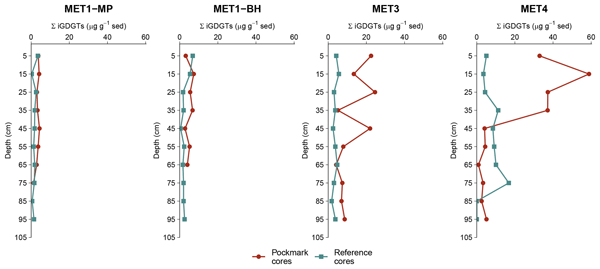
This study examined seafloor gas- and/or water-venting craters (pockmarks) to understand the drivers of the microorganisms inhabiting these environments. By combining lipid biomarkers extracted from seabed sediments with genetic analyses, the study found that the microbial community is shaped mainly by nitrogen availability, methane seepage, and porewater freshening. Pockmarks may therefore modulate coastal nutrient cycling and greenhouse gas dynamics, a finding relevant to ecosystem monitoring.
Aleksandra Smyrak-Sikora, Peter Betlem, Victoria S. Engelschiøn, William J. Foster, Sten-Andreas Grundvåg, Mads E. Jelby, Morgan T. Jones, Grace E. Shephard, Kasia K. Śliwińska, Madeleine L. Vickers, Valentin Zuchuat, Lars Eivind Augland, Jan Inge Faleide, Jennifer M. Galloway, William Helland-Hansen, Maria A. Jensen, Erik P. Johannessen, Maayke Koevoets, Denise Kulhanek, Gareth S. Lord, Tereza Mosociova, Snorre Olaussen, Sverre Planke, Gregory D. Price, Lars Stemmerik, and Kim Senger
Clim. Past, 21, 2133–2187, https://doi.org/10.5194/cp-21-2133-2025, https://doi.org/10.5194/cp-21-2133-2025, 2025
Short summary
Short summary
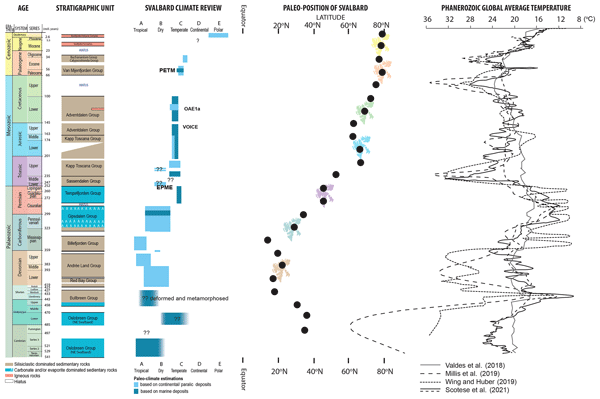
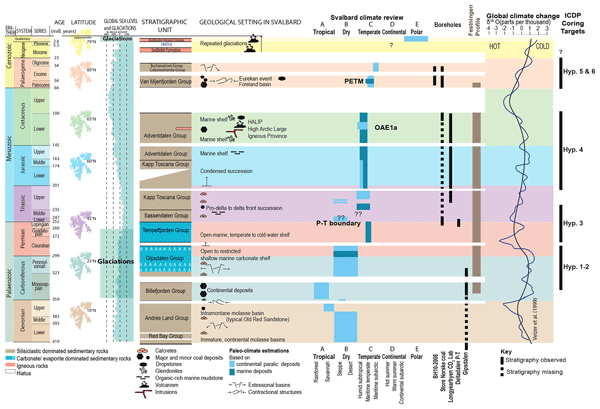
In this review article we present Svalbard’s unique geological archive, revealing its climate history over the last 540 million years. We uncover how this Arctic region recorded key global events, including the End-Permian Mass Extinction, and climate crises like the Paleocene–Eocene Thermal Maximum. The overall climate trend recorded in sedimentary successions in Svalbard is discussed in the context of global climate fluctuations and continuous drift of Svalbard from near equatorial to Arctic latitudes.
Peter K. Bijl, Kasia K. Śliwińska, Bella Duncan, Arnaud Huguet, Sebastian Naeher, Ronnakrit Rattanasriampaipong, Claudia Sosa-Montes de Oca, Alexandra Auderset, Melissa A. Berke, Bum Soo Kim, Nina Davtian, Tom Dunkley Jones, Desmond D. Eefting, Felix J. Elling, Pierrick Fenies, Gordon N. Inglis, Lauren O'Connor, Richard D. Pancost, Francien Peterse, Addison Rice, Appy Sluijs, Devika Varma, Wenjie Xiao, and Yi Ge Zhang
Biogeosciences, 22, 6465–6508, https://doi.org/10.5194/bg-22-6465-2025, https://doi.org/10.5194/bg-22-6465-2025, 2025
Short summary
Short summary
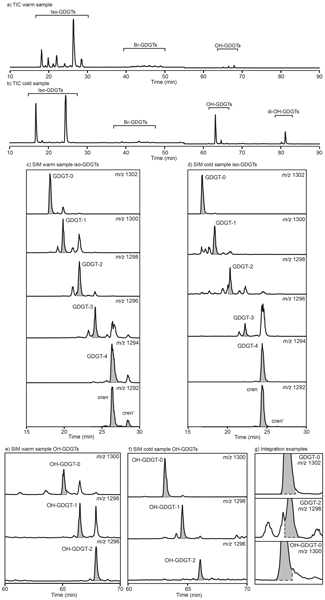
Many academic laboratories worldwide process environmental samples for analysis of membrane lipid molecules of archaea, for the reconstruction of past environmental conditions. However, the sample workup scheme involves many steps, each of which has a risk of contamination or bias, affecting the results. This paper reviews steps involved in sampling, extraction and analysis of lipids, interpretation and archiving of the data. This ensures reproducible, reusable, comparable and consistent data.
Jingjing Guo, Martin Ziegler, Louise Fuchs, Youbin Sun, and Francien Peterse
Clim. Past, 21, 343–355, https://doi.org/10.5194/cp-21-343-2025, https://doi.org/10.5194/cp-21-343-2025, 2025
Short summary
Short summary
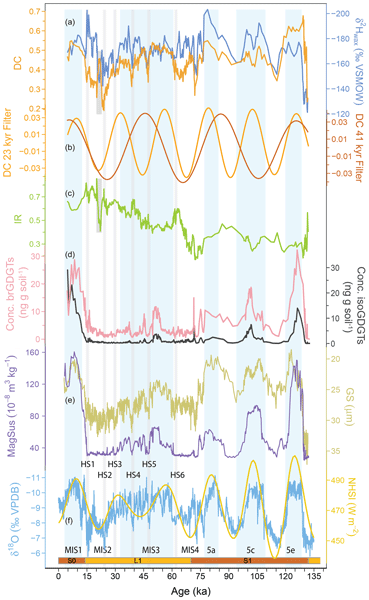
In this study, we use the distribution of soil bacterial membrane lipids stored on the Chinese Loess Plateau (CLP) to quantitatively reconstruct variations in precipitation amount over the past 130 kyr. The precipitation record shows orbital- and millennial-scale variations and varies at precession and obliquity scale. The application of this precipitation proxy across the CLP indicates a more pronounced spatial gradient during glacials, when the western CLP experiences more arid conditions.
Allix J. Baxter, Francien Peterse, Dirk Verschuren, Aihemaiti Maitituerdi, Nicolas Waldmann, and Jaap S. Sinninghe Damsté
Biogeosciences, 21, 2877–2908, https://doi.org/10.5194/bg-21-2877-2024, https://doi.org/10.5194/bg-21-2877-2024, 2024
Short summary
Short summary
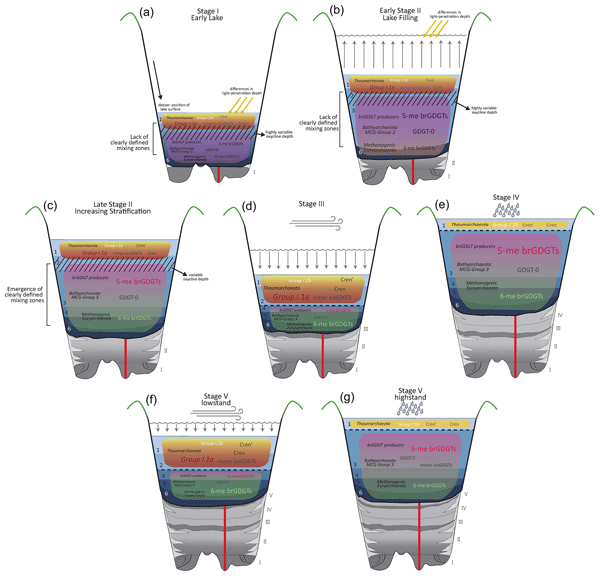
This study investigates the impact of long-term lake-system evolution on the climate signal recorded by glycerol dialkyl glycerol tetraethers (GDGTs), a popular biomarker in paleoclimate research. It compares downcore changes in GDGTs in the 250 000 year sediment sequence of Lake Chala (Kenya/Tanzania) to independent data for lake mixing and water-column chemistry. These factors influence the GDGT proxies in the earliest depositional phases (before ~180 ka), confounding the climate signal.
Chris D. Fokkema, Tobias Agterhuis, Danielle Gerritsma, Myrthe de Goeij, Xiaoqing Liu, Pauline de Regt, Addison Rice, Laurens Vennema, Claudia Agnini, Peter K. Bijl, Joost Frieling, Matthew Huber, Francien Peterse, and Appy Sluijs
Clim. Past, 20, 1303–1325, https://doi.org/10.5194/cp-20-1303-2024, https://doi.org/10.5194/cp-20-1303-2024, 2024
Short summary
Short summary
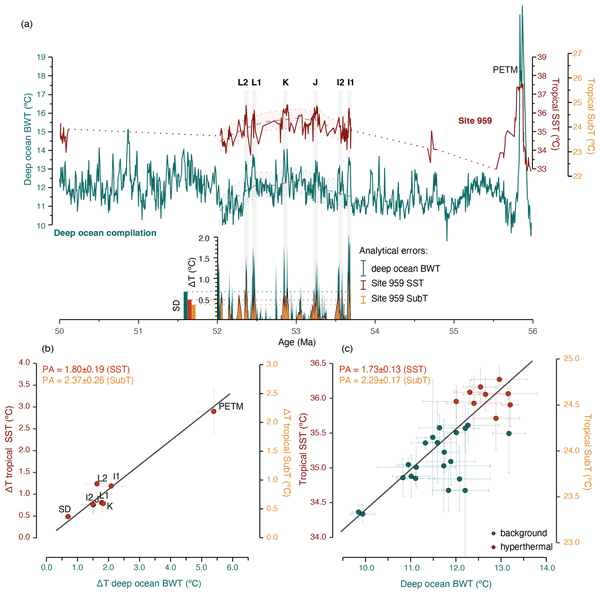
Polar amplification (PA) is a key uncertainty in climate projections. The factors that dominantly control PA are difficult to separate. Here we provide an estimate for the non-ice-related PA by reconstructing tropical ocean temperature variability from the ice-free early Eocene, which we compare to deep-ocean-derived high-latitude temperature variability across short-lived warming periods. We find a PA factor of 1.7–2.3 on 20 kyr timescales, which is somewhat larger than model estimates.
Yord W. Yedema, Timme Donders, Francien Peterse, and Francesca Sangiorgi
J. Micropalaeontol., 42, 257–276, https://doi.org/10.5194/jm-42-257-2023, https://doi.org/10.5194/jm-42-257-2023, 2023
Short summary
Short summary
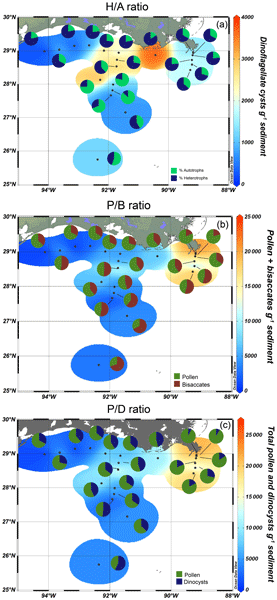
The pollen and dinoflagellate cyst content of 21 surface sediments from the northern Gulf of Mexico is used to test the applicability of three palynological ratios (heterotroph/autotroph, pollen/dinocyst, and pollen/bisaccate ratio) as proxies for marine productivity and distance to the coast/river. Redundancy analysis confirms the suitability of these three ratios, where the H/A ratio can be used as an indicator of primary production, and the P/B ratio best tracks the distance to the coast.
Kim Senger, Denise Kulhanek, Morgan T. Jones, Aleksandra Smyrak-Sikora, Sverre Planke, Valentin Zuchuat, William J. Foster, Sten-Andreas Grundvåg, Henning Lorenz, Micha Ruhl, Kasia K. Sliwinska, Madeleine L. Vickers, and Weimu Xu
Sci. Dril., 32, 113–135, https://doi.org/10.5194/sd-32-113-2023, https://doi.org/10.5194/sd-32-113-2023, 2023
Short summary
Short summary
Geologists can decipher the past climates and thus better understand how future climate change may affect the Earth's complex systems. In this paper, we report on a workshop held in Longyearbyen, Svalbard, to better understand how rocks in Svalbard (an Arctic archipelago) can be used to quantify major climatic shifts recorded in the past.
Frida S. Hoem, Adrián López-Quirós, Suzanna van de Lagemaat, Johan Etourneau, Marie-Alexandrine Sicre, Carlota Escutia, Henk Brinkhuis, Francien Peterse, Francesca Sangiorgi, and Peter K. Bijl
Clim. Past, 19, 1931–1949, https://doi.org/10.5194/cp-19-1931-2023, https://doi.org/10.5194/cp-19-1931-2023, 2023
Short summary
Short summary
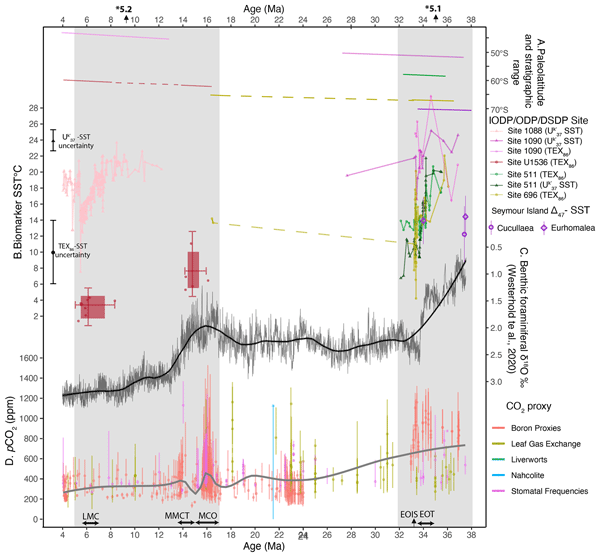
We present two new sea surface temperature (SST) records in comparison with available SST records to reconstruct South Atlantic paleoceanographic evolution. Our results show a low SST gradient in the Eocene–early Oligocene due to the persistent gyral circulation. A higher SST gradient in the Middle–Late Miocene infers a stronger circumpolar current. The southern South Atlantic was the coldest region in the Southern Ocean and likely the main deep-water formation location in the Middle Miocene.
Suning Hou, Foteini Lamprou, Frida S. Hoem, Mohammad Rizky Nanda Hadju, Francesca Sangiorgi, Francien Peterse, and Peter K. Bijl
Clim. Past, 19, 787–802, https://doi.org/10.5194/cp-19-787-2023, https://doi.org/10.5194/cp-19-787-2023, 2023
Short summary
Short summary
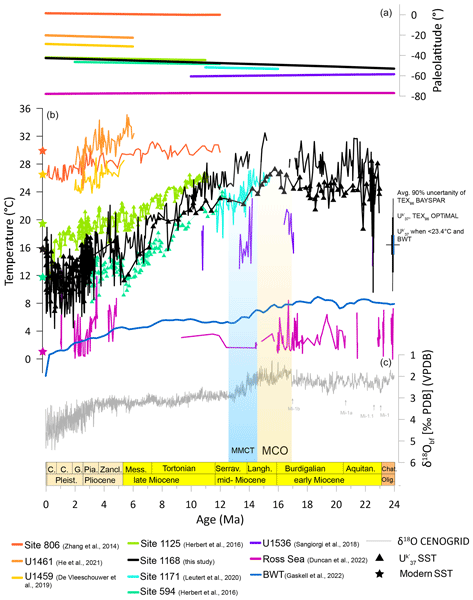
Neogene climate cooling is thought to be accompanied by increased Equator-to-pole temperature gradients, but mid-latitudes are poorly represented. We use biomarkers to reconstruct a 23 Myr continuous sea surface temperature record of the mid-latitude Southern Ocean. We note a profound mid-latitude cooling which narrowed the latitudinal temperature gradient with the northward expansion of subpolar conditions. We surmise that this reflects the strengthening of the ACC and the expansion of sea ice.
Yord W. Yedema, Francesca Sangiorgi, Appy Sluijs, Jaap S. Sinninghe Damsté, and Francien Peterse
Biogeosciences, 20, 663–686, https://doi.org/10.5194/bg-20-663-2023, https://doi.org/10.5194/bg-20-663-2023, 2023
Short summary
Short summary
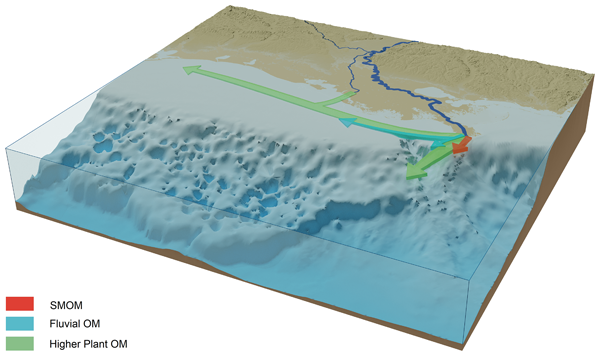
Terrestrial organic matter (TerrOM) is transported to the ocean by rivers, where its burial can potentially form a long-term carbon sink. This burial is dependent on the type and characteristics of the TerrOM. We used bulk sediment properties, biomarkers, and palynology to identify the dispersal patterns of plant-derived, soil–microbial, and marine OM in the northern Gulf of Mexico and show that plant-derived OM is transported further into the coastal zone than soil and marine-produced TerrOM.
Kasia K. Śliwińska, Helen K. Coxall, David K. Hutchinson, Diederik Liebrand, Stefan Schouten, and Agatha M. de Boer
Clim. Past, 19, 123–140, https://doi.org/10.5194/cp-19-123-2023, https://doi.org/10.5194/cp-19-123-2023, 2023
Short summary
Short summary
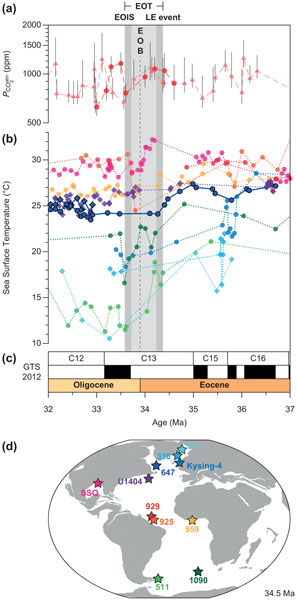
We provide a sea surface temperature record from the Labrador Sea (ODP Site 647) based on organic geochemical proxies across the late Eocene and early Oligocene. Our study reveals heterogenic cooling of the Atlantic. The cooling of the North Atlantic is difficult to reconcile with the active Atlantic Meridional Overturning Circulation (AMOC). We discuss possible explanations like uncertainty in the data, paleogeography and atmospheric CO2 boundary conditions, model weaknesses, and AMOC activity.
Frédérique M. S. A. Kirkels, Hugo J. de Boer, Paulina Concha Hernández, Chris R. T. Martes, Marcel T. J. van der Meer, Sayak Basu, Muhammed O. Usman, and Francien Peterse
Biogeosciences, 19, 4107–4127, https://doi.org/10.5194/bg-19-4107-2022, https://doi.org/10.5194/bg-19-4107-2022, 2022
Short summary
Short summary
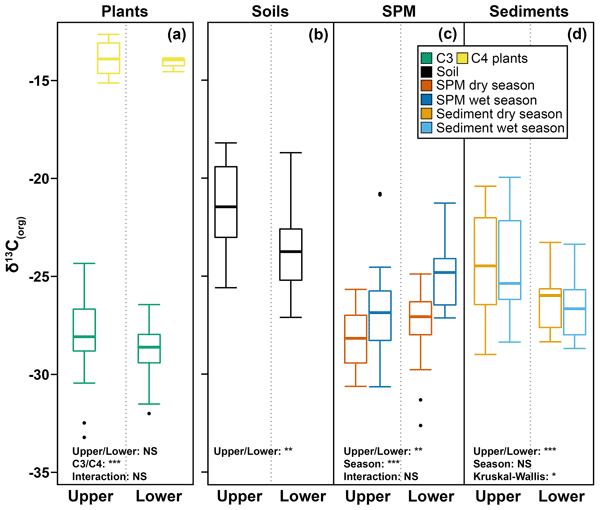
The distinct carbon isotopic values of C3 and C4 plants are widely used to reconstruct past hydroclimate, where more C3 plants reflect wetter and C4 plants drier conditions. Here we examine the impact of regional hydroclimatic conditions on plant isotopic values in the Godavari River basin, India. We find that it is crucial to identify regional plant isotopic values and consider drought stress, which introduces a bias in C3 / C4 plant estimates and associated hydroclimate reconstructions.
Frédérique M. S. A. Kirkels, Huub M. Zwart, Muhammed O. Usman, Suning Hou, Camilo Ponton, Liviu Giosan, Timothy I. Eglinton, and Francien Peterse
Biogeosciences, 19, 3979–4010, https://doi.org/10.5194/bg-19-3979-2022, https://doi.org/10.5194/bg-19-3979-2022, 2022
Short summary
Short summary
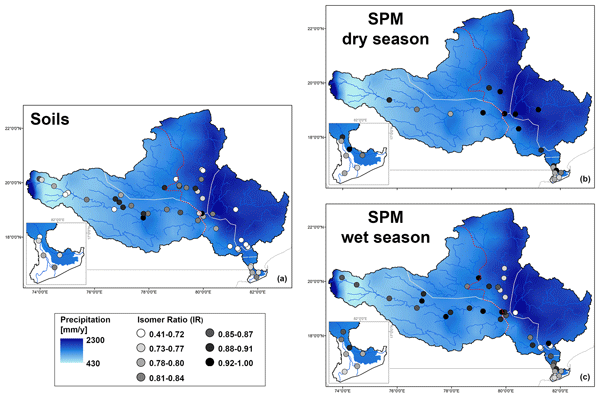
Soil organic carbon (SOC) that is transferred to the ocean by rivers forms a long-term sink of atmospheric CO2 upon burial on the ocean floor. We here test if certain bacterial membrane lipids can be used to trace SOC through the monsoon-fed Godavari River basin in India. We find that these lipids trace the mobilisation and transport of SOC in the wet season but that these lipids are not transferred far into the sea. This suggests that the burial of SOC on the sea floor is limited here.
Carolien M. H. van der Weijst, Koen J. van der Laan, Francien Peterse, Gert-Jan Reichart, Francesca Sangiorgi, Stefan Schouten, Tjerk J. T. Veenstra, and Appy Sluijs
Clim. Past, 18, 1947–1962, https://doi.org/10.5194/cp-18-1947-2022, https://doi.org/10.5194/cp-18-1947-2022, 2022
Short summary
Short summary
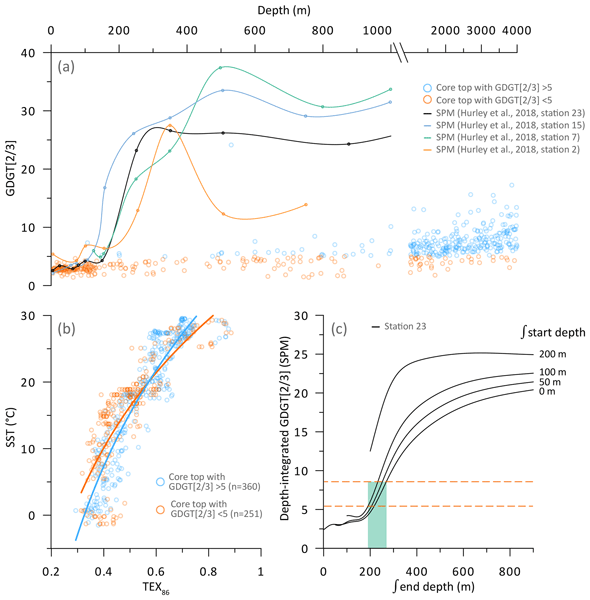
The TEX86 proxy is often used by paleoceanographers to reconstruct past sea-surface temperatures. However, the origin of the TEX86 signal in marine sediments has been debated since the proxy was first proposed. In our paper, we show that TEX86 carries a mixed sea-surface and subsurface temperature signal and should be calibrated accordingly. Using our 15-million-year record, we subsequently show how a TEX86 subsurface temperature record can be used to inform us on past sea-surface temperatures.
Peter K. Bijl, Joost Frieling, Marlow Julius Cramwinckel, Christine Boschman, Appy Sluijs, and Francien Peterse
Clim. Past, 17, 2393–2425, https://doi.org/10.5194/cp-17-2393-2021, https://doi.org/10.5194/cp-17-2393-2021, 2021
Short summary
Short summary
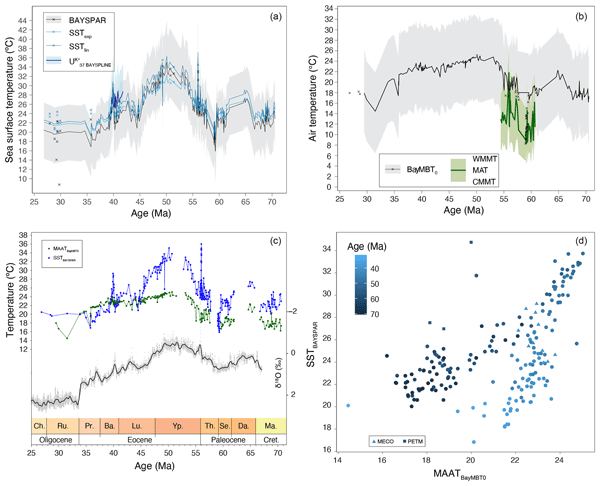
Here, we use the latest insights for GDGT and dinocyst-based paleotemperature and paleoenvironmental reconstructions in late Cretaceous–early Oligocene sediments from ODP Site 1172 (East Tasman Plateau, Australia). We reconstruct strong river runoff during the Paleocene–early Eocene, a progressive decline thereafter with increased wet/dry seasonality in the northward-drifting hinterland. Our critical review leaves the anomalous warmth of the Eocene SW Pacific Ocean unexplained.
Cited articles
Anthonissen, E. D.: A new Miocene biostratigraphy for the northeastern North Atlantic: an integrated foraminiferal, bolboformid, dinoflagellate and diatom zonation, Newsletters on Stratigraphy, 45, 281–307, https://doi.org/10.1127/0078-0421/2012/0025, 2012.
Bijl, P. K., Sliwinska, K. K., Duncan, B., Huguet, A., Naeher, S., Rattanasriampaipong, R., Sosa-Montes de Oca, C., Auderset, A., Berke, M., Kim, B. S., Davtian, N., Dunkley Jones, T., Eefting, D., Elling, F., O'Connor, L., Pancost, R. D., Peterse, F., Fenies, P., Rice, A., Sluijs, A., Varma, D., Xiao, W., and Zhang, Y.: Reviews and syntheses: Best practices for the application of marine GDGTs as proxy for paleotemperatures: sampling, processing, analyses, interpretation, and archiving protocols, EGUsphere [preprint], https://doi.org/10.5194/egusphere-2025-1467, 2025.
Blaga, C. I., Reichart, G.-J., Heiri, O., and Sinninghe Damsté, J. S.: Tetraether membrane lipid distributions in water-column particulate matter and sediments: a study of 47 European lakes along a north–south transect, Journal of Paleolimnology, 41, 523–540, https://doi.org/10.1007/s10933-008-9242-2, 2009.
Boyd, J. L., Riding, J. B., Pound, M. J., De Schepper, S., Ivanovic, R. F., Haywood, A. M., and Wood, S. E. L.: The relationship between Neogene dinoflagellate cysts and global climate dynamics, Earth-Science Reviews, 177, 366–385, https://doi.org/10.1016/j.earscirev.2017.11.018, 2018.
Clausen, O. R., Gregersen, U., Michelsen, O., and Sørensen, J. C.: Factors controlling the Cenozoic sequence development in the eastern parts of the North Sea, Journal of the Geological Society, 156, 809–816, https://doi.org/10.1144/gsjgs.156.4.0809, 1999.
Dale, B.: Dinoflagellate cyst ecology: modeling and geological applications, in: Palynology: principles and applications, edited by: Jansonius, J. and McGregor, D., American Association of Stratigraphic Palynologists Foundation Dallas, TX, 1249–1275, ISBN 9780931871030, 1996.
De Man, E. and Van Simaeys, S.: Late Oligocene warming event in the southern North Sea Basin: Benthic foraminifera as paleotemperature proxies, Geologie en Mijnbouw/Netherlands Journal of Geosciences, 83, 227–239, https://doi.org/10.1017/S0016774600020291, 2004.
De Schepper, S.: Plio‐Pleistocene dinoflagellate cyst biostratigraphy and palaeoecology of the eastern North Atlantic and southern North Sea Basin, PhD Thesis, University of Cambridge, Cambridge, UK, 2006.
De Schepper, S., Head, M. J., and Louwye, S.: Pliocene dinoflagellate cyst stratigraphy, palaeoecology and sequence stratigraphy of the Tunnel-Canal Dock, Belgium, Geological Magazine, 146, 92–112, https://doi.org/10.1017/S0016756808005438, 2009.
De Schepper, S., Fischer, E. I., Groeneveld, J., Head, M. J., and Matthiessen, J.: Deciphering the palaeoecology of Late Pliocene and Early Pleistocene dinoflagellate cysts, Palaeogeography, Palaeoclimatology, Palaeoecology, 309, 17–32, https://doi.org/10.1016/j.palaeo.2011.04.020, 2011.
De Vernal, A.: Marine palynology and its use for studying nearshore environments, IOP Conference Series: Earth and Environmental Science, 5, 012002, https://doi.org/10.1088/1755-1307/5/1/012002, 2009.
Donders, T. H., Weijers, J. W. H., Munsterman, D. K., Kloosterboer-van Hoeve, M. L., Buckles, L. K., Pancost, R. D., Schouten, S., Sinninghe Damsté, J. S., and Brinkhuis, H.: Strong climate coupling of terrestrial and marine environments in the Miocene of northwest Europe, Earth and Planetary Science Letters, 281, 215–225, https://doi.org/10.1016/j.epsl.2009.02.034, 2009.
Dybkjær, K.: Dinocyst stratigraphy and palynofacies studies used for refining a sequence stratigraphic model – Uppermost Oligocene to lower Miocene, Jylland, Denmark, Review of Palaeobotany and Palynology, 131, 201–249, https://doi.org/10.1016/j.revpalbo.2004.03.006, 2004a.
Dybkjær, K.: Morphological and abundance variations in Homotryblium-cyst assemblages related to depositional environments; uppermost Oligocene-Lower Miocene, Jylland, Denmark, Palaeogeography, Palaeoclimatology, Palaeoecology, 206, 41–58, https://doi.org/10.1016/j.palaeo.2003.12.021, 2004b.
Dybkjær, K. and Piasecki, S.: Neogene dinocyst zonation for the eastern North Sea Basin, Denmark, Review of Palaeobotany and Palynology, 161, 1–29, https://doi.org/10.1016/j.revpalbo.2010.02.005, 2010.
Dybkjær, K., Rasmussen, E. S., Śliwińska, K. K., Esbensen, K. H., and Mathiesen, A.: A palynofacies study of past fluvio-deltaic and shelf environments, the Oligocene-Miocene succession, North Sea Basin: A reference data set for similar Cenozoic systems, Marine and Petroleum Geology, 100, 111–147, https://doi.org/10.1016/j.marpetgeo.2018.08.012, 2019.
Dybkjær, K., Rasmussen, E. S., Eidvin, T., Grøsfjeld, K., Riis, F., Piasecki, S., and Śliwińska, K. K.: A new stratigraphic framework for the Miocene – Lower Pliocene deposits offshore Scandinavia: A multiscale approach, Geological Journal, 56, 1699–1725, https://doi.org/10.1002/gj.3982, 2020.
Eidvin, T. and Rundberg, Y.: Late Cainozoic stratigraphy of the Tampen area (Snorre and Visund fields) in the northern North Sea, with emphasis on the chronology of early Neogene sands, Norsk Geologisk Tidsskrift, 81, 119–160, 2001.
Eidvin, T. and Rundberg, Y.: Post-Eocene strata of the southern Viking Graben, northern North Sea; integrated biostratigraphic, strontium isotopic and lithostratigraphic study, Norsk Geologisk Tidsskrift, 87, 391–450, 2007.
Eidvin, T., Ullmann, C. V., Dybkjær, K., Rasmussen, E. S., and Piasecki, S.: Discrepancy between Sr isotope and biostratigraphic datings of the upper middle and upper Miocene successions (Eastern North Sea Basin, Denmark), Palaeogeography, Palaeoclimatology, Palaeoecology, 411, 267–280, https://doi.org/10.1016/j.palaeo.2014.07.005, 2014.
GeoBioTec: Department of Earth and Sciences, NOVA University – FCT, Lisbon, Research Center funding reference UIDB/04035/2020, https://doi.org/10.54499/UIDB/04035/2020, 2020.
Gregersen, U.: Upper Cenozoic channels and fans on 3D seismic data in the northern Norwegian North Sea, Petroleum Geoscience, 4, 67–80, https://doi.org/10.1144/petgeo.4.1.67, 1998.
Head, M. J.: Morphology and Paleoenvironmental significance of the Cenozoic dinoflagellate genera Tectatodinium and Habibacysta, Micropaleontology, 40, 289–321, https://doi.org/10.2307/1485937, 1994.
Head, M. J.: Modern dinoflagellate cysts and their biological affnities, in: Palynology: principles and applications, edited by: Jansonius, J. and McGregor D.C., 1197–1248, ISBN 9-931871-03-4, 1996.
Head, M. J.: Thermophilic dinoflagellate assemblages from the mid Pliocene of eastern England, Journal of Paleontology, 71, 165–193, https://doi.org/10.1017/S0022336000039123, 1997.
Heilmann-Clausen, C. and Van Simaeys, S.: Dinoflagellate cysts from the Middle Eocene to lowermost Oligocene succession in the Kysing research borehole, Central Danish Basin, Palynology, 29, 143–204, https://doi.org/10.2113/29.1.143, 2005.
Herbert, T. D., Lawrence, K. T., Tzanova, A., Peterson, L. C., Caballero-Gill, R., and Kelly, C. S.: Late Miocene global cooling and the rise of modern ecosystems, Nature Geoscience, 9, 843–847, https://doi.org/10.1038/ngeo2813, 2016.
Herbert, T. D., Rose, R., Dybkjær, K., Rasmussen, E. S., and Śliwińska, K. K.: Bi-Hemispheric Warming in the Miocene Climatic Optimum as Seen from the Danish North Sea, Paleoceanography and Paleoclimatology, e2020PA003935, https://doi.org/10.1029/2020PA003935, 2020.
Hopmans, E. C., Schouten, S., and Sinninghe Damsté, J. S.: The effect of improved chromatography on GDGT-based palaeoproxies, Organic Geochemistry, 93, 1–6, https://doi.org/10.1016/j.orggeochem.2015.12.006, 2016.
Hopmans, E. C., Weijers, J. W. H., Schefuß, E., Herfort, L., Sinninghe Damsté, J. S., and Schouten, S.: A novel proxy for terrestrial organic matter in sediments based on branched and isoprenoid tetraether lipids, Earth and Planetary Science Letters, 224, 107–116, https://doi.org/10.1016/j.epsl.2004.05.012, 2004.
Howarth, R. J. and McArthur, J. M.: Statistics for Strontium Isotope Stratigraphy: A Robust LOWESS Fit to the Marine Sr-Isotope Curve for 0 to 206 Ma, with Look-up Table for Derivation of Numeric Age, The Journal of Geology, 105, 441–456, https://doi.org/10.1086/515938, 1997.
Ingold, C. T.: Fungal spores: their liberation and dispersal, Clarendon Press, Oxford, 302 pp., ISBN 978-0198541158, 1971.
Jolley, D., Vieira, M., Jin, S., and Kemp, D.: Palynofloras, paleoenvironmental change and the inception of the Paleocene Eocene Thermal Maximum; the record of the Forties Fan, Sele Formation, North Sea Basin, J. Geol. Soc., jgs2021-131, https://doi.org/10.1144/jgs2021-131, 2022.
Kellner, L., Dybkjær, K., Piasecki, P., Fredborg, J., Peterse, F., Rasmussen, E., Vieira, M., Castro, L., and Sliwinska, K.: Early to Middle Miocene in the North Sea Basin: proxy-based insights into environment, depositional settings and sea surface temperature evolution Supplementary Data, Dataverse GEUS [data set], https://doi.org/10.22008/FK2/F2YYEV, 2025.
Kim, J. H., van der Meer, J., Schouten, S., Helmke, P., Willmott, V., Sangiorgi, F., Koç, N., Hopmans, E. C., and Damsté, J. S. S.: New indices and calibrations derived from the distribution of crenarchaeal isoprenoid tetraether lipids: Implications for past sea surface temperature reconstructions, Geochimica et Cosmochimica Acta, 74, 4639–4654, https://doi.org/10.1016/j.gca.2010.05.027, 2010.
King, C., Gale, A. S., and Barry, T. L.: A revised correlation of Tertiary rocks in the British Isles and adjacent areas of NW Europe, Geological Society of London, https://doi.org/10.1144/sr27, 2016.
Knox, R. W. O. B., Bosh, J. H. A., Rasmussen, E. S. H.-C. C., Hiss, M., Kasiński, J., King, C., Köthe, A., Słodkowska, B., and Standke, G. V. N.: Cenozoic, in: Petroleum Geological Atlas of the Southern Permian Basin Area., edited by: Doornenbal, J. C., and Stevenson, A. G., EAGE Publication B.V., Houten, 211–223, ISBN 978-90-73781-83-2, 2010.
Köthe, A. and Piesker, B.: Stratigraphic distribution of Paleogene and Miocene dinocysts in Germany, Revue de Paleobiologie, 26, 1–39, 2007.
Larsson, L. M., Dybkjær, K., Rasmussen, E. S., Piasecki, S., Utescher, T., and Vajda, V.: Miocene climate evolution of northern Europe: A palynological investigation from Denmark, Palaeogeography, Palaeoclimatology, Palaeoecology, 309, 161–175, https://doi.org/10.1016/j.palaeo.2011.05.003, 2011.
Laursen, G. V. and Kristoffersen, F. N.: Detailes foraminiferal biostratigraphy of Miocene formations in Denmark, Contributions to Tertiary and Quaternary Geology, 36, 73–107, 1999.
Liboriussen, J., Ashton, P., and Tygesen, T.: The tectonic evolution of the Fennoscandian Border Zone in Denmark, Tectonophysics, 137, 21–29, https://doi.org/10.1016/0040-1951(87)90310-6, 1987.
Marret, F. and Zonneveld, K. A. F.: Atlas of modern organic-walled dinoflagellate cyst distribution, Review of Palaeobotany and Palynology, 125, 1–200, https://doi.org/10.1016/S0034-6667(02)00229-4, 2003.
Matthiessen, J. and Brenner, W. W.: Dinoflagellate cyst ecostratigraphy of Pliocene-Pleistocene sediments from the Yermak Plateau (Arctic Ocean, Hole 911A), in: Proceedings of the Ocean Drilling Program, Scientific Results, Vol. 151, edited by: Thiede, J., Myhre, A. M., Firth, J. V., Johnson, G. L., and Ruddiman, W. F., https://doi.org/10.2973/odp.proc.sr.151.109.1996, 1996.
McCarthy, F., Gostlin, K., Mudie, P., and Hopkins, J.: Terresirial and marine palynomorphs as sea-level proxies: an example from Quaternary sediments on the New Jersey Margin, USA, 119–129, https://doi.org/10.2110/pec.03.75.0119, 2003.
McCarthy, F. M. G. and Mudie, P. J.: Oceanic pollen transport and pollen: dinocyst ratios as markers of late Cenozoic sea level change and sediment transport, Palaeogeography, Palaeoclimatology, Palaeoecology, 138, 187–206, https://doi.org/10.1016/S0031-0182(97)00135-1, 1998.
Michelsen, O., Danielsen, M., Heilmann-Clausen, C., Laursen, G., and Thomsen, E.: Occurrence of major sequence stratigraphic boundaries in relation to basin development in Cenozoic deposits of the southeastern North Sea, in: Sequence Stratigraphy on the Northwest European Margin, edited by: Steel, R. J. and Al, E., Elsevier, Amsterdam, 415–427, https://doi.org/10.1016/S0928-8937(06)80079-2, 1995.
Michelsen, O., Thomsen, E., Danielsen, M., Heilmann-Clausen, C., Jordt, H., and Laursen, G. V.: Cenozoic Sequence Stratigraphy in the Eastern North Sea, in: Mesozoic and Cenozoic Sequence Stratigraphy of European Basins, edited by: Graciansky, P.-C. D., Hardenbol, J., Jacquin, T., and Vail, P. R., SEPM Society for Sedimentary Geology, https://doi.org/10.2110/pec.98.02.0091, 1999.
Miller, K. G., Wright, J. D., and Fairbanks, R. G.: Unlocking the Ice House: Oligocene-Miocene oxygen isotopes, eustasy, and margin erosion, Journal of Geophysical Research: Solid Earth, 96, 6829–6848, https://doi.org/10.1029/90JB02015, 1991.
Mogensen, T. E. and Jensen, L. N.: Cretaceous subsidence and inversion along the Tornquist Zone from Kattegat to the Egersund Basin, First Break, 12, 211–222, 1994.
Mudie, P. J.: Pollen distribution in recent marine sediments, eastern Canada, Canadian Journal of Earth Sciences, 19, 729–747, https://doi.org/10.1139/e82-062, 1982.
Munsterman, D. K. and Brinkhuis, H.: A southern North Sea Miocene dinoflagellate cyst zonation, Geologie en Mijnbouw, 83, 267–285, https://doi.org/10.1017/S0016774600020369, 2013.
O'Brien, C., Robinson, S., Pancost, R., Sinninghe-Damste, J., Schouten, S., Lunt, D., Alsenz, H., Bornemann, A., Bottini, C., Brassell, S., Farnsworth, A., Forster, A., Huber, B., Inglis, G., Jenkyns, H., Linnert, C., Littler, K., Markwick, P., McAnena, A., and Wrobel, N.: Cretaceous sea-surface temperature evolution: Constraints from TEX86 and planktonic foraminiferal oxygen isotopes, Earth-Science Reviews, 172, https://doi.org/10.1016/j.earscirev.2017.07.012, 2017.
O'Brien, C. L., Huber, M., Thomas, E., Pagani, M., Super, J. R., Elder, L. E., and Hull, P. M.: The enigma of Oligocene climate and global surface temperature evolution, Proceedings of the National Academy of Sciences, 117, 25302–25309, https://doi.org/10.1073/pnas.2003914117, 2020.
Piasecki, S.: Neogene dinoflagellate cysts from Davis Strait, offshore West Greenland, Marine and Petroleum Geology, https://doi.org/10.1016/S0264-8172(02)00089-2, 2003.
Powell, A. J.: Dinoflagellate cysts of the Tertiary System, in: A stratigraphic index of dinoflagellate cysts, edited by: Powell, A. J., BMS Occasional Publicaton Series, Chapman and Hall, London, 153–155, ISBN 0412362805, 1992.
Pross, J. and Brinkhuis, H.: Organic-walled dinoflagellate cysts as paleoenvironmental indicators in the Paleogene; a synopsis of concepts, Paläontologische Zeitschrift, 79, 53–59, https://doi.org/10.1007/BF03021753, 2005.
Pross, J. and Schmiedl, G.: Early Oligocene dinoflagellate cysts from the Upper Rhine Graben (SW Germany): Paleoenvironmental and paleoclimatic implications, Marine Micropaleontology, 45, 1–24, https://doi.org/10.1016/S0377-8398(01)00046-9, 2002.
Quaijtaal, W., Donders, T. H., Persico, D., and Louwye, S.: Characterising the middle Miocene Mi-events in the Eastern North Atlantic realm: A first high-resolution marine palynological record from the Porcupine Basin, Palaeogeography, Palaeoclimatology, Palaeoecology, 399, 140–159, https://doi.org/10.1016/j.palaeo.2014.02.017, 2014.
Rasmussen, E. S.: Sequence stratigraphic subdivison of the Oligocene and Miocene succession in South Jutland, GEUS Bulletin, 43, 143–155, https://doi.org/10.37570/bgsd-1996-43-14, 1996.
Rasmussen, E. S.: The interplay between true eustatic sea-level changes, tectonics, and climatic changes: What is the dominating factor in sequence formation of the Upper Oligocene-Miocene succession in the eastern North Sea Basin, Denmark?, Global and Planetary Change, 41, 15–30, https://doi.org/10.1016/j.gloplacha.2003.08.004, 2004.
Rasmussen, E. S.: Detailed mapping of marine erosional surfaces and the geometry of clinoforms on seismic data: a tool to identify the thickest reservoir sand, Basin Research, 21, 721–737, https://doi.org/10.1111/j.1365-2117.2009.00422.x, 2009.
Rasmussen, E. S.: Cenozoic structures in the eastern North Sea Basin – A case for salt tectonics: Discussion, Tectonophysics, 601, 226–233, https://doi.org/10.1016/j.tecto.2012.10.038, 2013.
Rasmussen, E. S. and Dybkjær, K.: Sequence stratigraphy of the Upper Oligocene-Lower Miocene of eastern Jylland, Denmark: Role of structural relief and variable sediment supply in controlling sequence development, Sedimentology, 52, 25–63, https://doi.org/10.1111/j.1365-3091.2004.00681.x, 2005.
Rasmussen, E., Dybkjær, K., and Piasecki, S.: Neogene fluvial and nearshore marine deposits of the Salten section, central Jylland, Denmark, Bulletin of the Geological Society of Denmark, 53, https://doi.org/10.37570/bgsd-2006-53-02, 2006.
Rasmussen, E. S., Dybkjær, K., and Piasecki, S.: Lithostratigraphy of the Upper Oligocene – Miocene succession of Denmark, GEUS Bulletin, 22, 1–92, https://doi.org/10.34194/geusb.v22.4733, 2010.
Rasmussen, E. S., Dybkjær, K., Toft, J. C., Nielsen, O. B., Sheldon, E., and Mørk, F.: Lithostratigraphy of the Neogene succession of the Danish North Sea, GEUS Bulletin, 61, in press, 2025.
Rees, G.: Factors Affecting the Sedimentation Rate of Marine Fungal Spores, Botanica Marina, 23, 375–386, https://doi.org/10.1515/bot-1980-230606, 1980.
Sangiorgi, F., Quaijtaal, W., Donders, T. H., Schouten, S., and Louwye, S.: Middle Miocene Temperature and Productivity Evolution at a Northeast Atlantic Shelf Site (IODP U1318, Porcupine Basin): Global and Regional Changes, Paleoceanography and Paleoclimatology, 36, e2020PA004059, https://doi.org/10.1029/2020PA004059, 2021.
Schiøler, P.: Dinoflagellate cysts and acritarchs from the Oligocene-Lower Miocene interval of the Alma-1X well, Danish North Sea, Journal of Micropalaeontology, 24, 1–37, https://doi.org/10.1144/jm.24.1.1, 2005.
Schiøler, P., Andsbjerg, J., Clausen, O. R., Dam, G., Dybkjær, K., Hamberg, L., Heilmann-Clausen, C., Johannessen, E. P., Kristensen, L. E., Prince, I., and Rasmussen, J. A.: Lithostratigraphy of the Palaeogene – Lower Neogene succession of the Danish North Sea, GEUS Bulletin, 12, 1–77, https://doi.org/10.34194/geusb.v12.5249, 2007.
Schouten, S., Hopmans, E. C., Schefuß, E., and Sinninghe Damsté, J. S.: Distributional variations in marine crenarchaeol membrane lipids: a new tool for reconstructing ancient sea water temperatures?, Earth and Planetary Science Letters, https://doi.org/10.1016/S0012-821X(03)00193-6, 2002.
Schreck, M., Matthiessen, J., and Head, M. J.: A magnetostratigraphic calibration of Middle Miocene through Pliocene dinoflagellate cyst and acritarch events in the Iceland Sea (Ocean Drilling Program Hole 907A), Review of Palaeobotany and Palynology, 187, 66–94, https://doi.org/10.1016/j.revpalbo.2012.08.006, 2012.
Schreck, M., Meheust, M., Stein, R., and Matthiessen, J.: Response of marine palynomorphs to Neogene climate cooling in the Iceland Sea (ODP Hole 907A), Marine Micropaleontology, 101, 49–67, https://doi.org/10.1016/j.marmicro.2013.03.003, 2013.
Schreck, M., Nam, S.-I., Clotten, C., Fahl, K., De Schepper, S., Forwick, M., and Matthiessen, J.: Neogene dinoflagellate cysts and acritarchs from the high northern latitudes and their relation to sea surface temperature, Marine Micropaleontology, 136, 51–65, https://doi.org/10.1016/j.marmicro.2017.09.003, 2017.
Sheldon, E., Rasmussen, E. S., Dybkjær, K., Eidvin, T., Riis, F., and Weibel, R.: Miocene oil-bearing diatom ooze from the North Sea, GEUS Bulletin, 41, 29–32, https://doi.org/10.34194/geusb.v41.4335, 2018.
Sheldon, E., Dybkjær, K., Skovbjerg Rasmussen, E. S., and Oksman, M.: A multidisciplinary biostratigraphic framework for the Lower to Middle Miocene of the Norwegian North Sea – the siliceous succession of the Valhall–Hod area, GEUS Bulletin 59, 8381, in press, 2025.
Shevenell, A. E., Kennett, J. P., and Lea, D. W.: Middle Miocene Southern Ocean Cooling and Antarctic Cryosphere Expansion, Science, 305, 1766–1770, https://doi.org/10.1126/science.1100061, 2004.
Sinninghe Damsté, J. S., Ossebaar, J., Schouten, S., and Verschuren, D.: Distribution of tetraether lipids in the 25-ka sedimentary record of Lake Challa: Extracting reliable TEX86 and MBT/CBT palaeotemperatures from an equatorial African lake, Quaternary Science Reviews, 50, 43–54, https://doi.org/10.1016/j.quascirev.2012.07.001, 2012.
Śliwińska, K. K.: Early Oligocene dinocysts as a tool for palaeoenvironment reconstruction and stratigraphical framework – a case study from a North Sea well, Journal of Micropalaeontology, 38, 143–176, https://doi.org/10.5194/jm-38-143-2019, 2019.
Śliwińska, K. K., Abrahamsen, N., Beyer, C., Brünings-Hansen, T., Thomsen, E., Ulleberg, K., and Heilmann-Clausen, C.: Bio- and magnetostratigraphy of Rupelian–mid Chattian deposits from the Danish land area, Review of Palaeobotany and Palynology, 172, 48–69, https://doi.org/10.1016/j.revpalbo.2012.01.008, 2012.
Śliwińska, K. K., Dybkjær, K., Schoon, P. L., Beyer, C., King, C., Schouten, S., and Nielsen, O. B.: Paleoclimatic and paleoenvironmental records of the Oligocene–Miocene transition, central Jylland, Denmark, Marine Geology, 350, 1–15, 10.1016/j.margeo.2013.12.014, 2014.
Śliwińska, K. K., Denk, T., Dybkjær, K., Fredborg, J. M., Lindström, S., Piasecki, S., and Rasmussen, E. S.: Miocene vegetation and climate in the eastern North Sea Basin, onshore Denmark, compared to the present, GEUS Bulletin, 57, https://doi.org/10.34194/geusb.v57.8365, 2024.
Steinthorsdottir, M., Coxall, H. K., Boer, A. M. D., Huber, M., Barbolini, N., Bradshaw, C. D., Burls, N. J., Feakins, S. J., Gasson, E., Henderiks, J., Holbourn, A., Kiel, S., Kohn, M. J., Knorr, G., Kürschner, W. M., Lear, C. H., Liebrand, D., Lunt, D. J., Mörs, T., Pearson, P. N., Pound, M. J., Stoll, H., and Strömberg, C. A. E.: The Miocene: the Future of the Past, Paleoceanography and Paleoclimatology, 2020, e2020PA004037, https://doi.org/10.1029/2020PA004037, 2020.
Sulsbrück, H. and Toft, J.: A new observation of a biosiliceous opal bearing sequence in the Miocene Lark Formation in the Danish North Sea, 33rd Nordic Geological Winter meeting, Lyngby, http://2dgf.dk/foreningen/33rd-nordic-geological-winter-meeting/ngwm-2018-abstracts/3-sedimentary-rocks-and-processes (last access: 5 March 2025), 2018.
Sørensen, J. C., Gregersen, U., Breiner, M., and Michelsen, O.: High-frequency sequence stratigraphy of Upper Cenozoic deposits in the central and southeastern North Sea areas, Marine and Petroleum Geology, 14, 99–123, https://doi.org/10.1016/S0264-8172(96)00052-9, 1997.
Taylor, K. W. R., Huber, M., Hollis, C. J., Hernandez-Sanchez, M. T., and Pancost, R. D.: Re-evaluating modern and Palaeogene GDGT distributions: Implications for SST reconstructions, Global and Planetary Change, 108, 158–174, https://doi.org/10.1016/j.gloplacha.2013.06.011, 2013.
Tyson, R. V.: Sedimentary organic matter: organic facies and palynofacies, ChapmanHall, London/New York, 615 pp., ISBN 978-0-412-36350-4, https://doi.org/10.1007/978-94-011-0739-6, 1995.
Van Simaeys, S., Munsterman, D., and Brinkhuis, H.: Oligocene dinoflagellate cyst biostratigraphy of the southern North Sea Basin, Review of Palaeobotany and Palynology, 134, 105–128, https://doi.org/10.1016/j.revpalbo.2004.12.003, 2005.
Versteegh, G. J. M.: Recognition of cyclic and non-cyclic environmental changes in the Mediterranean Pliocene: A palynological approach, Marine Micropaleontology, 23, 147–183, https://doi.org/10.1016/0377-8398(94)90005-1, 1994.
Vieira, M. and Jolley, D.: Stratigraphic and spatial distribution of palynomorphs in deep-water turbidites: A meta-data study from the UK central North Sea paleogene, Marine and Petroleum Geology, 104638, https://doi.org/10.1016/j.marpetgeo.2020.104638, 2020.
Vieira, M., Mahdi, S., Casas-Gallego, M., and Ayress, M.: Using microplankton proxies to evaluate palaeonvironmental changes during late Maastrichtian: evidence from the Møre Basin (Norwegian continental shelf), Cretaceous Research, 130, 105071, https://doi.org/10.1016/j.cretres.2021.105071, 2022.
Westerhold, T., Marwan, N., Drury, A. J., Liebrand, D., Agnini, C., Anagnostou, E., Barnet, J. S. K., Bohaty, S. M., De Vleeschouwer, D., Florindo, F., Frederichs, T., Hodell, D. A., Holbourn, A. E., Kroon, D., Lauretano, V., Littler, K., Lourens, L. J., Lyle, M., Pälike, H., Röhl, U., Tian, J., Wilkens, R. H., Wilson, P. A., and Zachos, J. C.: An astronomically dated record of Earth's climate and its predictability over the last 66 million years, Science, 369, 1383–1387, https://doi.org/10.1126/science.aba6853, 2020.
Williams, G. L., Fensome, R. A., and MacRae, R. A.: DINOFLAJ3. American Association of Stratigraphic Palynologists, Data Series no. 2, http://dinoflaj.smu.ca/dinoflaj3 (last access: 15 August 2024), 2017.
Zachos, J., Pagani, M., Sloan, L., Thomas, E., and Billups, K.: Trends, Rhythms, and Aberrations in Global Climate 65 Ma to Present, Science, 292, 686–693, https://doi.org/10.1126/science.1059412, 2001.
Zevenboom, D.: Dinoflagellate cysts from the Mediterranean Late Oligocene and Miocene, PhD thesis, University of Utrecht, 9 pl., Cip-Gegevens Koninklijke Bibliotheek, Den Haag, the Netherlands, 221 pp., 1995.
Zhang, Y. G., Zhang, C. L., Liu, X. L., Li, L., Hinrichs, K. U., and Noakes, J. E.: Methane Index: A tetraether archaeal lipid biomarker indicator for detecting the instability of marine gas hydrates, Earth and Planetary Science Letters, 307, 525–534, https://doi.org/10.1016/j.epsl.2011.05.031, 2011.
Zhang, Y. G., Pagani, M., and Wang, Z.: Ring Index: A new strategy to evaluate the integrity of TEX86 paleothermometry, Paleoceanography, 31, 220–232, https://doi.org/10.1002/2015PA002848, 2016.
Ziegler, P. A.: Geological atlas of Western and Central Europe, 2nd and completely rev. ed, Shell Internationale Petroleum Maatschappij, B.V., The Hague, ISBN 9789066441255, ISBN 9066441259, 1990.
Zonneveld, K. A. F., Versteegh, G. J. M., Kasten, S., Eglinton, T. I., Emeis, K.-C., Huguet, C., Koch, B. P., de Lange, G. J., de Leeuw, J. W., Middelburg, J. J., Mollenhauer, G., Prahl, F. G., Rethemeyer, J., and Wakeham, S. G.: Selective preservation of organic matter in marine environments; processes and impact on the sedimentary record, Biogeosciences, 7, 483–511, https://doi.org/10.5194/bg-7-483-2010, 2010.
Zonneveld, K. A. F., Marret, F., Versteegh, G. J. M., Bogus, K., Bonnet, S., Bouimetarhan, I., Crouch, E., de Vernal, A., Elshanawany, R., Edwards, L., Esper, O., Forke, S., Grøsfjeld, K., Henry, M., Holzwarth, U., Kielt, J.-F., Kim, S.-Y., Ladouceur, S., Ledu, D., Chen, L., Limoges, A., Londeix, L., Lu, S. H., Mahmoud, M. S., Marino, G., Matsouka, K., Matthiessen, J., Mildenhal, D. C., Mudie, P., Neil, H. L., Pospelova, V., Qi, Y., Radi, T., Richerol, T., Rochon, A., Sangiorgi, F., Solignac, S., Turon, J.-L., Verleye, T., Wang, Y., Wang, Z., and Young, M.: Atlas of modern dinoflagellate cyst distribution based on 2405 data points, Review of Palaeobotany and Palynology, 191, 1–197, https://doi.org/10.1016/j.revpalbo.2012.08.003, 2013.
Short summary
We analysed Miocene dinocyst taxa and organic particle assemblages along a distal–proximal transect in the North Sea Basin. Based on distal and shallow marine successions, we reconstruct depositional changes across the Miocene Climatic Optimum (MCO; ~16.9–14.7 Ma) and use dinocysts as palaeoclimate proxies. Additionally, we provide five GDGT-derived sea surface temperature data points that support our dinocyst-based climate interpretation.
We analysed Miocene dinocyst taxa and organic particle assemblages along a distal–proximal...


