
Articles | Volume 44, issue 2
https://doi.org/10.5194/jm-44-601-2025
© Author(s) 2025. This work is distributed under
the Creative Commons Attribution 4.0 License.
the Creative Commons Attribution 4.0 License.
https://doi.org/10.5194/jm-44-601-2025
© Author(s) 2025. This work is distributed under
the Creative Commons Attribution 4.0 License.
the Creative Commons Attribution 4.0 License.
Research article
| 
02 Dec 2025
Research article |
| 02 Dec 2025
| 02 Dec 2025
Low-latitude biostratigraphy and diversity of planktonic foraminifera from the middle Eocene to early Oligocene
Adam Woodhouse
CORRESPONDING AUTHOR

School of Geography, Earth and Environmental Sciences, University of Birmingham, Birmingham, B15 2TT, UK
School of Earth Sciences, University of Bristol, Bristol, BS8 1RJ, UK
School of Earth and Environmental Sciences, Cardiff University, Cardiff, CF10 3AT, UK
School of Environment, Earth and Ecosystem Sciences, Open University, Walton Hall, Kents Hill, Milton Keynes, MK7 6AA, UK
Bridget S. Wade
Department of Earth Sciences, University College London, Gower Street, London, WC1E 6BT, UK
Tom Dunkley Jones
School of Geography, Earth and Environmental Sciences, University of Birmingham, Birmingham, B15 2TT, UK
Carina Hoorn
Department for Ecosystem Dynamics, Institute for Biodiversity and Ecosystem Dynamics (IBED), University of Amsterdam, 1090 GE Amsterdam, the Netherlands
Kirsty M. Edgar
School of Geography, Earth and Environmental Sciences, University of Birmingham, Birmingham, B15 2TT, UK
Lapworth Museum of Geology, University of Birmingham, Birmingham, B15 2TT, UK
Related authors
Adam Woodhouse and Jennifer Kasbohm
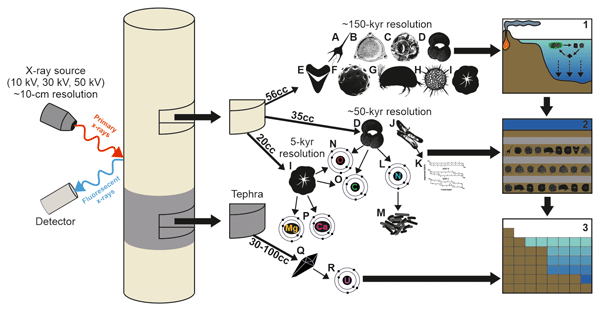
Proc. Int. Ocean Drill. Prog., 505S, 1, https://doi.org/10.5194/piodp-505S-1-2026, https://doi.org/10.5194/piodp-505S-1-2026, 2026
Short summary
Short summary
ENIGMA investigates a major, little-understood global oceanic and ecological upheaval during the early Miocene (23–17 million years ago). This interval saw distinct biodiversity shifts such as a >70% shark extinction, plankton turnovers, and cetacean radiations, alongside changes in global productivity and ice sheet dynamics. ENIGMA will analyze Atlantic Ocean sediment cores, refine age models, reconstruct climate and biotic records, and model ecosystem responses to Earth system change.
Adam Woodhouse and Jennifer Kasbohm
Proc. Int. Ocean Drill. Prog., 505S, 1, https://doi.org/10.5194/piodp-505S-1-2026, https://doi.org/10.5194/piodp-505S-1-2026, 2026
Short summary
Short summary
ENIGMA investigates a major, little-understood global oceanic and ecological upheaval during the early Miocene (23–17 million years ago). This interval saw distinct biodiversity shifts such as a >70% shark extinction, plankton turnovers, and cetacean radiations, alongside changes in global productivity and ice sheet dynamics. ENIGMA will analyze Atlantic Ocean sediment cores, refine age models, reconstruct climate and biotic records, and model ecosystem responses to Earth system change.
Boris-Theofanis Karatsolis, Matthias Sinnesael, Tom Dunkley Jones, Anna Joy Drury, Leah LeVay, Anne Briais, Ross Parnell-Turner, Emma Hanson, Paul N. Pearson, Margaret Morris, Haley Svadlenak, Sidney R. Hemming, Claire E. Jasper, Anita Di Chiara, Sara Satolli, Sarah Friedman, Deepa Dwyer, and Philippe Claeys
EGUsphere, https://doi.org/10.5194/egusphere-2026-3764, https://doi.org/10.5194/egusphere-2026-3764, 2026
Short summary
Short summary
The lower branch of the Atlantic Meridional overturning consists of deep-water currents which flow within North Atlantic basins and deposit sediments known as contourite drifts. Fluctuations in the accumulation and the lithology of these drifts can help us understand deep-ocean circulation during past warm intervals. In this study we investigated the sedimentary archive of the Gardar Drift and identified a weakening in bottom current activity across the latest Miocene climatic warming.
Sherilyn C. Fritz, André O. Sawakuchi, Anders Noren, Paul A. Baker, Cleverson Silva, Carlos Jaramillo, Renato Paes de Almeida, Liliane Janikian, Isaac Salém Bezerra, Marcos Barbosa, Dailson Bertassoli, Rain Blankenship, Cristiano M. Chiessi, Sarah J. Feakins, Maria da Glória Garcia, Cécile Gautheron, Brian Grivna, Gelvam Hartmann, Cindy Kunkel, André Marconato, Angela Martinez, Sebastian G. Marulanda, Carlos Eduardo M. Mazoca, Francisco R. Negri, Mauricio Parra, Werner E. Piller, Fabiano N. Pupim, Victor Salgado, Rachel T. So, Priscila Emerich Souza, Elena Stiles, Caroline A. E. Strömberg, Siu Mui Tsai, Ingo Wahnfried, Josh West, Marc-Élie Adaimé, Jhon Afonso, Thomas Kenji Akabane, Camila Eliza Althaus, Carlos D'Apolito, Kleiton R. Araújo, Roney da Silva de Azevedo Júnior, Jessica Barcellos, Tacio Bicudo, Giovanni Bogota, Bodo Bookhagen, Caio Breda, Alderlene Pimentel de Brito, Francy Carvajal, Daniel Antunes Coppi, Carolina Barbosa Leite da Cruz, Felipe Torres Figueiredo, Kate Freeman, Pedro Victor Oliveira Gomes, Martin Gross, Emma Hartke, Katja Heeschen, William Mozart Henrichs, Leonardo Henrique, Carina Hoorn, Brian K. Horton, Andrés Díaz-Jamamillo, Said Kamrani-Mehni, Fatima Leite, Lin Li, Rodrigo Ferreira de Lucena, Alastair Milne, Thomás Miranda, Marcelo Mota, Diana Ochoa, Vinicius de Lima Passos, Rafaela Maciel Lopes de Paula, Elisa Piispa, Angelo Plata Torres, Surangi W. Punyasena, Adriano Domingos dos Reis, Catherine Rigsby, Andrés F. Salazar Rios, Fernanda Costa Gonçalves Rodrigues, Raquel M. M. Romão, Ingrid C. Romero, Henrique O. Sawakuchi, Doug Schnurrenberger, Kristina Brady Shannon, Silane A. F. da Silva-Caminha, Clauses Sousa, Larissa Natsumi Tamura, Thomas Wiersberg, Helanlin Xiang, and Belén Zamudio
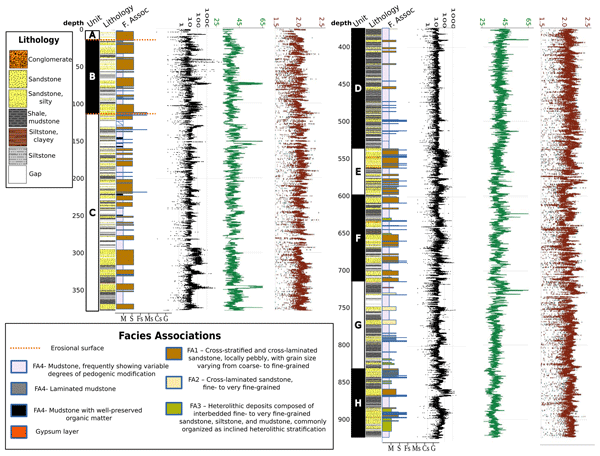
Sci. Dril., 35, 127–157, https://doi.org/10.5194/sd-35-127-2026, https://doi.org/10.5194/sd-35-127-2026, 2026
Short summary
Short summary
The Trans-Amazon Drilling Project seeks to reconstruct the origins of biodiversity in the world's largest and most diverse rain forest, and the roles of landscape changes driven by Andean uplift and global climate change in diversification. We provide a project overview and preliminary results from a drill core from the Acre Basin of western Brazil, which recovered an 860 m sequence that was deposited in a large river system and which will yield critical insights on evolutionary history.
Peter K. Bijl, Kasia K. Śliwińska, Bella Duncan, Arnaud Huguet, Sebastian Naeher, Ronnakrit Rattanasriampaipong, Claudia Sosa-Montes de Oca, Alexandra Auderset, Melissa A. Berke, Bum Soo Kim, Nina Davtian, Tom Dunkley Jones, Desmond D. Eefting, Felix J. Elling, Pierrick Fenies, Gordon N. Inglis, Lauren O'Connor, Richard D. Pancost, Francien Peterse, Addison Rice, Appy Sluijs, Devika Varma, Wenjie Xiao, and Yi Ge Zhang
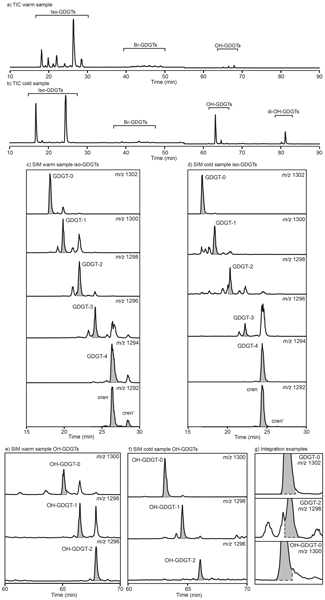
Biogeosciences, 22, 6465–6508, https://doi.org/10.5194/bg-22-6465-2025, https://doi.org/10.5194/bg-22-6465-2025, 2025
Short summary
Short summary
Many academic laboratories worldwide process environmental samples for analysis of membrane lipid molecules of archaea, for the reconstruction of past environmental conditions. However, the sample workup scheme involves many steps, each of which has a risk of contamination or bias, affecting the results. This paper reviews steps involved in sampling, extraction and analysis of lipids, interpretation and archiving of the data. This ensures reproducible, reusable, comparable and consistent data.
Alessio Fabbrini, Paul N. Pearson, Anieke Brombacher, Francesco Iacoviello, Thomas H. G. Ezard, and Bridget S. Wade
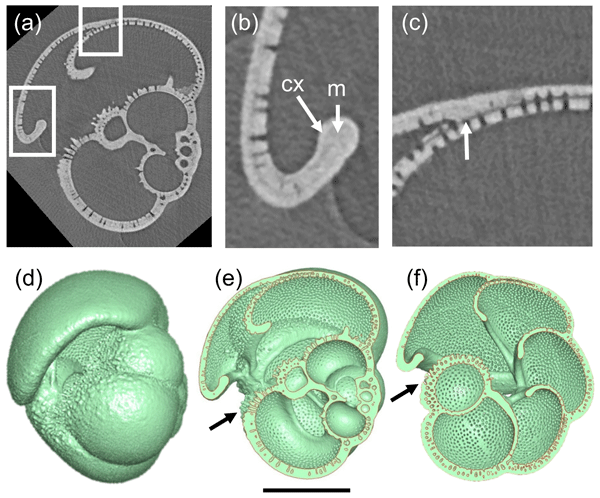
J. Micropalaeontol., 44, 213–235, https://doi.org/10.5194/jm-44-213-2025, https://doi.org/10.5194/jm-44-213-2025, 2025
Short summary
Short summary
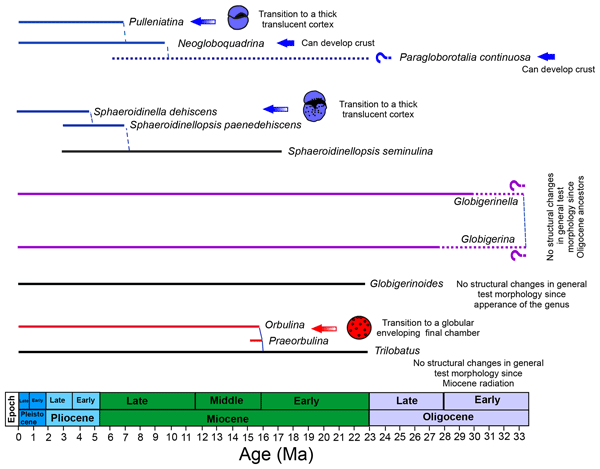
Pulleniatina is a genus of planktonic foraminifera used in biostratigraphy. Here, we illustrate typical specimens of Pulleniatina and the likely ancestor Neogloboquadrina acostaensis from International Ocean Discovery Program Site U1488. We present a novel integration of high-definition light microscopy images, X-ray microcomputed tomography data, and scanning electron microscope images to compare the six Pulleniatina species, supporting an evolutionary model with two diverging lineages.
Kirsty M. Edgar, Maria Grigoratou, Fanny M. Monteiro, Ruby Barrett, Rui Ying, and Daniela N. Schmidt
Biogeosciences, 22, 3463–3483, https://doi.org/10.5194/bg-22-3463-2025, https://doi.org/10.5194/bg-22-3463-2025, 2025
Short summary
Short summary
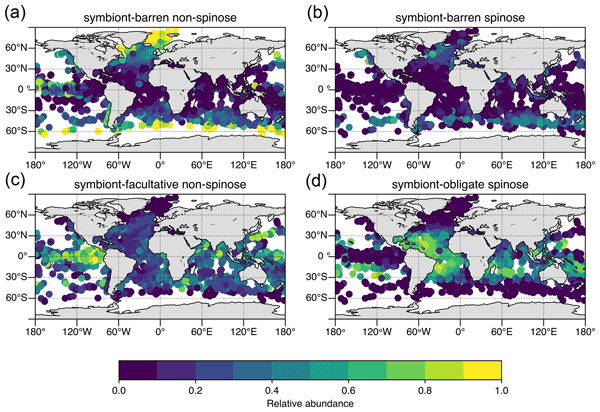
Planktic foraminifera are microscopic marine organisms whose calcium carbonate shells provide valuable insights into past ocean conditions. A promising means of understanding foraminiferal ecology and their environmental interactions is to constrain their key functional traits relating to feeding, symbioses, motility, calcification, and reproduction. Here we review what we know of their functional traits, key gaps in our understanding, and suggestions on how to fill them.
Lukas Jonkers, Tonke Strack, Montserrat Alonso-Garcia, Simon D'haenens, Robert Huber, Michal Kucera, Iván Hernández-Almeida, Chloe L. C. Jones, Brett Metcalfe, Rajeev Saraswat, Lóránd Silye, Sanjay K. Verma, Muhamad Naim Abd Malek, Gerald Auer, Cátia F. Barbosa, Maria A. Barcena, Karl-Heinz Baumann, Flavia Boscolo-Galazzo, Joeven Austine S. Calvelo, Lucilla Capotondi, Martina Caratelli, Jorge Cardich, Humberto Carvajal-Chitty, Markéta Chroustová, Helen K. Coxall, Renata M. de Mello, Anne de Vernal, Paula Diz, Kirsty M. Edgar, Helena L. Filipsson, Ángela Fraguas, Heather L. Furlong, Giacomo Galli, Natalia L. García Chapori, Robyn Granger, Jeroen Groeneveld, Adil Imam, Rebecca Jackson, David Lazarus, Julie Meilland, Marína Molčan Matejová, Raphael Morard, Caterina Morigi, Sven N. Nielsen, Diana Ochoa, Maria Rose Petrizzo, Andrés S. Rigual-Hernández, Marina C. Rillo, Matthew L. Staitis, Gamze Tanık, Raúl Tapia, Nishant Vats, Bridget S. Wade, and Anna E. Weinmann
J. Micropalaeontol., 44, 145–168, https://doi.org/10.5194/jm-44-145-2025, https://doi.org/10.5194/jm-44-145-2025, 2025
Short summary
Short summary
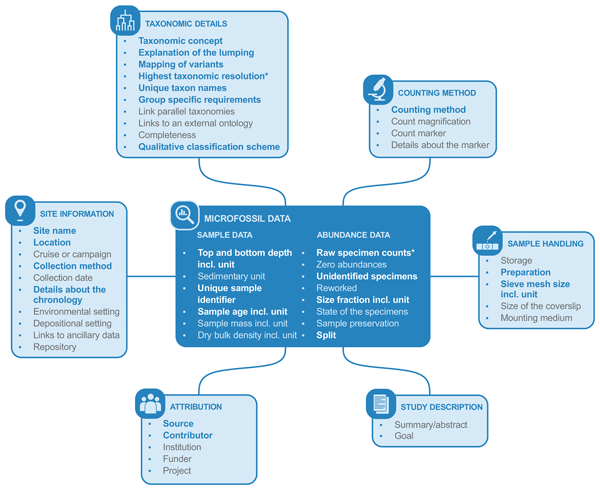
Our study provides guidelines improving the reuse of marine microfossil assemblage data, which are valuable for understanding past ecosystems and environmental change. Based on a survey of 113 researchers, we identified key data attributes required for effective reuse. Analysis of a selection of datasets available online reveals a gap between the attributes scientists consider essential and the data currently available, highlighting the need for clearer data documentation and sharing practices.
Flavia Boscolo-Galazzo, David Evans, Elaine M. Mawbey, William R. Gray, Paul N. Pearson, and Bridget S. Wade
Biogeosciences, 22, 1095–1113, https://doi.org/10.5194/bg-22-1095-2025, https://doi.org/10.5194/bg-22-1095-2025, 2025
Short summary
Short summary
Here we compare the Mg / Ca and oxygen isotope signatures for 57 recent to fossil species of planktonic foraminifera for the last 15 Myr. We find the occurrence of lineage-specific offsets in Mg / Ca conservative between ancestor-descendent species. Taking into account species kinship significantly improves temperature reconstructions, and we suggest that the occurrence of Mg / Ca offsets in modern species results from their evolution when ocean properties were different from today's.
Alessio Fabbrini, Maria Rose Petrizzo, Isabella Premoli Silva, Luca M. Foresi, and Bridget S. Wade
J. Micropalaeontol., 43, 121–138, https://doi.org/10.5194/jm-43-121-2024, https://doi.org/10.5194/jm-43-121-2024, 2024
Short summary
Short summary
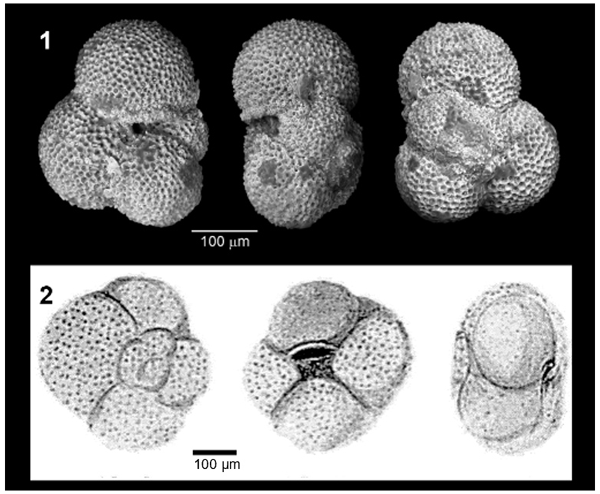
We report on the rediscovery of Globigerina bollii, a planktonic foraminifer described by Cita and Premoli Silva (1960) in the Mediterranean Basin. We redescribe G. bollii as a valid species belonging to the genus Globoturborotalita. We report and summarise all the recordings of the taxon in the scientific literature. Then we discuss how the taxon might be a palaeogeographical indicator of the intermittent gateways between the Mediterranean Sea, Paratethys, and Indian Ocean.
Paul N. Pearson, Jeremy Young, David J. King, and Bridget S. Wade
J. Micropalaeontol., 42, 211–255, https://doi.org/10.5194/jm-42-211-2023, https://doi.org/10.5194/jm-42-211-2023, 2023
Short summary
Short summary
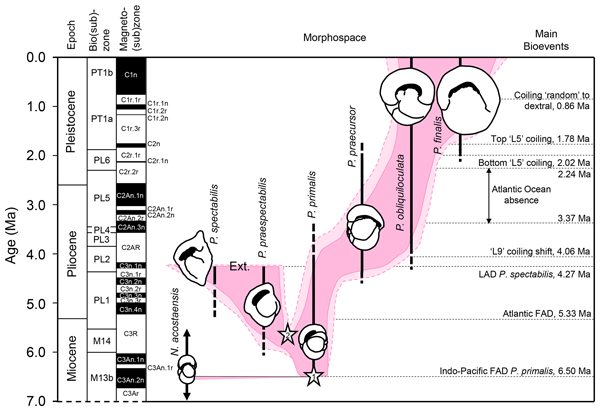
Planktonic foraminifera are marine plankton that have a long and continuous fossil record. They are used for correlating and dating ocean sediments and studying evolution and past climates. This paper presents new information about Pulleniatina, one of the most widespread and abundant groups, from an important site in the Pacific Ocean. It also brings together a very large amount of information on the fossil record from other sites globally.
Marcin Latas, Paul N. Pearson, Christopher R. Poole, Alessio Fabbrini, and Bridget S. Wade
J. Micropalaeontol., 42, 57–81, https://doi.org/10.5194/jm-42-57-2023, https://doi.org/10.5194/jm-42-57-2023, 2023
Short summary
Short summary
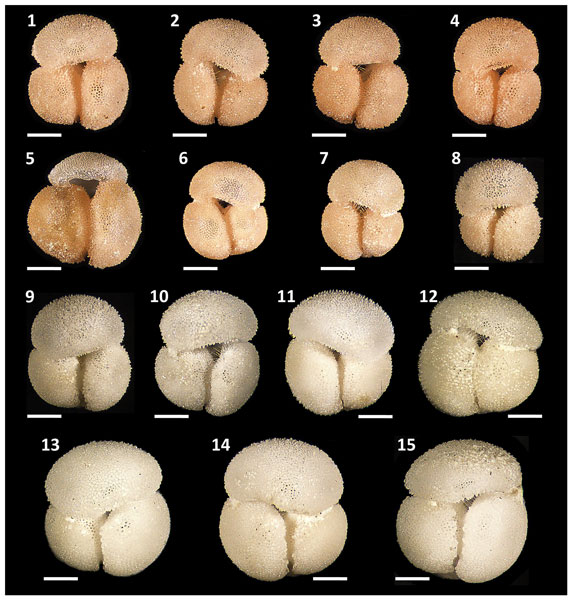
Planktonic foraminifera are microscopic single-celled organisms populating world oceans. They have one of the most complete fossil records; thanks to their great abundance, they are widely used to study past marine environments. We analysed and measured series of foraminifera shells from Indo-Pacific sites, which led to the description of a new species of fossil planktonic foraminifera. Part of its population exhibits pink pigmentation, which is only the third such case among known species.
Paul N. Pearson, Eleanor John, Bridget S. Wade, Simon D'haenens, and Caroline H. Lear
J. Micropalaeontol., 41, 107–127, https://doi.org/10.5194/jm-41-107-2022, https://doi.org/10.5194/jm-41-107-2022, 2022
Short summary
Short summary
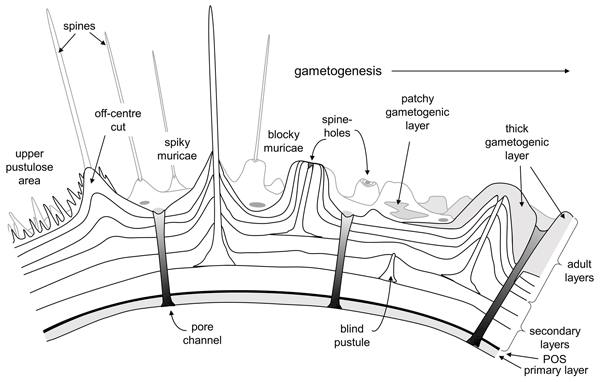
The microscopic shells of planktonic foraminifera accumulate on the sea floor over millions of years, providing a rich archive for understanding the history of the oceans. We examined an extinct group that flourished between about 63 and 32 million years ago using scanning electron microscopy and show that they were covered with needle-like spines in life. This has implications for analytical methods that we use to determine past seawater temperature and acidity.
Flavia Boscolo-Galazzo, Amy Jones, Tom Dunkley Jones, Katherine A. Crichton, Bridget S. Wade, and Paul N. Pearson
Biogeosciences, 19, 743–762, https://doi.org/10.5194/bg-19-743-2022, https://doi.org/10.5194/bg-19-743-2022, 2022
Short summary
Short summary
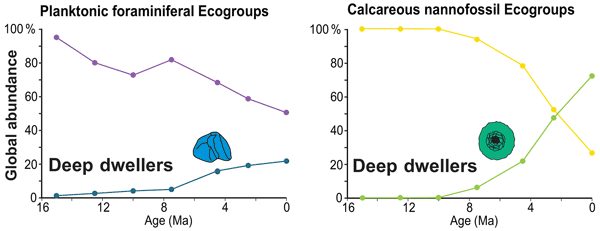
Deep-living organisms are a major yet poorly known component of ocean biomass. Here we reconstruct the evolution of deep-living zooplankton and phytoplankton. Deep-dwelling zooplankton and phytoplankton did not occur 15 Myr ago, when the ocean was several degrees warmer than today. Deep-dwelling species first evolve around 7.5 Myr ago, following global climate cooling. Their evolution was driven by colder ocean temperatures allowing more food, oxygen, and light at depth.
Cited articles
Agnini, C., Fornaciari, E., Giusberti, L., Grandesso, P., Lanci, L., Luciani, V., Muttoni, G., Pälike, H., Rio, D., Spofforth, D. J., and Stefani, C.: Integrated biomagnetostratigraphy of the Alano section (NE Italy): A proposal for defining the middle-late Eocene boundary, Bulletin, 123, 841–872, https://doi.org/10.1130/B30158.1, 2011.
Agnini, C., Fornaciari, E., Raffi, I., Catanzariti, R., Pälike, H., Backman, J., and Rio, D.: Biozonation and biochronology of Paleogene calcareous nannofossils from low and middle latitudes, Newslett. Stratigr., 47, 131–181, 2014.
Aljahdali, M. H., Elhag, M., Mufrreh, Y., Memesh, A., Alsoubhi, S., and Zalmout, I. S.: Upper Eocene calcareous nannofossil biostratigraphy: a new preliminary priabonian record from northern Saudi Arabia, Applied Ecology and Environmental Research, 18, https://doi.org/10.15666/aeer/1804_56075625, 2020.
Al-Sabouni, N., Kucera, M., and Schmidt, D. N.: Vertical niche separation control of diversity and size disparity in planktonic foraminifera, Mar. Micropaleontol., 63, 75–90, 2007.
Anagnostou, E., John, E. H., Edgar, K. M., Foster, G. L., Ridgwell, A., Inglis, G. N., Pancost, R. D., Lunt, D. J., and Pearson, P. N.: Changing atmospheric CO2 concentration was the primary driver of early Cenozoic climate, Nature, 533, 380–384, https://doi.org/10.1038/nature17423, 2016.
Antell, G. T., Fenton, I. S., Valdes, P. J., and Saupe, E. E.: Thermal niches of planktonic foraminifera are static throughout glacial–interglacial climate change, P. Natl. Acad. Sci. USA, 118, e2017105118, https://doi.org/10.1073/pnas.2017105118, 2021.
Anthonissen, D. E. and Ogg, J. G.: Cenozoic and Cretaceous biochronology of planktonic foraminifera and calcareous nannofossils, The geologic time scale, Elsevier, https://doi.org/10.1016/B978-0-444-59425-9.15003-6, 1083–1127, 2012.
Antoine, P. O., Yans, J., Castillo, A. A., Stutz, N., Abello, M. A., Adnet, S., Custódio, M. A., Benites-Palomino, A., Billet, G., Boivin, M., and Herrera, F.: Biotic community and landscape changes around the Eocene–Oligocene transition at Shapaja, Peruvian Amazonia: Regional or global drivers?, Global Planet. Change, 202, 103512, https://doi.org/10.1016/j.gloplacha.2021.103512, 2021.
Arimoto, J., Nishi, H., Kuroyanagi, A., Takashima, R., Matsui, H., and Ikehara, M.: Changes in upper ocean hydrography and productivity across the Middle Eocene Climatic Optimum: Local insights and global implications from the Northwest Atlantic, Global Planet. Change, 193, 103258, https://doi.org/10.1016/j.gloplacha.2020.103258, 2020.
Aze, T.: Unraveling ecological signals from a global warming event of the past, P. Natl. Acad. Sci. USA, 119, e2201495119, https://doi.org/10.1073/pnas.2201495119, 2022.
Aze, T., Ezard, T. H. G., Purvis, A., Coxall, H. K., Stuart, D. R. M., Wade, B. S., and Pearson, P. N.: A phylogeny of Cenozoic macroperforate planktonic foraminifera from fossil data, Biol. Rev., 86, 900–927, 2011.
Barrera, E. and Huber, B. T.: Paleogene and early Neogene oceanography of the southern Indian Ocean: Leg 119 foraminifer stable isotope results, Proc. Ocean Drill. Program, 119, 693–717, 1991.
Bayona, G., Cortés, M., Jaramillo, C., Ojeda, G., Aristizabal, J. J., and Reyes-Harker, A.: An integrated analysis of an orogen–sedimentary basin pair: Latest Cretaceous–Cenozoic evolution of the linked Eastern Cordillera orogen and the Llanos foreland basin of Colombia, Geol. Soc. Am. Bull., 120, 1171–1197, 2008.
Beckman, J. P.: The foraminifera and some associated microfossils of Sites 135 to 144, Initial Reports of the Deep Sea Drilling Project, Lisbon, Portugal to San Juan, Puerto Rico, Initial Reports of the Deep Sea Drilling Project, Vol. 14,Texas A&M University, Ocean Drilling Program, College Station, TX, USA, 389–420, https://doi.org/10.2973/dsdp.proc.14.113.1972, 1972.
Berggren, W. A.: Neogene planktonic foraminifer magnetobiostratigraphy of the southern Kerguelen Plateau (Sites 747, 748, and 751), in: Proceedings of the Ocean Drilling Program, Ocean Drilling Program, https://doi.org/10.2973.odp.proc.sr.120.153.1992, 1992.
Berggren, W. A. and Pearson, P. N.: A revised tropical and subtropical Paleogene planktonic foraminiferal zonation, J. Foraminifer. Res., 35, 279–298, 2005.
Berggren, W. A., Kent, D. V., and Flynn, J. J.: Jurassic to Paleogene: Part 2 Paleogene geochronology and chronostratigraphy, Geol. Soc. Lond. Memoirs, 10, 141–195, 1985.
Berggren, W. A., Pearson, P. N., Huber, B. T., and Wade, B. S.: Taxonomy, biostratigraphy, and phylogeny of Eocene Acarinina, in: Atlas of Eocene Planktonic Foraminifera, edited by: Pearson, P. N., Olsson, R. K., Huber, B. T., Hemleben, C., and Berggren, W. A., Cushman Foundation Special Publication 41, Cushman Foundation, 257–326, ISBN 9781970168365, 2006.
Bice, K. I., Sloan, L. C., and Barron, F. J.: Comparison of early Eocene isotopic paleotemperatures and the three-dimensional OGCM temperature field: the potential for use of model-derived surface water δ18O, in: Warm Climates in Earth History, edited by: Huber, B. T., MacLeod, K. G., and Wing, S. L., Cambridge University Press, Cambridge, 79–131, https://doi.org/10.1017/CBO9780511564512, 2000.
Blow, W. H.: The cainozoic globigerinida (Vol. 3), Leiden: Brill, ISBN 9789004059351, ISBN 9004059350, 1979.
Boersma, A. and Premoli Silva, I.: Terminal Eocene events: planktonic Foraminifera and isotopic evidence, in: Developments in Palaeontology and Stratigraphy, Vol. 9, Elsevier, 213–223, https://doi.org/10.1016/S0920-5446(08)70124-9, 1986.
Boersma, A. and Premoli Silva, I.: Atlantic Paleogene biserial heterohelicid foraminifera and oxygen minima, Paleoceanography, 4, 271–286, 1989.
Boersma, A. and Premoli Silva, I.: Distribution of Paleogene planktonic foraminifera – analogies with the Recent?, Palaeoceanogr. Palaeocl. Palaeoecol., 83, 29–48, 1991.
Boersma, A. and Shackleton, N. J.: Oxygen and carbon isotope record through the Oligocene, Site 366, Equatorial Atlantic, Initial Reports of the Deep Sea Drilling Project 41, 957–962, https://doi.org/10.2973/dsdp.proc.41.136.1978, 1977.
Boersma, A., Premoli Silva, I., and Shackleton, N. J.: Atlantic Eocene planktonic foraminiferal paleohydrographic indicators and stable isotope paleoceanography, Paleoceanography, 2, 287–331, 1987.
Bohaty, S. M., Zachos, J. C., Florindo, F., and Delaney, M. L.: Coupled greenhouse warming and deep-sea acidification of the Middle Eocene, Paleoceanography, 24, PA2207, https://doi.org/10.1029/2008PA001676, 2009.
Borrelli, C., Cramer, B. S., and Katz, M. E.: Bipolar Atlantic deepwater circulation in the middle-late Eocene: Effects of Southern Ocean gateway openings, Paleoceanography, 29, 308–327, 2014.
Boscolo-Galazzo, F., Crichton, K. A., Ridgwell, A., Mawbey, E. M., Wade, B. S., and Pearson, P. N.: Temperature controls carbon cycling and biological evolution in the ocean twilight zone, Science, 371, 1148–1152, https://doi.org/10.1126/science.abb6643, 2021.
Boscolo-Galazzo, F., Jones, A., Dunkley Jones, T., Crichton, K. A., Wade, B. S., and Pearson, P. N.: Late Neogene evolution of modern deep-dwelling plankton, Biogeosciences, 19, 743–762, https://doi.org/10.5194/bg-19-743-2022, 2022.
Bown, P., Coe, A., Cope, J., Edgar, K., Harper, D., Marshall, J., Wakefield, M., Pearson, P. N., and Zalasiewicz, J.: Biostratigraphy – using fossils to date and correlate rock, in: Deciphering Earth's History: the Practice of Stratigraphy, edited by: Coe, A. L., Geological Society of London, ISBN 9781786205742, https://doi.org/10.1144/GIP1-2022-42, 2022.
Bown, P. R., Dunkley Jones, T., Lees, J. A., Randell, R. D., Mizzi, J. A., Pearson, P. N., Coxall, H. K., Young, J. R., Nicholas, C. J., Karega, A., Singano, J., and Wade, B. S.: A Paleogene calcareous microfossil Konservat-Lagerstätte from the Kilwa Group of coastal Tanzania, Geol. Soc. Am. Bull., 120, 3–12, 2008.
Boyle, P. R., Romans, B. W., Tucholke, B. E., Norris, R. D., Swift, S. A., and Sexton, P. F.: Cenozoic North Atlantic deep circulation history recorded in contourite drifts, offshore Newfoundland, Canada, Mar. Geol., 385, 185–203, 2017.
Brandão, J. A. S. and Feijó, F. J.: Bacia da Foz do Amazonas, Boletim de Geosciênces da Petrobrás, 8, 91–99, 1994.
Broecker, W. S. and Clark, E.: CaCO3 size index paleocarbonate ion proxy?, Paleoceanography, 14, 596–604, 1999.
Brombacher, A., Wilson, P. A., Bailey, I., and Ezard, T. H.: The dynamics of diachronous extinction associated with climatic deterioration near the Neogene/Quaternary boundary, Paleoceanography and Paleoclimatology, 36, e2020PA004205, 2021.
Bryant, R., Leckie, R. M., Bralower, T. J., Jones, M. M., and Sageman, B. B.: Microfossil and geochemical records reveal high-productivity paleoenvironments in the Cretaceous Western Interior Seaway during Oceanic Anoxic Event 2, Palaeogeogr. Palaeocl. Palaeoecol., 584, 110679, https://doi.org/10.1016/j.palaeo.2021.110679, 2021.
Castro, J. C., Miura, K., and Braga, J. A. E.: Stratigraphic and structural framework of the Foz do Amazonas, in: 10th Annual Offshore Technology Conference, 1843–1847, https://doi.org/10.4043/3265-MS, 1978.
Coccioni, R., Monaco, P., Monechi, S., Nocchi, M., and Parisi, G.: Biostratigraphy of the Eocene–Oligocene boundary at Massignano (Ancona, Italy), International Subcommission on Paleogene Stratigraphy, 50–80, 1988.
Cordey, W. G., Berggren, W. A., and Olsson, R. K.: Phylogenetic trends in the planktonic foraminiferal genus Pseudohastigerina Banner and Blow, 1959, Micropaleontology, 16, 235–242, 1970.
Coxall, H. K.: Hantkeninid planktonic foraminifera and Eocene palaeoceanographic change, Doctoral dissertation, University of Bristol, 2000.
Coxall, H. K. and Pearson, P. N.: Taxonomy, biostratigraphy, and phylogeny of the Hantkeninidae (Clavigerinella, Hantkenina, and Cribrohantkenina), edited by: Pearson, P. N., Olsson, R. K., Huber, B. T., Hemleben, C., and Berggren, W. A., Atlas of Eocene Planktonic Foraminifera : Cushman Foundation Special Publication, 41, 216–256, ISBN 9781970168365, 2006.
Coxall, H. K. and Pearson, P. N.: The Eocene-Oligocene transition, Deep Time Perspect. Clim. Chang. Marrying Signal From Comput. Model. Biol. Proxies, The Micropalaeontological Society, Special Publications, The Geological Society, London, UK, 351–387, https://doi.org/10.1144/TMS002.16, 2007.
Coxall, H. K., Pearson, P. N., Shackleton, N. J., and Hall, M. A.: Hantkeninid depth adaptation: an evolving life strategy in a changing ocean, Geology, 28, 87–90, 2000.
Coxall, H. K., Huber, B. T., and Pearson, P. N.: Origin and morphology of the Eocene planktonic foraminifer Hantkenina, J. Foraminifer. Res., 33, 237–261, 2003.
Coxall, H. K. and Spezzaferri, S.: Taxonomy, biostratigraphy, and phylogeny of Oligocene Catapsydrax, Globorotaloides, and Protentelloides, in: Atlas of Oligocene Planktonic Foraminifera, Cushman Foundation of Foraminiferal Research, Special Publi55 cation 46, edited by: Wade, B. S., Olsson, R. K., Pearson, P. N., Huber, B. T., and Berggren, W. A., Cushman Foundation, ISBN 9781970168419, 2018.
Coxall, H. K., Huck, C. E., Huber, M., Lear, C. H., Legarda-Lisarri, A., O'regan, M., Sliwinska, K. K., Van De Flierdt, T., De Boer, A. M., Zachos, J. C., and Backman, J.: Export of nutrient rich Northern Component Water preceded early Oligocene Antarctic glaciation, Nat. Geosci., 11, 190–196, 2018.
Coxall, H. K., Jones, T. D., Jones, A. P., Lunt, P., MacMillan, I., Marliyani, G. I., Nicholas, C. J., O'Halloran, A., Piga, E., Sanyoto, P., Rahardjo, W., and Pearson, P. N.: The Eocene–Oligocene transition in Nanggulan, Java: lithostratigraphy, biostratigraphy and foraminiferal stable isotopes, J. Geol. Soc., 178, jgs2021-2006, https://doi.org/10.1144/jgs2021-006, 2021.
Cramer, B. S., Miller, K. G., Barrett, P. J., and Wright, J. D.: Late Cretaceous–Neogene trends in deep ocean temperature and continental ice volume: Reconciling records of benthic foraminiferal geochemistry (δ18O and Mg/Ca) with sea level history, Journal of Geophysical Research: Oceans, 116, https://doi.org/10.1029/2011JC007255, 2011.
Cramer, B. S., Toggweiler, J. R., Wright, J. D., Katz, M. E., and Miller, K. G.: Ocean overturning since the Late Cretaceous: Inferences from a new benthic foraminiferal isotope composition, Paleoceanography, 24, PA4216, https://doi.org/10.1029/2008PA001683, 2009.
Defant, A.: Physical Oceanography, vol. 2, Pergamon, New York, 1961.
D'Hondt, S., Zachos, J. C., and Schultz, G.: Stable isotopic signals and photosymbiosis in late Paleocene planktic foraminifera. Paleobiology, 20, 391–406, https://doi.org/10.1017/S0094837300012847, 1994.
Dobson, D. M., Dickens, G. R., and Rea, D. K.: Terrigenous sediment on Ceara Rise: a Cenozoic record of South American orogeny and erosion, Palaeogeogr. Palaeocl., Palaeoecol., 165, 215–229, 2001.
D'Onofrio, R., Luciani, V., Dickens, G. R., Wade, B. S., and Kirtland-Turner, S.: Demise of the planktic foraminifer genus Morozovella during the early Eocene climatic optimum: New records from ODP site 1258 (Demerara Rise, Western Equatorial Atlantic) and site 1263 (Walvis Ridge, South Atlantic), Geosciences, 10, 88, https://doi.org/10.3390/geosciences10030088, 2020.
Douglas, R. G.: Planktonic foraminiferal biostratigraphy in the Central North Pacific Ocean, Initial Reports of the Deep Sea Drilling Project, Vol. 17, Texas A&M University, Ocean Drilling Program, College Station, TX, USA, 673–694, https://doi.org/10.2973/dsdp.proc.17.122.1973, 1973.
Douglas, R. G. and Savin, S. M.: Oxygen isotopic evidence for the depth stratification of Tertiary and Cretaceous planktic foraminifera, Marine Micropaleontology, 3, 175–196, https://doi.org/10.1016/0377-8398(78)90004-X, 1978.
Dowsett, H., Robinson, M., Foley, K., Herbert, T., Hunter, S., Andersson, C., and Spivey, W.: The Relative Stability of Planktic Foraminifer Thermal Preferences over the Past 3 Million Years, Geosciences, 13, 71, https://doi.org/10.3390/geosciences13030071, 2023.
Duarte, D., Erba, E., Bottini, C., Wagner, T., Aduomahor, B., Jones, T. D. and Nicholson, U.: Early Cretaceous deep-water bedforms west of the Guinea Plateau revise the opening history of the Equatorial Atlantic Gateway. Global Planet. Change, 249, 104777, https://doi.org/10.1016/j.gloplacha.2025.104777, 2025.
Edgar, K. M., Wilson, P. A., Sexton, P. F., Gibbs, S. J., Roberts, A. P., and Norris, R. D.: New biostratigraphic, magnetostratigraphic and isotopic insights into the Middle Eocene Climatic Optimum in low latitudes, Palaeogeogr. Palaeocl. Palaeoecol., 297, 670–682, 2010.
Edgar, K. M., Bohaty, S. M., Gibbs, S. J., Sexton, P. F., Norris, R. D., and Wilson, P. A.: Symbiont `bleaching' in planktic foraminifera during the Middle Eocene Climatic Optimum, Geology, 41, 15–18, 2013.
Edgar, K. M., Anagnostou, E., Pearson, P. N., and Foster, G. L.: Assessing the impact of diagenesis on δ11B, δ13C, δ18O, Sr/Ca and B/Ca values in fossil planktic foraminiferal calcite, Geochim. Cosmochim. Ac., 166, 189–209, 2015.
Edgar, K. M., Hull, P. M., and Ezard, T. H.: Evolutionary history biases inferences of ecology and environment from δ13C but not δ18O values, Nat. Commun., 8, 1106, https://doi.org/10.1038/s41467-017-01154-7, 2017.
Edgar, K. M., Bohaty, S. M., Coxall, H. K., Bown, P. R., Batenburg, S. J., Lear, C. H., and Pearson, P. N.: New composite bio-and isotope stratigraphies spanning the Middle Eocene Climatic Optimum at tropical ODP Site 865 in the Pacific Ocean, J. Micropalaeontol., 39, 117–138, 2020.
Egan, K. E., Rickaby, R. E., Hendry, K. R., and Halliday, A. N.: Opening the gateways for diatoms primes Earth for Antarctic glaciation, Earth Planet. Sc. Lett., 375, 34–43, 2013.
Erhardt, A. M., Pälike, H., and Paytan, A.: High-resolution record of export production in the eastern equatorial Pacific across the Eocene–Oligocene transition and relationships to global climatic records, Paleoceanography, 28, 130–142, 2013.
Expedition 320/321 Scientists: Site U1332, in: Proc. IODP, 320/321, edited by: Pälike, H., Lyle, M., Nishi, H., Raffi, I., Gamage, K., Klaus, A., and the Expedition 320/321 Scientists, Integrated Ocean Drilling Program Management International, Inc., Tokyo, https://doi.org/10.2204/iodp.proc.320321.104.2010, 2010a.
Expedition 320/321 Scientists: Site U1333, in: Proc. IODP, 320/321, edited by: Pälike, H., Lyle, M., Nishi, H., Raffi, I., Gamage, K., Klaus, A., and the Expedition 320/321 Scientists, Integrated Ocean Drilling Program Management International, Inc., Tokyo, https://doi.org/10.2204/iodp.proc.320321.105.2010, 2010b.
Expedition 320/321 Scientists: Site U1334, in: Proc. IODP, 320/321, edited by: Pälike, H., Lyle, M., Nishi, H., Raffi, I., Gamage, K., Klaus, A., and the Expedition 320/321 Scientists, Integrated Ocean Drilling Program Management International, Inc., Tokyo, https://doi.org/10.2204/iodp.proc.320321.106.2010, 2010c.
Ezard, T. H. G., Aze, T., Pearson, P. N., and Purvis, A.: Interplay between changing climate and species' ecology drives macroevolutionary dynamics, Science, 332, 349–351, 2011.
Faith, D. P., Minchin, P. R., and Belbin, L.: Compositional dissimilarity as a robust measure of ecological distance, Vegetatio, 69, 57–68, 1987.
Fenton, I. S., Woodhouse, A., Aze, T., Lazarus, D., Renaudie, J., Dunhill, A. M., Young, J. R., and Saupe, E. E.: Triton, a new species-level database of Cenozoic planktonic foraminiferal occurrences. Sci. Data, 8, 160, https://doi.org/10.1038/s41597-021-00942-7, 2021.
Figueiredo, J. J. J. P., Hoorn, C., Van der Ven, P., and Soares, E.: Late Miocene onset of the Amazon River and the Amazon deep-sea fan: Evidence from the Foz do Amazonas Basin, Geology, 37, 619–622, 2009.
Filippi, G., Barrett, R., Schmidt, D. N., D'Onofrio, R., Westerhold, T., Brombin, V., and Luciani, V.: Impacts of the Early Eocene Climatic Optimum (EECO,∼ 53‐49 Ma) on Planktic Foraminiferal Resilience, Paleoceanography and Paleoclimatology, 39, e2023PA004820, 2024.
Flannery‐Sutherland, J. T., Raja, N. B., Kocsis, Á. T., and Kiessling, W.: Fossilbrush: An R package for automated detection and resolution of anomalies in palaeontological occurrence data, Methods in Ecology and Evolution, 13, 2404–2418, https://doi.org/10.1111/2041-210X.13966, 2022.
Fleisher, R. L.: Cenozoic planktonic foraminifera and biostratigraphy, Arabian Sea, Deep Sea Drilling Project, Leg 23A, in: Init. Repts. DSDP 23, edited by: Whitmarsh, R. B., US Govt. Printing Office, Washington, 1001–1072, https://doi.org/10.2973/dsdp.proc.23.139.1974, 1974.
Fluegeman, R. H.: Preliminary paleontological report on the foraminifera of the Mossy Grove core, Hinds County, Mississippi, Mississippi Geology, 17, 9–15, 1996.
Fluegeman, R. H., Grigsby, J. D., and Hurley, J. V.: Eocene-Oligocene greenhouse to icehouse transition on a subtropical clastic shelf, the Jackson-Vicksburg Groups of the eastern Gulf Coastal Plain of the United States, Spec. Pap. -Geol. Soc. Am., 452, 261–277, 2009.
Fofonoff, N. P.: Machine computations of mass transport in the North Pacific Ocean, Journal of the Fisheries Board of Canada, 19, 1121–1141, 1962.
Fornaciari, E., Agnini, C., Catanzariti, R., Rio, D., Bolla, M. E., and Valvasoni, E.: Mid-latitude calcareous nannofossil biostratigraphy and biochronology across the middle to late Eocene transition, Stratigraphy, 7, 229–264, 2010.
Foster, G. L., Royer, D. L., and Lunt, D. J.: Future climate forcing potentially without precedent in the last 420 million years, Nature communications, 8, 14845, 2017.
Fraass, A. J., Kelly, D. C., and Peters, S. E.: Macroevolutionary history of the planktic foraminifera, Annual Review of Earth and Planetary Sciences, 43, 139–166, https://doi.org/10.1146/annurev-earth-060614-105059, 2015.
Gaskell, D. E., Huber, M., O’Brien, C. L., Inglis, G. N., Acosta, R. P., Poulsen, C. J., and Hull, P. M.: The latitudinal temperature gradient and its climate dependence as inferred from foraminiferal δ18O over the past 95 million years, Proceedings of the National Academy of Sciences, 119, e2111332119, 2022.
Gómez, E., Jordan, T. E., Allmendinger, R. W., Hegarty, K., Kelley, S., and Heizler, M.: Controls on architecture of the late Cretaceous to Cenozoic southern middle Magdalena valley basin, Colombia, Geol. Soc. Am. Bull., 115, 131–147, 2003.
Gradstein, F., Ogg, J. G., Schmitz, M. D., and Ogg, G. M. (Eds.): The geologic time scale 2012, Elsevier, ISBN 978-0-444-59425-9, 2012.
Griffith, E. M., Paytan, A., Eisenhauer, A., Bullen, T. D., and Thomas, E.: Seawater calcium isotope ratios across the Eocene–Oligocene transition, Geology, 39, 683–686, 2011.
Guasti, E. and Speijer, R. P.: The Paleocene-Eocene Thermal Maximum in Egypt and Jordan: An overview of the planktic foraminiferal record, in: Large ecosystem perturbations: Causes and consequences, Geological Society of America Special Paper 424, edited by: Monechi, S., Coccioni, R., and Rampino, M., Geological Society of America, 53–67, https://doi.org/10.1130/2007.2424(03), 2007.
Hallock, P.: Why are large Foraminifera large?, Paleobiology, 11, 195–208, 1985.
Hancock, H. J. L. and Dickens, G. R.: Carbonate dissolution episodes in Paleocene and Eocene sediment, Shatsky Rise, west-central Pacific, in: Proceedings of the Ocean Drilling Program, Scientific Results 198, edited by: Bralower, T. J., Premoli Silva, I., and Malone, M. J., 1–24, https://doi.org/10.2973/odp.proc.sr.198.116.2005, 2005.
Hayward, B. W., Grenfell, H. R., Reid, C. M., and Hayward, K. A.: Recent New Zealand shallow-water benthic foraminifera: taxonomy, ecologic distribution, biogeography, and use in paleoenvironmental assessment, New Zealand Geological Survey Bulletin, 75, 1999.
Heine, C., Zoethout, J. and Müller, R. D.: Kinematics of the South Atlantic rift, Solid Earth, 4, 215–253, https://doi.org/10.5194/se-4-215-2013, 2013.
Hohbein, M. W., Sexton, P. F., and Cartwright, J. A.: Onset of North Atlantic Deep Water production coincident with inception of the Cenozoic global cooling trend, Geology, 40, 255–258, 2012.
Hoorn, C. and Wesselingh, F.: Amazonia: Landscape and species evolution, Blackwell Publishing, Chichester, 210 pp., https://doi.org/10.1002/9781444306408, 2010.
Hoorn, C., Bogotá-A, G. R., Romero-Baez, M., Lammertsma, E. I., Flantua, S. G., Dantas, E. L., Dino, R., do Carmo, D. A., and Chemale Jr., F.: The Amazon at sea: Onset and stages of the Amazon River from a marine record, with special reference to Neogene plant turnover in the drainage basin, Global Planet. Change, 153, 51–65, 2017.
Houben, A. J., Bijl, P. K., Sluijs, A., Schouten, S., and Brinkhuis, H.: Late Eocene Southern Ocean cooling and invigoration of circulation preconditioned Antarctica for full-scale glaciation, Geochem. Geophy. Geosy., 20, 2214–2234, 2019.
Huber, B. T. and Sloan, L. C.: Modelling the Paleogene: Part II. Paleogene wind-driven circulation changes predicted from climatic modelling studies, Geologiska Foreningens i Stokholm Forhandlingar, 122, 80–81, 2000.
Huber, B. T., Olsson, R. K., and Pearson, P. N.: Taxonomy, biostratigraphy, and phylogeny of Eocene microperforate planktonic foraminifera (Jenkinsina, Cassigerinelloita, Chiloguembelina, Streptochilus, Zeauvigerina, Tenuitella, and Cassigerinella) and Problematica (Dipsidripella), in: Atlas of Eocene Planktonic Foraminifera, Cushman Foundation Special Publication 41, edited by: Pearson, P. N., Olsson, R. K., Huber, B. T., Hemleben, C., and Berggren, W. A., Cushman Foundation, 461–508, ISBN 9781970168365, 2006.
Huber, B. T., Petrizzo, M. R., Young, J. R., Falzoni, F., Gilardoni, S. E., Bown, P. R. and Wade, B. S.: Pforams@ microtax, Micropaleontology, 62(6), pp. 429–438, 2016.
Hutchinson, D. K., Coxall, H. K., O'Regan, M., Nilsson, J., Caballero, R., and de Boer, A. M.: Arctic closure as a trigger for Atlantic overturning at the Eocene–Oligocene Transition, Nat. Commun., 10, 3797, https://doi.org/10.1038/s41467-019-11828-z, 2019.
Hutchinson, D. K., Coxall, H. K., Lunt, D. J., Steinthorsdottir, M., de Boer, A. M., Baatsen, M., von der Heydt, A., Huber, M., Kennedy-Asser, A. T., Kunzmann, L., Ladant, J.-B., Lear, C. H., Moraweck, K., Pearson, P. N., Piga, E., Pound, M. J., Salzmann, U., Scher, H. D., Sijp, W. P., Śliwińska, K. K., Wilson, P. A., and Zhang, Z.: The Eocene–Oligocene transition: a review of marine and terrestrial proxy data, models and model–data comparisons, Clim. Past, 17, 269–315, https://doi.org/10.5194/cp-17-269-2021, 2021.
Hyland, E. G. and Sheldon, N. D.: Coupled CO2-climate response during the early Eocene climatic optimum. Palaeogeography, Palaeoclimatology, Palaeoecology, 369, 125–135, https://doi.org/10.1016/j.palaeo.2012.10.011, 2013.
Inglis, G. N., Farnsworth, A., Lunt, D., Foster, G. L., Hollis, C. J., Pagani, M., Jardine, P. E., Pearson, P. N., Markwick, P., Galsworthy, A. M., and Raynham, L.: Descent toward the Icehouse: Eocene sea surface cooling inferred from GDGT distributions, Paleoceanography, 30, 1000–1020, 2015.
Inglis, G. N., Bragg, F., Burls, N. J., Cramwinckel, M. J., Evans, D., Foster, G. L., Huber, M., Lunt, D. J., Siler, N., Steinig, S., Tierney, J. E., Wilkinson, R., Anagnostou, E., de Boer, A. M., Dunkley Jones, T., Edgar, K. M., Hollis, C. J., Hutchinson, D. K., and Pancost, R. D.: Global mean surface temperature and climate sensitivity of the early Eocene Climatic Optimum (EECO), Paleocene–Eocene Thermal Maximum (PETM), and latest Paleocene, Clim. Past, 16, 1953–1968, https://doi.org/10.5194/cp-16-1953-2020, 2020.
John, E. H., Pearson, P. N., Coxall, H. K., Birch, H., Wade, B. S., and Foster, G. L.: Warm ocean processes and carbon cycling in the Eocene. Philosophical Transactions of the Royal Society A: Mathematical, Physical and Engineering Sciences, 371, 20130099, https://doi.org/10.1098/rsta.2013.0099, 2013.
Jones, A. P. and Dunkley Jones, T.: Middle Eocene to early Oligocene calcareous nannofossils from the Nanggulan Formation, Java, Indonesia, J. Nannoplankt. Res., 38, 57–79, 2020.
Jones, A. P., Dunkley Jones, T., Coxall, H., Pearson, P. N., Nala, D., and Hoggett, M.: Low-latitude calcareous nannofossil response in the Indo-Pacific warm pool across the Eocene–Oligocene transition of Java, Indonesia, Paleoceanogr. Paleoclimatol., 34, 1833–1847, 2019.
Jones, M. M., Sageman, B. B., Selby, D., Jacobson, A. D., Batenburg, S. J., Riquier, L., MacLeod, K. G., Huber, B. T., Bogus, K. A., Tejada, M. L. G., and Kuroda, J.: Abrupt episode of mid-Cretaceous ocean acidification triggered by massive volcanism, Nat. Geosci., 16, 169–174, 2023.
Katz, M. E., Cramer, B. S., Toggweiler, J. R., Esmay, G., Liu, C., Miller, K. G., Rosenthal, Y., Wade, B. S., and Wright, J. D.: Impact of Antarctic Circumpolar Current development on late Paleogene ocean structure, Science, 332, 1076–1079, 2011.
Kearns, L. E., Bohaty, S. M., Edgar, K. M., Nogué, S., and Ezard, T. H.: Searching for function: reconstructing adaptive niche changes using geochemical and morphological data in planktonic foraminifera, Front. Ecol. Evol., 9, 679722, https://doi.org/10.3389/fevo.2021.679722, 2021.
Kearns, L. E., Bohaty, S. M., Edgar, K. M., and Ezard, T. H. G.: Small but mighty: how overlooked small species maintain community structure through middle Eocene climate change, Paleobiology, 49, 77–98, 2023.
Keller, G.: Biochronology and paleoclimatic implications of Middle Eocene to Oligocene planktonic foraminiferal faunas, Mar. Micropaleontol., 7, 463–486, 1983.
Keller, G., MacLeod, N., and Barrera, E.: Eocene–Oligocene faunal turnover in planktic foraminifer, and Antarctic glaciation, in: Eocene–Oligocene climatic and biotic evolution, edited by: Prothero, D. R. and Berggren, W. A., Princeton University Press, Princeton, 218–244, ISBN 978-1-4008-6292-4, 1992.
Kelly, D. C.: Response of Antarctic (ODP Site 690) planktonic foraminifera to the Paleocene–Eocene thermal maximum: faunal evidence for ocean/climate change, Paleoceanography, 17, 1–13, 2002.
Kennett, J. P., Houtz, R. E., Andrews, P. B., Edwards, A. R., Gostin, V. A., Hajós, M., Hampton, M., Jenkins, D. G., Margolis, S. V., Ovenshine, A. T., and Perch-Nielsen, K.: Cenozoic paleoceanography in the southwest Pacific Ocean, Antarctic glaciation, and the development of the Circum-Antarctic Current, Initial reports of the deep sea drilling project, U.S. Government Printing Office, Washington, D.C., 29, 1155–1169, https://doi.org/10.2973/dsdp.proc.29.144.1975, 1975.
King, D. J. and Wade, B. S.: The extinction of Chiloguembelina cubensis in the Pacific Ocean: implications for defining the base of the Chattian (upper Oligocene), Newslett. Stratigr., 50, 311–339, 2017.
Krashininnikov, V. A. A.: Cenozoic Foraminifera. In. Initial reports of the Deep Sea Drilling Project, covering Leg 6 of the cruises of the drilling vessel “Glomar Challenger”, Honolulu, Hawaii to Apra, Guam, June–August, 1969, in: Initial Reports of the Deep Sea Drilling Project, Vol. 6, edited by: Fischer, A. G., Heezen, B. C., Boyce, R. E., Bukry, J. D., Douglas, R. G., Garrison, R. E., Kling, S. A., Krasheninnikov, V. A. A., Lisitzin, A. P., and Pimm., A. C., Texas A&M University, Ocean Drilling Program, College Station, TX, USA, 1055–1068, https://doi.org/:10.2973/dsdp.proc.6.133.1971, 1971.
Krause, A. J., Sluijs, A., Van der Ploeg, R., Lenton, T. M., and Pogge von Strandmann, P. A.: Enhanced clay formation key in sustaining the Middle Eocene Climatic Optimum, Nat. Geosci., 16, 730–738, 2023.
Lam, A. R., Crundwell, M. P., Leckie, R. M., Albanese, J., and Uzel, J. P.: Diachroneity rules the mid-latitudes: A test case using Late Neogene planktic foraminifera across the Western Pacific, Geosciences, 12, 190, https://doi.org/10.3390/geosciences12050190, 2022.
Lammertsma, E. I., Troelstra, S. R., Flores, J. A., Sangiorgi, F., Chemale Jr., F., do Carmo, D. A., and Hoorn, C.: Primary productivity in the western tropical Atlantic follows Neogene Amazon River evolution, Palaeogeogr. Palaeocl. Palaeoecol., 506, 12–21, 2018.
Lazarus, D., Weinkauf, M., and Diver, P.: Pacman profiling: a simple procedure to identify stratigraphic outliers in high-density deep-sea microfossil data, Paleobiology, 38, 144–161, https://doi.org//10.1666/10067.1, 2012.
Leckie, R. M.: A paleoceanographic model for the early evolutionary history of planktonic foraminifera. Palaeogeography, Palaeoclimatology, Palaeoecology, 73, 107–138, https://doi.org/10.1016/0031-0182(89)90048-5, 1989.
Leckie, M., Farnham, C., and Schmidt, M. G.: Oligocene planktonic foraminifer biostratigraphy of Hole 803D (Ontong Java Plateau) and Hole 628A (Little Bahama Bank), and comparison with the southern high latitudes, in: Proceedings of the Ocean Drilling Program, Scientific Results, edited by: Berger, W. H., Kroenke, L. W., Janecek, T. R., Backman, J., Bassinot, F., Corfield, R. M., Delaney, M. L., Hagen, R., Jansen, E., Krissek, L. A., Lange, C., Leckie, R. M., Lind, I. L., Lyle, M. W., Mahoney, J. J., Marsters, J. C., Mayer, L., Mosher, D. C., Musgrave, R., Prentice, M. L., Resig, J. M., Schmidt, H., Stax, R., Storey, M., Takahashi, K., Takayama, T., Tarduno, J.A., Wilkens, R. H., Wu, G., and Maddox, E. M., Ocean Drilling Program College Station, Texas, USA, 130, 113–136, https://doi.org/10.2973/odp.proc.sr.130.012.1993, 1993.
Leckie, R. M., Yuretich, R. F., West, O. L., Finkelstein, D., and Schmidt, M.: Paleoceanography of the southwestern Western Interior Sea during the time of the Cenomanian-Turonian boundary (Late Cretaceous), edited by: Dean, W., and Arthur, M. A., Stratigraphy and Paleoenvironments of the Cretaceous Western Interior Seaway, SEPM Concepts in Sedimentology and Paleontology, vol. 6, 101–126, https://doi.org/10.2110/csp.98.06.0101, 1998.
Leckie, R. M., Wade, B. S., Pearson, P. N., Fraass, A. J., King, D. J., Olsson, R. K., Silva, I. P., Spezzaferri, S., and Berggren, W. A.: Taxonomy, biostratigraphy, and phylogeny of Oligocene and early Miocene Paragloborotalia and Parasubbotina, in: Atlas of Oligocene Planktonic Foraminifera, Cushman Foundation of Foraminiferal Research, Special Publication 46, edited by: Wade, B. S., Olsson, R. K., Pearson, P. N., Huber, B. T., and Berggren, W. A., Cushman Foundation, ISBN 9781970168419, 2018.
Liu, C., Browning, J. V., Miller, K. G., and Olsson, R. K.: Upper Cretaceous to Miocene planktonic foraminiferal biostratigraphy: Results of Leg 150X, the New Jersey Coastal Plain Drilling Project, in: Proceedings of the Ocean Drilling Program, Scientific Results, edited by: Miller, K. G. and Snyder, S. W., Ocean Drilling Program College Station, Texas, USA, 150X, 111-127, https://doi.org/10.2973/odp.proc.sr.150x.308.1997, 1997.
Liu, Z., Pagani, M., Zinniker, D., DeConto, R., Huber, M., Brinkhuis, H., Shah, S. R., Leckie, R. M., and Pearson, A.: Global cooling during the Eocene–Oligocene climate transition, Science, 323, 1187–1190, 2009.
Liow, L. H., Skaug, H. J., Ergon, T., and Schweder, T.: Global occurrence trajectories of microfossils: environmental volatility and the rise and fall of individual species, Paleobiology, 36, 224–252, https://doi.org/10.1666/08080.1, 2010.
Lowery, C. M., Bown, P. R., Fraass, A. J., and Hull, P. M.: Ecological response of plankton to environmental change: thresholds for extinction. Annual Review of Earth and Planetary Sciences, 48, 403–429, https://doi.org/10.1146/annurev-earth-081619-052818, 2020.
Luciani, V., Giusberti, L., Agnini, C., Fornaciari, E., Rio, D., Spofforth, D. J. A., and Pälike, H.: Ecological and evolutionary response of Tethyan planktonic foraminifera to the middle Eocene climatic optimum (MECO) from the Alano section (NE Italy), Palaeogeogr. Palaeocl. Palaeoecol., 292, 82–95, 2010.
Luciani, V., Dickens, G. R., Backman, J., Fornaciari, E., Giusberti, L., Agnini, C., and D'Onofrio, R.: Major perturbations in the global carbon cycle and photosymbiont-bearing planktic foraminifera during the early Eocene, Clim. Past, 12, 981–1007, https://doi.org/10.5194/cp-12-981-2016, 2016.
Luciani, V., D'Onofrio, R., Dickens, G. R., and Wade, B. S.: Planktic foraminiferal response to early Eocene carbon cycle perturbations in the southeast Atlantic Ocean (ODP Site 1263), Global Planet. Change, 158, 119–133, https://doi.org/10.1016/j.gloplacha.2017.09.007, 2017a.
Luciani, V., D'Onofrio, R., Dickens, G. R., and Wade, B. S.: Did Photosymbiont Bleaching Lead to the Demise of Planktic Foraminifer Morozovella at the Early Eocene Climatic Optimum?: Early Eocene Photosymbiont Bleaching, Paleoceanography, 32, 1115–1136, https://doi.org/10.1002/2017PA003138, 2017b.
Luciani, V., D'Onofrio, R., Dickens, G. R., and Wade, B. S.: Dextral to sinistral coiling switch in planktic foraminifer Morozovella during the Early Eocene Climatic Optimum, Global Planet. Change, 206, 103634, https://doi.org/10.1016/j.gloplacha.2021.103634, 2021.
Majewski, W.: Water-depth distribution of Miocene planktonic foraminifera from ODP Site 744, Southern Indian Ocean, The Journal of Foraminiferal Research, 33, 144–154, https://doi.org/10.2113/0330144, 2003.
McCave, I. N.: Chapter one deep-sea sediment deposits and properties controlled by currents, Dev. Mar. Geol., 1, 19–62, 2007.
McGowran, B.: Foraminifera, Initial Reports of the Deep Sea Drilling Project, https://doi.org/10.2973/dsdp.proc.22.128.1974, 1974.
McGowran, B.: Cenozoic environmental shifts and foraminiferal evolution. In Earth and life: Global biodiversity, extinction intervals and biogeographic perturbations through time, Dordrecht: Springer Netherlands, 937–965, https://doi.org/10.1007/978-90-481-3428-1_33, 2012.
McNown, J. S. and Malaika, J.: Effects of particle shape on settling velocity at low Reynolds numbers. Eos, Transactions American Geophysical Union, 31, 74–82, https://doi.org/10.1029/TR031i001p00074, 1950.
Mello, M. R., Mosmann, R., Silva, S. R. P., Maciel, R. R., and Miranda, F. P.: Foz do Amazonas area: The last frontier for elephant hydrocarbon accumulations in the South Atlantic realm, in: Petroleum provinces of the twenty-first century, edited by: Downey, M. W., Threet, J. C., and Morgan, W. A., AAPG Memoir, 74, 403–414, 2001.
Miller, K. G., Browning, J. V., Aubry, M. -P., Wade, B. S., Katz., M. E., Kulpecz, A. A., and Wright, J. D.: Eocene–Oligocene global climate and sea-level: St. Stephens Quarry, Alabama, Geol. Soc. Am. Bull., 120, 34–53, 2008.
Mohriak, W. U.: Bacias Sedimentares da Margem Continental Brasileria, in: Geologia, tectônica e recursos minerais do Brasil, edited by: Lizzi, L. A., Schobbenhaus, C., Vidotti, R. M., and Gon?alves, J. H., CPRM, Brasilia, 131 pp., 2003.
Moore Jr., T. C., Wade, B. S., Westerhold, T., Erhardt, A. M., Coxall, H. K., Baldauf, J., and Wagner, M.: Equatorial Pacific productivity changes near the Eocene–Oligocene boundary, Paleoceanography, 29, 825–844, 2014.
Mora, A., Baby, P., Roddaz, M., Parra, M., Brusset, S., Hermoza, W., and Espurt, N.: Tectonic history of the Andes and sub-Andean zones: implications for the development of the Amazon drainage basin. Amazonia, landscape and species evolution: a look into the past, Wiley-Blackwell, 38–60, https://doi.org/10.1002/9781444306408.ch4, 2010.
Müller, R. D., Seton, M., Zahirovic, S., Williams, S. E., Matthews, K. J., Wright, N. M., Shephard, G. E., Maloney, K. T., Barnett-Moore, N., Hosseinpour, M., and Bower, D. J.: Ocean basin evolution and global-scale plate reorganization events since Pangea breakup, Annual Review of Earth and Planetary Sciences, 44, 107–138, https://doi.org/10.1146/annurev-earth-060115-012211, 2016.
Niederbockstruck, B., Jones, H. L., Yasukawa, K., Raffi, I., Tanaka, E., Westerhold, T., Ikehara, M., and Röhl, U.: Apparent diachroneity of calcareous nannofossil datums during the early Eocene in the high-latitude South Pacific Ocean. Paleoceanogr. Paleoclimatol., 39, e2023PA004801, https://doi.org/10.1029/2023PA004801, 2024.
Nocchi, M., Parisi, G., Monaco, P., Monechi, S., Madile, M., Napoleone, G., Ripepe, M., Orlando, M., Silva, I. P., and Bice, D. M.: The Eocene–Oligocene boundary in the Umbrian pelagic sequences, Italy, in: Developments in Palaeontology and Stratigraphy, Vol. 9, Elsevier, 25–40, https://doi.org/10.1016/S0920-5446(08)70091-8, 1986.
Norris, R. D.: Parallel evolution in the keel structure of planktonic foraminifera, J. Foraminifer. Res., 21, 319–331, 1991.
Norris, R. D.: Symbiosis as an evolutionary innovation in the radiation of Paleocene planktic foraminifera, Paleobiology, 22, 461–480, 1996.
Oberhänsli, H. and Beniamovskii, V. N.: Dysoxic bottom water events in the pero-Tethys during the late Ypresian: A result of changes in the evaporation/precipitation balance in adjacent continental regions, in: Early Paleogene warm climates and biosphere dynamics, edited by: Andreasson, F. P., Schmitz, B., and Thompson, E. I., Geologiska Foreningens i Stokholm Forhandlingar, 122, 121–123, 2000.
Olsson, R. K. and Hemleben, C.: Taxonomy, biostratigraphy, and phylogeny of Eocene Globanomalina, Planoglobanomalina n. gen., and Pseudohastigerina, in: Atlas of Eocene Planktonic Foraminifera, Cushman Foundation Special Publication 41, edited by: Pearson, P. N., Olsson, R. K., Huber, B. T., Hemleben, C., and Berggren, W. A., Cushman Foundation, ISBN 9781970168365, 2006.
Olsson, R. K., Pearson, P. N., Huber, B. T., and Berggren, W. A.: Taxonomy, biostratigraphy, and phylogeny of Eocene Globigerina, Globoturborotalita, Subbotina, and Turborotalita, in: Atlas of Eocene Planktonic Foraminifera, Cushman Foundation Special Publication 41, edited by: Pearson, P. N., Olsson, R. K., Huber, B. T., Hemleben, C., and Berggren, W. A., Cushman Foundation, 111–168, ISBN 9781970168365, 2006.
Parker, W. C. and Arnold, A. J.: Quantitative methods of data analysis in foraminiferal ecology, in: Modern Foraminifera, edited by: Sen Gupta, B. K., Kluwer Academic Publishers, Dordrecht, 74 pp., https://doi.org/10.1007/0-306-48104-9_5, 2003.
Parra, M., Mora, A., Jaramillo, C., Strecker, M. R., and Veloza, G.: New stratigraphic data on the initiation of mountain building at the eastern front of the Colombian Eastern Cordillera, in: International Symposium on Andean Geodynamics, Extended Abstracts, 567–571, ISBN 2-7099-1575-8, 2005.
Passchier, S., Bohaty, S. M., Jiménez‐Espejo, F., Pross, J., Röhl, U., van de Flierdt, T., Escutia, C. and Brinkhuis, H.: Early Eocene to middle Miocene cooling and aridification of East Antarctica. Geochemistry, Geophysics, Geosystems, 14, 1399–1410, https://doi.org/10.1002/ggge.20106, 2013.
Pasley, M. A., Shepherd, D. B., Pocknall, D. T., Boyd, K. P., Vander, A., and Figueiredo, J. J. P.: Sequence stratigraphy and basin evolution of the Foz do Amazonas Basin, Brazil, Search and Discovery article no. 10082, http://www.searchanddiscovery.net/ (last access: 1 December 2025), 2005.
Pearson, P. N. and Berggren, W. A.: Taxonomy, biostratigraphy, and phylogeny of Morozovelloides n. gen., in: Atlas of Eocene Planktonic Foraminifera, Cushman Foundation Special Publication 41, edited by: Pearson, P. N., Olsson, R. K., Huber, B. T., Hemleben, C., and Berggren, W. A., Cushman Foundation, 327–342, ISBN 9781970168365, 2006.
Pearson, P. N. and Burgess, C. E.: Foraminifer test preservation and diagenesis: comparison of high latitude Eocene sites, in: Biogeochemical Controls on Palaeoceanographic Environmental Proxies, edited by: Austin, W. E. and James, R. H., Geol. Soc. Lond. Spec. Publ., 303, 59–72, 2008.
Pearson, P. N. and Wade, B. S.: Systematic taxonomy of exceptionally well-preserved planktonic foraminifera from the Eocene/Oligocene boundary of Tanzania, Special Publication 45, Cushman Foundation for Foraminiferal Research, 1–85, ISBN 9781970168402, 2015.
Pearson, P. N., Chaisson, W. P., Curry, W. B., Shackleton, N. J., and Richter, C.: Late Paleocene to middle Miocene planktonic foraminifer biostratigraphy of the Ceara Rise, in: Proceedings of the Ocean Drilling Program, Scientific Results, Vol. 154, Ocean Drilling Program College Station, Texas, USA, 33–68, https://doi.org/10.2973/odp.proc.sr.154.106.1997, 1997.
Pearson, P. N., Ditchfield, P. W., Singano, J., Harcourt-Brown, K. G., Nicholas, C. J., Olsson, R. K., Shackleton, N. J., and Hall, M. A.: Warm tropical sea surface temperatures in the Late Cretaceous and Eocene epochs, Nature, 413, 481–487, 2001.
Pearson, P. N., Evans, S. L., and Evans, J.: Effect of diagenetic recrystallization on the strength of planktonic foraminifer tests under compression, Geological Society of London, https://doi.org/10.1144/jmpaleo2013-032, 2015.
Pearson, P. N., Foster, G. L., and Wade, B. S.: Atmospheric carbon dioxide through the Eocene–Oligocene climate transition, Nature, 461, 1110–1113, https://doi.org/10.1038/nature08447, 2009.
Pearson, P. N., Nicholas, C. J., Singano, J. M., Bown, P. R., Coxall, H. K., van Dongen, B. E., Huber, B. T., Karega, A., Lees, J. A., Msaky, E., and Pancost, R. D. Paleogene and Cretaceous sediment cores from the Kilwa and Lindi areas of coastal Tanzania: Tanzania Drilling Project Sites 1–5, J. Afr. Earth Sci., 39, 25–62, 2004.
Pearson, P. N., Olsson, R. K., Huber, B. T., Hemleben, C., Berggren, W. A., and Coxall, H. K.: Overview of Eocene planktonic foraminiferal taxonomy, paleoecology, phylogeny, and biostratigraphy, in: Atlas of Eocene Planktonic Foraminifera, Cushman Foundation Special Publication 41, edited by: Pearson, P. N., Olsson, R. K., Huber, B. T., Hemleben, C., and Berggren, W. A., Cushman Foundation, 18–24, ISBN 9781970168365, 2006a.
Pearson, P. N., Olsson, R. K., Huber, B. T., Hemleben, C., and Berggren, W. A.: Atlas of Eocene Planktonic Foraminifera, in: Cushman Foundation Special Publication 41, Cushman Foundation, 1–513, ISBN 9781970168365, 2006b.
Pearson, P. N., Premec-Fucek, V., and Premoli Silva, I.: Taxonomy, biostratigraphy, and phylogeny of Eocene Turborotalia, in: Atlas of Eocene Planktonic Foraminifera, Cushman Foundation Special Publication 41, edited by: Pearson, P. N., Olsson, R. K., Huber, B. T., Hemleben, C., and Berggren, W. A., Cushman Foundation, 422–460, ISBN 9781970168365, 2006c.
Pearson, P. N., Olsson, R. K., Spezzaferri, S., and Leckie, R. M.: Taxonomy, biostratigraphy, and phylogeny of Oligocene Globanomalinidae (Pseudohastigerina and Turborotalia), in: Atlas of Oligocene Planktonic Foraminifera, Cushman Foundation of Foraminiferal Research, Special Publication 46, edited by: Wade, B. S., Olsson, R. K., Pearson, P. N., Huber, B. T., and Berggren, W. A., Cushman Foundation, ISBN 9781970168365, 2018.
Pearson, P. N., Shackleton, N. J., and Hall, M. A.: Stable isotope paleoecology of middle Eocene planktonic foraminifera and multi-species isotope stratigraphy, DSDP Site 523, South Atlantic, The Journal of Foraminiferal Research, 23, 123–140, https://doi.org/10.2113/gsjfr.23.2.123, 1993.
Pearson, P. N., John, E., Wade, B. S., D'haenens, S., and Lear, C. H.: Spine-like structures in Paleogene muricate planktonic foraminifera, J. Micropalaeontol., 41, 107–127, https://doi.org/10.5194/jm-41-107-2022, 2022.
Pearson, P. N. and Wade, B. S.: Taxonomy and stable isotope paleoecology of well-preserved planktonic foraminifera from the uppermost Oligocene of Trinidad, The Journal of Foraminiferal Research, 39, 191–217, https://doi.org/10.2113/gsjfr.39.3.191, 2009.
Poore, R. Z. and Matthews, R. K.: Oxygen isotope ranking of Late Eocene and Oligocene planktonic foraminifers: implications for Oligocene sea-surface temperature and global ice volume, Mar. Micropalaeontol., 9, 111–134, 1984.
Premoli Silva, I., Orlando, M., Monechi, S., Madile, M., Napoleone, G., and Ripepe, M.: Calcareous plancton biostratigraphy and magnetostratigraphy at the Eocene–Oligocene transition in the Gubbio area, in: The Eocene–Oligocene Boundary in the Marche-Umbria Basin (Italy), International Subcommission on Paleogene Stratigraphy, stampa Aniballi, Ancona, 137–161, 1988.
Premoli Silva, I., Wade, B. S., and Pearson, P. N.: Taxonomy, biostratigraphy, and phylogeny of Globigerinatheka and Orbulinoides, in: Atlas of Eocene Planktonic Foraminifera, Cushman Foundation Special Publication 41, edited by: Pearson, P. N., Olsson, R. K., Huber, B. T., Hemleben, C., and Berggren, W. A., Cushman Foundation, 169–212, ISBN 9781970168365, 2006.
Pross, J., Contreras, L., Bijl, P. K., Greenwood, D. R., Bohaty, S. M., Schouten, S., Bendle, J. A., Röhl, U., Tauxe, L., Raine, J. I., and Huck, C. E.: Persistent near-tropical warmth on the Antarctic continent during the early Eocene epoch, Nature, 488, 73–77, https://doi.org/10.1038/nature11300, 2012.
Rae, J. W., Zhang, Y. G., Liu, X., Foster, G. L., Stoll, H. M., and Whiteford, R. D.: 2021. Atmospheric CO2 over the past 66 million years from marine archives, Annual Review of Earth and Planetary Sciences, 49, 609–641, https://doi.org/10.1146/annurev-earth-082420-063026, 2021.
Renaudie, J., Danelian, T., Saint Martin, S., Le Callonnec, L., and Tribovillard, N.: Siliceous phytoplankton response to a Middle Eocene warming event recorded in the tropical Atlantic (Demerara Rise, ODP Site 1260A), Palaeogeogr. Palaeocl. Palaeoecol., 286, 121–134, 2010.
Rodrigues de Faria, G., Lazarus, D., Renaudie, J., Stammeier, J., Özen, V., and Struck, U.: Late Eocene to early Oligocene productivity events in the proto-Southern Ocean and correlation to climate change, Clim. Past, 20, 1327–1348, https://doi.org/10.5194/cp-20-1327-2024, 2024.
Saito, T.: Planktonic foraminifera biostratigraphy of eastern equatorial Pacific sediments, Deep-Sea Drilling Project Leg-85, Initial Reports of the Deep Sea Drilling Project, Texas A&M University, Ocean Drilling Program, College Station, TX, USA, 85, 621–653, https://doi.org/10.2973/dsdp.proc.85.116.1985, 1985.
Schiebel, R. and Hemleben, C.: Planktic foraminifers in the modern ocean (Vol. 358), Berlin: Springer, https://doi.org/10.1007/978-3-662-50297-6, 2017.
Schmidt, D. N., Thierstein, H. R., Bollmann, J., and Schiebel, R.: Abiotic forcing of plankton evolution in the Cenozoic, Science, 303, 207–210, https://doi.org/10.1126/science.1090592, 2004a.
Schmidt, D. N., Thierstein, H. R., and Bollmann, J.: The evolutionary history of size variation of planktic foraminiferal assem-blages in the Cenozoic, Palaeogeogr. Palaeocl., 212, 159–180, 2004b.
Sexton, P. F., Wilson, P. A., and Pearson, P. N.: Microstructural and geochemical perspectives on planktic foraminiferal preservation: “Glassy” versus “Frosty”, Geochem. Geophy. Geosy., 7, Q12P19, https://doi.org/10.1029/2006GC001291, 2006a.
Sexton, P. F., Wilson, P. A., and Pearson, P. N.: Palaeoecology of late middle Eocene planktic foraminifera and evolutionary implications, Mar. Micropaleontol., 60, 1–16, 2006b.
Shannon, C. E. and Weaver, W.: The Mathematical Theory of Communication, University of Illinois Press, Champaign, II, https://doi.org/10.1002/j.1538-7305.1948.tb01338.x, 1949.
Sloan, L. C. and Huber, M.: North Atlantic climate variability in the early Palaeogene: a climate modelling sensitivity study, in: Western North Atlantic Palaeogene and Cretaceous Palaeoceanography, edited by: Kroon, D., Norris, R. D., and Klaus, A., Geol. Soc. Spec. Publ., 183, 253–272, 2001a.
Sloan, L. C. and Huber, M.: Eocene oceanic response to orbital forcing on precessional time scales, Paleoceanography, 16, 101–111, 2001b.
Smart, C. W. and Thomas, E.: The enigma of early Miocene biserial planktic foraminifera, Geology, 34, 1041–1044, 2006.
Spezzaferri, S.: Planktonic foraminiferal biostratigraphy and taxonomy of the Oligocene and lower Miocene in the oceanic record. An Overview, Palaeontogr. Ital., 81, 1–187, 1994.
Spezzaferri, S., Olsson, R. K., Hemleben, C., Wade, B. S., and Coxall, H. K.: Taxonomy, biostratigraphy, and phylogeny of Oligocene and lower Miocene Globoturborotalita, in: Atlas of Oligocene Planktonic Foraminifera, Cushman Foundation of Foraminiferal Research, Special Publi55 cation 46, edited by: Wade, B. S., Olsson, R. K., Pearson, P. N., Huber, B. T., and Berggren, W. A., Cushman Foundation, ISBN 9781970168419, 2018.
Stott, L. D. and Kennett, J. P.: 34. Antarctic Paleogene planktonic foraminifer biostratigraphy: ODP Leg 113, Sites 689 and 690, edited by: Barker, P. F. and Kennett, J. P., Proc. Ocean Drill. Prog., 113, 549–569, 1990.
Swain, A., Woodhouse, A., Fagan, W. F., Fraass, A. J., and Lowery, C. M.: Biogeographic response of marine plankton to Cenozoic environmental changes, Nature, 629, 616–623, 2024.
Thomas, E.: Descent into the Icehouse, Geology, 36, 191–192, 2008.
Toumoulin, A., Tardif, D., Donnadieu, Y., Licht, A., Ladant, J.-B., Kunzmann, L., and Dupont-Nivet, G.: Evolution of continental temperature seasonality from the Eocene greenhouse to the Oligocene icehouse – a model–data comparison, Clim. Past, 18, 341–362, https://doi.org/10.5194/cp-18-341-2022, 2022.
van Andel, T. H., and Moore Jr., T. C.: Cenozoic calcium carbonate distribution and calcite compensation depth in the central equatorial Pacific Ocean, Geology, 2, 87–92, 1974.
Vandenberghe, N., Hilgen, F. J., and Speijer, R. P.: The Paleogene Period, Chapter 28, in: The Geologic Time Scale 2012, Vol. 2, edited by: Gradstein, F. M., Ogg, J. G., Schmitiz, M. D., and Ogg, G. M., Elsevier, Amsterdam, 855–922, https://doi.org/10.1016/B978-0-444-59425-9.00028-7, 2012.
van der Zwaan, G. J., Jorissen, F. J., and de Stigter, H. C.: The depth dependency of planktonic/benthic foraminiferal ratios: Constraints and applications, Mar. Geol., 95, 1–16, 1990.
Van Eijden, A. J. M. and Ganssen, G. M.: An Oligocene multi-species foraminiferal oxygen and carbon isotope record from ODP Hole 758A (Indian Ocean): paleoceanographic and paleo-ecologic implications, Marine Micropaleontology, 25, 47–65, https://doi.org/10.1016/0377-8398(94)00028-L, 1995.
Varol O.: Nannofossil Biostratigraphy of BP Offshore Well, Internal Report, Agência Nacional do Petróleo, Gás Natural e Biocombustíveis, Brazil, 2004.
Wade, B. S.: Planktonic foraminiferal biostratigraphy and mechanisms in the extinction of Morozovella in the late Middle Eocene, Mar. Micropaleontol., 51, 23–38, 2004.
Wade, B. S., Al-Sabouni, N., Hemleben, C., and Kroon, D.: Symbiont bleaching in fossil planktonic foraminifera, Evolutionary Ecology, 22, 253–265, https://doi.org/10.1007/s10682-007-9176-6, 2008.
Wade, B. S. and Cheng, N. K.: No paleoclimatic anomalies are associated with the late Eocene extraterrestrial impact events, Commun. Earth Environ., 5, 710, https://doi.org/10.1038/s43247-024-01874-x, 2024.
Wade, B. S. and Olsson, R. K.: Investigation of pre-extinction dwarfing in Cenozoic planktonic foraminifera, Palaeogeogr. Palaeocl. Palaeoecol., 284, 39–46, 2009.
Wade, B. S. and Pearson, P. N.: Planktonic foraminiferal turnover, diversity fluctuations and geochemical signals across the Eocene/Oligocene boundary in Tanzania, Mar. Micropaleontol., 68, 244–255, 2008.
Wade, B. S., Pearson, P. N., Berggren, W. A., and Pälike, H.: Review and revision of Cenozoic tropical planktonic foraminiferal biostratigraphy and calibration to the geomagnetic polarity and astronomical time scale, Earth-Sci. Rev., 104, 111–142, 2011.
Wade, B. S., Houben, A. J. P., Quaijtaal, W., Schouten, S., Rosenthal, Y., Miller, K. G., Katz, M. E., Wright, J. D., and Brinkhuis, H.: Multiproxy record of abrupt sea-surface cooling across the Eocene–Oligocene transition in the Gulf of Mexico, Geology, 40, 159–162, 2012.
Wade, B. S., Pearson, P. N., Olsson, R. K., Premoli Silva, I., Berggren, W. A., Spezzaferri, S., Huber, B. T., Coxall, H. K., Premec-Fucek, V., Hernitz Kucenjak, M., Hemleben, C., Leckie, R. M., and Smart, C. W.: Taxonomy, biostratigraphy, phylogeny, and diversity of Oligocene and early Miocene planktonic foraminifera, in: Atlas of Oligocene Planktonic Foraminifera, Cushman Foundation of Foraminiferal Research, Special Publication 46, edtied by: Wade, B. S., Olsson, R. K., Pearson, P. N., Huber, B. T., and Berggren, W. A., Cushman Foundation, 11–28, ISBN 9781970168419, 2018a.
Wade, B. S., Olsson, R. K., Pearson, P. N., Huber, B. T., and Berggren, W. A. (Eds.): Atlas of Oligocene Planktonic Foraminifera, in: Cushman Foundation Special Publication 46, Cushman Foundation, 528 pp., ISBN 9781970168419, 2018b.
Wade, B. S., Olsson, R. K. Pearson, P. N., Edgar, K. M., and Premoli Silva, I.: Taxonomy, biostratigraphy, and phylogeny of Oligocene Subbotina, in: Atlas of Oligocene Planktonic Foraminifera, Cushman Foundation of Foraminiferal Research, Special Publication 46, edited by: Wade, B. S., Olsson, R. K., Pearson, P. N., Huber, B. T., and Berggren, W. A., Cushman Foundation, 307–330, ISBN 9781970168419, 2018c.
Wade, B. S., Pearson, P. N., Olsson, R. K., Fraass, A. Leckie, R. M., and Hemleben, C.: Taxonomy, biostratigraphy, and phylogeny of Oligocene and lower Miocene Dentoglobigerina and Globoquadrina, in: Atlas of Oligocene Planktonic Foraminifera, Cushman Foundation of Foraminiferal Research, Special Publication 46, edited by: Wade, B. S., Olsson, R. K., Pearson, P. N., Huber, B. T., and Berggren, W. A., Cushman Foundation, 331–384, ISBN 9781970168419, 2018d.
Wade, B. S., Aljahdali, M. H., Mufrreh, Y. A., Memesh, A. M., AlSoubhi, S. A., and Zalmout, I. S.: Upper Eocene planktonic foraminifera from northern Saudi Arabia: implications for stratigraphic ranges, J. Micropalaeontol., 40, 145–161, 2021.
Walker, M.: Linking shape and sinking speed in planktonic Foraminifera, Doctoral dissertation, University of Lincoln, https://doi.org/10.24385/lincoln.24326140, 2019.
Waterson, A. M., Edgar, K. M., Schmidt, D. N., and Valdes, P. J.: Quantifying the stability of planktic foraminiferal physical niches between the Holocene and Last Glacial Maximum, Paleoceanography, 32, 74–89, 2017.
Westerhold, T., Marwan, N., Drury, A. J., Liebrand, D., Agnini, C., Anagnostou, E., Barnet, J. S., Bohaty, S. M., De Vleeschouwer, D., Florindo, F., and Frederichs, T.: An astronomically dated record of Earth’s climate and its predictability over the last 66 million years. science, 369, 1383–1387, https://doi.org/10.1126/science.aba6853, 2020.
Winterer, E. L., Riedel, W. R., Moberly, R. M., Resig Jr., J. M., Kroenke, L. W., Gealy, E. L., Heath, G. R., Brönnimann, P., Martini, E., and Worsley, T. R.: Site 64, in: Initial reports of the Deep Sea Drilling Project covering Leg 7 of the cruises of the drilling vessel Glomar Challenger, Apra, Guam to Honolulu, Hawaii, August–September 1969, Initial Reports of the Deep Sea Drilling Project, Vol. 7, Part 1, edited by: Winterer, E. L., Riedel, W. R., Brönnimann, P., Gealy, E. L., Heath, G. R., Kroenke, L. W., Martini, E., Moberly Jr., R., Resig, J. M., and Worsley, T. R., Texas A&M University, Ocean Drilling Program, College Station, TX, USA, 473–606, https://doi.org/10.2973/dsdp.proc.7.106.1971, 1971.
Witkowski, J., Penman, D. E., Bryłka, K., Wade, B. S., Matting, S., Harwood, D. M., and Bohaty, S. M.: Early Paleogene biosiliceous sedimentation in the Atlantic Ocean: Testing the inorganic origin hypothesis for Paleocene and Eocene chert and porcellanite, Palaeogeogr. Palaeocl. Palaeoecol., 556, 109896, https://doi.org/10.1016/j.palaeo.2020.109896, 2020.
Witkowski, J., Bryłka, K., Bohaty, S. M., Mydłowska, E., Penman, D. E., and Wade, B. S.: North Atlantic marine biogenic silica accumulation through the early to middle Paleogene: implications for ocean circulation and silicate weathering feedback, Clim. Past, 17, 1937–1954, https://doi.org/10.5194/cp-17-1937-2021, 2021.
Woodhouse, A.: Evolutionary dynamics of Cenozoic planktonic foraminifera: insights from biogeography, geochemistry, and morphology, Doctoral dissertation, University of Leeds, 2021.
Woodhouse, A.: Palaeobiology: Emergence of the Southern Ocean, Curr. Biol., 35, R104–R107, 2025.
Woodhouse, A., Jackson, S. L., Jamieson, R. A., Newton, R. J., Sexton, P. F., and Aze, T.: Adaptive ecological niche migration does not negate extinction susceptibility, Sci. Rep., 11, 15411, https://doi.org/10.1038/s41598-021-94140-5, 2021.
Woodhouse, A., Procter, F. A., Jackson, S. L., Jamieson, R. A., Newton, R. J., Sexton, P. F., and Aze, T.: Paleoecology and evolutionary response of planktonic foraminifera to the mid-Pliocene Warm Period and Plio-Pleistocene bipolar ice sheet expansion, Biogeosciences, 20, 121–139, https://doi.org/10.5194/bg-20-121-2023, 2023a.
Woodhouse, A., Swain, A., Fagan, W. F., Fraass, A. J., and Lowery, C. M.: Late Cenozoic cooling restructured global marine plankton communities, Nature, 614, 713–718, https://doi.org/10.1038/s41586-023-05694-5, 2023b.
Yasuhara, M. and Deutsch, C. A.: Tropical biodiversity linked to polar climate, Nature, 614, 626–628, 2023.
Zachos, J. C., Pagani, M., Sloan, L., Thomas, E., and Billups, K.: Trends, rhythms, and aberrations in global climate 65 Ma to present, Science, 292, 686–693, 2001.
Zhang, Y. G., Pagani, M., Liu, Z., Bohaty, S. M., and DeConto, R.: A 40-million-year history of atmospheric CO2, Philosophical Transactions of the Royal Society A: Mathematical, Physical and Engineering Sciences, 371, 20130096, 2013.
Short summary
Between 44–34 million years ago, Earth's climate substantially cooled, leading to permanent Antarctic glaciation and major ocean changes. This caused high extinction rates amongst marine organisms, including the planktonic foraminifera. New data from the western Atlantic Ocean highlight how these organisms responded, where surface species declined and deeper species increased in abundance, reflecting shifts in vertical ocean structure during this key climate transition.
Between 44–34 million years ago, Earth's climate substantially cooled, leading to permanent...


