Bown, P. R.: New calcareous nannofossil taxa from the Jurassic/Cretaceous boundary interval of Sites 765 and 261, Argo Abyssal Plain, Proceedings of the Ocean Drilling Program, Scientific Results, 123, 369–379, https://doi.org/10.2973/odp.proc.sr.123.170.1992, 1992.
Bown, P. R.: Cenozoic calcareous nannofossil biostratigraphy, ODP Leg 198 Site 1208 (Shatsky Rise, northwest Pacific Ocean), in: Proceedings of the Ocean Drilling Program, Scientific Results, edited by: Bralower, T. J., Premoli Silva, I., and Malone, M. J., College Station, TX (Ocean Drilling Program), 198, 1–44, https://doi.org/10.2973/odp.proc.sr.198.104.2005, 2005.
Diepenbroek, M., Grobe, H., Reinke, M., Schindler, U., Schlitzer, R., Sieger, R., and Wefer, G.: PANGAEA – an information system for environmental sciences, Comput. Geosci., 28, 1201–1210, https://doi.org/10.1016/s0098-3004(02)00039-0, 2002.
Dunhill, A., Renaudie, J., Young, J. R., Fenton, I. S., Saupe, E. E., Woodhouse, A., Aze, T., and Lazarus, D.: Triton, a new database of Cenozoic Planktonic Foraminifera, figshare [data set], Collection, https://doi.org/10.6084/m9.figshare.c.5242154.v4, 2021.
Fenton, I. S., Woodhouse, A., Aze, T., Lazarus, D., Renaudie, J., Dunhill, A. M., Young, J. R., and Saupe, E. E.: Triton, a new species-level database of Cenozoic planktonic foraminiferal occurrences, Sci. Data, 8, 1–9, https://doi.org/10.1038/s41597-021-00942-7, 2021.
Fenton, I. S., Aze, T., Farnsworth, A., Valdes, P., and Saupe, E. E.: Origination of the modern-style diversity gradient 15 million years ago, Nature, 614, 708–712, https://doi.org/10.1038/s41586-023-05712-6, 2023.
Finkel, Z. V., Katz, M. E., Wright, J. D., Schofield, O. M. E., and Falkowski, P. G.: Climatically driven macroevolutionary patterns in the size of marine diatoms over the Cenozoic, Proc. Natl. Acad. Sci. U.S.A., 102, 8927–8932, https://doi.org/10.1073/pnas.0409907102, 2005.
Gradstein, F. M., Ogg, J. G., Schmitz, M., and Ogg, G. M. (Eds.): The Geologic Time Scale 2020, Elsevier, Amsterdam, 69–73, ISBN 9780128243626, 2020.
Herrle, J. O., Pross, J., Friedrich, O., Kler, P., and Hemleben, C.: Forcing mechanisms for mid-Cretaceous black shale formation: evidence from the Upper Aptian and lower Albian of the Vocontian Basin (SE France), Palaeogeogr. Palaeoclimatol. Palaeoecol., 190, 399–426, https://doi.org/10.1016/S0031-0182(02)00616-8, 2003.
Huber, B. T., MacLeod, K. G., Watkins, D. K., and Coffin, M. F.: The rise and fall of the Cretaceous hot greenhouse climate, Glob. Planet. Chang., 167, 1–23, https://doi.org/10.1016/j.gloplacha.2018.04.004, 2018.
Kucera, M. and Schönfeld, J.: The origin of modern oceanic foraminiferal faunas and Neogene climate change, in: Deep-Time Perspectives on Climate Change: Marrying the Signal from Computer Models and Biological Proxies, edited by: Williams, M., Haywood, A. M., Gregory, F. J., and Schmidt, D. N., Micropalaeontology Society Special Publications, 409–425, https://doi.org/10.1144/TMS002, 2007.
Lazarus, D. B.: Neptune: A marine Micropaleontology Database, Math. Geo., 26, 817–832, https://doi.org/10.1007/bf02083119, 1994.
Lees, J. A.: Calcareous nannofossil biogeography illustrates palaeoclimate change in the Late Cretaceous Indian Ocean, Cre. Res., 23, 537–634, https://doi.org/10.1006/cres.2003.1021, 2002.
Lees, J. A., Bown, P. R., and Mattioli, E.: Problems with proxies? Cautionary tales of calcareous nannofossil paleoenvironmental indicators, Micropaleontology, 51, 333–343, https://doi.org/10.2113/gsmicropal.51.4.333, 2005.
Matthews, K. J., Maloney, K. T., Zahirovic, S., Williams, S. E., Seton, M., and Müller, R. D.: Global plate boundary evolution and kinematics since the late Paleozoic: Global plate boundary evolution and kinematics since the late Paleozoic, Glob. Planet. Chang., 146, 226–250, https://doi.org/10.1016/j.gloplacha.2016.10.002, 2016.
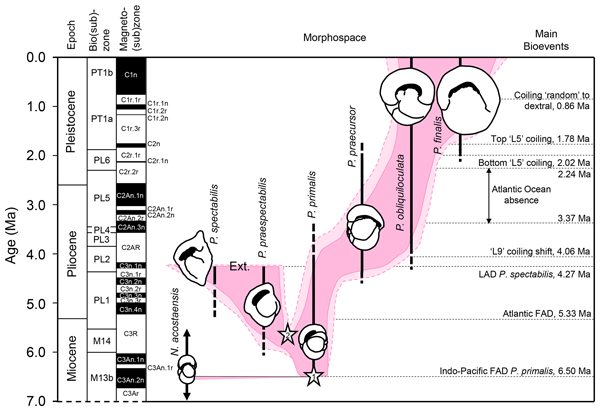
Pearson, P. N., Young, J., King, D. J., and Wade, B. S.: Biochronology and evolution of
Pulleniatina (planktonic foraminifera), J. Micropalaeontol., 42, 211–255, https://doi.org/10.5194/jm-42-211-2023, 2023.
Rabosky, D. L. and Sorhannus, U.: Diversity dynamics of marine planktonic diatoms across the Cenozoic, Nature, 457, 183–187, https://doi.org/10.1038/nature07435, 2009.
Reichstein, M., Camps-Valls, G., Stevens, B., Jung, M., Denzler, J., Carvalhais, N., and Prabhat: Deep learning and process understanding for data-driven Earth system science, Nature, 566, 195–204, https://doi.org/10.1038/s41586-019-0912-1, 2019.
Renaudie, J., Lazarus, D. B., and Diver, P.: NSB (Neptune Sandbox Berlin): An expanded and improved database of marin
e planktonic nannofossil data and deep-sea stratigraphy, Palaeontol. Electron., 23, a11, https://doi.org/10.26879/1032, 2020.
Seton, M., Müller, R. D., Zahirovic, S., Gaina, C., Torsvik, T., Shephard, G., Talsma, A., Gurnis, M., Turner, M., Maus, S., and Chandler, M.: Global continental and ocean basin reconstructions since 200 Ma, Earth Sci. Rev., 113, 212–270, https://doi.org/10.1016/j.earscirev.2012.03.002, 2012.
Street, C.: Palaeobiogeography of early Cretaceous calcareous nannoplankton, PhD thesis, University College London, 1–405,
https://discovery.ucl.ac.uk/id/eprint/1317754/ (last access: 8 February 2026), 1999.
Street, C. and Bown, P. R.: Palaeobiogeography of Early Cretaceous (Berriasian–Barremian) calcareous nannoplankton, Mar. Micropaleontol., 39, 265–291, https://doi.org/10.1016/S0377-8398(00)00024-4, 2000.
Spencer-Cervato, C.: The Cenozoic deep sea microfossil record: Explorations of the DSDP/ODP sample set using the NEPTUNE database, Palaeontol. Electron., 2, a13, https://doi.org/10.26879/99013, 1999.
Woodhouse, A., Swain, A., Fagan, W. F., Fraass, A. J., and Lowery, C. M.: Late Cenozoic cooling restructured global marine plankton communities, Nature, 614, 713–720, https://doi.org/10.1038/s41586-023-05694-5, 2023.
Young, J. R.: Best practices for preserving and reporting stratigraphical data: cyber infrastructure for stratigraphical data and information, in: Deciphering Earth's History: the Practice of Stratigraphy, edited by: Coe, A. L., The Geological Society, London, 277–292, https://doi.org/10.1144/GIP1-2022-28, 2022.
Young, J. R., Bown, P. R., Wade, B. S., Pedder, B. E., Huber, B. T., and Lazarus, D. B.: Mikrotax: developing a genuinely effective platform for palaeontological geoinformatics, Acta Geol. Sin.-Engl., 93, 70–72, https://doi.org/10.1111/1755-6724.14249, 2019.