
Articles | Volume 45, issue 1
https://doi.org/10.5194/jm-45-219-2026
© Author(s) 2026. This work is distributed under
the Creative Commons Attribution 4.0 License.
the Creative Commons Attribution 4.0 License.
https://doi.org/10.5194/jm-45-219-2026
© Author(s) 2026. This work is distributed under
the Creative Commons Attribution 4.0 License.
the Creative Commons Attribution 4.0 License.
Research article
| 
02 Apr 2026
Research article |
| 02 Apr 2026
| 02 Apr 2026
Marine palynology of the Alano di Piave Bartonian–Priabonian Global Stratotype Section and Point, NE Italy
Alexander J. P. Houben
CORRESPONDING AUTHOR
Geological Survey of the Netherlands TNO, Princetonlaan 6, 3584 CB, Utrecht, the Netherlands
Alina I. Iakovleva
Geological Institute, Russian Academy of Sciences, Pyzhevsky pereulok 7, Moscow, 119017, Russian Federation
Simone Galeotti
Dipartimento di Scienze Pure e Applicate, Università degli Studi di Urbino Carlo Bo, Campus Scientifico “E. Mattei”, 61029 Urbino, Italy
Henk Brinkhuis
Department of Ocean Systems research (OCS), NIOZ Royal Netherlands Institute for Sea Research, PO Box 1790 AB Den Burg, the Netherlands
Department of Earth Sciences, Marine Palynology and Paleoceanography, Laboratory of Palaeobotany and Palynology, Faculty of Geosciences, Utrecht University, Princetonlaan 8a, 3584 CB Utrecht, the Netherlands
Related authors
No articles found.
Mei Nelissen, Appy Sluijs, Debra A. Willard, and Henk Brinkhuis
J. Micropalaeontol., 44, 431–467, https://doi.org/10.5194/jm-44-431-2025, https://doi.org/10.5194/jm-44-431-2025, 2025
Short summary
Short summary
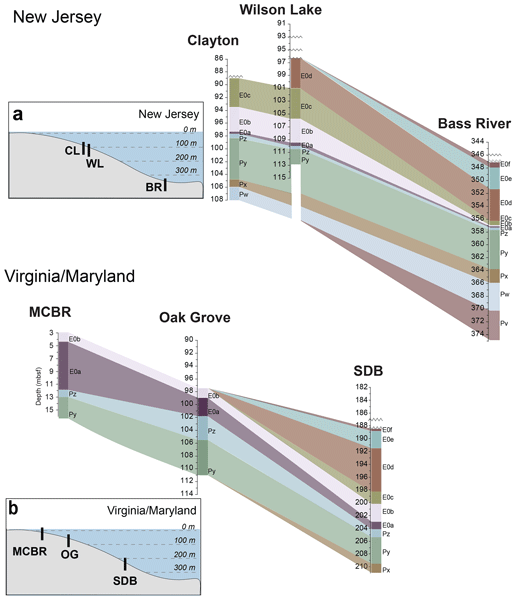
We studied a short-lived episode of major warming ~56 million years ago, often seen as a past analogue for modern climate change. We developed a scheme to correlate biological signals from this warming period across six sediment cores from the US East Coast. Based on the occurrences and distribution of organic remains of planktonic microfossils, we can correlate events in time, allowing detailed reconstructions of how climate and environments changed regionally during this extreme warming.
Mustafa Yücel Kaya, Henk Brinkhuis, Chiara Fioroni, Serdar Görkem Atasoy, Alexis Licht, Dirk Nürnberg, and Taylan Vural
Clim. Past, 21, 1405–1429, https://doi.org/10.5194/cp-21-1405-2025, https://doi.org/10.5194/cp-21-1405-2025, 2025
Short summary
Short summary
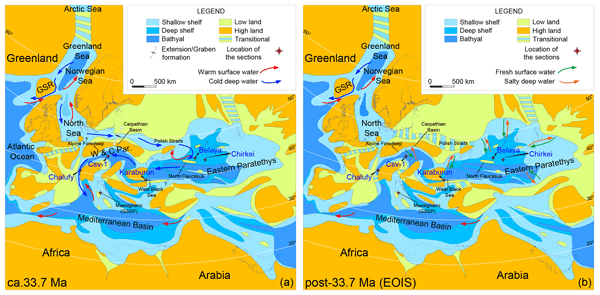
The Eocene–Oligocene Transition (EOT) marked global cooling and Antarctic glaciation, but its impact on marginal seas is less known. This study analyzes the Karaburun section in the eastern Paratethys, using biostratigraphy and geochemistry to reveal boreal water ingress due to Arctic–Atlantic gateway closure. Findings highlight the interplay of global and regional climate dynamics in shaping marginal marine environments.
Frida S. Hoem, Karlijn van den Broek, Adrián López-Quirós, Suzanna H. A. van de Lagemaat, Steve M. Bohaty, Claus-Dieter Hillenbrand, Robert D. Larter, Tim E. van Peer, Henk Brinkhuis, Francesca Sangiorgi, and Peter K. Bijl
J. Micropalaeontol., 43, 497–517, https://doi.org/10.5194/jm-43-497-2024, https://doi.org/10.5194/jm-43-497-2024, 2024
Short summary
Short summary
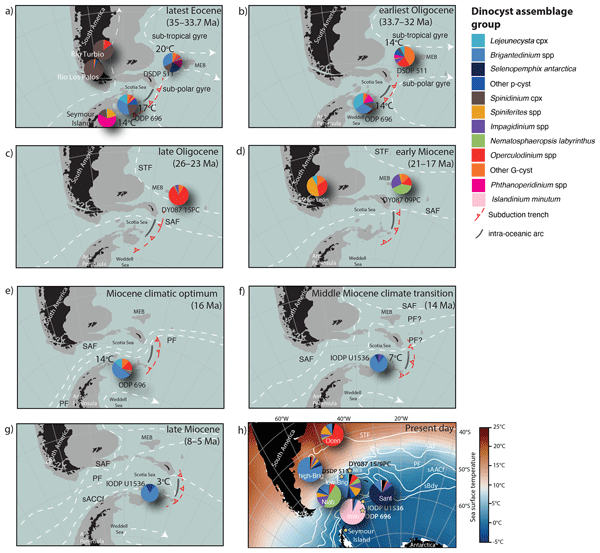
The timing and impact of onset of Antarctic Circumpolar Current (ACC) on climate and Antarctic ice are unclear. We reconstruct late Eocene to Miocene southern Atlantic surface ocean environment using microfossil remains of dinoflagellates (dinocysts). Our dinocyst records shows the breakdown of subpolar gyres in the late Oligocene and the transition into a modern-like oceanographic regime with ACC flow, established frontal systems, Antarctic proximal cooling, and sea ice by the late Miocene.
Appy Sluijs and Henk Brinkhuis
J. Micropalaeontol., 43, 441–474, https://doi.org/10.5194/jm-43-441-2024, https://doi.org/10.5194/jm-43-441-2024, 2024
Short summary
Short summary
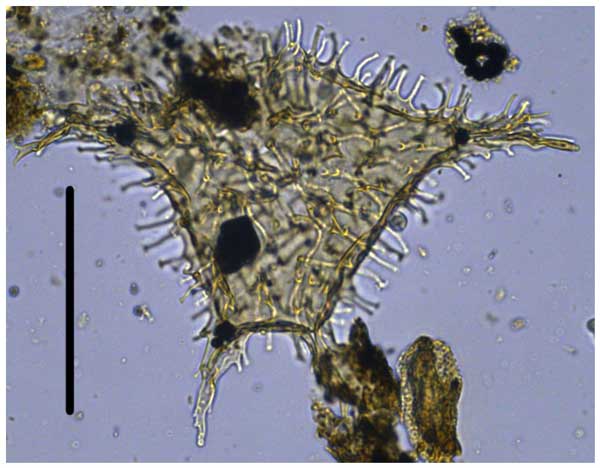
We present intrinsic details of dinocyst taxa and assemblages from the sole available central Arctic late Paleocene–early Eocene sedimentary succession recovered at the central Lomonosov Ridge by the Integrated Ocean Drilling Program (IODP) Expedition 302. We develop a pragmatic taxonomic framework, document critical biostratigraphic events, and propose two new genera and seven new species.

Peter K. Bijl and Henk Brinkhuis
J. Micropalaeontol., 42, 309–314, https://doi.org/10.5194/jm-42-309-2023, https://doi.org/10.5194/jm-42-309-2023, 2023
Short summary
Short summary
We developed an online, open-access database for taxonomic descriptions, stratigraphic information and images of organic-walled dinoflagellate cyst species. With this new resource for applied and academic research, teaching and training, we open up organic-walled dinoflagellate cysts for the academic era of open science. We expect that palsys.org represents a starting point to improve taxonomic concepts, and we invite the community to contribute.
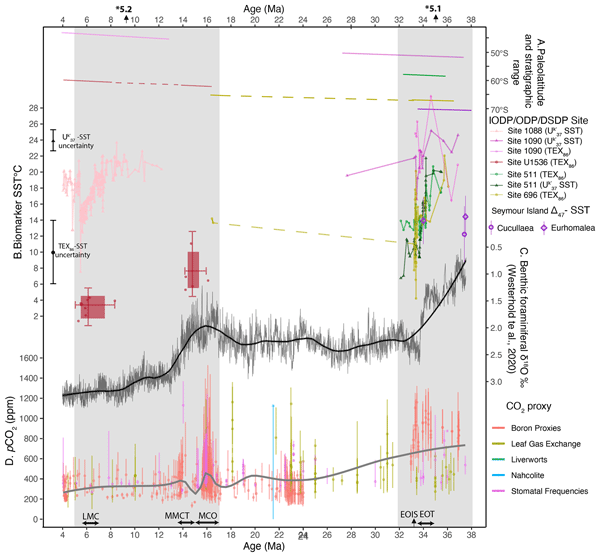
Frida S. Hoem, Adrián López-Quirós, Suzanna van de Lagemaat, Johan Etourneau, Marie-Alexandrine Sicre, Carlota Escutia, Henk Brinkhuis, Francien Peterse, Francesca Sangiorgi, and Peter K. Bijl
Clim. Past, 19, 1931–1949, https://doi.org/10.5194/cp-19-1931-2023, https://doi.org/10.5194/cp-19-1931-2023, 2023
Short summary
Short summary
We present two new sea surface temperature (SST) records in comparison with available SST records to reconstruct South Atlantic paleoceanographic evolution. Our results show a low SST gradient in the Eocene–early Oligocene due to the persistent gyral circulation. A higher SST gradient in the Middle–Late Miocene infers a stronger circumpolar current. The southern South Atlantic was the coldest region in the Southern Ocean and likely the main deep-water formation location in the Middle Miocene.
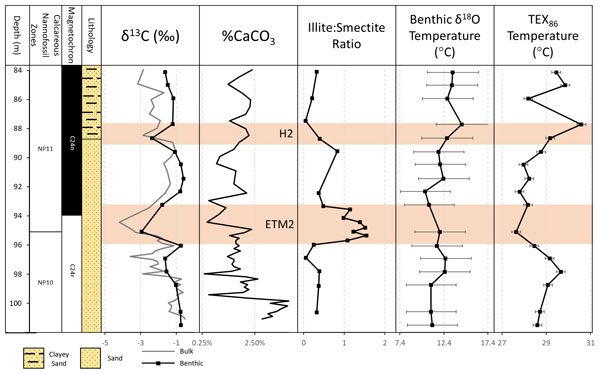
William Rush, Jean Self-Trail, Yang Zhang, Appy Sluijs, Henk Brinkhuis, James Zachos, James G. Ogg, and Marci Robinson
Clim. Past, 19, 1677–1698, https://doi.org/10.5194/cp-19-1677-2023, https://doi.org/10.5194/cp-19-1677-2023, 2023
Short summary
Short summary
The Eocene contains several brief warming periods referred to as hyperthermals. Studying these events and how they varied between locations can help provide insight into our future warmer world. This study provides a characterization of two of these events in the mid-Atlantic region of the USA. The records of climate that we measured demonstrate significant changes during this time period, but the type and timing of these changes highlight the complexity of climatic changes.
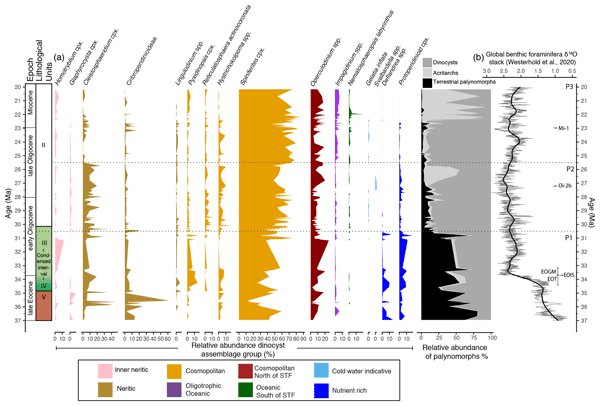
Frida S. Hoem, Isabel Sauermilch, Suning Hou, Henk Brinkhuis, Francesca Sangiorgi, and Peter K. Bijl
J. Micropalaeontol., 40, 175–193, https://doi.org/10.5194/jm-40-175-2021, https://doi.org/10.5194/jm-40-175-2021, 2021
Short summary
Short summary
We use marine microfossil (dinocyst) assemblage data as well as seismic and tectonic investigations to reconstruct the oceanographic history south of Australia 37–20 Ma as the Tasmanian Gateway widens and deepens. Our results show stable conditions with typically warmer dinocysts south of Australia, which contrasts with the colder dinocysts closer to Antarctica, indicating the establishment of modern oceanographic conditions with a strong Southern Ocean temperature gradient and frontal systems.
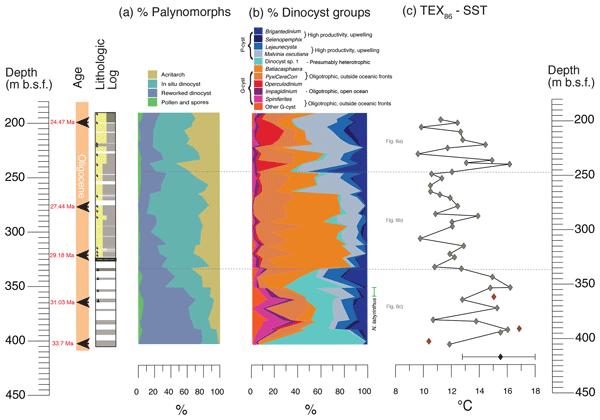
Frida S. Hoem, Luis Valero, Dimitris Evangelinos, Carlota Escutia, Bella Duncan, Robert M. McKay, Henk Brinkhuis, Francesca Sangiorgi, and Peter K. Bijl
Clim. Past, 17, 1423–1442, https://doi.org/10.5194/cp-17-1423-2021, https://doi.org/10.5194/cp-17-1423-2021, 2021
Short summary
Short summary
We present new offshore palaeoceanographic reconstructions for the Oligocene (33.7–24.4 Ma) in the Ross Sea, Antarctica. Our study of dinoflagellate cysts and lipid biomarkers indicates warm-temperate sea surface conditions. We posit that warm surface-ocean conditions near the continental shelf during the Oligocene promoted increased precipitation and heat delivery towards Antarctica that led to dynamic terrestrial ice sheet volumes in the warmer climate state of the Oligocene.
Cited articles
Abbink, O. A., Van Konijnenburg-Van Cittert, J. H. A., and Visscher, H.: A sporomorph ecogroup model for the Northwest European Jurassic-Lower Cretaceous: concepts and framework, Netherlands Journal of Geosciences, 83, 17–31, 2004.
Agelopoulos, J.: Hystrichostrogylon membraniphorum n.g. n.sp. aus dem Heiligenhafener Kieselton (Eozän), Neues Jahrbuch für Geologie und Paläontologie, Monatshefte, 11, 673–675, 1964.
Agnini, C., Fornaciari, E., Raffi, I., Catanzariti, R., Pälike, H., Backman, J., and Rio, D.: Integrated biomagnetostratigraphy of the Alano section (NE Italy): a proposal for defining the Middle-Late Eocene boundary. Geological Society of America Bulletin, 123, 841–872, https://doi.org/10.1130/B30432.1, 2011.
Agnini, C., Backman, J., Fornaciari, E., Galeotti, S., Giusberti, L., Grandesso, P., Lanci, L., Rio, D., and Stefani, C.: The Alano section: the candidate GSSP for the Priabonian stage, in: First International Congress on Stratigraphy At the Cutting Edge of Stratigraphy, edited by: Rocha, R., Pais, J., Kullberg, J. C., and Finney, S., Strati 2013, Springer International Publishing, Cham, 55–59, 2014.
Agnini, C., Muttoni, G., Giusberti, L., Fornaciari, E., Rio, D., Spofforth, D. J. A., Pälike, H., Backman, J., Condon, D. J., Lanci, L., and Stefani, C.: Proposal for the global boundary stratotype section and point (GSSP) for the Priabonian stage (Eocene) at the Alano section (Italy), Episodes Journal of International Geoscience, 44, 151–173, https://doi.org/10.18814/epiiugs/2020/020074, 2021.
Alberti, G.: Zur Kenntnis Mesozoischer und Alttertiärer Dinoflagellaten und Hystrichosphaerideen von Nord- und Mitteldeutschland sowie einigen anderen Europäischen Gebieten, Palaeontographica, Abteilung A, 116, 1–58, 1961.
Bati, Z.: Dinoflagellate cyst biostratigraphy of the upper Eocene and lower Oligocene of the Kirmizitepe Section, Azerbaijan, South Caspian Basin, Review of Palaeobotany and Palynology, 217, 9–38, https://doi.org/10.1016/j.revpalbo.2015.02.001, 2015.
Benedek, P. N.: Phytoplanktonten aus dem Mittel- und Oberoligozän von Tönisberg (Niederrheingebiet), Palaeontographica, Abteilung B, 137, 1–71, 1972.
Bijl, P. K.: DINOSTRAT: a global database of the stratigraphic and paleolatitudinal distribution of Mesozoic–Cenozoic organic-walled dinoflagellate cysts, Earth System Science Data, 14, 579–617, https://doi.org/10.5194/essd-14-579-2022, 2022.
Bijl, P. K., Brinkhuis, H., Egger, L. M., Eldrett, J. S., Frieling, J., Grothe, A., Houben, A. J. P., Pross, J., Śliwińska, K. K., and Sluijs, A.: Comment on “Wetzeliella” and its allies – the “hole” story: a taxonomic revision of the Paleogene dinoflagellate subfamily Wetzelielloideae' by Williams et al. (2015), Palynology, 42, 66–72, https://doi.org/10.1080/01916122.2017.1283367, 2017.
Bohaty, S. M. and Zachos, J. C.: Significant Southern Ocean warming event in the late middle Eocene, Geology, 31, 1017–1020, https://doi.org/10.1130/G19800.1, 2003.
Bohaty, S. M., Zachos, J. C., Florindo, F.. and Delaney, M. L.: Coupled greenhouse warming and deep-sea acidification in the middle Eocene, Paleoceanography, 24, https://doi.org/10.1029/2008PA001676, 2009.
Bosellini, A.: Dynamics of Tethyan carbonate platforms, in: Controls on Carbonate Platform and Basin Development, edited by: Crevello, P. D., Wilson, J. L., Sarg, J. F., and Read, J. F., SEPM Special Publication 44, Society for Sedimentary Geology, Tulsa, 1989.
Brinkhuis, H.: Late Paleogene dinoflagellate cysts with special reference to the Eocene/Oligocene boundary, in: Eocene–Oligocene Climatic and Biotic Evolution, edited by: Prothero, D. R. and Berggren, W. A., Princeton University Press, Princeton, 327–340, 1992.
Brinkhuis, H.: Late Eocene to Early Oligocene dinoflagellate cysts from the Priabonian type-area (Northeast Italy): biostratigraphy and paleoenvironmental interpretation, Palaeogeography, Palaeoclimatology, Palaeoecology, 107, 121–163, 1994.
Brinkhuis, H. and Biffi, U.: Dinoflagellate cyst stratigraphy of the Eocene/Oligocene transition in central Italy, Marine Micropaleontology, 22, 131–183, 1993.
Brinkhuis, H., Fioroni, C., and Kaya, M. Y.: There and back again; on dinoflagellate cyst “index events'; of the Eocene Oligocene Transition in the (Para) Tethyan Realm, Review of Palaeobotany and Palynology, 343, 105414, https://doi.org/10.1016/j.revpalbo.2025.105414, 2025.
Brosius, M.: Plankton aus dem nordhessischen Kasseler Meeressand (Oberoligozän), Zeitschrift der Deutschen Geologischen Gesellschaft, 114, 32–56, 1963.
Bujak, J. P.: An evolutionary series of Late Eocene dinoflagellate cysts from southern England, Mar. Micropaleontol., 1, 101–117, https://doi.org/10.1016/0377-8398(76)90007-4, 1976.
Bujak, J. P.: Dinoflagellate cysts and acritarchs from the Eocene Barton Beds of southern England, in: Dinoflagellate cysts and acritarchs from the Eocene of southern England, edited by: Bujak, J. P., Downie, C., Eaton, G. L., and Williams, G. L., Special Papers in Palaeontology, 24, 36–91, 1980.
Bujak, J. P.: Cenozoic dinoflagellate cysts and acritarchs from the Bering Sea and northern North Pacific, D.S.D.P. Leg 19, Micropaleontology, 30, 180–212, 1984.
Bujak, J. P.: New dinocyst taxa from the Eocene of the North Sea, Journal of Micropalaeontology, 13, 119–131, 1994.
Bujak, J. P. and Matsuoka, K.: Taxonomic reallocation of Cenozoic dinoflagellate cysts from Japan and the Bering Sea, Palynology, 10, 235–241, 1986.
Bütschli, O.: Erster Band. Protozoa, in: Dr. H.G. Bronn's Klassen und Ordnungen des Thier-Reichs, wissenschaftlich dargestellt in Wort und Bild, C.F. Winter'sche Verlagsbuchhandlung, Leipzig and Heidelberg, 865–1088, 1885.
Châteauneuf, J.-J. and Gruas-Cavagnetto, C.: Les zones de Wetzeliellaceae (Dinophyceae) du bassin de Paris. Comparaison et corrélations avec les zones du Paléogène des bassins du nord-ouest de l'Europe, Bulletin du Bureau des recherches géologiques et minières, 2, 59–93, 1978.
Cookson, I. C.: Cretaceous and Tertiary microplankton from south-eastern Australia, Proceedings of the Royal Society of Victoria, 78, 85–93, 1965.
Cookson, I. C. and Eisenack, A.: Tertiary microplankton from the Rottnest Island Bore, Western Australia, Journal of the Royal Society of Western Australia, 44, 39–47, 1961.
Cookson, I. C. and Eisenack, A.: Microplankton from the Browns Creek Clays, sw. Victoria, Proceedings of the Royal Society of Victoria, 79, 119–131, 1965.
Cookson, I. C. and Eisenack, A.: Some microplankton from the Paleocene Rivernook Bed, Victoria, Proceedings of the Royal Society of Victoria, 80, 247–257, 1967.
Costa, L. I. and Downie, C.: The Wetzeliellaceae; Palaeogene dinoflagellates, in: Proceedings of the 4th International Palynological Conference, Lucknow (1976–77), v.2, 34–46, 1979.
Cramwinckel, M. J., Coxall, H. K., Śliwińska, K. K., Polling, M., Harper, D. T., Bijl, P. K., Reichart, G.-J., Schouten, S., and Sluijs, A.: A warm, stratified, and restricted Labrador Sea across the Middle Eocene and its climatic optimum, Paleoceanography and Paleoclimatology, 35, https://doi.org/10.1029/2020PA003932, 2020.
Damassa, S. P.: Eocene dinoflagellates from the Coastal Belt of the Franciscan Complex, northern California, Journal of Paleontology, 53, 815–840, 1979.
Davey, R. J. and Williams, G. L.: IV. The genera Hystrichosphaera and Achomosphaera, in: Studies on Mesozoic and Cainozoic dinoflagellate cysts, edited by: Davey, R. J., Downie, C., Sarjeant, W. A. S., and Williams, G. L., British Museum (Natural History) Geology, Bulletin, Supplement 3, 28–52, 1966.
Deflandre, G. and Cookson, I. C.: Fossil microplankton from Australian Late Mesozoic and Tertiary sediments, Australian Journal of Marine and Freshwater Research, 6, 242–313, 1955.
Drugg, W. S.: Some new genera, species, and combinations of phytoplankton from the Lower Tertiary of the Gulf Coast, U.S.A., Proceedings of the North American Paleontological Convention, Chicago, September 1969, Part G, 809–843, 1970.
Drugg, W. S. and Loeblich, A. R. Jr.: Some Eocene and Oligocene phytoplankton from the Gulf Coast, U.S.A., Tulane Studies in Geology, 5, 181–194, 1967.
Eaton, G. L.: A morphogenetic series of dinoflagellate cysts from the Bracklesham Beds of the Isle of Wight, Hampshire, England, in: Proceedings of the 2nd Planktonic Conference, Rome, 1970, edited by: Farinacci, A., Edizioni Tecnoscienza, Rome, 355–379, 1971.
Eaton, G. L.: Dinoflagellate cysts from the Bracklesham Beds (Eocene) of the Isle of Wight, southern England, British Museum (Natural History) Geology, Bulletin, 26, 227–332, 1976.
Edwards, L. E.: Biostratigraphically important species of Pentadinium Gerlach 1961 and a likely ancestor, Hafniasphaera goodmanii n. sp. and from the Eocene of the Atlantic and Gulf coastal plains, Palynology, 6, 105–117, https://doi.org/10.1080/01916122.1982.9989237, 1982.
Edwards, L. E.: Dinocyst biostratigraphy of Tertiary sediments from five cores from Screven and Burke counties, Georgia, in: Geology and paleontology of five cores from Screven and Burke counties, eastern Georgia, edited by: Edwards, L. E., United States Geological Survey Professional Paper, 1603, G1–G25, https://doi.org/10.3133/pp1603G, 2001.
Ehrenberg, C. G.: Über das Massenverhältniss der jetzt lebenden Kiesel-Infusorien und über ein neues Infusorien-Conglomerat als Polirschiefer von Jastraba in Ungarn, Abhandlungen der Königlichen Akademie der Wissenschaften zu Berlin, Physikalische Klasse, 109–135, 1837.
Eisenack, A.: Die Phosphoritknollen der Bernsteinformation als Überlieferer tertiären Planktons, Schriften der Physikalisch-Ökonomischen Gesellschaft zu Königsberg, 70, 181–188, 1938.
Eisenack, A.: Mikrofossilien aus Phosphoriten des samländischen Unteroligozäns und über die Einheitlichkeit der Hystrichosphaerideen, Palaeontographica, Abteilung A, 105, 49–95, 1954.
Eisenack, A.: Kritische Bemerkungen und Richtigstellungen im Gebiet der fossilen Dinoflagellaten und Acritarchen, Neues Jahrbuch für Geologie und Paläontologie, Abhandlungen, 134, 101–116, 1969.
Eisenack, A. and Gocht, H.: Neue Namen für einige Hystrichosphären der Bernsteinformation Ostpreussens, Neues Jahrbuch für Geologie und Paläontologie, Monatshefte, 11, 511–518, 1960.
Eisenack, A. and Kjellström, G.: Katalog der Fossilen Dinoflagellaten, Hystrichosphären und Verwandten Mikrofossilien. Band I. Dinoflagellaten. 2. Ergänzungslieferung, E. Schweizerbart'sche Verlagsbuchhandlung, Stuttgart, 215 pp., 1971.
Fensome, R. A., Taylor, F. J. R., Norris, G., Sarjeant, W. A. S., Wharton, D. I., and Williams, G. L.: A classification of fossil and living dinoflagellates, Micropaleontology Press Special Paper, 7, 351 pp., 1993.
Fensome, R. A., Williams, G. L., and MacRae, R. A.: Late Cretaceous and Cenozoic fossil dinoflagellates and other palynomorphs from the Scotian Margin, offshore eastern Canada, Journal of Systematic Palaeontology, 7, 1–79, https://doi.org/10.1017/S147720190800262X, 2009.
Fensome, R. A., Williams, G. L., and MacRae, R. A.: The Lentin and Williams index of fossil dinoflagellates edition 2019, American Association of Stratigraphic Palynologists Contribution Series 50, 1173, https://palynologyshop.org/product/the-lentin-and-williams-index-of-fossil-dinoflagellates-2019 (last access: 10 March 2026), 2019.
Fokkema, C. D., Buijs, S., Bialik, O. M., Meilijson, A., Waldmann, N. D., Makovsky, Y., and Sluijs, A.: Late Paleocene to middle Eocene carbon isotope stratigraphy of the Northern Negev, Southern Israel: potential for paleoclimate reconstructions, Newsletters on Stratigraphy, 55, 361–384, https://doi.org/10.1127/nos/2022/0684, 2022.
Frieling, J. and Sluijs, A.: Towards quantitative environmental reconstructions from ancient non-analogue microfossil assemblages: Ecological preferences of Paleocene–Eocene dinoflagellates, Earth-Science Reviews, 185, 956–973, https://doi.org/10.1016/j.earscirev.2018.08.014, 2018.
Galazzo, F. B., Giusberti, L., Luciani, V., and Thomas, E.: Paleoenvironmental changes during the Middle Eocene Climatic Optimum (MECO) and its aftermath: The benthic foraminiferal record from the Alano section (NE Italy), Palaeogeography, Palaeoclimatology, Palaeoecology, 378, 22–35, https://doi.org/10.1016/j.palaeo.2013.03.018, 2013.
Galeotti, S., Sahy, D., Agnini, C., Condon, D., Fornaciari, E., Francescone, F., Giusberti, L., Guasti, E., Jutson, D., Lanci, L., Pälike, H., Spofforth, D. J. A., and Rio, D.: Astrochronology and radio-isotopic dating of the Alano di Piave section (NE Italy), candidate GSSP for the Priabonian Stage (late Eocene), Earth and Planetary Science Letters, 525, 115746, https://doi.org/10.1016/j.epsl.2019.115746, 2019.
Gedl, P.: Dinoflagellate cyst record of the deep-sea Cretaceous–Tertiary boundary at Uzgruň, Carpathian Mountains, Czech Republic, Studia Geologica Polonica, 123, 243–267, 2004a.
Gedl, P.: Dinoflagellate cyst record of the Eocene–Oligocene boundary succession in flysch deposits at Leluchów, Carpathian Mountains, Poland, Geologica Carpathica, 55, 203–219, 2004b.
Gedl, P.: Late Eocene-early Oligocene organic-walled dinoflagellate cysts from Folusz, Magura Nappe, Polish Carpathians, Acta Palaeobotanica, 45, 27–81, 2005.
Gerlach, E.: Mikrofossilien aus dem Oligozän und Miozän Nordwestdeutschlands, unter besonderer Berücksichtigung der Hystrichosphaeren und Dinoflagellaten, Neues Jahrbuch für Geologie und Paläontologie, Abhandlungen, 112, 143–228, 1961.
Gocht, H.: Rhombodinium und Dracodinium, zwei neue Dinoflagellaten-Gattungen aus dem norddeutschen Tertiär, Neues Jahrbuch für Geologie und Paläontologie, Monatshefte, 2, 84–92, 1955.
Haiblen, A. M., Opdyke, B. N., Roberts, A. P., Heslop, D., and Wilson, P. A.: Midlatitude southern hemisphere temperature change at the end of the Eocene greenhouse shortly before dawn of the Oligocene icehouse, Paleoceanography and Paleoclimatology, 34, 1995–2004, https://doi.org/10.1029/2019PA003679, 2019.
Head, M. J.: Last Interglacial (Eemian) hydrographic conditions in the southwestern Baltic Sea based on dinoflagellate cysts from Ristinge Klint, Denmark, Geological Magazine, 144, 987–1013, https://doi.org/10.1017/S0016756807003780, 2007.
Heilmann-Clausen, C. and van Simaeys, S.: Dinoflagellate cysts from the Middle Eocene to ?lowermost Oligocene succession in the Kysing Research Borehole, central Danish Basin, Palynology, 29, 143–204, https://doi.org/10.2113/29.1.143, 2005.
Houben, A. J. P., van Mourik, C. A., Montanari, A., Coccioni, R., and Brinkhuis, H.: The Eocene–Oligocene transition: Changes in sea level, temperature or both?, Palaeogeography, Palaeoclimatology, Palaeoecology, 335–336, 75–83, https://doi.org/10.1016/j.palaeo.2011.04.008, 2012.
Houben, A. J. P., Quaijtaal, W., Wade, B. S., Schouten, S., and Brinkhuis, H.: Quantitative organic-walled dinoflagellate cyst stratigraphy across the Eocene-Oligocene transition in the Gulf of Mexico: A record of climate and sea level change during the onset of Antarctic glaciation, Newsletters on Stratigraphy, 52, 131–154, https://doi.org/10.1127/nos/2018/0455, 2019.
Houben, A., Brinkhuis, H., Iakovleva, A., and Galeotti, S.: Supplement to “Marine palynology of the Alano di Piave Bartonian–Priabonian Global Stratotype Section and Point, NE Italy”, Zenodo [data set], https://doi.org/10.5281/zenodo.19338992, 2026.
Iakovleva, A. I.: Organic walled dinoflagellate cyst biostratigraphy of the Bartonian/Priabonian GSSP Alano di Piave section, NE Italy, Review of Palaeobotany and Palynology, 332, https://doi.org/10.1016/j.revpalbo.2024.105233, 2025.
Iakovleva, A. I., Shcherbinina, E. A., Muzylev, N. G., and Aleksandrova, G. N.: Middle–Late Eocene Dinocysts from the Aktumsuk Section (Ustyurt Plateau, Uzbekistan): Biostratigraphy and Paleoenvironments, Stratigraphy and Geological Correlation, 27, 682–706, https://doi.org/10.1134/S0869593819060078, 2019.
Iakovleva, A. I., Waga, D. D., Andreeva-Grigorovich, A. S., and Radionova, E. P.: New palynological data from the middle Eocene deposits of the Kheu reference section (Kabardino-Balkaria, North Caucasus), Stratigraphy and Geological Correlation, 28, 88–106, https://doi.org/10.1134/S0869593820010062, 2020.
Iakovleva, A. I., Zakrevskaya, E. Y., and Shcherbinina, E. A.: Middle Eocene to earliest Oligocene dinoflagellate cysts from southern Armenia: biostratigraphy and palaeoecology, Palynology, 48, https://doi.org/10.1080/01916122.2024.2343902, 2024.
Islam, M. A.: Dinoflagellate cysts from the Eocene of the London and the Hampshire basins, southern England, Palynology, 7, 71–92, 1983.
Jan du Chêne, R. and Châteauneuf, J.-J.: Nouvelles espèces de Wetzeliella et Deflandrea (Pyrrhophyta, Dinophyceae) de l'Eocène des Alpes occidentales, Revue de Micropaléontologie, 18, 28–37, 1975.
Jenkyns, H. C.: Geochemistry of oceanic anoxic events, Geochemistry, Geophysics, Geosystems, 11, https://doi.org/10.1029/2009GC002788, 2010.
Kaya, M. Y., Brinkhuis, H., Fioroni, C., Atasoy, S. G., Licht, A., Nürnberg, D., and Vural, T.: The Eocene–Oligocene Transition in the Paratethys: boreal water ingression and its paleoceanographic implications, Climate of the Past, 21, 1405–1429, https://doi.org/10.5194/cp-21-1405-2025, 2025.
Klumpp, B.: Beitrag zur Kenntnis der Mikrofossilien des mittleren und oberen Eozän, Palaeontographica, Abteilung A, 103, 377–406, 1953.
Lentin, J. K. and Vozzhennikova, T. F.: The fossil dinoflagellate cysts Kisselovia emend. and Charlesdowniea gen. nov., Review of Palaeobotany and Palynology, 58, 215–229, https://doi.org/10.1016/0034-6667(89)90087-0, 1989.
Lentin, J. K. and Williams, G. L.: Fossil dinoflagellates: index to genera and species, Geological Survey of Canada, Paper 73-42, 176 pp., 1973.
Lentin, J. K. and Williams, G. L.: A monograph of fossil peridinioid dinoflagellate cysts, Bedford Institute of Oceanography, Report Series, BI-R-75-16, 237 pp., 1976.
Lentin, J. K. and Williams, G. L.: Fossil dinoflagellates: index to genera and species, 1977 edn., Bedford Institute of Oceanography, Report Series, BI-R-77-8, 209 pp., 1977.
Lentin, J. K. and Williams, G. L.: Fossil dinoflagellates: index to genera and species, 1981 edn., Bedford Institute of Oceanography, Report Series, BI-R-81-12, 345 pp., 1981.
Lentin, J. K. and Williams, G. L.: Fossil dinoflagellates: index to genera and species, 1985 edn., Canadian Technical Report of Hydrography and Ocean Sciences, 60, 451 pp., 1985.
Lentin, J. K. and Williams, G. L.: Fossil dinoflagellates: index to genera and species, 1989 edn., American Association of Stratigraphic Palynologists, Contributions Series, 20, 473 pp., 1989.
Liengjarern, M., Costa, L., and Downie, C.: Dinoflagellate cysts from the Upper Eocene-Lower Oligocene of the Isle of Wight, Palaeontology, 23, 475–499, 1980.
Lindemann, E.: Abteilung Peridineae (Dinoflagellatae), in: Die Natürlichen Pflanzenfamilien nebst ihren Gattungen und wichtigeren Arten insbesondere den Nutzpflanzen, edited by: Engler, A. and Prantl, K., Wilhelm Engelmann, Leipzig, 2, 3–104, 1928.
Lucas-Clark, J. and Helenes, J.: Ynezidinium, a new genus within the Gonyaulacaceae (fossil Dinophyceae), J. Micropalaeontol., 19, 113–121, https://doi.org/10.1144/jm.19.2.113, 2000.
Luciani, V., Giusberti, L., Agnini, C., Fornaciari, E., Rio, D., Spofforth, D. J. A., and Pälike, H.: Ecological and evolutionary response of Tethyan planktonic foraminifera to the middle Eocene climatic optimum (MECO) from the Alano section (NE Italy). Palaeogeography, Palaeoclimatology, Palaeoecology, 292, 82–95, https://doi.org/10.1016/j.palaeo.2010.03.029, 2010.
Mann, M. E. and Lees, J. M.: Robust estimation of background noise and signal detection in climatic time series, Climatic Change, 33, 409–445, https://doi.org/10.1007/BF00142586, 1996.
Marret, F. and De Vernal, A.: Dinoflagellate cysts as proxies of environmental, ocean and climate changes in the Atlantic realm during the quaternary, Frontiers in Ecology and Evolution, 12, 1378931, https://doi.org/10.3389/fevo.2024.1378931, 2024.
Menéndez, C. A.: Microplancton fósil de sedimentos Terciarios y Cretácicos del norte de Tierra del Fuego (Argentina), Ameghiniana, 4, 7–15, 1965.
Michoux, D.: Palynostratigraphie de l'Éocène de Montfort-en-Chalosse (Landes, France), Revue de Micropaléontologie, 28, 138–153, 1985.
Morgenroth, P.: Neue in organischer Substanz erhaltene Mikrofossilien des Oligozäns, Neues Jahrbuch für Geologie und Paläontologie, Abhandlungen, 127, 1–12, 1966.
Oreshkina, T. V., Iakovleva, A. I., and Shcherbinina, E. A.: Micropaleontological analysis of Eocene sediments from eastern pre-Caspian region (Borehole no. 57, Shubarsay Mould, Kazachstan), Bulletin of the Moscow Society of Naturalists, Geological Series, 90, 42–80, 2015.
Pascher, A.: Über Flagellaten und Algen, Deutsche Botanische Gesellschaft, Berichte, 32, 136–160, 1914.
Pross, J. and Brinkhuis, H.: Organic-walled dinoflagellate cysts as paleoenvironmental indicators in the Paleogene; a synopsis of concepts, Paläontologische Zeitschrift, 79, 53–59, https://doi.org/10.1007/BF03021753, 2005.
Rossignol, M.: Hystrichosphères du Quaternaire en Méditerranée orientale, dans les sédiments Pléistocènes et les boues marines actuelles, Revue de micropaléontologie, 7, 83–99, 1964.
Sancay, R. H. and Bati, Z.: Late Eocene to Early Oligocene palynostratigraphy of the Western Black Sea, Eastern Paratethys, Turkish Journal of Earth Sciences, 29, 115–138, https://doi.org/10.3906/yer-1905-10, 2020.
Sarjeant, W. A. S.: A restudy of some dinoflagellate cyst holotypes in the University of Kiel Collections. II. The Eocene holotypes of Barbara Klumpp (1953); with a revision of the genus Cordosphaeridium Eisenack, 1963, Meyniana, 33, 97–132, 1981.
Schiøler, P.: Dinoflagellate cysts and acritarchs from the Oligocene–Lower Miocene interval of the Alma-1X well, Danish North Sea, Journal of Micropalaeontology, 24, 1–37, https://doi.org/10.1144/jm.24.1.1, 2005.
Shcherbinina, E., Iakovleva, A. I., Gavrilov, Y., Golovanova, O., and Muzylev, N.: Lower Eocene sedimentary succession and microfossil biostratigraphy in the central northern Caucasus basin, Geologica acta: an international earth science journal, 18, 1, https://doi.org/10.1344/GeologicaActa2020.18.1, 2020.
Sluijs, A. and Brinkhuis, H.: High Arctic late Paleocene and early Eocene dinoflagellate cysts, Journal of Micropalaeontology, 43, 441–474, https://doi.org/10.5194/jm-43-441-2024, 2024.
Sluijs, A., Pross, J., and Brinkhuis, H.: From greenhouse to icehouse; organic-walled dinoflagellate cysts as paleoenvironmental indicators in the Paleogene, Earth-Science Reviews, 68, 281–315, https://doi.org/10.1016/j.earscirev.2004.06.001, 2005.
Spofforth, D. J. A., Agnini, C., Pälike, H., Rio, D., Fornaciari, E., Giusberti, L., Kuroda, J., Muttoni, G., and Tescari, C.: Organic carbon burial following the middle Eocene climatic optimum in the central western Tethys, Paleoceanography, 25, https://doi.org/10.1029/2009PA001738, 2010.
Stover, L. E.: Observations on some Australian Eocene dinoflagellates, Geoscience and Man, 11, 35–45, 1975.
Stover, L. E. and Evitt, W. R.: Analyses of pre-Pleistocene organic-walled dinoflagellates, Stanford University Publications, Geological Sciences, 15, 300 pp., 1978.
Stover, L. E. and Hardenbol, J.: Dinoflagellates and depositional sequences in the Lower Oligocene (Rupelian) Boom Clay Formation, Belgium, Bulletin de la Société Belge de Géologie, 102, 5–77, 1994.
Stover, L. E. and Williams, G. L.: A revision of the Paleogene dinoflagellate genera Areosphaeridium Eaton 1971 and Eatonicysta Stover and Evitt 1978, Micropaleontology, 41, 97–141, 1995.
Streel, M. and Richelot, C.: Wind and water transport and sedimentation of miospores along two rivers subject to major floods and entering the Mediterranean Sea at Calvi (Corsica, France), Grana, 33, 157–164, 1994.
Taylor, F. J. R.: On dinoflagellate evolution, BioSystems, 13, 65–108, 1980.
Toffanin, F., Agnini, C., Fornaciari, E., Rio, D., Giusberti, L., Luciani, V., Reggiani, M., and Pälike, H.: Changes in calcareous nannofossil assemblages during the Middle Eocene Climatic Optimum: Clues from the central-western Tethys (Alano section, NE Italy), Marine Micropaleontology, 81, 22–31, https://doi.org/10.1016/j.marmicro.2011.06.005, 2011.
Van Mourik, C. A., Brinkhuis, H., and Williams, G. L.: Mid-to Late Eocene organic-walled dinoflagellate cysts from ODP Leg 171B, offshore Florida, in: Western North Atlantic Palaeogene and Cretaceous Palaeoceanography, edited by: Kroon, D., Norris, R. D., and Klaus, A., Special Publication – Geological Society of London, 183, 225–251, 2001.
Vasiliyeva, O. N. and Musatov, V. A.: Dinoflagellate cyst and nannoplankton assemblages from the Middle Eocene Kuma Formation of Crimean Peninsula – biostratigraphy and palynofacies, Palaeoworld, 32, 523–546, https://doi.org/10.1016/j.palwor.2022.11.006, 2023.
Vieira, M. and Mahdi, S.: New Paleocene species and biostratigraphic relevance of the genus Spiniferites across the North Sea and Norwegian Sea, Review of Palaeobotany and Palynology, 262, 28–43, https://doi.org/10.1016/j.revpalbo.2019.01.002, 2019.
Vozzhennikova, T. F.: Iskopaemye peridinei Yurskikh, Melovykh i Paleogenovykh otlozheniy SSSR, Izdatelstvo Nauka, Moscow, 347 pp., 1967.
Wade, B. S., Houben, A. J. P., Quaijtaal, W., Schouten, S., Rosenthal, Y., Miller, K. G., Sluijs, A., Ullgren, J., and Brinkhuis, H.: Multiproxy record of abrupt sea-surface cooling across the Eocene-Oligocene transition in the Gulf of Mexico, Geology, 40, 159–162, https://doi.org/10.1130/G32577.1, 2012.
Wall, D.: Fossil microplankton in deep-sea cores from the Caribbean Sea, Palaeontology, 10, 95–123, 1967.
Westerhold, T., Marwan, N., Drury, A. J., Liebrand, D., Agnini, C., Anagnostou, E., Barnet, J. S. K., Bohaty, S. M., De Vleeschouwer, D., Florindo, F., Frederichs, T., Hodell, D. A., Holbourn, A. E., Kroon, D., Lauretano, V., Littler, K., Lourens, L. J., Lyle, M., Pälike, H., Röhl, U., Tian, J., Wilkens, R. H., Wilson, P. A., and Zachos, J. C.: An astronomically dated record of Earth's climate and its predictability over the last 66 million years, Science, 369, 1383–1387, https://doi.org/10.1126/science.aba6853, 2020.
Williams, G. L.: Palynological biostratigraphy, Deep Sea Drilling Project Sites 367 and 370, Deep Sea Drilling Project, Washington, Initial Reports 41, 783–815, 1978.
Williams, G. L. and Downie, C.: Further dinoflagellate cysts from the London Clay, in: Studies on Mesozoic and Cainozoic dinoflagellate cysts, edited by: Davey, R. J., Downie, C., Sarjeant, W. A. S., and Williams, G. L., British Museum (Natural History) Geology, Bulletin, Supplement 3, 215–236, 1966.
Wilson, G. J.: Some species of Wetzeliella Eisenack (Dinophyceae) from New Zealand Eocene and Paleocene strata, New Zealand Journal of Botany, 5, 469–497, 1967.
Wilson, G. J.: Paleocene and Eocene dinoflagellate cysts from Waipawa, Hawkes Bay, New Zealand, New Zealand Geological Survey Paleontological Bulletin, 57, 96 pp., 1988.
Winterer, E. L. and Bosellini, A.: Subsidence and sedimentation on Jurassic passive continental margin, Southern Alps, Italy, AAPG Bulletin, 65, 394–421, 1981.
Zachos, J. C., Dickens, G. R., and Zeebe, R. E.: An early Cenozoic perspective on greenhouse warming and carbon-cycle dynamics, Nature, 451, 279–283, https://doi.org/10.1038/nature06588, 2008.
Zonneveld, K. A. F., Marret, F., Versteegh, G. J. M., Bogus, K., Bonnet, S., Bouimetarhan, I., Crouch, E., de Vernal, A., Elshanawany, R., Edwards, L., Esper, O., Forke, S., Grøsfjeld, K., Henry, M., Holzwarth, U., Kielt, J.-F., Kim, S.-Y., Ladouceur, S., Ledu, D., Chen, L., Limoges, A., Londeix, L., Lu, S.-H., Mahmoud, M. S., Marino, G., Matsuoka, K., Matthiessen, J., Mildenhal, D. C., Mudie, P., Hanh, L., Parris, P. J., Radi, T., Rochon, A., Sangiorgi, F., van der Schootbrugge, B., Solignac, S., Turon, J.-L., Verleye, T., Wang, Y., Wang, Z., and Young, M.: Atlas of modern dinoflagellate cyst distribution based on 2405 data points, Review of Palaeobotany and Palynology, 191, 1–197, https://doi.org/10.1016/j.revpalbo.2012.08.003, 2013.
Short summary
Tiny fossils aged 40 x 106 years from an Italian rock section show that the ancient sea's environment was mostly stable. A global warming event caused wetter periods and river runoff into this sea. The study also provides fossil photos and introduces new types, important for future research.
Tiny fossils aged 40 x 106 years from an Italian rock section show that the ancient sea's...


