
Articles | Volume 45, issue 2
https://doi.org/10.5194/jm-45-547-2026
© Author(s) 2026. This work is distributed under
the Creative Commons Attribution 4.0 License.
the Creative Commons Attribution 4.0 License.
https://doi.org/10.5194/jm-45-547-2026
© Author(s) 2026. This work is distributed under
the Creative Commons Attribution 4.0 License.
the Creative Commons Attribution 4.0 License.
Research article
| 
24 Jul 2026
Research article |
| 24 Jul 2026
| 24 Jul 2026
Emendation of the genera Selenopemphix and Multispinula (Peridiniales, Dinophyceae), with the description of Multispinula varispinosa sp. nov. and Multispinula robusta sp. nov.
Ophélie David
CORRESPONDING AUTHOR

Univ. Brest, CNRS, Ifremer, Geo-Ocean, UMR 6538, 29280 Plouzané, France
Ifremer, COAST/LER BO, Station de Biologie Marine, 29900 Concarneau, France
Pjotr Meyvisch
Department of Earth and Planetary Sciences, Johns Hopkins University, Baltimore, Maryland, USA
Department of Geology, Ghent University, Ghent, Belgium
Haifeng Gu
Key Laboratory of Marine Ecology and Restoration, Third Institute of Oceanography, Ministry of Natural Resources, Xiamen 361005, China
Gwenael Bilien
Ifremer, COAST/LER BO, Station de Biologie Marine, 29900 Concarneau, France
Dave Clarke
Marine Institute, Rinville, Oranmore, H91 R673, Galway, Ireland
Fabienne Marret
Department of Geography and Planning, School of Environmental Sciences, University of Liverpool, Liverpool, UK
Kenneth N. Mertens
Ifremer, COAST/LER BO, Station de Biologie Marine, 29900 Concarneau, France
Related authors
No articles found.
Antonia U. Thielecke, Clara J. M. Hoppe, Jeffrey W. Krause, Sarah Lena Eggers, Uwe John, Dave Clarke, Martin Whitehouse, Heejin Jeon, Nicolè Caputo, Francesca Cucchi, Amanda Curtin, and Mar Fernández-Méndez
EGUsphere, https://doi.org/10.5194/egusphere-2026-3186, https://doi.org/10.5194/egusphere-2026-3186, 2026
Short summary
Short summary
Climate change is reshaping Arctic phytoplankton blooms. Using mesocosms, we tracked competition between Phaeocystis and the diatom Chaetoceros under varying silicic acid availability. Silicic acid directly determines the magnitude of the diatom bloom, but species competition is shaped by diverging responses to nutrient scarcity, grazing and viral pressure. Warming is thus likely to restructure Arctic blooms, with consequences for food webs and carbon export.
Valeria Ana Guinder, Urban Tillmann, Martin Rivarossa, Carola Ferronato, Fernando J. Ramírez, Bernd Krock, Haifeng Gu, and Martin Saraceno
Biogeosciences, 22, 3397–3428, https://doi.org/10.5194/bg-22-3397-2025, https://doi.org/10.5194/bg-22-3397-2025, 2025
Short summary
Short summary
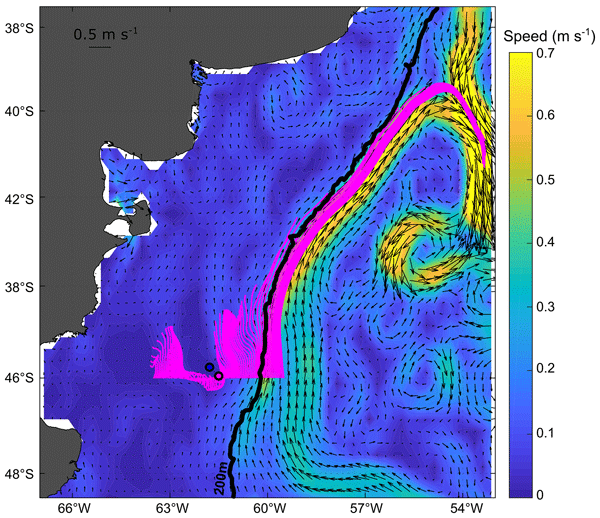
An unusual survey involving two vessels in the Argentine Sea over a 10 d period enabled synoptic observations of a significant toxic phytoplankton bloom. Simultaneous species characterization of the bloom, along with measurements of surface currents and mesoscale fronts, provided insights into its retention. Interdisciplinary approaches shed light on the biophysical coupling that underlies the persistence and horizontal transport of harmful algal blooms in productive continental shelves.

Lena Mareike Thöle, Peter Dirk Nooteboom, Suning Hou, Rujian Wang, Senyan Nie, Elisabeth Michel, Isabel Sauermilch, Fabienne Marret, Francesca Sangiorgi, and Peter Kristian Bijl
J. Micropalaeontol., 42, 35–56, https://doi.org/10.5194/jm-42-35-2023, https://doi.org/10.5194/jm-42-35-2023, 2023
Short summary
Short summary
Dinoflagellate cysts can be used to infer past oceanographic conditions in the Southern Ocean. This requires knowledge of their present-day ecologic affinities. We add 66 Antarctic-proximal surface sediment samples to the Southern Ocean data and derive oceanographic conditions at those stations. Dinoflagellate cysts are clearly biogeographically separated along latitudinal gradients of temperature, sea ice, nutrients, and salinity, which allows us to reconstruct these parameters for the past.
Cited articles
Abé, T. H.: Studies on the family Peridinidae an unfinished monograph on the armoured dinoflagellata, Spec. Publ. Seto Mar. Biol. Lab. 6. Acad. Sci. Book Tokyo, 6, 1–409, 1981.
Bada, J. L., Wang, X. S., and Hamilton, H.: Preservation of key biomolecules in the fossil record: current knowledge and future challenges, Philos. T. Roy. Soc. B, 354, 77–87, https://doi.org/10.1021/bk-1998-0707.ch005, 1999.
Balech, E.: El genero “Protoperidinium conicum” Bergh, 1881 (“Peridinium” Ehrenberg, 1831, partim), Revista Mus Argent Ci Nat, Bernardino Rivadavia Inst. Nac. Invest. Ci. Nat. Bot., 4, 1–79, 1974.
Balech, E.: On the thecal morphology of dinoflagellates with special emphasis on cingular and sulcal plates, An. Centro Cienc. Mar. Limnol. Univ. Nat. Auton. Mexico., 7, 57–68, 1980.
Benedek, P.: Phytoplanktonten aus dem Mittel- und Oberoligozän von Tönisberg (Niederrheingebiet), Paleontographica, B 137, 1–71, 1972.
Bijl, P. K., Houben, A. J. P., Bruls, A., Pross, J., and Sangiorgi, F.: Stratigraphic calibration of Oligocene–Miocene organic-walled dinoflagellate cysts from offshore Wilkes Land, East Antarctica, and a zonation proposal, J. Micropalaeontol., 37, 105–138, https://doi.org/10.5194/jm-37-105-2018, 2018.
Bolch, C. and Hallegraeff, G.: Dinoflagellate cysts in recent marine sediments from Tasmania, Australia, Bot. Mar., 33, 173–192, 1990.
Bolch, C. J. S.: The use of sodium polytungstate for the separation and concentration of living dinoflagellate cysts from marine sediments, Phycologia, 36, 472–478, https://doi.org/10.2216/i0031-8884-36-6-472.1, 1997.
Bradford, M. R.: New dinoflagellate cyst genera from the recent sediments of the Persian Gulf, Can. J. Bot., 53, 3064–3074, https://doi.org/10.1139/b75-335, 1975.
Bradford, M. R. and Wall, D.: The distribution of Recent organic-walled dinoflagellate cysts in the Persian Gulf, Gulf of Oman, and northwestern Arabian Sea, Palaeontographica, 192, 16–84, 1984.
Brinkhuis, H., Munsterman, D. K., Sengers, S., Sluijs, A., Warnaar, J., and Williams, G. L.: Late Eocene to Quaternary dinoflagellate cysts from ODP Site 1168, off western Tasmania, in: Proceedings of the Ocean Drilling Program, Scientific Results, edited by: Exon, N. F., Kennett, J. P., and Malone, M. J., Texas A & M University, 1–36, 2003.
Bujak, J. P.: Cenozoic dinoflagellate cysts and acritarchs from the Bering Sea and northern North Pacific, DSDP Leg 19, Micropaleontology, 180–212, https://doi.org/10.2307/1485717, 1984.
Bujak, J. P., Downie, C., Eaton, G. L., and Williams, G. L.: Dinoflagellate cysts and acritarchs from the Eocene of southern England, Paleontol. Assoc. Spec. Pap. Paleontol., 24, 36–91, 1980.
Chomérat, N. and Couté, A.: Protoperidinium bolmonense sp. nov. (Peridiniales, Dinophyceae), a small dinoflagellate from a brackish hypereutrophic lagoon (South of France), Phycologia, 47, 392–403, https://doi.org/10.2216/PH07-82.1, 2008.
Chomérat, N., Iti Gatti, C. M., Nézan, É., and Chinain, M.: Studies on the benthic genus Sinophysis (Dinophysales, Dinophyceae) II. S. canaliculata from Rapa Island (French Polynesia), Phycologia, 56, 193–203, https://doi.org/10.2216/16-96.1, 2017.
Coates, J.: Interpretation of infrared spectra, a practical approach, in: Encyclopedia of analytical chemistry edited by: Meyers, R. A., Vol. 12, JohnWiley & SonsLtd, Chichester, 10815–10837, 2000.
Daugbjerg, N., Hansen, G., Larsen, J., and Moestrup, Ø.: Phylogeny of some of the major genera of dinoflagellates based on ultrastructure and partial LSU rDNA sequence data, including the erection of three new genera of unarmoured dinoflagellates, Phycologia, 39, 302–317, https://doi.org/10.2216/i0031-8884-39-4-302.1, 2000.
De Coninck, J.: Organic walled microfossils from the Eocene of the Woensdrecht borehole, Southern Netherlands, Mededelingen Rijks Geologische Dienst, Nieuwe Serie, 28, 33–64, 1977.
Dodge, J. D.: Ornamentation of thecal plates in Protoperidinium (Dinophyceae) as seen by scanning electron microscopy, J. Plankton Res., 5, 119–127, https://doi.org/10.1093/plankt/5.2.119, 1983.
Faust, M. A.: Creation of the subgenus Testeria Faust subgen. nov. Protoperidinium Bergh from the SW Atlantic Ocean: Protoperidinium novella sp. nov. and Protoperidinium concinna sp. nov. Dinophyceae, Phycologia, 45, 1–9, https://doi.org/10.2216/04-62.1, 2006.
Fensome, R., Bijl, P., Grothe, A., Head, M., Sangiorgi, F., and Williams, G.: (2450–2451) Proposals to conserve the names Selenopemphix against Margosphaera, and S. nephroides against M. velata (Dinophyceae), Taxon, 65, 636–637, https://doi.org/10.12705/653.21, 2016.
Gabbott, S. E., Donoghue, P. C. J., Sansom, R. S., Vinther, J., Dolocan, A., and Purnell, M. A.: Pigmented anatomy in Carboniferous cyclostomes and the evolution of the vertebrate eye, Proc. Biol. Sci., 283, 20161151, https://doi.org/10.1098/rspb.2016.1151, 2016.
Gran, H. H.: Das Plankton des Norwegischen Nordmeeres von biologischen und hydrographischen Gesichtspunkten behandelt, Norwegian Fishery Investigation, Report, 2, 1–222, 1902.
Gribble, K. E. and Anderson, D. M.: Molecular phylogeny of the heterotrophic dinoflagellates, Protoperidinium, Diplopsalid and Preperidinium (Dinophyceae), inferred from large subunit rDNA, J. Phycol., 42, 1081–1095, https://doi.org/10.1111/j.1529-8817.2006.00267.x, 2006.
Gu, H., Liu, T., and Mertens, K. N.: Cyst–theca relationship and phylogenetic positions of Protoperidinium (Peridiniales, Dinophyceae) species of the sections Conica and Tabulata, with description of Protoperidinium shanghaiense sp. nov., Phycologia, 54, 49–66, https://doi.org/10.2216/14-047.1, 2015.
Guiry, M. D. and Guiry, G. M.: AlgaeBase, World-wide electronic publication, National University of Ireland, Galway (https://www.algaebase.org, last access: 23 July 2026), 2025.
Gurdebeke, P. R., Mertens, K. N., Pospelova, V., Matsuoka, K., Li, Z., Gribble, K. E., Gu, H., Bogus, K., Vrielinck, H., and Louwye, S.: Taxonomic revision, phylogeny, and cyst wall composition of the dinoflagellate cyst genus Votadinium Reid (Dinophyceae, Peridiniales, Protoperidiniaceae), Palynology, 44, 310–335, https://doi.org/10.1080/01916122.2019.1580627, 2020.
Harland, R.: A review of Recent and Quaternary organic-walled dinoflagellate cysts of the genus Protoperidinium, Paleontology, 25, 369–397, 1982.
Harland, R. and Pudsey, C. J.: Protoperidiniacean dinoflagellate cyst taxa from the Upper Miocene of ODP Leg 178, Antarctic Peninsula, Rev. Paleobot. Palynol., 120, 263–284, https://doi.org/10.1016/S0034-6667(02)00080-5, 2002.
Head, M. J.: Dinoflagellates, sporomorphs, and other palynomorphs from the Upper Pliocene St. Erth Beds of Cornwall, southwestern England, J. Paleontol. Memoir, 31, 1–62, 1993.
Head, M. J.: Modern dinoflagellate cysts and their biological affinities, Palynology, 3, 1197–1248, 1996.
Head, M. J., Mertens, K. N., and Fensome, R. A.: Dual nomenclature in organic-walled dinoflagellate cysts I: concepts, methods and applications, Palynology, 48, 2290200, https://doi.org/10.1080/01916122.2023.2290200, 2024.
Hoppenrath, M.: Marine Phytoplankton. Selected microphytoplankton species from the North Sea around Helgoland and Sylt, Kleine Senckenberg-Reihe, 46, 264, 2009.
Katoh, K., Rozewicki, J., and Yamada, K. D.: MAFFT online service: multiple sequence alignment, interactive sequence choice and visualization, Brief. Bioinform., 20, 1160–1166, https://doi.org/10.1093/bib/bbx108, 2019.
King, C., Iakovleva, A., Heilmann-Clausen, C., and Steurbaut, E.: Ypresian (early Eocene) stratigraphy of the Suvlu-Kaya reference section in Bakhchisaray area (Crimea), Newsl. Stratigr., 51, 167–208, 2018.
Kobayashi, S. and Matsuoka, K.: Protoperidinium conicum (Gran) Balech (Dinophyceae), Jap. J. Phycol., 32, 251–256, 1984.
Kojima, N.: 884. Dinoflagellate cyst analysis of Holocene sediments from lake Hamana in Central Japan, in: Transactions and proceedings of the Paleontological Society of Japan. New series, 197–211, https://doi.org/10.14825/prpsj1951.1989.155_197, 1989.
Kumar, A., Sharma, J., and Kapoor, P. N.: Selenopemphix maastrichta sp. nov.: the first pre-Tertiary record of the genus Selenopemphix (Benedek) Bujak in Bujak et al., 1980, Bulletin of Oil and Natural Gas Corporation, 30, 139–146, 1993.
Kumar, S., Stecher, G., Suleski, M., Sanderford, M., Sharma, S., and Tamura, K.: MEGA12: Molecular Evolutionary Genetic Analysis version 12 for adaptive and green computing, Mol. Biol. Evol., 41, msae263, https://doi.org/10.1093/molbev/msae263, 2024.
Lentin, J. K. and Williams, G. L.: A monograph of fossil peridinioid dinoflagellate cysts, Bedford Institute of Oceanography, Rep. Ser., 75, 237, 1976.
Lentin, J. K. and Williams, G. L.: Fossil dinoflagellates: index to genera and species, American Association of Stratigraphic Palynologists Foundation, Contributions Series, 20, 473, 1989.
Liu, T., Gu, H., Mertens, K. N., and Lan, D.: New dinoflagellate species Protoperidinium haizhouense sp. nov. (Peridiniales, Dinophyceae), its cyst-theca relationship and phylogenetic position within the Monovela group, Phycol. Res., 62, 109–124, https://doi.org/10.1111/pre.12041, 2014.
Loeblich, A. R.: The amphiesma or dinoflagellate cell covering, Proceedings of the North American Paleontological Convention, 2, 867–929, 26 figs., 1970.
Marret, F., Scourse, J., Kennedy, H., Ufkes, E., and Jansen, J. H. F.: Marine production in the Congo-influenced SE Atlantic over the past 30,000 years: A novel dinoflagellate-cyst based transfer function approach, Mar. Micropaleontol., 68, 198–222, https://doi.org/10.1016/j.marmicro.2008.01.004, 2008.
Matsuoka, K.: Organic-walled dinoflagellate cysts from surface sediments of Nagasaki Bay and Senzaki Bay, West Japan, Bulletin of the Faculty of Liberal Arts, Nagasaki University: Natural Science, 25, 21–115, 1985.
Matsuoka, K.: Species diversity of modern dinoflagellate cysts in surface sediments around the Japanese Islands, in: Neogene and Quaternary dinoflagellate cysts and acritarchs, edited by: Head, M. J. and Wrenn, J. H. American Association of Stratigraphic Palynologists Foundation, Publishers Press, 33–53, 1992.
Matsuoka, K. and Head, M. J.: Clarifying cyst-motile stage relationships in dinoflagellates, in: Biological and Geological Perspectives of Dinoflagellates, edited by: Lewis, J. M., Marret, F., and Bradley, L., Vol. 5, The Micropalaeontological Society, Special Publications. Geological Society, London, 325–350, https://doi.org/10.1144/TMS5.31, 2013.
Mertens, K. N., Ribeiro, S., Bouimetarhan, I., Caner, H., Combourieu Nebout, N., Dale, B., De Vernal, A., Ellegaard, M., Filipova, M., Godhe, A., Goubert, E., Grøsfjeld, K., Holzwarth, U., Kotthoff, U., Leroy, S. A. G., Londeix, L., Marret, F., Matsuoka, K., Mudie, P. J., Naudts, L., Peña-Manjarrez, J. L., Persson, A., Popescu, S.-M., Pospelova, V., Sangiorgi, F., Van Der Meer, M. T. J., Vink, A., Zonneveld, K. A. F., Vercauteren, D., Vlassenbroeck, J., and Louwye, S.: Process length variation in cysts of a dinoflagellate, Lingulodinium machaerophorum, in surface sediments: Investigating its potential as salinity proxy, Mar. Micropaleontol., 70, 54–69, https://doi.org/10.1016/j.marmicro.2008.10.004, 2009.
Mertens, K. N., Dale, B., Ellegaard, M., Jansson, I.-M., Godhe, A., Kremp, A., and Louwye, S.: Process length variation in cysts of the dinoflagellate Protoceratium reticulatum, from surface sediments of the Baltic–Kattegat–Skagerrak estuarine system: a regional salinity proxy, Boreas, 40, 242–255, https://doi.org/10.1111/j.1502-3885.2010.00193.x, 2011.
Mertens, K. N., Bringué, M., Van Nieuwenhove, N., Takano, Y., Pospelova, V., Rochon, A., De Vernal, A., Radi, T., Dale, B., Patterson, R. T., Weckström, K., Andrén, E., Louwye, S., and Matsuoka, K.: Process length variation of the cyst of the dinoflagellate Protoceratium reticulatum in the North Pacific and Baltic-Skagerrak region: calibration as an annual density proxy and first evidence of pseudo-cryptic speciation, J. Quaternary Sci., 27, 734–744, https://doi.org/10.1002/jqs.2564, 2012.
Mertens, K. N., Yamaguchi, A., Takano, Y., Pospelova, V., Head, M. J., Radi, T., Pieñkowski, A. J., De Vernal, A., Kawami, H., and Matsuoka, K.: A New Heterotrophic Dinoflagellate from the North-eastern Pacific, Protoperidinium fukuyoi: Cyst–Theca Relationship, Phylogeny, Distribution and Ecology, J. Euk. Microbiol., 60, 545–563, https://doi.org/10.1111/jeu.12058, 2013.
Mertens, K. N., Wolny, J., Carbonell-Moore, C., Bogus, K., Ellegaard, M., Limoges, A., de Vernal, A., Gurdebeke, P., Omura, T., Al-Muftah, A., and Matsuoka, K.: Taxonomic re-examination of the toxic armored dinoflagellate Pyrodinium bahamense Plate 1906: Can morphology or LSU sequencing separate P. bahamense var. compressum from var. bahamense?, Harmful Algae, 41, 1–24, https://doi.org/10.1016/j.hal.2014.09.010, 2015.
Mertens, K. N., Gu, H., Takano, Y., Price, A. M., Pospelova, V., Bogus, K., Versteegh, G. J. M., Marret, F., Turner, R. E., Rabalais, N. N., and Matsuoka, K.: The cyst-theca relationship of the dinoflagellate cyst Trinovantedinium pallidifulvum, with erection of Protoperidinium lousianensis sp. nov. and their phylogenetic position within the Conica group, Palynology, 41, 183–202, https://doi.org/10.1080/01916122.2016.1147219, 2017.
Mertens, K. N., Gu, H., Gurdebeke, P. R., Takano, Y., Clarke, D., Aydin, H., Li, Z., Pospelova, V., Shin, H. H., Li, Z., Matsuoka, K., and Head, M. J.: A review of rare, poorly known, and morphologically problematic extant marine organic-walled dinoflagellate cyst taxa of the orders Gymnodiniales and Peridiniales from the Northern Hemisphere, Mar. Micropaleontol., 159, 101773, https://doi.org/10.1016/j.marmicro.2019.101773, 2020.
Mertens, K. N., Morquecho, L., Carbonell-Moore, C., Meyvisch, P., Gu, H., Bilien, G., Duval, A., Derrien, A., Pospelova, V., Śliwiñska, K. K., Gárate-Lizárraga, I., and Pérez-Cruz, B.: Pentaplacodinium lapazense sp. nov. from Central and Southern Gulf of California, a new non-toxic gonyaulacalean resembling Protoceratium reticulatum, Mar. Micropaleontol., 178, 102187, https://doi.org/10.1016/j.marmicro.2022.102187, 2023.
Mertens, K. N., Meyvisch, P., Gurdebeke, P., Pospelova, V., Matsuoka, K., Bilien, G., Gu, H., and Yamaguchi, A.: New investigation of the cyst–motile relationship for Votadinium spinosum reveals a Protoperidinium claudicans species complex (Dinophyceae, Peridiniales), Palynology, 48, 2303170, https://doi.org/10.1080/01916122.2024.2303170, 2024.
Meunier, A.: Microplancton de la mer Flamande. Partie 3, Les péridiniens, Mémoires du Musée royal d’histoire naturelle de Belgique, 8, 3–116, 1919.
Meyvisch, P.: Infrared spectroscopic analysis of modern and fossil organic-walled microfossils: a comparative study of dinoflagellate cysts and other palynomorphs, PhD Thesis, Ghent University, 2025.
Meyvisch, P., Gurdebeke, P. R., Vrielinck, H., Neil Mertens, K., Versteegh, G., and Louwye, S.: Attenuated Total Reflection (ATR) Micro-Fourier Transform Infrared (Micro-FT-IR) spectroscopy to enhance repeatability and reproducibility of spectra derived from single specimen organic-walled dinoflagellate cysts, Appl. Spectrosc., 76, 235–254, https://doi.org/10.1177/00037028211041172, 2022.
Meyvisch, P., Mertens, K. N., Gurdebeke, P. R., Sandt, C., Pospelova, V., Vrielinck, H., Borondics, F., and Louwye, S.: Does dinocyst wall composition really reflect trophic affinity? New evidence from ATR micro-FTIR spectroscopy measurements, J. Phycol., 59, 1064–1084, https://doi.org/10.1111/jpy.13382, 2023.
Nunn, G. B., Theisen, B. F., Christensen, B., and Arctander, P.: Simplicity-correlated size growth of the nuclear 28S ribosomal RNA D3 expansion segment in the crustacean order isopoda, J. Mol. Evol., 42, 211–223, https://doi.org/10.1007/BF02198847, 1996.
Okolodkov, Y. B.: The global distributional patterns of toxic, bloom dinoflagellates recorded from the Eurasian Arctic, Harmful Algae, 4, 351–369, https://doi.org/10.1016/j.hal.2004.06.016, 2005.
Orsi, W. D., Richards, T. A., and Francis, W. R.: Predicted microbial secretomes and their target substrates in marine sediment, Nat. Microbiol., 3, 32–37, https://doi.org/10.1038/s41564-017-0047-9, 2018.
Palamarczuk, S. C. and Barreda, V. D.: Palinología del Paleogeno tardío-Neo geno temprano, pozo Aries x-l, Plataforma Continental Argentina, Tierra del Fuego, 2000.
Paulsen, O.: Plankton-investigations in the waters round Iceland in 1903, Meddelelser fra Kommissionen for Danmarks Fiskeri-og Havundersøgelser, Serie Plankton, 1904.
Piriou, S.: Palynostratigraphie dans l'intervalle Oligocène-Miocène du domaine tropical ouest-africain. Analyse palynologique haute résolution de l'éventail sous-marin chattien du bassin du Bas-Congo, Doctoral dissertation, Université Bordeaux 1, 194C315 pp., https://theses.fr/2006BOR13208 (last access: 23 July 2026), 2006.
Qiu, B.: Kuroshio and Oyashio Currents, in: Encyclopedia of Ocean Sciences, edited by: Steele, J. H., Thorpe, S. A., Turekian, K. K., Academia, London, 1413–1425, 2001.
Rasband, W. S.: ImageJ, US National Institutes of Health, Bethesda, 1997.
Ribeiro, S., Lundholm, N., Amorim, A., and Ellegaard, M.: Protoperidinium minutum (Dinophyceae) from Portugal: cyst–theca relationship and phylogenetic position on the basis of single-cell SSU and LSU rDNA sequencing, Phycologia, 49, 48–63, https://doi.org/10.2216/09-11.1, 2010.
Rochon, A., de Vernal, A., Turon, J. L., and Head, M. J.: Distribution of recent dinoflagellate cysts in surface sediments from the North Atlantic and adjacent seas in relation to sea-surface parameters, AASP Contribution Series, 35, 1–146, 1999.
Ronquist, F., Teslenko, M., van der Mark, P., Ayres, D. L., Darling, A., Höhna, S., Larget, B., Liu, L., Suchard, M. A., and Huelsenbeck, J. P.: MrBayes 3.2: Efficient Bayesian phylogenetic inference and model choice across a large model space, Syst. Biol., 61, 539–542, https://doi.org/10.1093/sysbio/sys029, 2012.
Sarai, C., Yamaguchi, A., Kawami, H., and Matsuoka, K.: Two new species formally attributed to Protoperidinium oblongum (Aurivillius) Park et Dodge (Peridiniales, Dinophyceae): Evidence from cyst incubation experiments, Rev. Palaeobot. Palyno., 192, 103–118, https://doi.org/10.1016/j.revpalbo.2012.12.007, 2013.
Scholin, C.: Identification of group and strain-specific genetic markers for globally distributed Alexandrium (Dinophyceae). II. Sequence analysis of a fragment of the LSU rRNA gene, J. Phycol., 30, 999–1011, 1994.
Sonneman, J. A. and Hill, D. R. A.: A taxonomic survey of cyst-producing dinoflagellates from Recent sediments of Victorian coastal waters, Australia, Bot. Mar., 40, https://doi.org/10.1515/botm.1997.40.1-6.149, 1997.
Taylor, F. J. R.: Dinoflagellates from the International Indian Ocean Expedition. A material collected by the RV “Anton Bruun” 1963–1964, Bibl. Bot., 132, 1–234, 1976.
Thöle, L. M., Nooteboom, P. D., Hou, S., Wang, R., Nie, S., Michel, E., Sauermilch, I., Marret, F., Sangiorgi, F., and Bijl, P. K.: An expanded database of Southern Hemisphere surface sediment dinoflagellate cyst assemblages and their oceanographic affinities, J. Micropalaeontol., 42, 35–56, https://doi.org/10.5194/jm-42-35-2023, 2023.
Toplak, M., Read, S. T., Sandt, C., and Borondics, F.: Quasar: Easy Machine Learning for Biospectroscopy, Cells, 10, 2300, https://doi.org/10.3390/cells10092300, 2021.
Turner, S., Pryer, K. M., Miao, V. P. W., and Palmer, J. D.: Investigating deep phylogenetic relationships among Cyanobacteria and Plastids by small subunit rRNA sequence analysis, J. Euk. Microbiol., 46, 327–338, https://doi.org/10.1111/j.1550-7408.1999.tb04612.x, 1999.
Van Nieuwenhove, N., Head, M. J., Limoges, A., Pospelova, V., Mertens, K. N., Matthiessen, J., De Schepper, S., de Vernal, A., Eynaud, F., Londeix, L., Marret, F., Penaud, A., Radi, T., and Rochon, A.: An overview and brief description of common marine organic-walled dinoflagellate cyst taxa occurring in surface sediments of the Northern Hemisphere, Mar. Micropaleontol., 159, 101814, https://doi.org/10.1016/j.marmicro.2019.101814, 2020.
Verleye, T. J., Pospelova, V., Mertens, K. N., and Louwye, S.: The geographical distribution and (palaeo)ecology of Selenopemphix undulata sp. nov., a new late Quaternary dinoflagellate cyst from the Pacific Ocean, Mar. Micropaleontol., 78, 65–83, https://doi.org/10.1016/j.marmicro.2010.10.001, 2011.
Wall, D. and Dale, B.: Modern dinoflagellate cysts and evolution of the Peridiniales, Micropaleontology, 14, 265, https://doi.org/10.2307/1484690, 1968.
Yamaguchi, A.: A molecular phylogenetic study of the heterotrophic dinoflagellate genus Protoperidinium (Dinophyceaee), Hokkaido University, Japan, 63 pp., 2007.
Yamaguchi, A. and Horiguchi, T.: Molecular phylogenetic study of the heterotrophic dinoflagellate genus Protoperidinium (Dinophyceae) inferred from small subunit rRNA gene sequences, Phycol. Reas., 53, 30–42, https://doi.org/10.1111/j.1440-183.2005.00370.x, 2005.
Yamaguchi, A., Kawamura, H., and Horiguchi, T.: A further phylogenetic study of the heterotrophic dinoflagellate genus, Protoperidinium (Dinophyceae) based on small and large subunit ribosomal RNA gene sequences, Phycol. Reas., 54, 317–329, https://doi.org/10.1111/j.1440-1835.2006.00438.x, 2006.
Yamaguchi, A., Hoppenrath, M., Pospelova, V., Horiguchi, T., and Leander, B. S.: Molecular phylogeny of the marine sand-dwelling dinoflagellate Herdmania litoralis and an emended description of the closely related planktonic genus Archaeperidinium Jörgensen, Eur. J. Phycol., 46, 98–112, https://doi.org/10.1080/09670262.2011.564517, 2011.
Yule, B. L., Roberts, S., and Marshall, J. E. A.: The thermal evolution of sporopollenin, Org. Geochem., 31, 859–870, https://doi.org/10.1016/S0146-6380(00)00058-9, 2000.
Zonneveld, K. A. F., Marret, F., Versteegh, G. J. M., Bogus, K., Bonnet, S., Bouimetarhan, I., Crouch, E., de Vernal, A., Elshanawany, R., Edwards, L., Esper, O., Forke, S., Grøsfjeld, K., Henry, M., Holzwarth, U., Kielt, J.-F., Kim, S.-Y., Ladouceur, S., Ledu, D., Chen, L., Limoges, A., Londeix, L., Lu, S.-H., Mahmoud, M. S., Marino, G., Matsouka, K., Matthiessen, J., Mildenhal, D. C., Mudie, P., Neil, H. L., Pospelova, V., Qi, Y., Radi, T., Richerol, T., Rochon, A., Sangiorgi, F., Solignac, S., Turon, J.-L., Verleye, T., Wang, Y., Wang, Z., and Young, M.: Atlas of modern dinoflagellate cyst distribution based on 2405 data points, Rev. Palaeobot. Palyno., 191, 1–197, https://doi.org/10.1016/j.revpalbo.2012.08.003, 2013.
Short summary
By combining incubation experiments, microscopy, biomolecular analyses, and spectroscopy to assess the biomacromolecular composition of cyst walls, we show that Selenopemphix and Multispinula represent two distinct cyst-based genera, with different preservation potentials. We emend their diagnoses and describe two new Multispinula species, M. varispinosa sp. nov. and M. robusta sp. nov., in addition to M. quanta.
By combining incubation experiments, microscopy, biomolecular analyses, and spectroscopy to...


