
 | 03 Aug 2026
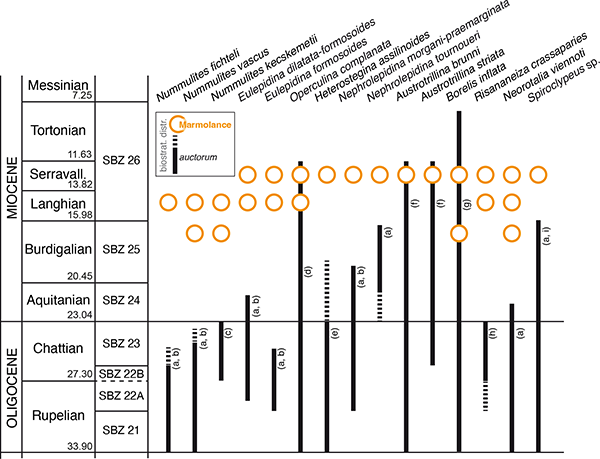
Reply to Papazzoni et al.'s comment on “Chronostratigraphic ranges of Early–Middle Miocene larger benthic foraminifera calibrated by planktonic foraminiferal assemblages (Sierra de Marmolance, Granada, SE Spain)” by Bolivar-Feriche et al. (2025)



Although we disagree with most of the criticisms of our results expressed in the comments by Papazzoni et al. (2026), we thank the authors for the opportunity to elaborate on aspects of our work that were not sufficiently detailed in our article on the chronostratigraphic distribution of larger benthic foraminifera (LBF) in the Middle Miocene limestones of Sierra de Marmolance (Bolivar-Feriche et al., 2025).
First, we welcome the fact that the authors of the comment accept that the planktonic foraminifera are correctly identified. A major criticism raised by some of them regarding a previous report of Risananeiza in the Middle Miocene of the Sierra de Marmolance (Bolívar-Feriche, 2022) was that the planktonic foraminifera defining the Miocene age of the Marmolance limestones “look like Oligocene” (Benedetti et al., 2025, pp. 3 and 5). We also appreciate that the authors consider the taxonomic identifications of LBF to be overall acceptable.
In the present comments, the main criticism of our results concerns the potential allochthony and provenance from older deposits of the recorded LBF. Before proposing such a significant extension (or change) of the chronostratigraphic ranges of several LBF species, we carefully evaluated the autochthony–parautochthony of the LBF assemblages. As stated in the article (Bolivar-Feriche et al., 2025, sect. 5.1 of the Discussion), different lines of evidence indicate that the LBF assemblages are not reworked from older deposits.
- a.
LBF facies, characterized by distinct assemblages, were identified through quantitative analyses of component proportions in 147 thin sections and differentiated using cluster analysis based on LBF components, as well as proportions of planktonic foraminifera and siliciclastics. The statistical significance of the identified LBF facies was tested using one-way ANOVA (Bolivar-Feriche et al., 2025, table S1).
Individual facies occur in all five sampled sections over relatively long intervals (from metres to tens of metres) and replace one another vertically, in some cases with gradual changes. There is no mixing of LBF from different facies within the same beds. This pattern can only result from deposition in different facies belts arranged from proximal to distal across the carbonate ramp, each characterized by a distinct LBF composition. In short, LBF assemblages in the Middle Miocene of Sierra de Marmolance are segregated both temporally and spatially. No sedimentary process on a ramp could produce such a clear taxonomic segregation of allochthonous particles with similar hydrodynamic properties derived from erosion of older deposits. In summary, no reworking process can account for such well-defined segregation of LBF components. The LBF in Marmolance are autochthonous within their respective facies belts or parautochthonous, as in the case of lepidocyclinids occurring in cross-bedded deposits. As mentioned in Bolivar-Feriche et al. (2025), the segregation of LBF species into bed sets in Marmolance was already recognized by Foucault (1971, p. 397), who attributed this pattern to ecological factors.
- b.
In most cases, LBF occur in flat-bedded wackestone to packstone lacking sedimentary structures indicative of coarse-grained gravity flows that could suggest reworking. As noted above, remobilization of LBF in cross-bedded lepidocyclinid packstone occurred within the inner ramp, in submarine dunes fed by bioclasts produced within a single facies belt dominated by lepidocyclinids. In these cross-bedded packstones, LBF are fragmented and abraded; however, the generally good preservation of LBF tests in the remaining facies indicates little to no transport, supporting the autochthonous–parautochthonous nature of the assemblages.
- c.
As additional evidence against reworking from Oligocene deposits, no Oligocene platform carbonates are present in the region (Foucault, 1971).
Contrary to the statement of Papazzoni et al. (2026), the samples with planktonic foraminifera were collected directly from LBF-bearing limestone successions. MARMO-1 and MARMO-2 were obtained from a marl bed intercalated with LBF-bearing limestones that can be physically traced to Section III, located 200 m away. The marly beds from which MARMO-3 to MARMO-5 were collected, although not continuously traceable to Section III, clearly underlie limestone beds that are laterally continuous with Section III toward the southwest. No Quaternary deposits or debris obscures the stratigraphic relationships in this part of the section. MARMO-M1 was collected from a marl bed in Section V (as shown in fig. 2d of Bolivar-Feriche et al., 2025) (Fig. 1), which can be physically and visually traced to Section IV. In our view, the red line in fig. 4 of Bolivar-Feriche et al. (2025) marking the planktonic foraminiferal datum sufficiently indicates the position of the washed sample within the stratigraphic column of Section V.
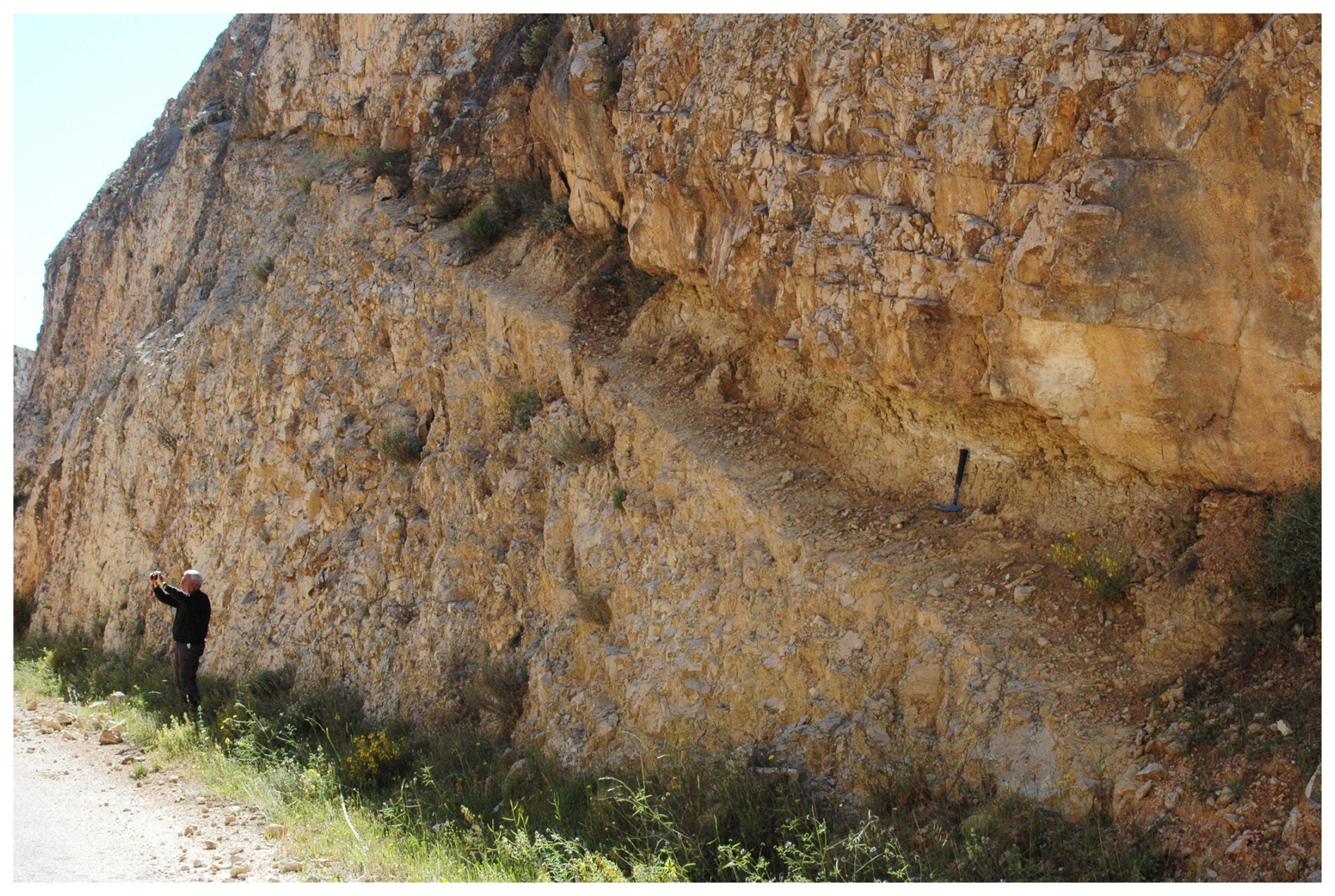
Figure 1The marl bed intercalated in the limestones in Section V of the Sierra de Marmolance (view from the west).
As Papazzoni et al. (2026) note, we stated in the article that “Quaternary materials and debris cover the succession … making it difficult to follow the lateral continuity of strata … and precluding systematic sampling of the marls” (Bolivar-Feriche et al., 2025, p. 575). This limitation explains why we did not attempt a direct correlation between the eastern and western sectors of the Marmolance. We show that parts of Sections II and III are younger than the Burdigalian–Langhian transition in the eastern sector, whereas parts of Sections IV and V postdate the Langhian–Serravallian transition in the western sector. The visual correlation presented in fig. 5 (Bolivar-Feriche et al., 2025) does not aim at bed-to-bed correlation among Sections I to V, but the lack of extremely precise correlation between the eastern and western sections does not affect the observed stratigraphic ranges of LBF genera when combining records from both sectors.
Contrary to the contention of Papazzoni et al. (2026), we show the relevant taxonomic composition of planktonic foraminifer assemblages in the marly samples and discuss their biostratigraphic significance. Since systematic sampling of marls was impracticable, we cannot pinpoint the first and last datum events of species in the succession, and, therefore, the age cannot be more precise than the overlapping interval of species ranges following the standard biostratigraphic scales for the Mediterranean and for the open-ocean mid-low latitudes (Bolivar-Feriche et al., 2025, sect. 4.2).
Concerning “Palaeobiogeography”, we stated that Nummulites in the Langhian of SE Spain partly fills a stratigraphic gap in the record of the genus. We did not propose any evolutionary relationship between western Mediterranean Nummulites and present-day Indo-Pacific Nummulites (or Palaeonummulites) venosus, nor any palaeobiogeographic connection between Langhian Nummulites from SE Spain and those from SE Asia. However, Papazzoni et al. (2026) appear to have misinterpreted the conclusions of Bialik et al. (2019), who indicate that the final closure of the Mediterranean connection with the Indian Ocean (Indian Gateway) occurred at 13.8 Ma (i.e., at the base of the Serravallian), postdating the disappearance of Nummulites in Marmolance. Therefore, no fully closed barrier would have prevented eastward migration of Nummulites while they inhabited the Mediterranean. Before its closure currents flew eastward through the Indian Gateway (Hernández-Molina and Scotese, 2026).
In their conclusions, Papazzoni et al. (2026) state that “the proposed survival of LBF species over 10–15 Myr is unlikely, given typical lifespans of 2–3 Myr for Cenozoic LBF species.” If this is so, and considering that the LBF taxa identified in Marmolance occur in situ within chronostratigraphically well-constrained Middle Miocene deposits, we suggest that LBF biostratigraphers should reassess the chronostratigraphic calibration of the Shallow Benthic Zones (SBZs) proposed by Cahuzac and Poignant (1997) and, consequently, the age assignments of rocks elsewhere in the Mediterranean region based on LBF characterizing these zones. Cahuzac and Poignant (1997, p. 157) expressed some doubts about the correlation they proposed of their biozones with the standard chronostratigraphic scale and assumed it was susceptible of later modifications. In this context, the assertions made in sect. 4 of Papazzoni et al. (2026) should be evaluated against robust correlations with the standard chronostratigraphic scale.