
Articles | Volume 45, issue 2
https://doi.org/10.5194/jm-45-581-2026
© Author(s) 2026. This work is distributed under
the Creative Commons Attribution 4.0 License.
the Creative Commons Attribution 4.0 License.
https://doi.org/10.5194/jm-45-581-2026
© Author(s) 2026. This work is distributed under
the Creative Commons Attribution 4.0 License.
the Creative Commons Attribution 4.0 License.
Research article
| 
11 Aug 2026
Research article |
| 11 Aug 2026
| 11 Aug 2026
Quaternary Arctic planktonic foraminifera: morphological differentiation and taxonomic reassessment of subpolar spinose taxa

Department of Geological Sciences, Stockholm University, Stockholm, Sweden
Bolin Centre for Climate Research, Stockholm University, Stockholm, Sweden
Thomas M. Cronin
U.S. Geological Survey, Florence Bascom Geoscience Center, Reston, VA, USA
Kate Darling
Biological and Environmental Sciences, University of Stirling, Stirling FK9 4LA, UK
School of Geosciences, University of Edinburgh, West Mains Road, Edinburgh EH9 3FE, UK
Katrine Husum
Norwegian Polar Institute, Tromsø, Norway
Tamara Handl
The Swedish Museum of Natural History, Stockholm, Sweden
Brian T. Huber
Department of Paleobiology, National Museum of Natural History, Smithsonian Institution, Washington, D.C., USA
Megh M. Kanvinde
Department of Geological Sciences, Stockholm University, Stockholm, Sweden
Bolin Centre for Climate Research, Stockholm University, Stockholm, Sweden
Mohammad Razmjooei
Department of Geological Sciences, Stockholm University, Stockholm, Sweden
Bolin Centre for Climate Research, Stockholm University, Stockholm, Sweden
Flor Vermassen
Department of Geological Sciences, Stockholm University, Stockholm, Sweden
Bolin Centre for Climate Research, Stockholm University, Stockholm, Sweden
Antje H. L. Voelker
Instituto Português do Mar e da Atmosfera (IPMA) Divisão de Geologia e Georecursos Marinhos Av. Doutor Alfredo Magalhães Ramalho,6 1495-165 Algés, Portugal
Centro de Ciências do Mar do Algarve (CCMAR/CIMAR LA), Universidade do Algarve, 8005-139 Faro, Portugal
Tirza M. Weitkamp
Department of Geological Sciences, Stockholm University, Stockholm, Sweden
Bolin Centre for Climate Research, Stockholm University, Stockholm, Sweden
Matt O'Regan
Department of Geological Sciences, Stockholm University, Stockholm, Sweden
Bolin Centre for Climate Research, Stockholm University, Stockholm, Sweden
Related authors
Lukas Jonkers, Tonke Strack, Montserrat Alonso-Garcia, Simon D'haenens, Robert Huber, Michal Kucera, Iván Hernández-Almeida, Chloe L. C. Jones, Brett Metcalfe, Rajeev Saraswat, Lóránd Silye, Sanjay K. Verma, Muhamad Naim Abd Malek, Gerald Auer, Cátia F. Barbosa, Maria A. Barcena, Karl-Heinz Baumann, Flavia Boscolo-Galazzo, Joeven Austine S. Calvelo, Lucilla Capotondi, Martina Caratelli, Jorge Cardich, Humberto Carvajal-Chitty, Markéta Chroustová, Helen K. Coxall, Renata M. de Mello, Anne de Vernal, Paula Diz, Kirsty M. Edgar, Helena L. Filipsson, Ángela Fraguas, Heather L. Furlong, Giacomo Galli, Natalia L. García Chapori, Robyn Granger, Jeroen Groeneveld, Adil Imam, Rebecca Jackson, David Lazarus, Julie Meilland, Marína Molčan Matejová, Raphael Morard, Caterina Morigi, Sven N. Nielsen, Diana Ochoa, Maria Rose Petrizzo, Andrés S. Rigual-Hernández, Marina C. Rillo, Matthew L. Staitis, Gamze Tanık, Raúl Tapia, Nishant Vats, Bridget S. Wade, and Anna E. Weinmann
J. Micropalaeontol., 44, 145–168, https://doi.org/10.5194/jm-44-145-2025, https://doi.org/10.5194/jm-44-145-2025, 2025
Short summary
Short summary
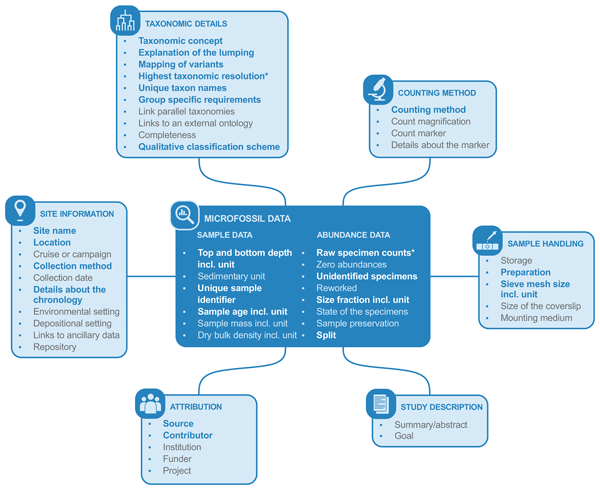
Our study provides guidelines improving the reuse of marine microfossil assemblage data, which are valuable for understanding past ecosystems and environmental change. Based on a survey of 113 researchers, we identified key data attributes required for effective reuse. Analysis of a selection of datasets available online reveals a gap between the attributes scientists consider essential and the data currently available, highlighting the need for clearer data documentation and sharing practices.
Flor Vermassen, Clare Bird, Tirza M. Weitkamp, Kate F. Darling, Hanna Farnelid, Céline Heuzé, Allison Y. Hsiang, Salar Karam, Christian Stranne, Marcus Sundbom, and Helen K. Coxall
Biogeosciences, 22, 2261–2286, https://doi.org/10.5194/bg-22-2261-2025, https://doi.org/10.5194/bg-22-2261-2025, 2025
Short summary
Short summary
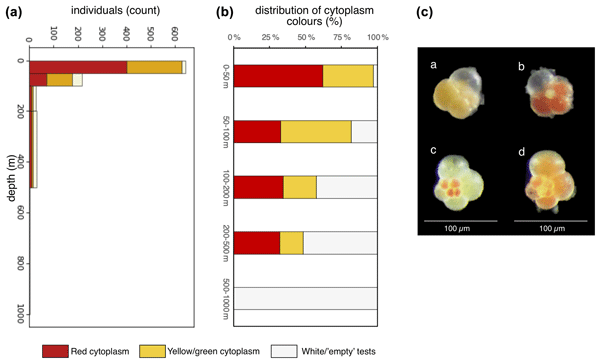
We provide the first systematic survey of planktonic foraminifera in the high Arctic Ocean. Our results describe the abundance and species composition under summer sea ice. They indicate that the polar specialist N. pachyderma is the only species present, with subpolar species absent. The data set will be a valuable reference for continued monitoring of the state of planktonic foraminifera communities as they respond to the ongoing sea-ice decline and the “Atlantification” of the Arctic Ocean.
Tirza Maria Weitkamp, Mohammad Javad Razmjooei, Paul Nicholas Pearson, and Helen Katherine Coxall
J. Micropalaeontol., 44, 1–78, https://doi.org/10.5194/jm-44-1-2025, https://doi.org/10.5194/jm-44-1-2025, 2025
Short summary
Short summary
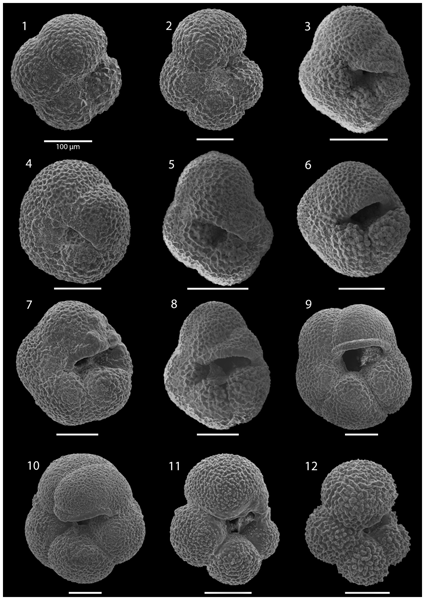
Deep Sea Drilling Project Site 407, near Iceland, offers a valuable 25-million-year record of planktonic foraminifera evolution from the Late Cenozoic. Species counts and ranges, assemblage changes, and biostratigraphic zones were identified. Key findings include the shifts in species dominance and diversity. Challenges include sediment gaps and missing biozone markers. We aim to enhance the Neogene–Quaternary Middle Atlas and improve the North Atlantic palaeoceanography and biostratigraphy.
Nico Wunderling, Anna S. von der Heydt, Yevgeny Aksenov, Stephen Barker, Robbin Bastiaansen, Victor Brovkin, Maura Brunetti, Victor Couplet, Thomas Kleinen, Caroline H. Lear, Johannes Lohmann, Rosa Maria Roman-Cuesta, Sacha Sinet, Didier Swingedouw, Ricarda Winkelmann, Pallavi Anand, Jonathan Barichivich, Sebastian Bathiany, Mara Baudena, John T. Bruun, Cristiano M. Chiessi, Helen K. Coxall, David Docquier, Jonathan F. Donges, Swinda K. J. Falkena, Ann Kristin Klose, David Obura, Juan Rocha, Stefanie Rynders, Norman Julius Steinert, and Matteo Willeit
Earth Syst. Dynam., 15, 41–74, https://doi.org/10.5194/esd-15-41-2024, https://doi.org/10.5194/esd-15-41-2024, 2024
Short summary
Short summary
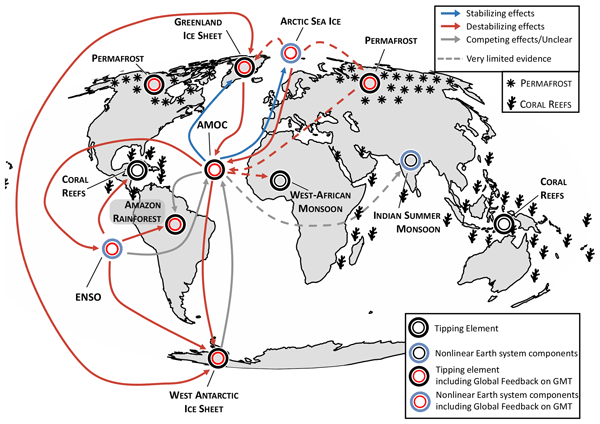
This paper maps out the state-of-the-art literature on interactions between tipping elements relevant for current global warming pathways. We find indications that many of the interactions between tipping elements are destabilizing. This means that tipping cascades cannot be ruled out on centennial to millennial timescales at global warming levels between 1.5 and 2.0 °C or on shorter timescales if global warming surpasses 2.0 °C.
Jesse R. Farmer, Katherine J. Keller, Robert K. Poirier, Gary S. Dwyer, Morgan F. Schaller, Helen K. Coxall, Matt O'Regan, and Thomas M. Cronin
Clim. Past, 19, 555–578, https://doi.org/10.5194/cp-19-555-2023, https://doi.org/10.5194/cp-19-555-2023, 2023
Short summary
Short summary
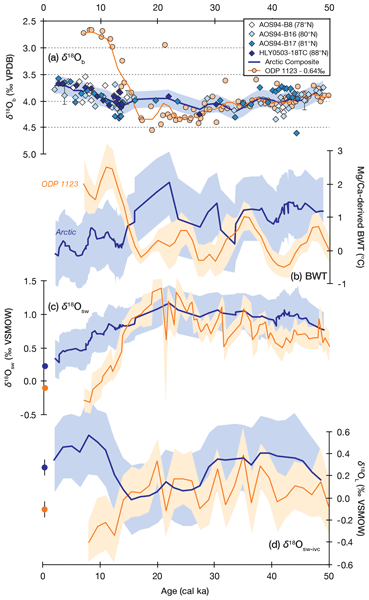
Oxygen isotopes are used to date marine sediments via similar large-scale ocean patterns over glacial cycles. However, the Arctic Ocean exhibits a different isotope pattern, creating uncertainty in the timing of past Arctic climate change. We find that the Arctic Ocean experienced large local oxygen isotope changes over glacial cycles. We attribute this to a breakdown of stratification during ice ages that allowed for a unique low isotope value to characterize the ice age Arctic Ocean.
Kasia K. Śliwińska, Helen K. Coxall, David K. Hutchinson, Diederik Liebrand, Stefan Schouten, and Agatha M. de Boer
Clim. Past, 19, 123–140, https://doi.org/10.5194/cp-19-123-2023, https://doi.org/10.5194/cp-19-123-2023, 2023
Short summary
Short summary
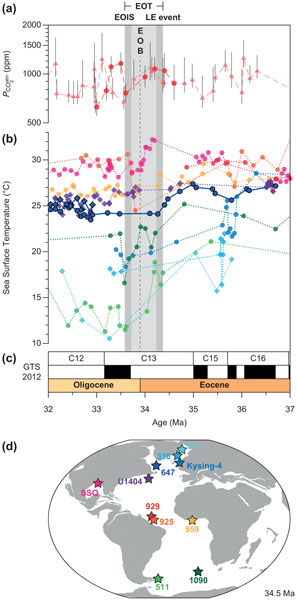
We provide a sea surface temperature record from the Labrador Sea (ODP Site 647) based on organic geochemical proxies across the late Eocene and early Oligocene. Our study reveals heterogenic cooling of the Atlantic. The cooling of the North Atlantic is difficult to reconcile with the active Atlantic Meridional Overturning Circulation (AMOC). We discuss possible explanations like uncertainty in the data, paleogeography and atmospheric CO2 boundary conditions, model weaknesses, and AMOC activity.
Albin Eriksson, Junjie Wu, Matt O'Regan, and Örjan Gustafsson
EGUsphere, https://doi.org/10.5194/egusphere-2026-2414, https://doi.org/10.5194/egusphere-2026-2414, 2026
Short summary
Short summary
Sea ice is an important regulator of the Arctic climate systems. Records of sea ice past instrumental records are necessary to understand how sea ice is altered during past periods of abrupt climate change, and what consequences such changes have on the polar climates. Here, we reconstructed the sea ice cover of the East Siberian Arctic and found that the sea ice extent likely was linked to protecting/eroding permafrost coastlines during the last deglaciation.
Alyssa R. Atwood, Andrea L. Moore, Kristine L. DeLong, Sylvia E. Long, Sara C. Sanchez, Jessica A. Hargreaves, Chandler A. Morris, Raquel E. Pauly, Émilie P. Dassié, Thomas Felis, Antje H. L. Voelker, Sujata A. Murty, and Kim M. Cobb
Earth Syst. Sci. Data, 18, 1921–1941, https://doi.org/10.5194/essd-18-1921-2026, https://doi.org/10.5194/essd-18-1921-2026, 2026
Short summary
Short summary
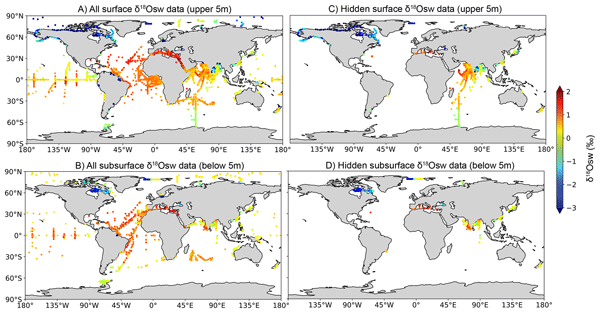
The stable isotopic composition of seawater is a valuable tool for studying the global water cycle in the past, present, and future. However, an active repository dedicated to archiving this type of data has been lacking, and many datasets remain hidden from public view. We have created a new database of observational seawater isotope data that is rich in metadata, publicly accessible, and machine readable to increase its availability and usability for a variety of Earth Science applications.
Gilles Reverdin, Claire Waelbroeck, Lola Goeme, Antje Voelker, and Hans-Christian Steen-Larsen
EGUsphere, https://doi.org/10.5194/egusphere-2026-851, https://doi.org/10.5194/egusphere-2026-851, 2026
Short summary
Short summary
The distributions of water isotopic properties (δ18O, δ2H, deuterium excess) as a function of salinity are studied in the surface Atlantic Ocean and southwest Indian Ocean using the CISE-LOCEAN data base. Large spatial gradients are found as well as a seasonal variability in the North Atlantic sub-polar gyre and in the equatorial Atlantic. Spatially-averaged seasonal cycles are established in these regions, as well as at the BATS site (31°50’ N, 64°10’ W), with weak interannual variability.
Giulia Silveira Molina, Gerhard Schmiedl, Francisco Jiménez-Espejo, Henning Kuhnert, Teresa Rodrigues, and Antje Helga Luise Voelker
J. Micropalaeontol., 45, 117–145, https://doi.org/10.5194/jm-45-117-2026, https://doi.org/10.5194/jm-45-117-2026, 2026
Short summary
Short summary
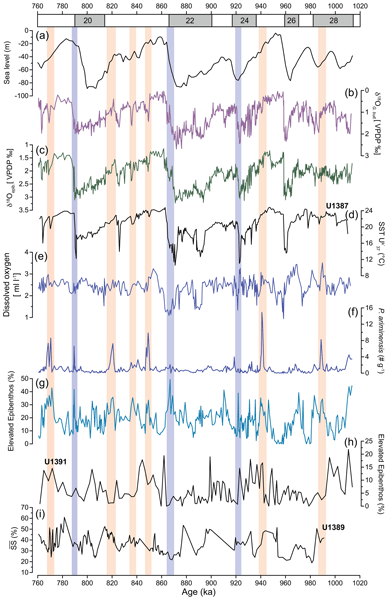
Benthic foraminifera from sediment cores collected in the Gulf of Cadiz were analysed to track ocean changes between 1014 and 761 kyr ago. Our results reveal shifts in species composition throughout the climate cycles. Oxygen loss occurred in the Mediterranean Outflow Water during warmer periods when solar insolation was intensified and productivity was higher. During cold periods, stronger bottom currents were identified by sand content and the abundance of the species Planulina ariminensis.
Madeleine Santos, Lisa Bröder, Matt O'Regan, Iván Hernández-Almeida, Tommaso Tesi, Lukas Bigler, Negar Haghipour, Daniel B. Nelson, Michael Fritz, and Julie Lattaud
Clim. Past, 22, 187–203, https://doi.org/10.5194/cp-22-187-2026, https://doi.org/10.5194/cp-22-187-2026, 2026
Short summary
Short summary
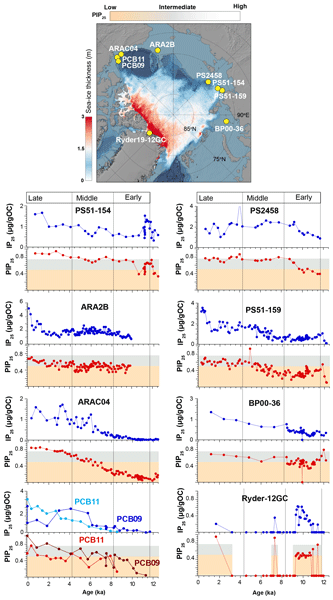
Our study examined how sea ice in the Beaufort Sea has changed over the past 13 000 years to better understand today's rapid losses. By analyzing chemical tracers preserved in seafloor sediments, we found that the Early Holocene was largely ice-free, with warmer waters and lower salinity. Seasonal ice began forming about 7000 years ago and expanded as the climate cooled. These long-term patterns show that continued warming could return the region to mostly ice-free conditions.
Clare Bird, Kate Darling, Rabecca Thiessen, and Anna J. Pieńkowski
Biogeosciences, 22, 4545–4577, https://doi.org/10.5194/bg-22-4545-2025, https://doi.org/10.5194/bg-22-4545-2025, 2025
Short summary
Short summary
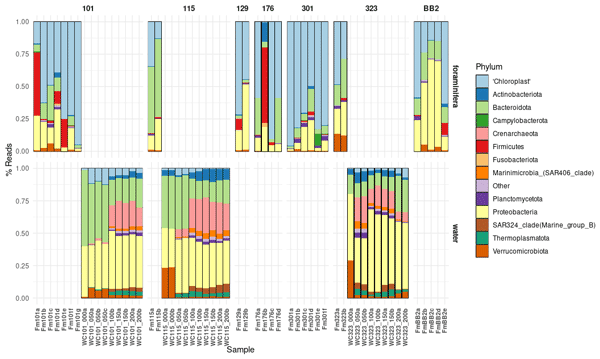
The polar planktonic foraminifer Neogloboquadrina pachyderma eats diatoms. Unlike other planktonic species, it also keeps the diatom chloroplasts (photosynthesising organelles) inside its cell. In benthic foraminifera, this is known as kleptoplasty, and the roles of these stolen chloroplasts are diverse. Their role in N. pachyderma needs to be investigated to find out if stored chloroplasts enable N. pachyderma to live in polar waters and under the ice, where no other planktonic species survive.
Jamie Barnett, Felicity A. Holmes, Joshua Cuzzone, Henning Åkesson, Mathieu Morlighem, Matt O'Regan, Johan Nilsson, Nina Kirchner, and Martin Jakobsson
The Cryosphere, 19, 3631–3653, https://doi.org/10.5194/tc-19-3631-2025, https://doi.org/10.5194/tc-19-3631-2025, 2025
Short summary
Short summary
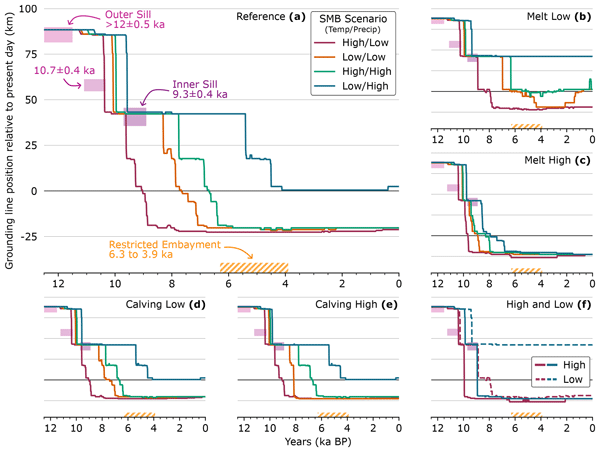
Understanding how ice sheets have changed in the past can allow us to make better predictions for the future. By running a state-of-the-art model of Ryder Glacier, North Greenland, over the past 12 000 years we find that both a warming atmosphere and the ocean play a key role in the evolution of the glacier. Our conclusions stress that accurately quantifying the ice sheet’s interactions with the ocean is required to predict future changes and reliable sea level rise estimates.
Lukas Jonkers, Tonke Strack, Montserrat Alonso-Garcia, Simon D'haenens, Robert Huber, Michal Kucera, Iván Hernández-Almeida, Chloe L. C. Jones, Brett Metcalfe, Rajeev Saraswat, Lóránd Silye, Sanjay K. Verma, Muhamad Naim Abd Malek, Gerald Auer, Cátia F. Barbosa, Maria A. Barcena, Karl-Heinz Baumann, Flavia Boscolo-Galazzo, Joeven Austine S. Calvelo, Lucilla Capotondi, Martina Caratelli, Jorge Cardich, Humberto Carvajal-Chitty, Markéta Chroustová, Helen K. Coxall, Renata M. de Mello, Anne de Vernal, Paula Diz, Kirsty M. Edgar, Helena L. Filipsson, Ángela Fraguas, Heather L. Furlong, Giacomo Galli, Natalia L. García Chapori, Robyn Granger, Jeroen Groeneveld, Adil Imam, Rebecca Jackson, David Lazarus, Julie Meilland, Marína Molčan Matejová, Raphael Morard, Caterina Morigi, Sven N. Nielsen, Diana Ochoa, Maria Rose Petrizzo, Andrés S. Rigual-Hernández, Marina C. Rillo, Matthew L. Staitis, Gamze Tanık, Raúl Tapia, Nishant Vats, Bridget S. Wade, and Anna E. Weinmann
J. Micropalaeontol., 44, 145–168, https://doi.org/10.5194/jm-44-145-2025, https://doi.org/10.5194/jm-44-145-2025, 2025
Short summary
Short summary
Our study provides guidelines improving the reuse of marine microfossil assemblage data, which are valuable for understanding past ecosystems and environmental change. Based on a survey of 113 researchers, we identified key data attributes required for effective reuse. Analysis of a selection of datasets available online reveals a gap between the attributes scientists consider essential and the data currently available, highlighting the need for clearer data documentation and sharing practices.
Aline Mega, Teresa Rodrigues, Emília Salgueiro, Mária Padilha, Henning Kuhnert, and Antje H. L. Voelker
Clim. Past, 21, 919–939, https://doi.org/10.5194/cp-21-919-2025, https://doi.org/10.5194/cp-21-919-2025, 2025
Short summary
Short summary
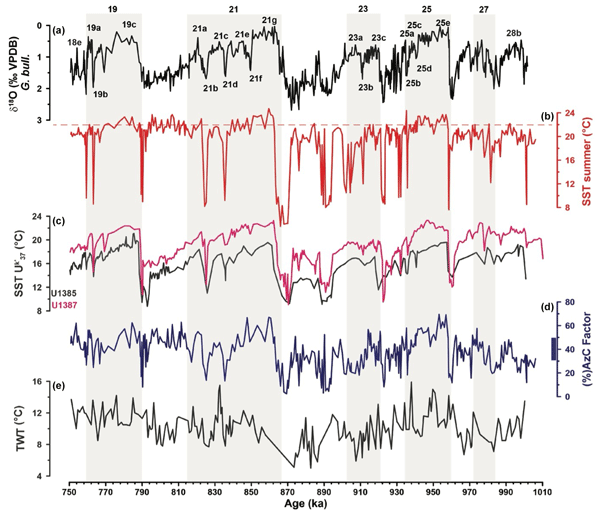
Our research explores climatic changes during the Early–Middle Pleistocene (1006–750 ka) on the southern Portuguese margin. We found that warm, subtropical-gyre-related conditions dominated. However, those conditions were occasionally interrupted by extreme cold events during the glacial periods. Our data show that these cold events, linked to changes in the North Atlantic's circulation, reached as far south as 36° N and significantly impacted marine ecosystems in the surface ocean.
Flor Vermassen, Clare Bird, Tirza M. Weitkamp, Kate F. Darling, Hanna Farnelid, Céline Heuzé, Allison Y. Hsiang, Salar Karam, Christian Stranne, Marcus Sundbom, and Helen K. Coxall
Biogeosciences, 22, 2261–2286, https://doi.org/10.5194/bg-22-2261-2025, https://doi.org/10.5194/bg-22-2261-2025, 2025
Short summary
Short summary
We provide the first systematic survey of planktonic foraminifera in the high Arctic Ocean. Our results describe the abundance and species composition under summer sea ice. They indicate that the polar specialist N. pachyderma is the only species present, with subpolar species absent. The data set will be a valuable reference for continued monitoring of the state of planktonic foraminifera communities as they respond to the ongoing sea-ice decline and the “Atlantification” of the Arctic Ocean.
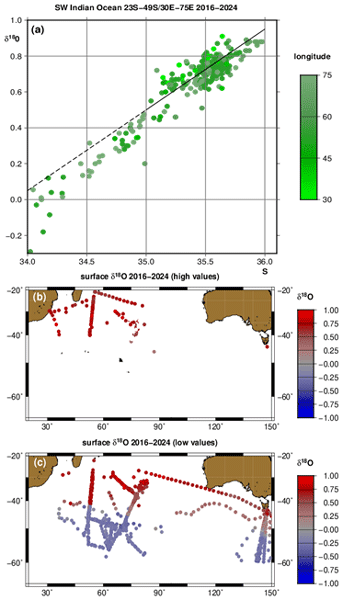
Gilles Reverdin, Claire Waelbroeck, Antje H. L. Voelker, and Hanno Meyer
Ocean Sci., 21, 567–575, https://doi.org/10.5194/os-21-567-2025, https://doi.org/10.5194/os-21-567-2025, 2025
Short summary
Short summary
Water isotopes in the ocean trace the freshwater exchanges between the ocean, the atmosphere, and the cryosphere and are used to investigate processes of the hydrological cycle. We illustrate offsets in seawater isotopic composition between different datasets that are larger than the expected variability that one often wants to explore. This highlights the need to share seawater isotopic composition samples dedicated to specific intercomparison of data produced in different laboratories.
Tirza Maria Weitkamp, Mohammad Javad Razmjooei, Paul Nicholas Pearson, and Helen Katherine Coxall
J. Micropalaeontol., 44, 1–78, https://doi.org/10.5194/jm-44-1-2025, https://doi.org/10.5194/jm-44-1-2025, 2025
Short summary
Short summary
Deep Sea Drilling Project Site 407, near Iceland, offers a valuable 25-million-year record of planktonic foraminifera evolution from the Late Cenozoic. Species counts and ranges, assemblage changes, and biostratigraphic zones were identified. Key findings include the shifts in species dominance and diversity. Challenges include sediment gaps and missing biozone markers. We aim to enhance the Neogene–Quaternary Middle Atlas and improve the North Atlantic palaeoceanography and biostratigraphy.
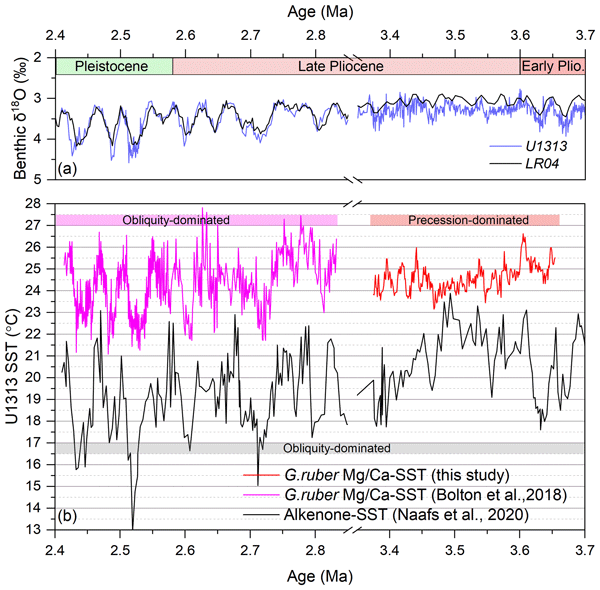
Xiaolei Pang, Antje H. L. Voelker, Sihua Lu, and Xuan Ding
Clim. Past, 20, 2103–2116, https://doi.org/10.5194/cp-20-2103-2024, https://doi.org/10.5194/cp-20-2103-2024, 2024
Short summary
Short summary
Our research discovered significant seasonal temperature variations in the North Atlantic's mid-latitudes during the early Late Pliocene. This highlights the necessity of using multiple methods to get a full picture of past climates, thus avoiding a biased understanding of the climate system. Moreover, our study reveals that the precession signal, which previously dominated surface temperature records, disappeared with the increased influence of the ice sheets in the Northern Hemisphere.
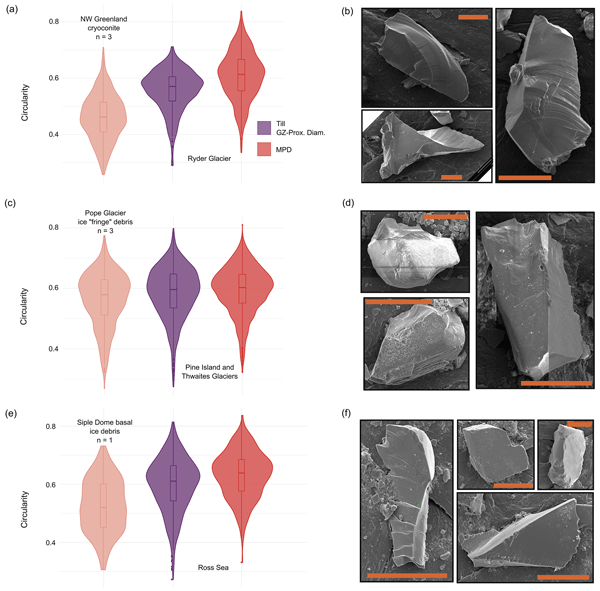
Allison P. Lepp, Lauren E. Miller, John B. Anderson, Matt O'Regan, Monica C. M. Winsborrow, James A. Smith, Claus-Dieter Hillenbrand, Julia S. Wellner, Lindsay O. Prothro, and Evgeny A. Podolskiy
The Cryosphere, 18, 2297–2319, https://doi.org/10.5194/tc-18-2297-2024, https://doi.org/10.5194/tc-18-2297-2024, 2024
Short summary
Short summary
Shape and surface texture of silt-sized grains are measured to connect marine sediment records with subglacial water flow. We find that grain shape alteration is greatest in glaciers where high-energy drainage events and abundant melting of surface ice are inferred and that the surfaces of silt-sized sediments preserve evidence of glacial transport. Our results suggest grain shape and texture may reveal whether glaciers previously experienced temperate conditions with more abundant meltwater.
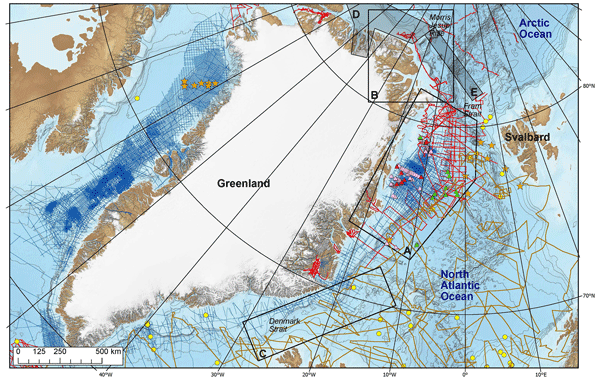
Lara F. Pérez, Paul C. Knutz, John R. Hopper, Marit-Solveig Seidenkrantz, Matt O'Regan, and Stephen Jones
Sci. Dril., 33, 33–46, https://doi.org/10.5194/sd-33-33-2024, https://doi.org/10.5194/sd-33-33-2024, 2024
Short summary
Short summary
The Greenland ice sheet is highly sensitive to global warming and a major contributor to sea level rise. In Northeast Greenland, ice–ocean–tectonic interactions are readily observable today, but geological records that illuminate long-term trends are lacking. NorthGreen aims to promote scientific drilling proposals to resolve key scientific questions on past changes in the Northeast Greenland margin that further affected the broader Earth system.
Nico Wunderling, Anna S. von der Heydt, Yevgeny Aksenov, Stephen Barker, Robbin Bastiaansen, Victor Brovkin, Maura Brunetti, Victor Couplet, Thomas Kleinen, Caroline H. Lear, Johannes Lohmann, Rosa Maria Roman-Cuesta, Sacha Sinet, Didier Swingedouw, Ricarda Winkelmann, Pallavi Anand, Jonathan Barichivich, Sebastian Bathiany, Mara Baudena, John T. Bruun, Cristiano M. Chiessi, Helen K. Coxall, David Docquier, Jonathan F. Donges, Swinda K. J. Falkena, Ann Kristin Klose, David Obura, Juan Rocha, Stefanie Rynders, Norman Julius Steinert, and Matteo Willeit
Earth Syst. Dynam., 15, 41–74, https://doi.org/10.5194/esd-15-41-2024, https://doi.org/10.5194/esd-15-41-2024, 2024
Short summary
Short summary
This paper maps out the state-of-the-art literature on interactions between tipping elements relevant for current global warming pathways. We find indications that many of the interactions between tipping elements are destabilizing. This means that tipping cascades cannot be ruled out on centennial to millennial timescales at global warming levels between 1.5 and 2.0 °C or on shorter timescales if global warming surpasses 2.0 °C.
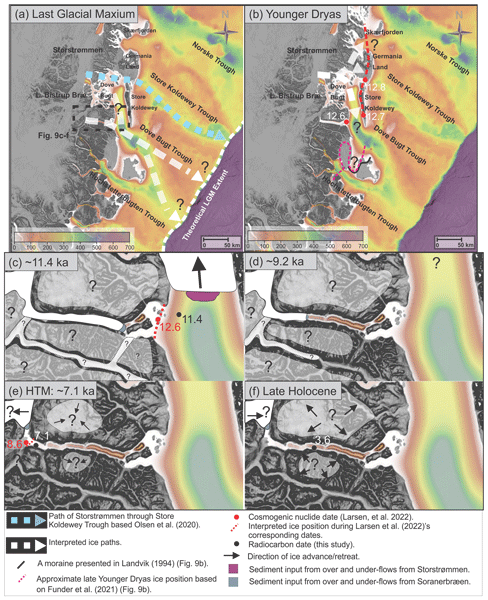
Kevin Zoller, Jan Sverre Laberg, Tom Arne Rydningen, Katrine Husum, and Matthias Forwick
Clim. Past, 19, 1321–1343, https://doi.org/10.5194/cp-19-1321-2023, https://doi.org/10.5194/cp-19-1321-2023, 2023
Short summary
Short summary
Marine geologic data from NE Greenland provide new information about the behavior of the Greenland Ice Sheet from the last glacial period to present. Seafloor landforms suggest that a large, fast-flowing ice stream moved south through southern Dove Bugt. This region is believed to have been deglaciated from at least 11.4 ka cal BP. Ice in an adjacent fjord, Bessel Fjord, may have retreated to its modern position by 7.1 ka cal BP, and the ice halted or readvanced multiple times upon deglaciation.
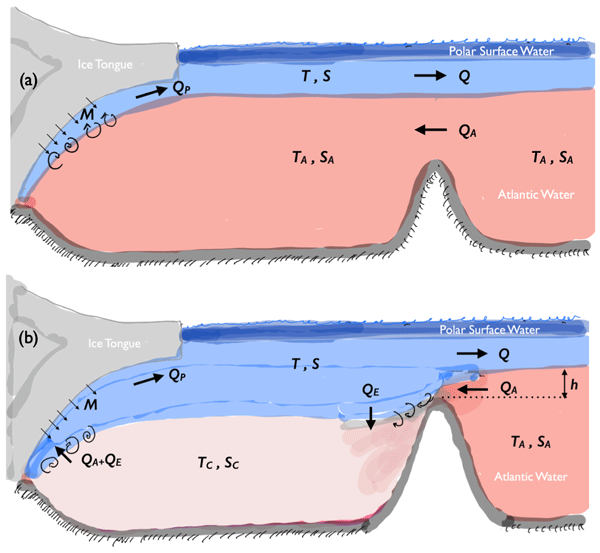
Johan Nilsson, Eef van Dongen, Martin Jakobsson, Matt O'Regan, and Christian Stranne
The Cryosphere, 17, 2455–2476, https://doi.org/10.5194/tc-17-2455-2023, https://doi.org/10.5194/tc-17-2455-2023, 2023
Short summary
Short summary
We investigate how topographical sills suppress basal glacier melt in Greenlandic fjords. The basal melt drives an exchange flow over the sill, but there is an upper flow limit set by the Atlantic Water features outside the fjord. If this limit is reached, the flow enters a new regime where the melt is suppressed and its sensitivity to the Atlantic Water temperature is reduced.
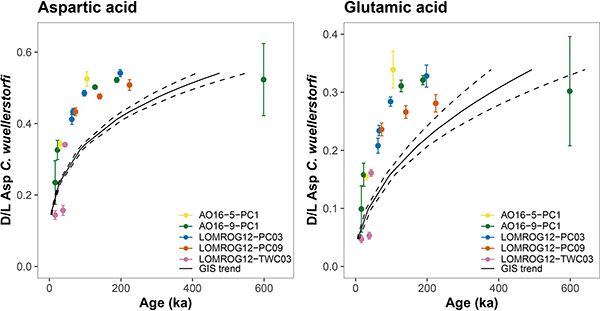
Gabriel West, Darrell S. Kaufman, Martin Jakobsson, and Matt O'Regan
Geochronology, 5, 285–299, https://doi.org/10.5194/gchron-5-285-2023, https://doi.org/10.5194/gchron-5-285-2023, 2023
Short summary
Short summary
We report aspartic and glutamic acid racemization analyses on Neogloboquadrina pachyderma and Cibicidoides wuellerstorfi from the Arctic Ocean (AO). The rates of racemization in the species are compared. Calibrating the rate of racemization in C. wuellerstorfi for the past 400 ka allows the estimation of sample ages from the central AO. Estimated ages are older than existing age assignments (as previously observed for N. pachyderma), confirming that differences are not due to taxonomic effects.
Jesse R. Farmer, Katherine J. Keller, Robert K. Poirier, Gary S. Dwyer, Morgan F. Schaller, Helen K. Coxall, Matt O'Regan, and Thomas M. Cronin
Clim. Past, 19, 555–578, https://doi.org/10.5194/cp-19-555-2023, https://doi.org/10.5194/cp-19-555-2023, 2023
Short summary
Short summary
Oxygen isotopes are used to date marine sediments via similar large-scale ocean patterns over glacial cycles. However, the Arctic Ocean exhibits a different isotope pattern, creating uncertainty in the timing of past Arctic climate change. We find that the Arctic Ocean experienced large local oxygen isotope changes over glacial cycles. We attribute this to a breakdown of stratification during ice ages that allowed for a unique low isotope value to characterize the ice age Arctic Ocean.
Kasia K. Śliwińska, Helen K. Coxall, David K. Hutchinson, Diederik Liebrand, Stefan Schouten, and Agatha M. de Boer
Clim. Past, 19, 123–140, https://doi.org/10.5194/cp-19-123-2023, https://doi.org/10.5194/cp-19-123-2023, 2023
Short summary
Short summary
We provide a sea surface temperature record from the Labrador Sea (ODP Site 647) based on organic geochemical proxies across the late Eocene and early Oligocene. Our study reveals heterogenic cooling of the Atlantic. The cooling of the North Atlantic is difficult to reconcile with the active Atlantic Meridional Overturning Circulation (AMOC). We discuss possible explanations like uncertainty in the data, paleogeography and atmospheric CO2 boundary conditions, model weaknesses, and AMOC activity.
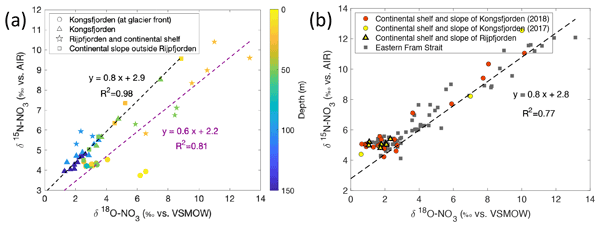
Marta Santos-Garcia, Raja S. Ganeshram, Robyn E. Tuerena, Margot C. F. Debyser, Katrine Husum, Philipp Assmy, and Haakon Hop
Biogeosciences, 19, 5973–6002, https://doi.org/10.5194/bg-19-5973-2022, https://doi.org/10.5194/bg-19-5973-2022, 2022
Short summary
Short summary
Terrestrial sources of nitrate are important contributors to the nutrient pool in the fjords of Kongsfjorden and Rijpfjorden in Svalbard during the summer, and they sustain most of the fjord primary productivity. Ongoing tidewater glacier retreat is postulated to favour light limitation and less dynamic circulation in fjords. This is suggested to encourage the export of nutrients to the middle and outer part of the fjord system, which may enhance primary production within and in offshore areas.

Raisa Alatarvas, Matt O'Regan, and Kari Strand
Clim. Past, 18, 1867–1881, https://doi.org/10.5194/cp-18-1867-2022, https://doi.org/10.5194/cp-18-1867-2022, 2022
Short summary
Short summary
This research contributes to efforts solving research questions related to the history of ice sheet decay in the Northern Hemisphere. The East Siberian continental margin sediments provide ideal material for identifying the mineralogical signature of ice sheet derived material. Heavy mineral analysis from marine glacial sediments from the De Long Trough and Lomonosov Ridge was used in interpreting the activity of the East Siberian Ice Sheet in the Arctic region.
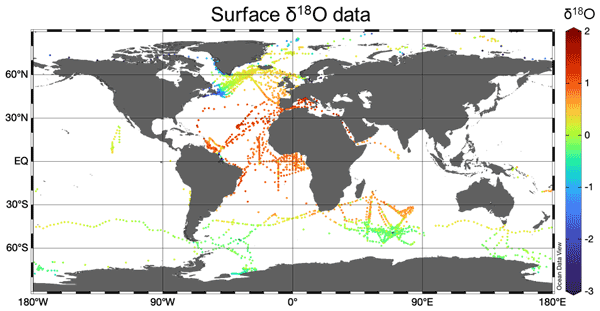
Gilles Reverdin, Claire Waelbroeck, Catherine Pierre, Camille Akhoudas, Giovanni Aloisi, Marion Benetti, Bernard Bourlès, Magnus Danielsen, Jérôme Demange, Denis Diverrès, Jean-Claude Gascard, Marie-Noëlle Houssais, Hervé Le Goff, Pascale Lherminier, Claire Lo Monaco, Herlé Mercier, Nicolas Metzl, Simon Morisset, Aïcha Naamar, Thierry Reynaud, Jean-Baptiste Sallée, Virginie Thierry, Susan E. Hartman, Edward W. Mawji, Solveig Olafsdottir, Torsten Kanzow, Anton Velo, Antje Voelker, Igor Yashayaev, F. Alexander Haumann, Melanie J. Leng, Carol Arrowsmith, and Michael Meredith
Earth Syst. Sci. Data, 14, 2721–2735, https://doi.org/10.5194/essd-14-2721-2022, https://doi.org/10.5194/essd-14-2721-2022, 2022
Short summary
Short summary
The CISE-LOCEAN seawater stable isotope dataset has close to 8000 data entries. The δ18O and δD isotopic data measured at LOCEAN have uncertainties of at most 0.05 ‰ and 0.25 ‰, respectively. Some data were adjusted to correct for evaporation. The internal consistency indicates that the data can be used to investigate time and space variability to within 0.03 ‰ and 0.15 ‰ in δ18O–δD17; comparisons with data analyzed in other institutions suggest larger differences with other datasets.
Cited articles
Adler, R. E., Polyak, L., Ortiz, J. D., Kaufman, D. S., Channell, J. E. T., Xuan, C., Grottoli, A. G., Sellén, E., and Crawford, K. A.: Sediment record from the western Arctic Ocean with an improved Late Quaternary age resolution: HOTRAX core HLY0503-8JPC, Mendeleev Ridge, Global Planet. Change, 68, 18–29, https://doi.org/10.1016/j.gloplacha.2009.03.026, 2009.
Aksu, A. E.: Holocene and Pleistocene dissolution cycles in deep-sea cores of Baffin Bay and Davis Strait: Palaeoceanographic implications, Mar. Geol., 53, 331–348, https://doi.org/10.1016/0025-3227(83)90049-X, 1983.
Aksu, A. E.: Paleomagnetic stratigraphy of the CESAR cores, in: Initial geological report on CESAR: the Canadian expedition to study the Alpha Ridge, edited by: Jackson, H. R., Mudie, P. J., and Blasco, S. M., Arctic Ocean Geological Survey of Canada, Paper 84-22, 101–114, https://doi.org/10.4095/120315, 1985.
Alonso-Garcia, M., Sierro, F. J., and Flores, J. A.: Arctic front shifts in the subpolar North Atlantic during the Mid-Pleistocene (800–400 ka) and their implications for ocean circulation, Palaeogeogr. Palaeoclim., 311, 268–280, https://doi.org/10.1016/j.palaeo.2011.09.004, 2011.
Anglada-Ortiz, G., Rasmussen, T. L., Chierici, M., Fransson, A., Ziveri, P., Thomsen, E., Zamelczyk, K., Meilland, J., Ezat, M. M., and Garcia-Orellana, J.: Changes in Planktic Foraminiferal Distribution, Productivity, and Preservation in the Barents Sea During the Last Three Millennia, Paleoceanogr. Paleoclim., 40, e2024PA004989, https://doi.org/10.1029/2024PA004989, 2025.
Armitage, D. V., Glock, N., Weiss, T. L., Ezat, M. M., Westgård, A., Sykes, F. E., Meilland, J., de la Vega, E., Fabbrini, A., Babila, T. L., and Morley, A.: The impact of essential climate variables on respiration rates in subpolar and polar planktonic foraminifera, Biogeosciences, 23, 3655–3673, https://doi.org/10.5194/bg-23-3655-2026, 2026.
Barrientos, N.: Arctic Ocean benthic foraminifera preservation and Mg/Ca ratios: Implications for bottom water palaeothermometry, Ph.D. thesis, Stockholm University, Sweden, 165 pp., ISBN (electronic): 978-91-7797-176-4, 2018.
Bauch, H. A.: Significance of variability in Turborotalita quinqueloba (Natland) test size and abundance for paleoceanographic interpretations in the Norwegian-Greenland Sea, Mar. Geol., 121, 129–141, https://doi.org/10.1016/0025-3227(94)90162-7, 1994.
Bauch, H. A.: Paleoceanography of the North Atlantic Ocean (68°–76°N) during the past 450 ky deduced from planktic foraminiferal assemblages and stable isotopes, in: Contributions to the Micropaleontology and Paleoceanography of the Northern North Atlantic, edited by: Hass, H. C. and Kaminski, M. A., Grzybowski Foundation Special Publication, Krakow, 83–100, 1997.
Bauch, H. A., Kandiano, E. S., and Helmke, J. P.: Contrasting ocean changes between the subpolar and polar North Atlantic during the past 135 ka, Geophys. Res. Lett., 39, https://doi.org/10.1029/2012GL051800, 2012.
Bé, A. W. H. and Hamlin, W. H.: Ecology of Recent Planktonic Foraminifera: Part 3: Distribution in the North Atlantic during the Summer of 1962, Micropaleontology, 13, 87–106, 1967.
Blow, W. H. and Banner, F. T.: The mid-Tertiary (upper Eocene to Aquitanian) Globigerinacae, in: Fundamentals of mid-Tertiary stratigraphical correlation, edited by: Eames, F. E., Banner, F. T., Blow, W. H., and Clarke, W. J., Cambridge University Press, London, 61-151, ISBN: 978-0-521-17229-5, 1962.
Bown, P. R. and Young, J. R.: Techniques, in: Calcareous nannofossil biostratigraphy, edited by: Bown, P. R., Cambridge, Chapman and Hall, London, 16–28, https://doi.org/10.1007/978-94-011-4902-0_2, 1998.
Brummer, G. J. A. and Kroon, D.: Planktonic foraminifers as tracers of ocean-climate history: ontogeny, relationships and preservation of modern species and stable isotopes, phenotypes and assemblage distribution in different water masses, Free University Press, 346 pp., ISBN 90-6256-744-4, 1988.
Brummer, G.-J. A. and Kučera, M.: Taxonomic review of living planktonic foraminifera, J. Micropalaeontol., 41, 29–74, https://doi.org/10.5194/jm-41-29-2022, 2022.
Brummer, G. J. A., Hemleben, C., and Spindler, M.: Ontogeny of extant spinose planktonic foraminifera (Globigerinidae): A concept exemplified by Globigerinoides sacculifer (Brady) and G. ruber (d'Orbigny), Mar. Micropaleontol., 12, 357–381, 1987.
Bukry, D.: Coccolith and Silicoflagellate Stratigraphy, Northern Mid-Atlantic Ridge and Reykjanes Ridge, Deep Sea Drilling Project Leg 49, in: Initial Reports of the Deep Sea Drilling Project, edited by: Luyendyk, B. P., Cann, J. R., and Sharman, G. S., US Government Printing Office, 551–581, https://doi.org/10.2973/dsdp.proc.49.118.1979, 1979.
Carstens, J. and Wefer, G.: Recent distribution of planktonic foraminifera in the Nansen Basin, Arctic Ocean, Deep-Sea Res. Pt. A, 39, S507–S524, https://doi.org/10.1016/S0198-0149(06)80018-X, 1992.
Carstens, J., Hebbeln, D. and Wefer, G.: Distribution of planktic foraminifera at the ice margin in the Arctic (Fram Strait), Mar. Micropaleontol., 29, 257–269, https://doi.org/10.1016/S0377-8398(96)00014-X, 1997.
Cifelli, R. and Smith, R. K.: Distribution of planktonic Foraminifera in the vicinity of the North Atlantic Current, Smithsonian Contributions to Paleobiology, 4, 359–866, 1970.
Clark, D. L.: Magnetic reversals and sedimentation rates in the Arctic Basin, Geol. Soc. Am. Bull., 81, 3129–3134, https://doi.org/10.1130/0016-7606(1970)81[3129:MRASRI]2.0.CO;2, 1970.
Clotten, C., Stein, R., Fahl, K., and De Schepper, S.: Seasonal sea ice cover during the warm Pliocene: Evidence from the Iceland Sea (ODP Site 907), Earth Planet. Sc. Lett., 481, 61–72, https://doi.org/10.1016/j.epsl.2017.10.011, 2018.
Cronin, T. M., Smith, S. A., Eynaud, F., O'Regan, M., and King, J.: Quaternary paleoceanography of the central Arctic based on Integrated Ocean Drilling Program Arctic Coring Expedition 302 foraminiferal assemblages, Paleoceanography, 23, https://doi.org/10.1029/2007PA001484, 2008.
Cronin, T. M., Polyak, L., Reed, D., Kandiano, E. S., Marzen, R. E., and Council, E. A.: A 600-ka Arctic sea-ice record from Mendeleev Ridge based on ostracodes, Quaternary Sci. Rev., 79, 157–167, https://doi.org/10.1016/j.quascirev.2012.12.010, 2013.
Cronin, T. M., DeNinno, L. H., Polyak, L., Caverly, E. K., Poore, R. Z., Brenner, A., Rodriguez-Lazaro, J., and Marzen, R. E.: Quaternary ostracode and foraminiferal biostratigraphy and paleoceanography in the western Arctic Ocean, Mar. Micropaleontol., 111, 118–133, https://doi.org/10.1016/j.marmicro.2014.05.001, 2014.
Cronin, T. M., Keller, K. J., Farmer, J. R., Schaller, M. F., O'Regan, M., Poirier, R., Coxall, H., Dwyer, G. S., Bauch, H. Kindstedt, I. G., Jakobsson, M., Marzen, R., and Santin, E.: Interglacial Paleoclimate in the Arctic, Paleoceanogr. Paleoclim., 34, 1959–1979, https://doi.org/10.1029/2019PA003708, 2019.
Darling, F. K., Kucera, M., Pudsey, C. J., and Wade, C. M.: Molecular evidence links cryptic diversification in polar planktonic protists to Quaternary climate dynamics, P. Natl. Acad. Sci. USA, 101, 7657–7662, https://doi.org/10.1073/pnas.0402401101, 2004.
Darling, K. F. and Wade, C. M.: The genetic diversity of planktic foraminifera and the global distribution of ribosomal RNA genotypes, Mar. Micropaleontol., 67, 216–238, https://doi.org/10.1016/j.marmicro.2008.01.009, 2008.
Darling, K. F., Kucera, M., Kroon, D., and Wade, C. M.: A resolution for the coiling direction paradox in Neogloboquadrina pachyderma, Paleoceanography, 21, 1–14, 2006.
Darling, K. F., Kucera, M., and Wade, C. M.: Global molecular phylogeography reveals persistent Arctic circumpolar isolation in a marine planktonic protist, P. Natl. Acad. Sci. USA, 104, https://doi.org/10.1073/pnas.0700520104, 2007.
Darling, K. F., Wade, C. M., Siccha, M., Trommer, G., Schulz, H., Abdolalipour, S., and Kurasawa, A.: Genetic diversity and ecology of the planktonic foraminifers Globigerina bulloides, Turborotalita quinqueloba and Neogloboquadrina pachyderma off the Oman margin during the late SW Monsoon, Mar. Micropaleontol., 137, 64–77, https://doi.org/10.1016/j.marmicro.2017.10.006, 2017.
Davis, C. V., Livsey, C. M., Palmer, H. M., Hull, P. M., Thomas, E., Hill, T. M., and Benitez-Nelson, C. R.: Extensive morphological variability in asexually produced planktic foraminifera, Sci. Adv., 6, eabb8930, https://doi.org/10.1126/sciadv.abb8930, 2020.
Ding, X., Wang, R., Zhang, H., and Tao, Z.: Distribution, ecology, and oxygen and carbon isotope characteristics of modern planktonic foraminifers in the Makarov Basin of the Arctic Ocean, Chinese Sci. Bull., 59, 674–687, https://doi.org/10.1007/s11434-013-0082-8, 2014.
El Bani Altuna, N., Pieńkowski, A. J., Eynaud, F., and Thiessen, R.: The morphotypes of Neogloboquadrina pachyderma: Isotopic signature and distribution patterns in the Canadian Arctic Archipelago and adjacent regions, Mar. Micropaleontol., 142, 13–24, https://doi.org/10.1016/j.marmicro.2018.05.004, 2018.
Eynaud, F.: Planktonic foraminifera in the Arctic: potentials and issues regarding modern and quaternary populations, IOP Conference Series: Earth and Environmental Science, 14, 012005, https://doi.org/10.1088/1755-1315/14/1/012005, 2011.
Eynaud, F., Cronin, T. M., Smith, S. A., Zaragosi, S., Mavel, J., Mary, Y., Mas, V., and Pujol, C.: Morphological variability of the planktonic foraminifer Neogloboquadrina pachyderma from ACEX cores: Implications for Late Pleistocene circulation in the Arctic Ocean, Micropaleontology, 55, The Arctic Coring Expedition (IODP 302): Micropaleontology at the North Pole, 101–116, https://doi.org/10.47894/mpal.55.2.02, 2009.
Ezard, T. H., Pearson, P. N., and Purvis, A.: Algorithmic approaches to aid species' delimitation in multidimensional morphospace, BMC Evol. Biol., 10, 175, https://doi.org/10.1186/1471-2148-10-175, 2010.
Fabbrini, A., Greco, M., Iacoviello, F., Kucera, M., Ezard, T. H. G., and Wade, B. S.: Bridging the extant and fossil record of planktonic foraminifera: implications for the Globigerina lineage, Palaeontology, 66, e12676, https://doi.org/10.1111/pala.12676, 2023.
Falzoni, F., Petrizzo, M. R., Huber, B. T., and MacLeod, K. G.: Insights into the meridional ornamentation of the planktonic foraminiferal genus Rugoglobigerina (Late Cretaceous) and implications for taxonomy, Cretaceous Res., 47, 87–104, https://doi.org/10.1016/j.cretres.2013.11.001, 2014.
Greco, M., Jonkers, L., Kretschmer, K., Bijma, J., and Kucera, M.: Depth habitat of the planktonic foraminifera Neogloboquadrina pachyderma in the northern high latitudes explained by sea-ice and chlorophyll concentrations, Biogeosciences, 16, 3425–3437, https://doi.org/10.5194/bg-16-3425-2019, 2019.
Greco, M., Morard, R., and Kucera, M.: Single-cell metabarcoding reveals biotic interactions of the Arctic calcifier Neogloboquadrina pachyderma with the eukaryotic pelagic community, J. Plankton Res., 43, 113–125, https://doi.org/10.1093/plankt/fbab015, 2021.
Greco, M., Werner, K., Zamelczyk, K., Rasmussen, T. L., and Kucera, M.: Decadal trend of plankton community change and habitat shoaling in the Arctic gateway recorded by planktonic foraminifera, Glob. Change Biol., 28, 1798–1808, https://doi.org/10.1111/gcb.16037, 2022.
Hanslik, D.: Late Quaternary biostratigraphy and paleoceanography of the central Arctic Ocean, Ph.D. Thesis, Stockholm University, Sweden, ISBN 978-91-7447-311-7, 2011.
Hanslik, D., Löwemark, L. and Jakobsson, M.: Biogenic and detrital-rich intervals in central Arctic Ocean cores identified using x-ray fluorescence scanning, Polar Res., 32, 18386, https://doi.org/10.3402/polar.v32i0.18386, 2013.
Hemleben, C., Spindler, M., and Anderson, O. R.: Modern planktonic foraminifera, Springer-Verlag, New York, 363 pp., ISBN 3-540-96815-6, 1989.
Hemleben, C. H., Olsson, R. K., Premec Fucek, V., and Hernández Fernández, M.: Wall textures of Oligocene normal perforate planktonic foraminifera, in: Atlas of Oligocene Planktonic Foraminifera, edited by: Wade, B., Olsson, R. K., Pearson, P. N., Huber, B. T., and Berggren, W. A., Cushman Foundation Special Publication, Washington D.C., 46, 55–78, ISBN (electronic volume): 978-1-970168-41-9, 2018.
Herman, Y.: Temperature water planktonic foraminifer in Quaternary sediments of the Arctic Ocean, Nature, 201, 386–387, 1964.
Herman, Y.: Arctic Paleo-Oceanography in Late Cenozoic Time, Science, 169, 474, https://doi.org/10.1126/science.169.3944.474, 1970.
Herman, Y.: Arctic Ocean sediments, microfauna, and the climatic record in late Cenozoic time, in: Marine geology and oceanography of the Arctic seas, edited by: Herman, Y., Springer, Berlin, 283–348, ISBN (Volume): 3-540-06628-4, 1974.
Herman, Y.: Globigerina exumbilicata Herman, 1974, a Synonym of G. quinqueloba egelida Cifelli and Smith, 1970, J. Paleontol., 54, 631, 1980.
Herman, Y.: Baffin Bay: present-day analog of the central Arctic during late Pliocene to mid-Pleistocene time, Geology, 11, 356–359, https://doi.org/10.1130/0091-7613(1983)11<356:BBPAOT>2.0.CO;2, 1983.
Herman, Y. and Hopkins, D. M.: Arctic Oceanic Climate in Late Cenozoic Time, Science, 209, 557, https://doi.org/10.1126/science.209.4456.557, 1980.
Herman, Y. and O'Neil, J. R.: Arctic palaeosalinities during late Cainozoic time, Nature, 258, 591–595, https://doi.org/10.1038/258591a0, 1975.
Hillaire-Marcel, C., Ghaleb, B., de Vernal, A., Maccali, J., Cuny, K., Jacobel, A., Le Duc, C., and McManus, J.: A New Chronology of Late Quaternary Sequences From the Central Arctic Ocean Based on “Extinction Ages” of Their Excesses in 231Pa and 230Th, Geochem. Geophy., Geosy., 18, 4573–4585, https://doi.org/10.1002/2017GC007050, 2017.
Huber, R., Meggers, H., Baumann, K.-H., Raymo, M. E., and Henrich, R.: Shell size variation of the planktonic foraminifer Neogloboquadrina pachyderma sin. in the Norwegian–Greenland Sea during the last 1.3 Myrs: implications for paleoceanographic reconstructions, Palaeogeogr, Palaeoclim., 160, 193–212, https://doi.org/10.1016/S0031-0182(00)00066-3, 2000.
Husum, K. and Hald, M.: Arctic planktic foraminiferal assemblages: Implications for subsurface temperature reconstructions, Mar. Micropaleontol., 99, 8–17, https://doi.org/10.1016/j.marmicro.2013.03.012, 2012.
ICZN (International Code of Zoological Nomenclature): International Code of Zoological Nomenclature, Fourth Edition, The Natural History Museum London, London, 306 pp., ISBN 0-85301-006-4, 2012.
Jakobsson, M., Løvlie, R., Arnold, E. M., Backman, J., Polyak, L., Knutsen, J. O., and Musatov, E.: Pleistocene stratigraphy and paleoenvironmental variation from Lomonosov Ridge sediments, central Arctic Ocean, Global Planet. Change, 31, 1–22, https://doi.org/10.1016/S0921-8181(01)00110-2, 2001.
Jakobsson, M., Mayer, L. A., Bringensparr, C., Castro, C. F., Mohammad, R., Johnson, P., Ketter, T., Accettella, D., Amblas, D., An, L., Arndt, J. E., Canals, M., Casamor, J. L., Chauché, N., Coakley, B., Danielson, S., Demarte, M., Dickson, M.-L., Dorschel, B., Dowdeswell, J. A., Dreutter, S., Fremand, A. C., Gallant, D., Hall, J. K., Hehemann, L., Hodnesdal, H., Hong, J., Ivaldi, R., Kane, E., Klaucke, I., Krawczyk, D. W., Kristoffersen, Y., Kuipers, B. R., Millan, R., Masetti, G., Morlighem, M., Noormets, R., Prescott, M. M., Rebesco, M., Rignot, E., Semiletov, I., Tate, A. J., Travaglini, P., Velicogna, I., Weatherall, P., Weinrebe, W., Willis, J. K., Wood, M., Zarayskaya, Y., Zhang, T., Zimmermann, M., and Zinglersen, K. B.: The International Bathymetric Chart of the Arctic Ocean Version 4.0, Sci. Data, 7, 176, https://doi.org/10.1038/s41597-020-0520-9, 2020.
Jang, K., Bayon, G., Han, Y., Joe, Y. J., Jun, S.-Y., Son, Y. J., Matthiessen, J., O’Regan, M., Vogt, C., Stein, R., Sakamoto, T., Byun, E., Woo, K. S., and Nam, S.-I.: The potential role of Arctic seaway expansion in driving the Mid-Pleistocene Transition, Commun. Earth Environ., 7, 449, doi.org/10.1038/s43247-026-03570-4, 2026.
Jansen, E., Fronval, T., Rack, F., and Channell, J. E. T.: Pliocene-Pleistocene ice rafting history and cyclicity in the Nordic Seas during the last 3.5 Myr, Paleoceanography, 15, 709–721, https://doi.org/10.1029/1999PA000435, 2000.
Jennings, A. E., Andrews, J. T., Ó Cofaigh, C., St-Onge, G., Belt, S., Cabedo-Sanz, P., Pearce, C., Hillaire-Marcel, and Calvin Campbell, D.: Baffin Bay paleoenvironments in the LGM and HS1: Resolving the ice-shelf question, Mar. Geol., 402, 5–16, https://doi.org/10.1016/j.margeo.2017.09.002, 2018.
Jensen, S.: Planktonforaminiferen im Europäischen Nordmeer: Verbreitung und Vertikalfluß sowie ihre Entwicklung während der letzten 15 000 Jahre, Berichte aus dem Sonderforschungsbereich, Ph.D. thesis, University Kiel, Germany, 105 pp., https://doi.org/10.2312/reports-sfb313.1998.75, 1998.
Johannessen, T., Jansen, E., Flatøy, A., and Ravelo, A.-C.: The Relationship between Surface Water Masses, Oceanographic Fronts and Paleoclimatic Proxies in Surface Sediments of the Greenland, Iceland, Norwegian Seas, in: Carbon Cycling in the Glacial Ocean: Constraints on the Ocean's Role in Global Change, edited by: Zahn, R., Pedersen, T. F., Kaminski, M. A., and Labeyrie, L., Springer Berlin Heidelberg, Berlin, Heidelberg, 61–85, ISBN 978-3-540-57594-8, 1994.
Jonkers, L., Brummer, G.-J. A., Peeters, F. J. C., van Aken, H. M., and De Jong, M. F.: Seasonal stratification, shell flux, and oxygen isotope dynamics of left-coiling N. pachyderma and T. quinqueloba in the western subpolar North Atlantic, Paleoceanography, 25, https://doi.org/10.1029/2009PA001849, 2010.
Keany, J. and Kennett, J. P.: Pliocene-early Pleistocene paleoclimatic history recorded in Antarctic-Subantarctic deep-sea cores, Deep-Sea Res., 19, 529–548, https://doi.org/10.1016/0011-7471(72)90038-1, 1972.
Keating-Bitonti, C. R. and Payne, J. L.: Environmental influence on growth history in marine benthic foraminifera, Paleobiology, 44, 736–757, https://doi.org/10.1017/pab.2018.19, 2018.
Kennett, J. P. and Srinivasan, M. S.: Neogene planktonic foraminifera: a phylogenetic atlas, Hutchinson Ross, Stroudsburg, Penn., 265 pp., ISBN 978-0879330705, 1983.
Knies, J., O'Regan, M., and Marcel, C. H.: Finding consensus on Arctic Ocean climate history, EOS T. Am. Geophys. Un., 106, https://doi.org/10.1029/2025EO250230, 2025.
Knutz, P. C., Jennings, A. E., Childress, L. B., and Scientists, E. (Eds.): NW Greenland Glaciated Margin. International Ocean Discovery Program, College Station, TX, https://doi.org/10.14379/iodp.proc.400.2025, 2025.
Kucera, M. and Darling, K. F.: 2002: Cryptic species of planktonic foraminifera: their effect on palaeoceanographic reconstructions, P. Trans. R. Soc. Lond. A, 360, https://doi.org/10.1098/rsta.2001.0962, 2002.
Lisiecki, L. E. and Raymo, M. E.: A Pliocene-Pleistocene stack of 57 globally distributed benthic δ18O records, Paleoceanography, 20, PA1003, https://doi.org/10.1029/2004PA001071, 2005.
Löwemark, L., März, C., O'Regan, M., and Gyllencreutz, R.: Arctic Ocean Mn-stratigraphy: Genesis, synthesis and inter-basin correlation, Quaternary Sci. Rev., 92, 97–111, https://doi.org/10.1016/j.quascirev.2013.11.018, 2014.
Malmgren, B. A., Berggren, W. A., and Lohmann, G. P.: Evidence for punctuated gradualism in the Late Neogene Globorotalia tumida lineage of planktonic foraminifera, Paleobiology, 9, 377–389, https://doi.org/10.1017/S0094837300007843, 1983.
Martinelli, P., Cacho, I., Cavallero, E., Cascella, A., Di Bella, L., Lirer, F., Selvaggi, M., and Gennari, R.: Increase the magnification, they are shrinking! Morphometric variations of the planktic foraminifera Globigerina bulloides in response to environmental changes over the last 27.4 ka in the Ligurian Sea, Mar. Micropaleontol., 203, 102552, https://doi.org/10.1016/j.marmicro.2026.102552, 2026.
Martini, E.: Calcareous Nannoplankton and Silicoflagellate Biostratigraphy at Reykjanes Ridge, Northeastern North Atlantic (DSDP Leg 49, Sites 407 and 409), in: Initial Reports of the Deep Sea Drilling Project, edited by: Luyendyk, B. P., Cann, J. R., and Sharman, G. S., US Government Printing Office, 49, 533–549, https://doi.org/10.2973/dsdp.proc.49.117.1979, 1979.
Matthiessen, J., Schreck, M., De Schepper, S., Zorzi, C., and de Vernal, A.: Quaternary dinoflagellate cysts in the Arctic Ocean: Potential and limitations for stratigraphy and paleoenvironmental reconstructions, Quaternary Sci. Rev., 192, 1–26, https://doi.org/10.1016/j.quascirev.2017.12.020, 2018.
Meilland, J., Howa, H., Hulot, V., Demangel, I., Salaün, J., and Garlan, T.: Population dynamics of modern planktonic foraminifera in the western Barents Sea, Biogeosciences, 17, 1437–1450, https://doi.org/10.5194/bg-17-1437-2020, 2020.
Meilland, J., Ezat, M. M., Westgård, A., Manno, C., Morard, R., Siccha, M., and Kucera, M.: Rare but persistent asexual reproduction explains the success of planktonic foraminifera in polar oceans, J. Plankton Res., 45, 15–32, https://doi.org/10.1093/plankt/fbac069, 2023.
Meilland, J., Siccha, M., Morard, R., and Kucera, M.: Continuous reproduction of planktonic foraminifera in laboratory culture, J. Eukaryot. Microbiol., e13022, https://doi.org/10.1111/jeu.13022, 2024.
Moffa-Sánchez, P., Hall, I. R., Barker, S., Thornalley, D. J. R., and Yashayaev, I.: Surface changes in the eastern Labrador Sea around the onset of the Little Ice Age, Paleoceanography, 29, 160–175, https://doi.org/10.1002/2013PA002523, 2014.
Mokeddem, Z., McManus, J. F., and Oppo, D. W.: Oceanographic dynamics and the end of the last interglacial in the subpolar North Atlantic, P. Natl. Acad. Sci. USA, 111, 11263–11268, https://doi.org/10.1073/pnas.1322103111, 2014.
Morard, R., Darling, K. F., Mahé, F., Audic, S., Ujiié, Y., Weiner, A. K., André, A., Seears, H. A., Wade, C. M., Quillévéré, F., Douady, C. J., Escarguel, G., de Garidel-Thoron, T., Siccha, M., Kucera, M., and de Vargas, C.: PFR2: a curated database of planktonic foraminifera 18S ribosomal DNA as a resource for studies of plankton ecology, biogeography and evolution, Mol. Ecol. Resour., 15, 1472–1485, https://doi.org/10.1111/1755-0998.12410, 2015.
Morard, R., Darling, K. F., Weiner, A. K. M., Hassenrück, C., Vanni, C., Cordier, T., Henry, N., Greco, M., Vollmar, N. M., Milivojevic, T., Rahman, S. N., Siccha, M., Meilland, J., Jonkers, L., Quillévéré, F., Escarguel, G., Douady, C. J., de Garidel, Thoron, T., de Vargas, C., and Kucera, M.: The global genetic diversity of planktonic foraminifera reveals the structure of cryptic speciation in plankton, Biol. Rev., 99, 1218–1241, https://doi.org/10.1111/brv.13065, 2024.
Natland, M. L.: New Species of foraminifera from off the west coast of North America and from the later Tertiary of the Los Angeles Basin, Bulletin of the Scripps Institution of Oceanography of the University of California La Jolla, California, Technical Series, 4, 137–164, 1938.
Norris, R. D., Wilson, P. A., Blum, P., and Scientists, E.: Proc. IODP, 342, http://https://doi.org/10.2204/iodp.proc.342.106.2014, 2014.
Nørgaard-Pedersen, N., Mikkelsen, N., Lassen, S. J., Kristoffersen, Y. and Sheldon, E.: Reduced sea ice concentrations in the Arctic Ocean during the last interglacial period revealed by sediment cores off northern Greenland, Paleoceanography, 22, PA1218, https://doi.org/10.1029/2006PA001283, 2007.
Ogg, J. G.: Geomagnetic Polarity Time Scale, in: Geologic Time Scale 2020, edited by: Gradstein, F. M., Ogg, J. G., Schmitz, M. D., and Ogg, G. M., Elsevier, 159–192, https://doi.org/10.1016/B978-0-12-824360-2.00005-X, 2020.
Olsson, R. K., Hemleben, C., Huber, B. T., and Berggren, W. A.: Taxonomy, biostratigraphy and phylogeny of Globigerina, Globoturborotalita, Subbotina, and Turborotalita, in: Atlas of Eocene planktonic foraminifera, Cushman Foundation of Foraminiferal Research, Special Publication no. 41, edited by: Pearson, P. N., Olsson, R. K., Hemleben, C., Huber, B. T., and Berggren, W. A., Allen Press, Lawrence, Kansas, 111–168, ISBN (electronic): 9781970168365, 2006.
O'Regan, M., King, J., Backman, J., Jakobsson, M., Pälike, H., Moran, K., Heil, C. Sakamoto, T. Cronin, T. M., and Jordan, R. W.: Constraints on the Pleistocene chronology of sediments from the Lomonosov Ridge, Paleoceanography, 23, PA1S19, https://doi.org/10.1029/2007PA001551, 2008.
O'Regan, M., Backman, J., Fornaciari, E., Jakobsson, M., and West, G.: Calcareous nannofossils anchor chronologies for Arctic Ocean sediments back to 500 ka, Geology, 48, 1115–1119, https://doi.org/10.1130/G47479.1, 2020.
O'Regan, M., Coxall, H. K., Cronin, T. M., Gyllencreutz, R., Jakobsson, M., Kaboth, S., Löwemark, L., Wiers, S., Löwemark, and West, G.: Stratigraphic Occurrences of Sub-Polar Planktic Foraminifera in Pleistocene Sediments on the Lomonosov Ridge, Arctic Ocean, Front. Earth Sci., 7, https://doi.org/10.3389/feart.2019.00071, 2019.
O'Regan, M., Jakobsson, M., and Moran, K.: Did the central Arctic become a sediment-starved basin in the Quaternary?, Mar. Geol., 494, 107729, https://doi.org/10.1016/j.margeo.2026.107729, 2026.
Parker, F. L.: Planktonic Foraminiferal Species in Pacific Sediments, Micropaleontology, 8, 219–254, 1962.
Pearson, P. N.: A lineage phylogeny for the Paleogene planktonic foraminifera, Micropaleontology, 39, 193–232, 1993.
Pearson, P. N. and Ezard, T. H. G.: Evolution and speciation in the Eocene planktonic foraminifer Turborotalia, Paleobiology, 40, 130–143, https://doi.org/10.1666/13004, 2014.
Pearson, P. N. and Kucera, M.: Taxonomy, biostratigraphy, and phylogeny of Oligocene Turborotalita, in: Atlas of Oligocene Planktonic Foraminifera, edited by: Wade, B., Olsson, R. K., Pearson, P. N., Huber, B. T., and Berggren, W. A., Cushman Foundation Special Publication, Washington D.C., 46, 385–392, 2018.
Perch-Nielsen, K.: Mesozoic calcareous nannofossils, in: Plankton stratigraphy, Cambridge University Press, edited by: Bolli, H. M., Saunders, J. B., and Perch-Nielsen, K., Cambridge University Press, UK, 329–426, ISBN 978-0521367196, 1985.
Polyak, L., Curry, W. B., Darby, D. A., Bischof, J., and Cronin, T. M.: Contrasting glacial/interglacial regimes in the western Arctic Ocean as exemplified by a sedimentary record from the Mendeleev Ridge. Palaeogeography, Palaeoclimatology, Palaeoecology, 203, 73–93, https://doi.org/10.1016/S0031-0182(03)00661-8, 2004.
Polyak, L., Alley, R. B., Andrews, J. T., Brigham-Gretted, J., Cronin, T. M., Darby, D. A., Dyke, A. S., Fitzpatrick, J. J., Funder, S., Holland, M. M., Jennings, A. E., Miller, G. H. , O'Regan, M., Savellel, J., Serreze, M., St. John, K., James, W. C., and Whitec, E. W.: History of sea ice in the Arctic, Quaternary Sci. Rev., 29, 1757–1778, 2010.
Polyak, L., Best, K. M., Crawford, K. A., Council, E. A., and St-Onge, G.: Quaternary history of sea ice in the western Arctic Ocean based on foraminifera, Quaternary Sci. Rev., 79, 145–156, https://doi.org/10.1016/j.quascirev.2012.12.018, 2013.
Poore, R. Z.: Oligocene through quaternary planktonic foraminiferal biostratigraphy of the North Atlantic: DSDP Leg 49, in: Initial Reports of the Deep Sea Drilling Project, edited by: Luyendyk, B. P., Cann, J. R., and Sharman, G. S., US Government Printing Office, 49, 447–571, https://doi.org/10.2973/dsdp.proc.49.115.1979, 1979.
Raffi, I., Backman, J., Fornaciari, E., Pälike, H., Rio, D., Lourens, L., and Hilgen, F.: A review of calcareous nannofossil astrobiochronology encompassing the past 25 million years, Quaternary Sci. Rev., 25, 3113–3137, https://doi.org/10.1016/j.quascirev.2006.07.007, 2006.
Razmjooei, M. J., Henderiks, J., Coxall, H. K., Baumann, K.-H., Vermassen, F., Jakobsson, M., Niessen, F., and O'Regan, M.: Revision of the Quaternary calcareous nannofossil biochronology of Arctic Ocean sediments, Q. Sci. Rev., 321, 108382, https://doi.org/10.1016/j.quascirev.2023.108382, 2023.
Saito, T. (Ed.): Micropaleontology, petrography and lithostratigraphy of Cenozoic rocks of the Yogyakarta region, Central Java, Dept of Earth Sciences, Yamagata University, 1981.
Schiebel, R. and Hemleben, C.: Planktic Foraminifera in the Modern Ocean, Springer, 358 pp., https://doi.org/10.1007/978-3-662-50297-6, 2017.
Schindler, J. F.: The impact of ice island-the story of Arlis II and Fletcher's Ice-Island, T-3, since 1962, in: Arctic Drifting Stations, edited by: Sater, J. E., Arctic Institute of North America, 49–78, 1968.
Schmidt, D. N., Renaud, S., and Bollmann, J.: Response of planktic foraminiferal size to late Quaternary climate change, Paleoceanography, 18, 12 pp., 2003.
Schneider, C. A., Rasband, W. S., and Eliceiri, K. W.: NIH Image to ImageJ: 25 years of image analysis, Nat. Meth., 9, 671–675, https://doi.org/10.1038/nmeth.2089, 2012.
Shipboard Scientific Party: Site 907, in: Proceedings of the ODP, Initial Reports 151, edited by: Myhre, A. M., Thiede, J., Firth, J. V., et al., 57–111, Ocean Drilling Program, College Station, TX, https://doi.org/10.2973/odp.proc.ir.151.105.1995, 1995.
Simstich, J., Sarnthein, M., and Erlenkeuser, H.: Paired δ18O signals of Neogloboquadrina pachyderma (s) and Turborotalita quinqueloba show thermal stratification structure in Nordic Seas, Mar. Micropaleontol., 48, 107–125, https://doi.org/10.1016/S0377-8398(02)00165-2, 2003.
Snoeijs-Leijonmalm, P. and the SAS-Oden 2021 Scientific Party: Expedition Report SWEDARCTIC: Synoptic Arctic Survey 2021 with icebreaker Oden, 300, ISBN (electronic): 978-91-519-3672-7, 2022.
Spezzaferri, S., Coxall, H. K., Olsson, R. K., and Hemleben, C. H.: Taxonomy, biostratigraphy, and phylogeny of Oligocene Globigerina, Globigerinella, and Quiltyella n. gen., in: Atlas of Oligocene Planktonic Foraminifera, edited by: Wade, B., Olsson, R. K., Pearson, P. N., Huber, B. T., and Berggren, W. A., Cushman Foundation Special Publication, Washington D.C., 46, 179–214, 2018.
Spiegler, D.: Planktonic foraminifer Cenozoic biostratigraphy of the Arctic Ocean, Fram Strait (Sites 908-909), Yermak Plateau (sites 910-912), and East Greenland Margin (Site 931), in: Proceedings of the Ocean Drilling Program, Scientific Results, edited by: Thiede, J., Myhre, A. M., Firth, J. V., Johnson, G. L., and Ruddiman, W. F., Ocean Drilling Program, College Station, TX, 151, 153–167, https://doi.org/10.2973/odp.proc.sr.151.104.1996, 1996.
Stangeew, E.: Distribution and isotopic composition of living planktonic foraminifera N. pachyderma (sinistral) and T. quinqueloba in the high latitude North Atlantic, Ph.D. dissertation, Christian-Albrechts-Univ., Kiel, Germany, 2001.
Stehman, C. F.: Planktonic foraminifera in Baffin Bay, Davis Strait and the Labrador Sea, Maritime Sediments, 8, 13–19, 1972.
Stehman, C. F. and Gregory, M.: A preliminary account of benthonic and planktonic foraminifera in Baffin Bay, Davis Strait and the Labrador Sea, in Earth science symposium on offshore eastern Canada, Geological Survey of Canada Paper, 71–23, 499–507, 1973.
Steinmetz, J. C.: Calcareous Nannofossils from the North Atlantic Ocean, Leg 49, Deep Sea Drilling Project, in: Initial Reports of the Deep Sea Drilling Project, edited by: Luyendyk, B. P., Cann, J. R., and Sharman, G. S., US Government Printing Office, 49, 519–531, https://doi.org/10.2973/dsdp.proc.49.116.1979, 1979.
Tabachnick, R. E. and Bookstein, F. L.: The structure of individual variation in Miocene Globorotalia, Evolution, 44, 416–434, https://doi.org/10.1111/j.1558-5646.1990.tb05209.x, 1990.
Takagi, H., Kimoto, K., Fujiki, T., Saito, H., Schmidt, C., Kucera, M., and Moriya, K.: Characterizing photosymbiosis in modern planktonic foraminifera, Biogeosciences, 16, 3377–3396, https://doi.org/10.5194/bg-16-3377-2019, 2019.
Tesi, T., Muschitiello, F., Mollenhauer, G., Miserocchi, S., Langone, L., Ceccarelli, C., Panieri, G., Chiggiato, J., Nogarotto, A., Hefter, J., Ingrosso, G., Giglio, F., Giordano, P., and Capotondi, L.: Rapid Atlantification along the Fram Strait at the beginning of the 20th century, Sci. Adv., 7, eabj2946, https://doi.org/10.1126/sciadv.abj2946, 2021.
Todd, C. L., Schmidt, D. N., Robinson, M. M., and De Schepper, S.: Planktic Foraminiferal Test Size and Weight Response to the Late Pliocene Environment, Paleoceanogr. Paleoclim., 35, e2019PA003738, https://doi.org/10.1029/2019PA003738, 2020.
Vermassen, F., O'Regan, M., West, G., Cronin, T. M., and Coxall, H. K.: Testing the stratigraphic consistency of Pleistocene microfossil bioevents identified on the Alpha and Lomonosov Ridges, Arctic Ocean, Arct. Antarct. Alp. Res., 53, 309–323, https://doi.org/10.1080/15230430.2021.1988356, 2021.
Vermassen, F., O'Regan, M., de Boer, A., Schenk, F., Razmjooei, M., West, G., Cronin, T. M., Jakobsson, M., and Coxall, H. K.: A seasonally ice-free Arctic Ocean during the Last Interglacial, Nat. Geosci., 16, 723–729, https://doi.org/10.1038/s41561-023-01227-x, 2023.
Vermassen, F., Bird, C., Weitkamp, T. M., Darling, K. F., Farnelid, H., Heuzé, C., Hsiang, A. Y., Karam, S., Stranne, C., Sundbom, M., and Coxall, H. K.: The distribution and abundance of planktonic foraminifera under summer sea ice in the Arctic Ocean, Biogeosciences, 22, 2261–2286, https://doi.org/10.5194/bg-22-2261-2025, 2025.
Volkmann, R.: Planktic foraminifers in the outer Laptev Sea and the Fram Strait – Modern distribution and ecology, J. Foramin. Res., 30, 157–176, https://doi.org/10.2113/0300157, 2000.
Wade, B. S., Olsson, R. K., Pearson, P. N., Huber, B. T., and Berggren, W. A.: Atlas of Oligocene Planktonic Foraminifera, Cushman Foundation Special Publication No. 46, Cushman Foundation Special Publication, Washington D.C., 528 pp., 2018.
Wang, R., Polyak, L., Xiao, W., Wu, L., Zhang, T., Sun, Y., and Xu, X.: Late-Middle Quaternary lithostratigraphy and sedimentation patterns on the Alpha Ridge, central Arctic Ocean: Implications for Arctic climate variability on orbital time scales, Quaternary Sci. Rev., 181, 93–108, https://doi.org/10.1016/j.quascirev.2017.12.006, 2018.
Wang, R., Polyak, L., Zhang, W., Yu, X., Ye, L., Dong, L., Liu, Y., Wang, W. and Diekmann, B.: Glacial-interglacial sedimentation and paleocirculation at the Northwind Ridge, western Arctic Ocean, Quaternary Sci. Rev., 258, https://doi.org/10.1016/j.quascirev.2021.106882, 2021.
Weitkamp, T. M., Bird, C., Darling, K. F., Hsiang, A. Y., Ramsay, J., Vermassen, F., and Coxall, H. K.: Aberrant coiling signatures reveal the specialised reproductive strategy of the planktonic foraminifera Neogloboquadrina pachyderma under Central Arctic perennial sea ice, Mar. Micropaleontol., 102503, https://doi.org/10.1016/j.marmicro.2025.102503, 2025a.
Weitkamp, T. M., Razmjooei, M. J., Pearson, P. N., and Coxall, H. K.: Upper Oligocene to Pleistocene planktonic foraminifera stratigraphy at North Atlantic DSDP Site 407, Reykjanes Ridge: diversity trends and biozonation using modern Neogene taxonomic concepts, J. Micropalaeontol., 44, 1–78, https://doi.org/10.5194/jm-44-1-2025, 2025b.
Werner, K., Spielhagen, R. F., Bauch, D., Hass, H. C., Kandiano, E., and Zamelczyk, K.: Atlantic Water advection to the eastern Fram Strait – Multiproxy evidence for late Holocene variability, Palaeogeogr. Palaeoclim., 308, 264–276, https://doi.org/10.1016/j.palaeo.2011.05.030, 2011.
West, G., Kaufman, D. S., Jakobsson, M., and O'Regan, M.: Amino acid racemization in Neogloboquadrina pachyderma and Cibicidoides wuellerstorfi from the Arctic Ocean and its implications for age models, Geochronology, 5, 285–299, https://doi.org/10.5194/gchron-5-285-2023, 2023.
Xiao, W., Polyak, L., Wang, R., Löwemark, L., Mei, J., You, D., Wang, W., Wu, L., and Jin, X.: Middle to Late Pleistocene Arctic paleoceanographic changes based on sedimentary records from Mendeleev Ridge and Makarov Basin, Quaternary Sci. Rev., 228, https://doi.org/10.1016/j.quascirev.2019.106105, 2020.
Young, J. R.: Neogene, in: Calcareous Nannofossil Biostratigraphy, edited by: Bown, P. R., British Micropalaeontological Society Publication Series, Chapman and Hall, Berlin, 225–265, ISBN: 10 0412789701, 1998.
Young, J. R., Bown, P. R., and Lees, J. A.: Nannotax3 website, International Nannoplankton Association, https://www.mikrotax.org/Nannotax3 (last access: 2 February 2026), 2022.
Zamelczyk, K., Rasmussen, T. L., Raitzsch, M., and Chierici, M.: Planktic foraminifera and structure of surface water masses at the SW Svalbard margin in relation to climate changes during the last 2000 years, Clim. Past Discuss. [preprint], https://doi.org/10.5194/cp-2018-93, 2018.
Zamelczyk, K., Fransson, A., Chierici, M., Jones, E., Meilland, J., Anglada-Ortiz, G., and Lødemel, H. H.: Distribution and Abundances of Planktic Foraminifera and Shelled Pteropods During the Polar Night in the Sea-Ice Covered Northern Barents Sea, Front. Mar. Sci., 8, https://doi.org/10.3389/fmars.2021.644094, 2021.
Zhuravleva, A., Bauch, H. A., and Spielhagen, R. F.: Atlantic water heat transfer through the Arctic Gateway (Fram Strait) during the Last Interglacial, Global and Planetary Change, 157, 232–243, https://doi.org/10.1016/j.gloplacha.2017.09.005, 2017.
Short summary
Today’s sea-ice-covered Arctic Ocean hosts only one species of calcifying planktonic foraminifera, unlike warmer oceans with diverse communities. Fossils show that other species once inhabited the Arctic, but their identities and environmental significance remain uncertain. Using detailed microscopy and hundreds of shell measurements, we resolve these fossil species and establish a new taxonomic framework providing the foundation for improved reconstructions of Quaternary Arctic climate history.
Today’s sea-ice-covered Arctic Ocean hosts only one species of calcifying planktonic...


