
the Creative Commons Attribution 4.0 License.
the Creative Commons Attribution 4.0 License.
 | 11 Aug 2026
Quaternary Arctic planktonic foraminifera: morphological differentiation and taxonomic reassessment of subpolar spinose taxa
Thomas M. Cronin
Kate Darling
Katrine Husum
Tamara Handl
Brian T. Huber
Megh M. Kanvinde
Mohammad Razmjooei
Flor Vermassen
Antje H. L. Voelker
Tirza M. Weitkamp
Matt O'Regan
Planktonic foraminifera in the modern Arctic Ocean are dominated by the non-spinose polar species Neogloboquadrina pachyderma. Acmes of two spinose, presumed subpolar taxa in Quaternary central Arctic sediment cores are therefore anomalous, implying significantly different past conditions. Currently the names Turborotalita quinqueloba (Natland) and Turborotalita egelida (Cifelli and Smith) are applied to the subpolar morphotypes, which have been associated with marine isotope stages (MISs) 5 and 11, respectively, although the latest age models challenge this. Besides age uncertainties, a major obstacle to fully interpreting these plankton events is unclear taxonomy, which complicates species identification, core correlations, and paleoenvironmental reconstructions. We address this by analyzing Arctic and sub-Arctic planktonic foraminifera using light and SEM imaging and conducting morphometric analysis.
Our results reveal consistent morphological and stratigraphic differences between the two Arctic spinose morphotypes, providing a basis for their taxonomic differentiation. We confirm that the younger morphotype corresponds to T. quinqueloba, characterized by tight coiling; an elongate final chamber overhanging the umbilicus; and, on average, a smaller proloculus. However, the central Arctic forms exhibit overall smaller tests than Nordic Sea counterparts and display smooth, non-encrusted wall textures. The older spinose morphotype is distinguished by larger size, a globular final chamber, an open umbilicus, evolute coiling, and a wider range and larger mean proloculus size. Compared to T. quinqueloba, it also has a lower chamber count and a distinctive wall texture that is never encrusted and characterized by sparse, robust spine bases and occasional linear ridges formed by aligned pustules. Our taxonomic investigation shows that the species name egelida is not appropriate for the older morphotype. We therefore reinstate the original species name exumbilicata, established by Herman in 1974. We highlight several morphospecies that may be confused with exumbilicata and that have contributed, or may contribute, to misassignments: Globigerina atlantisae Cifelli and Smith is consistent with the non-spinose Tenuitellita iota, whereas smooth-walled morphotypes of N. pachyderma that have been conflated with exumbilicata (egelida) can be seen under SEM to have a non-spinose wall. While it remains possible that the exumbilicata morphotype is an ecophenotype of T. quinqueloba, the absence of primary turborotalitid features and possession of some other features seen in the Globigerina falconensis lineage are instead suggestive of genus Globigerina. We here adopt a conservative taxonomic approach, referring to the older morphotype as “Globigerina” exumbilicata, pending future investigation. Our conclusions are outlined in a focused taxonomic framework covering relevant Arctic and subpolar planktonic foraminifera. The latest available biostratigraphic age constraints imply that “G.” exumbilicata is older than 0.44 Ma and younger than 1.8 Ma. It is possible that the “G.” exumbilicata acme represents a polar occupation by planktonic foraminifera in the central Arctic Ocean before ecological dominance by N. pachyderma. These new insights provide a foundation for advancing our understanding of Arctic planktonic foraminiferal evolution, the development of polar ecosystems, and Quaternary climate dynamics.
- Article
(22390 KB) - Full-text XML
- BibTeX
- EndNote


Planktonic foraminifera assemblages in the central Arctic Ocean (CAO) are today, and have been since at least the start of the Holocene, composed exclusively of Neogloboquadrina pachyderma (genetic Type Ia) (Carstens and Wefer, 1992; Volkmann, 2000; Darling et al., 2007; Darling et al., 2017; O'Regan et al., 2019; Morard et al., 2024; Vermassen et al., 2025; Weitkamp et al., 2025a). Believed to have entered the Arctic and adapted to the pelagic polar habitat around 1.7–1.1 Ma (Spiegler, 1996; Huber et al., 2000; Darling et al., 2004), this species thrives in cold halocline and polar mixed-layer waters (50–200 m water depth) even under thick perennial sea ice (Volkmann, 2000; Ding et al., 2014; Greco et al., 2019; Greco et al., 2021; Zamelczyk et al., 2021; Greco et al., 2022; Vermassen et al., 2023, 2025; Weitkamp et al., 2025a). Of significant paleoclimatic interest is the occurrence of several horizons in Quaternary central Arctic sediment cores characterized by acmes of sub-polar morphospecies currently assigned to the genus Turborotalita (Herman, 1974; Aksu, 1985; Nørgaard-Pedersen et al., 2007; Cronin et al., 2019; O'Regan et al., 2019; Vermassen et al., 2021, 2025). The implication of these “subpolar invasions” is that the high Arctic has experienced periods of significantly warmer and fundamentally different oceanic conditions in the recent geological past. These episodes likely involved extensive reductions in sea ice and differences in water mass structure, well beyond those of the Holocene interglacial (Herman 1970; Nørgaard-Pedersen et al., 2007; Polyak et al., 2010; Cronin et al., 2019; O'Regan et al., 2019; Vermassen et al., 2021, 2023). Understanding the nature and drivers of these ocean changes is important for understanding the sensitivity of the Arctic Ocean to future climate warming and the consequences for cryopelagic ecosystems. However, there are various complications to moving forward with paleoceanographic interpretations, beginning with the taxonomy and environmental significance of the planktonic indicators. This study focuses specifically on the taxonomic hurdles. Multiple “Turborotalita” bioevents are recognized in CAO cores and involve two morphologically distinct taxa. Attempts to independently correlate and date these events across the Eurasian and Amerasian basins have been made using sediment characteristics and other microfossils (Herman, 1974; Wang et al., 2018; Cronin et al., 2019; O'Regan et al., 2019; Xiao et al., 2020; Vermassen et al., 2021, 2023) (Fig. 1). The upper two Turborotalita acmes, often assigned to substages of marine isotope stage 5 (MIS 5), including the Last Interglacial (MIS 5e), involve the well-known species T. quinqueloba (Nørgaard-Pedersen et al., 2007; Adler et al., 2009; O'Regan et al., 2019; Vermassen et al., 2021; Vermassen et al., 2023). However, an MIS 5 age for these events is not universally accepted (Knies et al., 2025), and an alternate age model based on chronologies derived from excesses of the U-series daughter isotopes 230Th and 231Pa (Hillaire-Marcel et al., 2017) instead places them between MIS 7–MIS 11. In contrast, the stratigraphically deeper acmes are associated with a distinct morphotype, variably referred to as Globigerina exumbilicata or Turborotalita egelida (Herman, 1974; Aksu, 1985; Polyak et al., 2013; Wang et al., 2018; O'Regan et al., 2019; Xiao et al., 2020; Vermassen et al., 2021; Wang et al., 2021; Jang et al., 2026). Often termed the “T. egelida Zone”, this older horizon has previously been attributed to MIS 11 (Cronin et al., 2013, 2014, 2019), but more recent studies place it below the last occurrence of the nannofossil Pseudoemiliania lacunosa (∼ 0.44 Ma), implying an age older than MIS 12 (Razmjooei et al., 2023).
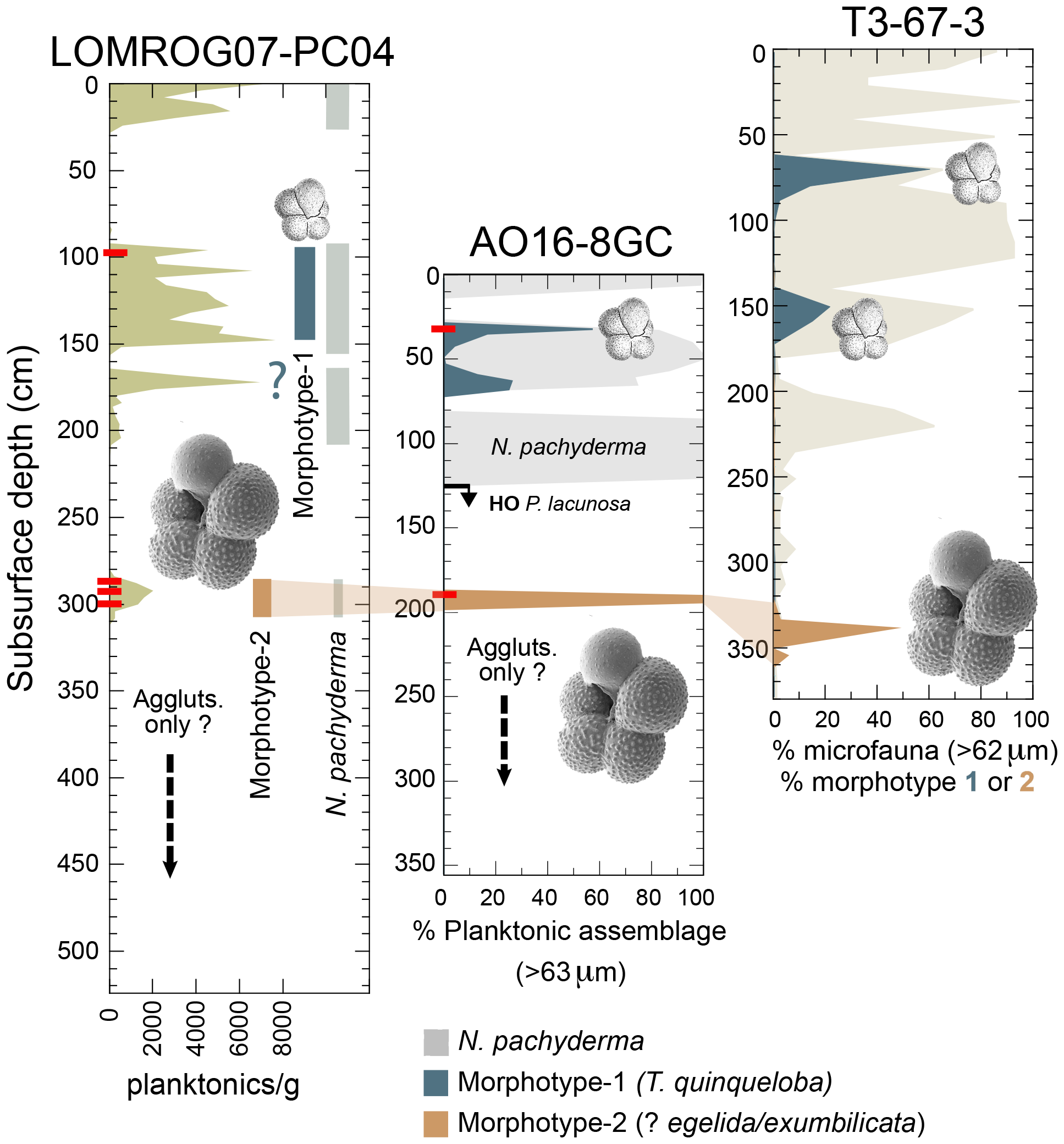
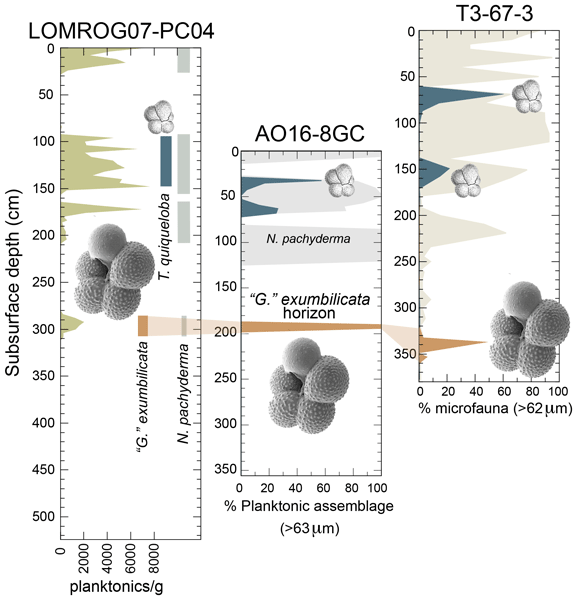
Figure 1Schematic stratigraphic distribution of foraminifera in selected CAO cores illustrating the broad occurrence of subpolar planktonic morphotypes (i.e. Morphotypes 1 and 2) based on published studies. The figure provides a simplified overview of their general stratigraphic relationships, which continue to be refined as new records become available. Count data are in different forms reflecting different data types in the respective studies. LOMROG07-PC04: total planktonic forams/g (olive shading) and subpolar species stratigraphic occurrences (Hanslik, 2011). AO16-8GC: quantitative data (% of the total foraminifera assemblage) for the three relevant morphospecies: N. pachyderma (pale grey shading), Morphotype-1 (T. quinqueloba, dark blue shading), and Morphotype-2 (“?” egelida/exumbilicata, gold shading) (Vermassen et al., 2021). T3-67-3: “% microfauna of the > 62 µm sand fraction” (pale beige shading), % “Globigerina quinqueloba” (dark blue shading), and % G. exumbilicata (gold shading) of Herman (1974). “Aggluts. only?” refers to the observation that below the Morphotype-2 horizon, calcareous foraminifera are largely absent and only agglutinated benthics occur (Cronin et al., 2008). See Fig. 2 and Table 1 for site localities. HO: highest occurrence of the P. lacunosa nannofossil event (ca. 0.44 Ma). Red markers: SEM sample horizons, this study. Throughout the paper we refer to Morphotype-1′, concluded to be T. quinqueloba, occurring stratigraphically above Morphotype-2′, concluded to be “Globigerina” exumbilicata Herman, previously known as T. egelida.
As efforts continue to document environmental events in the CAO and correlate them with ocean-climate changes, fundamental taxonomic questions have emerged. What exactly is T. egelida? How can it be reliably distinguished from T. quinqueloba? Do these morphotypes co-occur? Assigning specific “Turborotalita” events across the increasing number of CAO cores is not always straightforward, as spatial variations in sedimentation rates and stratigraphic continuity complicate site-to-site correlations. Moreover, the lack of robust taxonomic definitions and reference imagery for the morphospecies involved hampers confident identification of the two biohorizons, limiting correlation both within and beyond the CAO. A key issue is that T. egelida remains unfamiliar to most planktonic foraminifera experts. It is not included on the list of currently recognized living species (Brummer and Kučera, 2022) and did not appear in the last major taxonomic synthesis of Neogene and Quaternary taxa (Kennett and Srinivasan, 1983). Although listed as a possible valid Pleistocene taxon deserving further study (Saito, 1981), it has more recently been regarded as a growth stage of T. quinqueloba (Brummer and Kučera, 2022).
In this study, we investigate planktonic foraminiferal diversity in the Arctic and sub-Arctic seas using light and scanning electron microscope (SEM) imaging and morphometric analyses to objectively compare morphotypes and investigate the taxonomic history of the relevant taxa to conclude on an appropriate classification. The result is a set of reference images and a refined taxonomic framework for classifying Arctic Pleistocene planktonic foraminifera. This will support consistent species identifications and allow stratigraphic and paleoceanographic studies to move forward in a unified way. To preserve initial objectivity, we begin by referring to the stratigraphically upper and lower inferred “Turborotalita” morphotype groups as “Morphotype-1” and “Morphotype-2” (Fig. 1), with formal taxonomic names assigned later based on the outcomes of our morphological and stratigraphic analyses.
Our approach combines detailed morphological descriptions with morphometric analysis to characterize test morphologies, including ontogenetic and wall ultrastructural features, of modern and fossil morphospecies. Wall texture is a key phylogenetic character in planktonic foraminifera, particularly for fossil taxa where the test provides the only record of evolutionary history (Hemleben et al., 2018). Studied material comes from multiple sediment cores across the CAO and Atlantic subpolar regions and includes specimens and or populations of (i) “classic” T. quinqueloba from core top samples from the sub-Arctic Atlantic–Arctic gateway and northern North Atlantic, (ii) CAO Morphotype-1, and (iii) CAO Morphotype-2 (Fig. 2, Table 1). Individual foraminifera for imaging and morphometric analysis were picked from sand fraction samples, which were prepared (in various labs) by wet sieving over a > 63 µm sieve. Living individual T. quinqueloba were collected from the water column between the UK and Iceland in April 2002 during the RRV Discovery Cruise D262 (cruise 20; Darling and Wade, 2008). These were obtained from shipboard water-intake pumps at a depth of 5–6 m at stations between 50°50′ N, 05°51′ W and 62°20′ N, 22°27′ W. All T. quinqueloba specimens genotyped along this transect (n=18) in the April spring bloom were the same genotype (Type IIb; Kate Darling, personal communication; Morard et al., 2015). A bulk plankton sample was also picked and imaged at station 8 (Fig. 2; 62°20′ N; 22°27′ W) on Cruise D262, allowing comparison of “living” (mature and sub-adult) and sedimented (assumed to be mostly mature) morphologies. An important component of the present study was the examination and comparison of relevant type material (see details below). Due to the often small size of planktonic foraminifera in the CAO, taxonomic surveys were conducted on the > 63 µm sand fraction, where Turborotalita and other small species, such as Globigerinita glutinata and G. uvula (if present) occur (Volkmann, 2000). In this study, for practical purposes, picking was performed separately on the 63–125 and 125–250 µm sieve fractions. Observations were made using a Leica M205C optical light microscope equipped with a digital camera system.
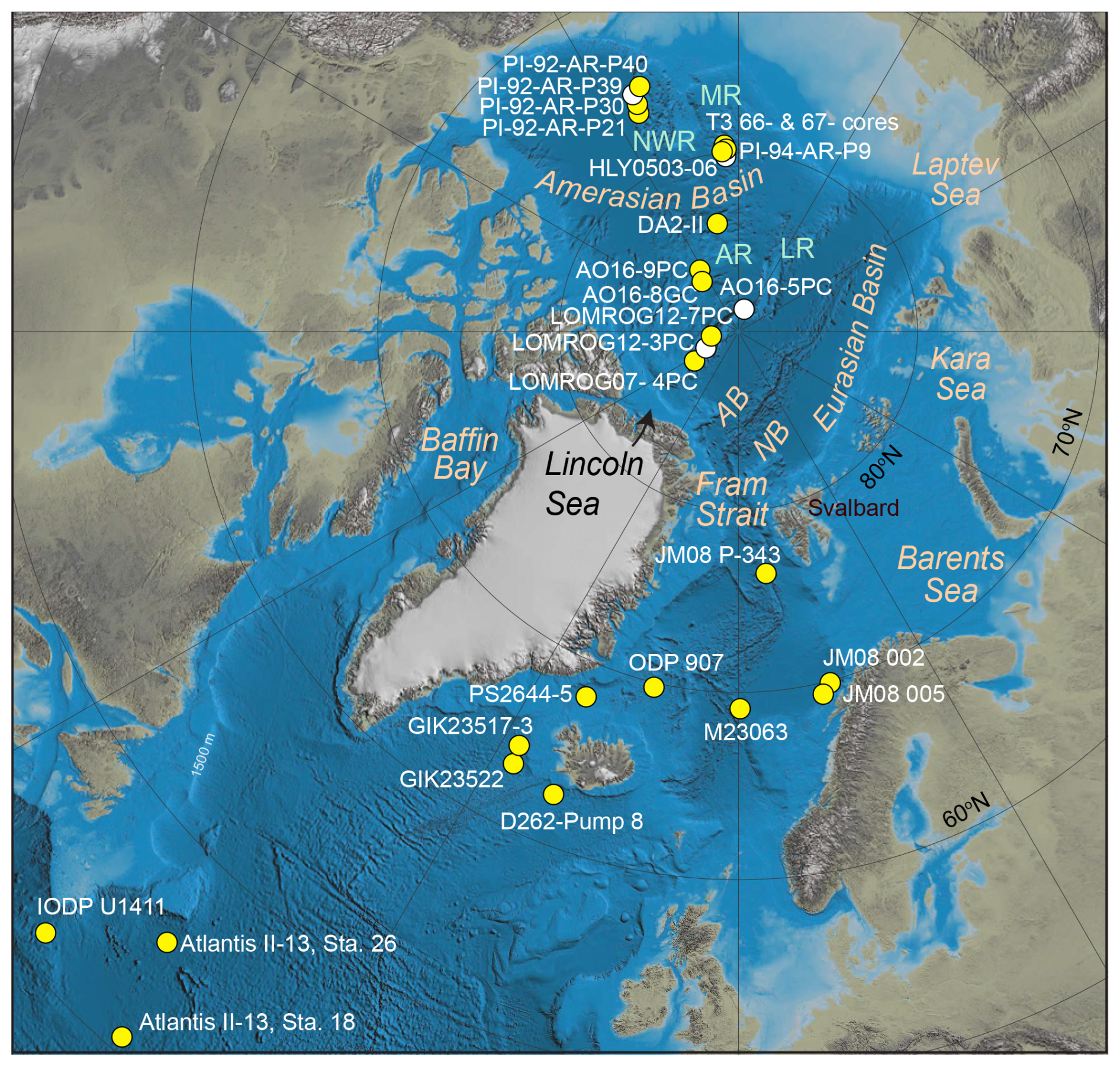
Figure 2Bathymetric map of the North Atlantic and Arctic oceans showing sediment core and plankton tow sites relevant to this study. Bathymetry and Arctic Ocean features are based on the IBCAO compilation (Jakobsson et al., 2020) and visualized using GMT and GIS software. Yellow dots indicate sites investigated directly in this study or indirectly (re-illustration of previously published images). White dots indicate additional previous reports of “Turborotalita spp.” (not exhaustive). See Table 1 for site information. Abbreviations of key bathymetric features: NWR, Northwind Ridge; MR, Mendeleev Ridge; AR, Alpha Ridge; and LR, Lomonosov Ridge.
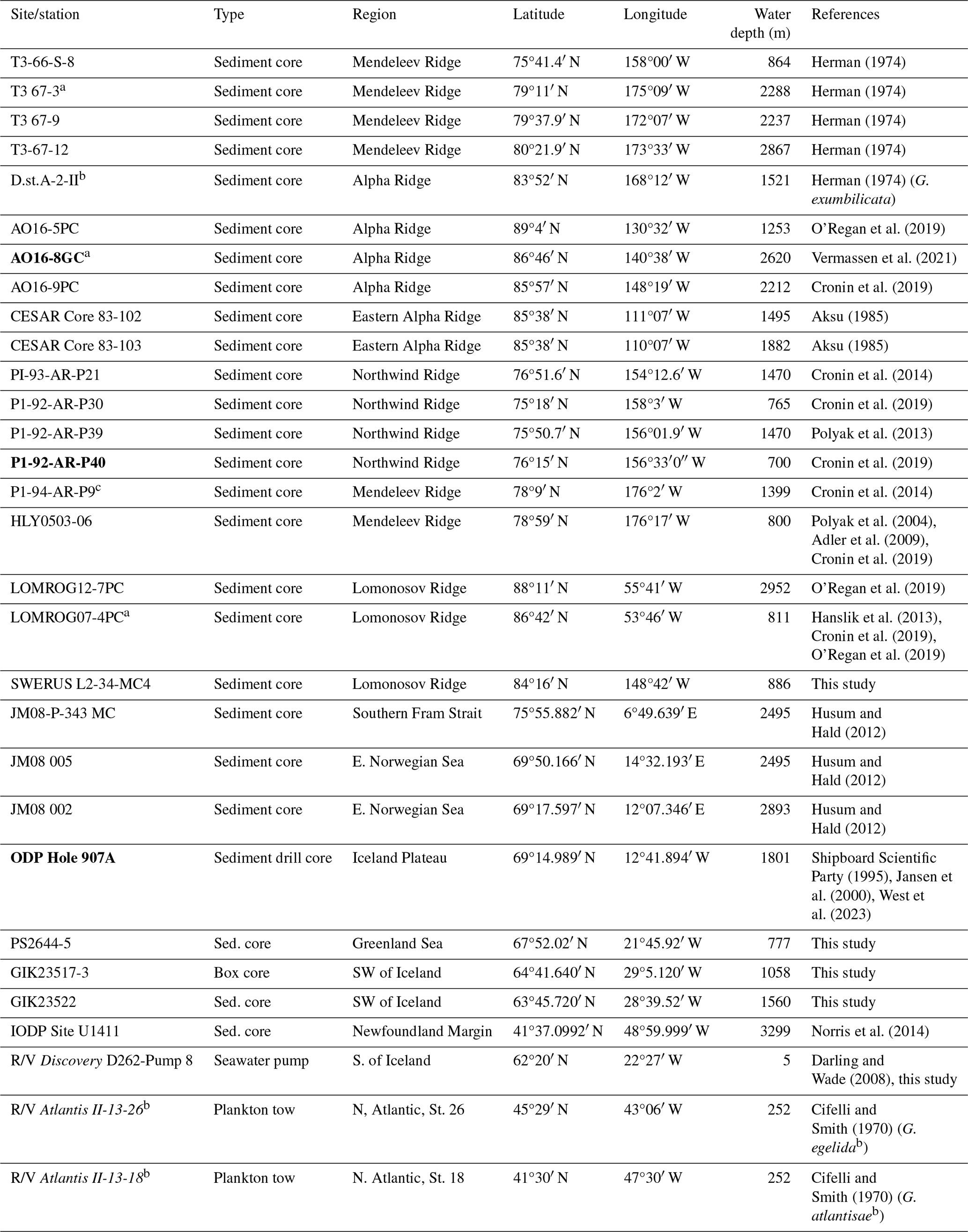
Table 1Locality information for sediment cores, plankton tow, plankton pump stations, and nannofossil samples referred to in this study. For the LOMROG cores, abbreviations LRG12-4PC and LRG12-7PC are used in Fig. 1. a Identifies the cores represented in Fig. 1. b Identifies the type localities of planktonic foraminifera species relevant to this study. St. – Station. Bold indicate the morphometric sample stations (see text for specific sample information). c Refers to sites with new nannofossil data (this study). Information on published chronologies for each core can be found in the associated references.
Multiple examples of CAO Morphotype-1 and Morphotype-2 and “classic” T. quinqueloba were collected for imaging. Assemblage (picking tray) views and isolated specimens were imaged to illustrate how these morphospecies appear in the light microscope (Plates 1 and 2). Additionally, a selection of morphotypes that may be confused with these forms, or was important for investigating taxonomy and possible synonyms, was also imaged. This included a smooth-walled N. pachyderma morphotype as well as type material of G. exumbilicata (Herman, 1974), G. egelida Cifelli and Smith 1970, and Globigerina atlantisae Cifelli and Smith 1970. The taxonomy of Arctic planktonic foraminifera has been reviewed from the literature and re-evaluated based on the results of our analysis. The criteria for the “availability” of species names were examined in accordance with the International Code of Zoological Nomenclature (ICZN, 2012).
2.1 Scanning electron microscopy
For SEM imaging of sedimented and plankton net samples, individuals were mounted on sticky carbon disks placed on steel stubs and were typically gold or gold/palladium coated (Table 2). Type material of G. exumbilicata Herman 1974, G. egelida Cifelli and Smith 1970, and Globigerina atlantisae Cifelli and Smith 1970, all archived in the USNM Cushman Collection of foraminifera, was imaged for the first time as part of this study. New images of an uncoated type specimen of T. quinqueloba (G. quinqueloba Natland, 1938) were also obtained using an FEI Apreo high-resolution field emission SEM, providing improved characterization of its wall texture.
Table 2Scanning electron microscopy facilities used in this study.

SEM images of other relevant type specimens were downloaded from the USNM collections (https://collections.nmnh.si.edu/search/paleo/, last access: 2 February 2018). Whole-specimen and wall texture images were taken to document test morphology and ultrastructure, including evidence of spines.
2.2 Morphometric analysis
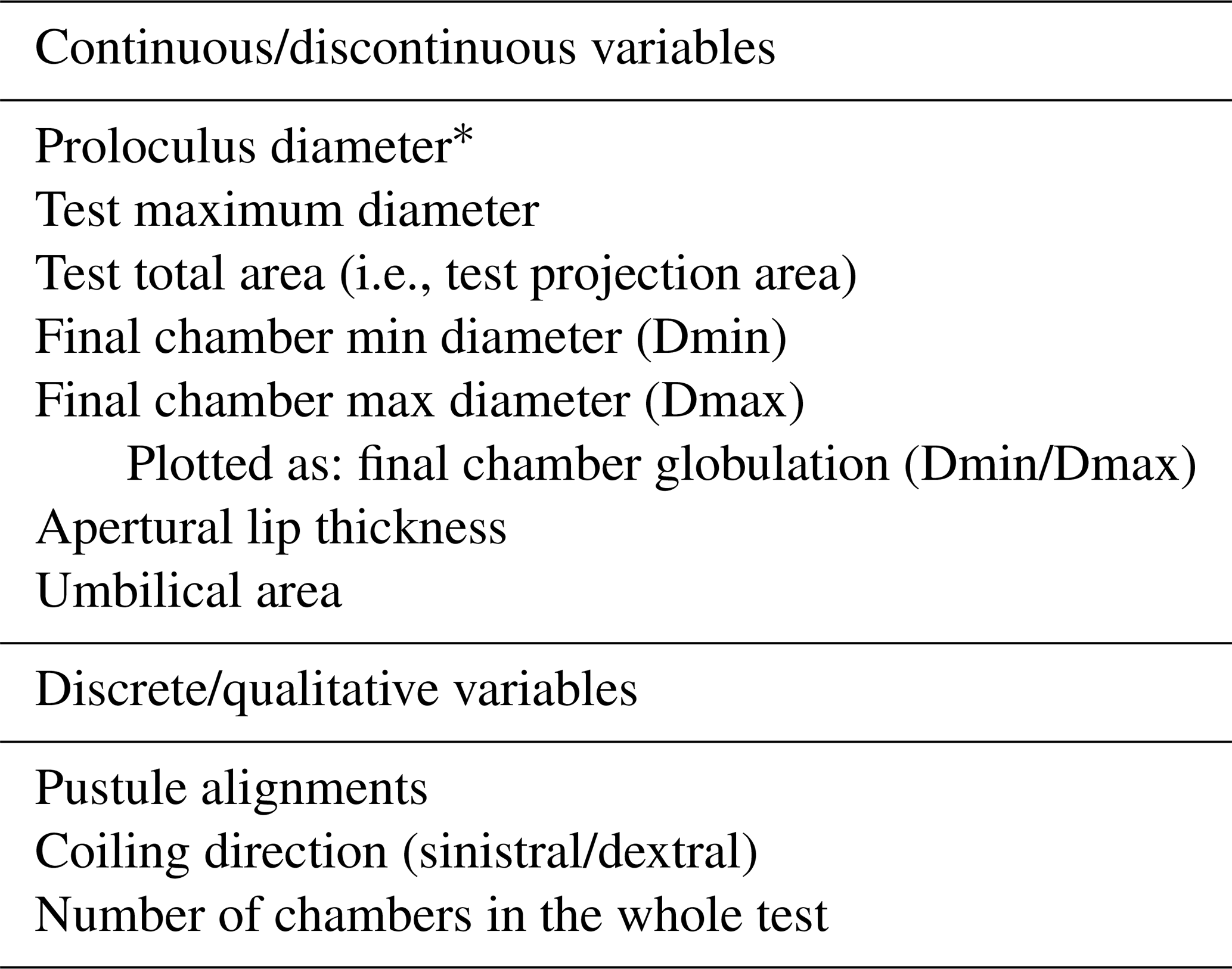
Morphometric analyses were made on three populations: one population of CAO Morphotype-1; (Sample AO16-8GC-2, 2.5–3.5 cm, 68.5–69.5 cmbsf, Alpha Ridge); one population of Morphotype-2 (Sample P1-92-AR-P40, 374–375 cmbsf, Northwind Ridge (Cronin et al., 2019)); and as an extra-Arctic out-group, one population of “classic” T. quinqueloba from MIS 5d (107 ka) (Sample ODP 907A-1H-2, 37–39 cm, Iceland Sea) (Table 1). In each case, measurements were made on ca. 300 individuals from the > 63 µm fraction. Samples were first split into manageable aliquots using an aluminum micro-splitter. All planktonic foraminifera were extracted from the splits until the target of ca. 300 was reached. All specimens were imaged in umbilical view using a Hitachi TM 3000 desktop SEM (Table 2). Measurements were made using the manual measuring tool in the open-source software Image-J (Schneider et al., 2012). Morphometric traits were recorded as continuous/discontinuous measurements or presence/absence conditions (coded as 1 = present, 0 = absent) (Table 4, Appendix Fig. A2). The proloculus was not always identifiable in SEM due to test thickening that obscures early chambers, especially in “classic” T. quinqueloba. Proloculus diameter, therefore, was measured on light microscope images, using a Leica M205C microscope and camera system, and water to emphasize chamber contrasts (Appendix Fig. A1). Proloculus diameter measurements are at the limits of accuracy due to this approach; they represent maximum estimates and likely carry greater uncertainty than measurements obtained using, e.g., micro-CT methods.
2.3 Multivariate statistical analysis of foraminifera morphometric variables
To assess morphological differentiation among populations, a simple one-way multivariate analysis of variance (MANOVA) and linear discriminant analysis (LDA) were conducted on the continuous morphometric parameters (maximum test diameter, proloculus diameter, maximum final chamber diameter, minimum final chamber diameter, and apertural lip thickness) using base R and the MASS package (R version 4.4.2). MANOVA tests whether groups differ in their multivariate means and is well suited to datasets like ours that reasonably meet assumptions of normality and linear relationships among variables (see Results section). Morphometric variables were first log-transformed to stabilize variance and approach multivariate normality, followed by z-score standardization to ensure equal weighting and mitigate scale-related biases. The MANOVA was used to test the null hypothesis that the multivariate centroids (i.e., the mean morphology in multivariate space) of the three populations are equal. Multivariate test statistics (Pillai's Trace) were obtained from the base R stats implementation of MANOVA. The LDA was performed to further explore group separation and assess the diagnostic potential of the measured traits. The classification accuracy of the LDA model was evaluated using leave-one-out cross-validation (LOOCV) to provide a conservative estimate of the model's predictive performance. This was also performed using base R.
2.4 Nannofossil analysis
Nannofossil analyses were undertaken on 5 cores from the Northwind Ridge, Mendeleev Ridge, and southern Lomonosov Ridge (Fig. 2; Table 1) in an attempt to identify independent age and paleoenvironmental constraints within documented subpolar planktonic foraminifera horizons from across the Arctic Ocean (Appendix Table 1) (Hanslik, 2011; Hanslik et al., 2013; Cronin et al., 2014). These were combined with existing nannofossil data from multiple sites in the CAO (Razmjooei et al., 2023) and foraminifera assemblages from core AO16-8GC on the Alpha Ridge (Vermassen et al., 2021). We specifically targeted records where we could investigate nannofossil occurrences associated with Morphotype-2 horizons.
Small amounts of unprocessed sediment were taken throughout the core, including horizons containing Morphotype-2. Nanno smear slides were prepared using the technique of Bown and Young (1998). The slides were examined using a ZEISS Axio Scope A1 polarizing light microscope at ×1000 magnification and imaged. Species identification followed the taxonomy of Perch-Nielsen (1985) and Young (1998), as well as the most up-to-date descriptions and illustrations in the online database Nannotax3 (Young et al., 2022). In order to examine the abundance of different taxa, all nannofossils were counted in 100 fields of view (FOVs). Additionally, two to three more traverses of each slide were scanned to detect rare and very rare species.
The results are organized by region and time interval, starting with the Holocene sedimented and living plankton foraminifera. The test morphological characteristics are described broadly and in the context of taxonomic features useful for species diagnosis. Results of the quantitative morphometric analysis are integrated into Sect. 3.2.
3.1 Holocene sedimented and living turborotalitids from the sub-Arctic Atlantic and Nordic Seas (60–80° North): qualitative observations of test morphology
Our Holocene core top samples contain “classic”-looking T. quinqueloba, which, under the optical light microscope, appear either reflective and shiny or white and non-reflective when a thickened outer crust is present (Plate 1, panels 1 and 2). It is these encrusted forms that are here referred to as “classic” T. quinqueloba. In the eastern Nordic Seas samples (Fig. 2; Plate 1, panel 2; Plate 3), specimens often exhibit the classic features diagnostic of the taxon, including an elongate/ampullate (tear-drop-shaped) final chamber that extends tightly over the umbilicus and a finely pustulose test surface. Tests commonly have 4.5 to 5 chambers in the final whorl or occasionally 6 (Plate 3, fig. 22), a petaloid peripheral outline, and a relatively flattened coil (see amended diagnosis by Pearson and Kucera, 2018). The terminal chamber is usually bordered by a distinctive lip or flap. The holotype of T. quinqueloba, which is described from recent sediments from the Californian margin (Natland 1938), exemplifies these features (Plate 3, fig. 26; Plate 6, figs. 1–6). We do, however, observe variability in the morphology of the terminal chamber in the Nordic Seas examples, with respect to the degree of final chamber elongation and overhang into the umbilicus (Plate 1, panel 2; Plate 3). The spinose, normal-perforate wall is visible in close-up SEM views of “classic” T. quinqueloba (Plate 3, figs. 5, 10, 25). The spine bases, which take the form of small pustules or mounds, are distributed between the pores and are mostly separated from each other. Gametogenic calcite tends to thicken the spine bases, which can conceal the spine holes. Extreme gametogenic test thickening can create highly rugose test surfaces and an N. pachyderma-like appearance (or N. incompta depending on coiling direction), emphasizing the value of SEM wall texture analysis in some cases (Plate 3, figs. 14, 17). Both right and left coilers are imaged here.
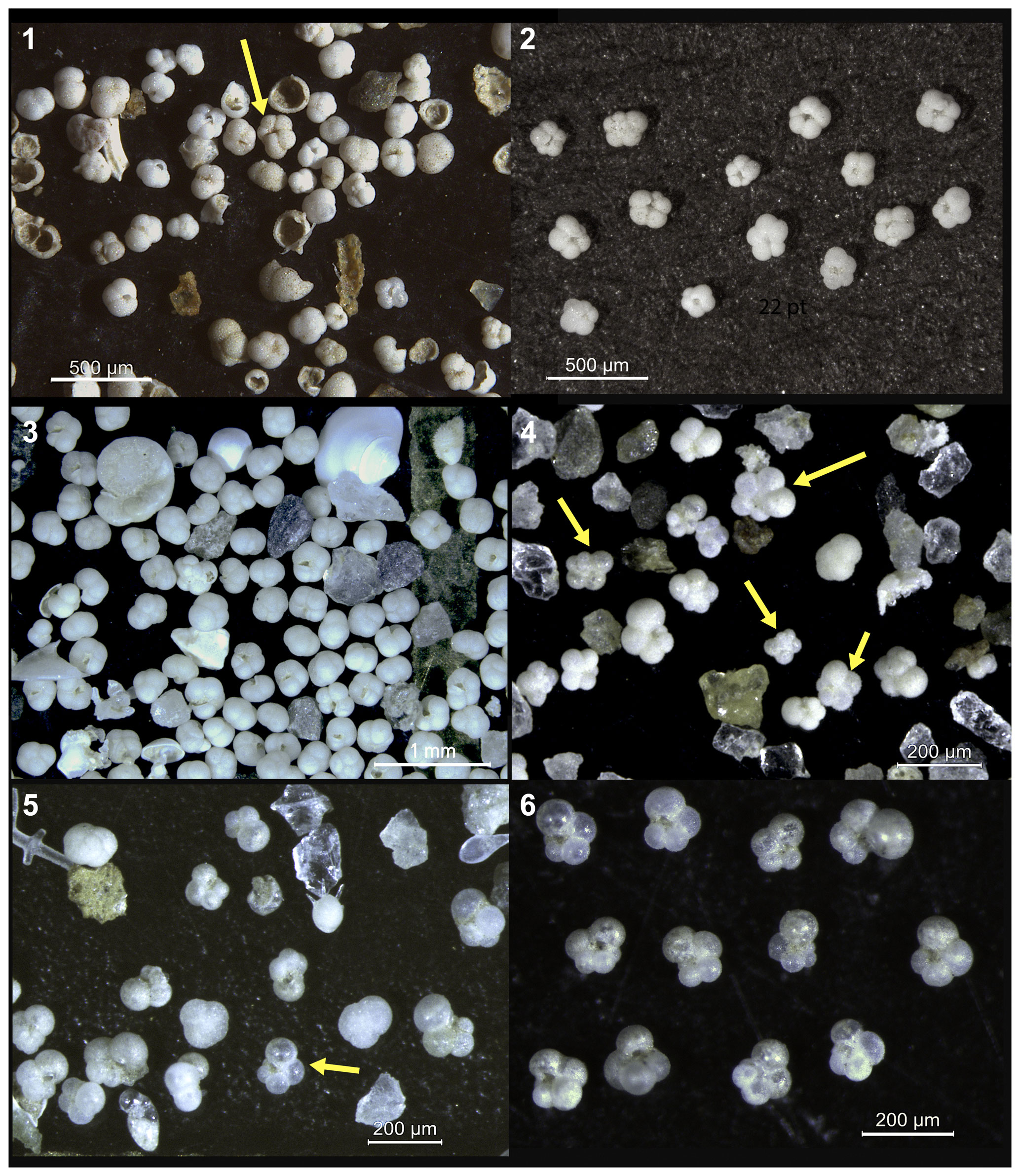
Plate 1Light microscope images of assemblage views of exemplary Arctic sediment samples containing Turborotalita and N. pachyderma relevant to this study. (1) Sample JMO8-P-343MC, Fram Strait, 180–100 mm, Holocene, core top. Contains abundant N. pachyderma and occasional “classic T. quinqueloba” (yellow arrows); (2) “classic T. quinqueloba” picked out of Sample JMO8-P-343MC; (3) Sample LRG7-4PC, 96–97 cm > 250 mm, probably MIS 5 (this study). Contains abundant N. pachyderma, as well as other microfossils and IRD but no Turborotalita in this fraction; (4) Sample LRG7-4PC, 96–97 cm, 63–125 mm fraction; abundant T. quinqueloba are present in this smaller fraction (examples indicated by yellow arrows); (5) Sample LRG7-4PC, 0–2 cm 63–125 mm, Holocene, no T. quinqueloba. The shiny form (indicated by an arrow) is a morphotype of N. pachyderma (Nps-5), which can be confused with T. quinqueloba; (6) examples of the Nps-5 morphotype extracted from Sample LRG7-4PC, 0–2 cm, 63–125 mm fraction. The relatively high proportion of right-coiling specimens is consistent with recent observations on N. pachyderma coiling ratios in the CAO (Weitkamp et al., 2025a). Wall texture SEMs (see Plate 7) show that this is not T. quinqueloba.
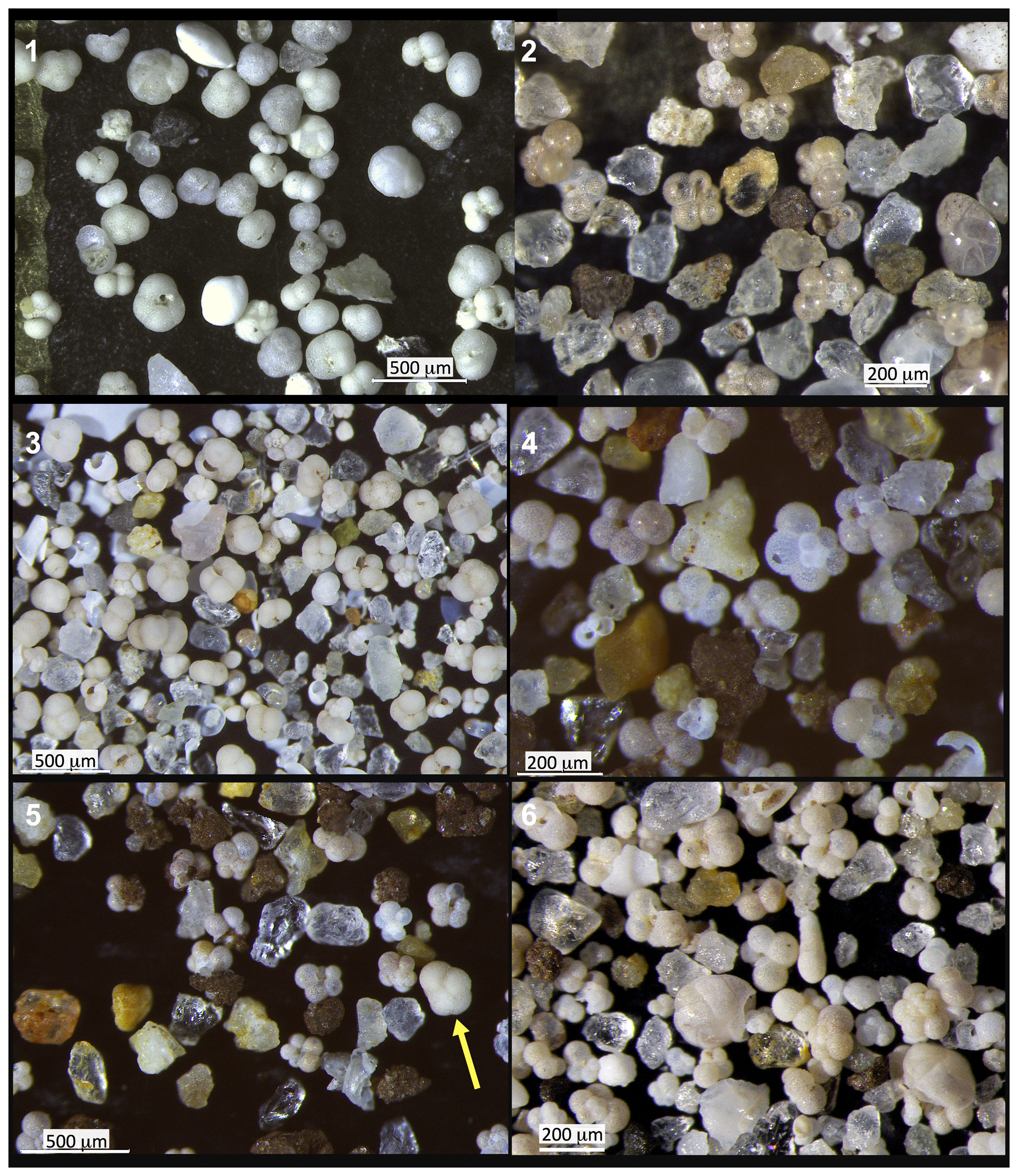
Plate 2Light microscope images of assemblage views of exemplary Arctic sediment samples containing N. pachyderma and/or assemblages of “exotic” spinose species. (1) Sample LRG7-4PC, 0–2 cm, 125–250 mm, Lomonosov Ridge, Holocene, abundant N. pachyderma, no T. quinqueloba; (2) Sample LRG7-4PC, 300–301 cm, > 125 mm, abundant “Morphotype-2” (“Globigerina” exumbilicata); (3) Sample AO16-9-1PC-1, 0–2 cm, Alpha Ridge, > 63 mm, Holocene. This sample contains abundant N. pachyderma, as well as other microfossils and IRD but no T. quinqueloba. (4) Sample AO16-9-1PC-3, 60–62 cm, > 150 mm, “mid-Pleistocene”, abundant “Morphotype-2” amongst IRD; (5) Sample AO16-9-1PC-3, 60–62 cm, > 150 mm, zoomed-out view showing rare N. pachyderma (arrow), amongst abundant “Morphotype-2”; (6) Sample P1-92-AR-40, 374–375 cm, > 63 mm, Northwind Ridge, abundant “Morphotype-2” (sample used for the “Morphotype-2” morphometric analysis).
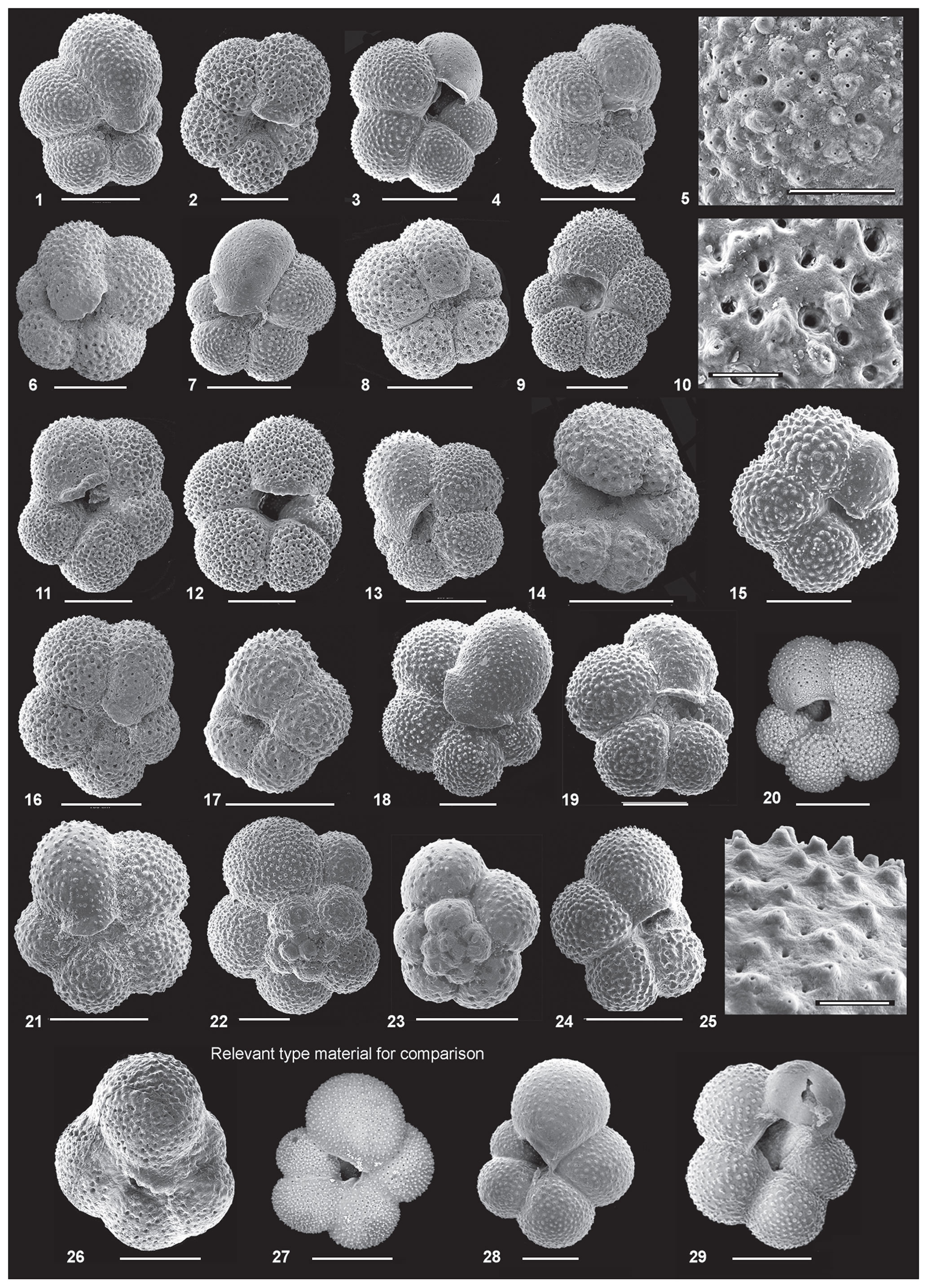
Plate 3SEM images of Holocene T. quinqueloba from the Nordic Seas and relevant type material. Figures (1)–(5), (7)–(13), core top: JM08 005 BC; figs. (6), (14), core top JM08-P-343 MC; fig. (15), core Sample PS2644-5 85 cm, NW or Iceland; figs. (16), (17), core top: JM08 002 BC; fig. (18), core top Sample GIK23522 0–1 cm; figs. (19), (20), core top Sample GIK23517 0–10 cm; figs. (21)–(23), core sample M23063, 263 cm (MIS 5e) central Nordic Seas; figs. (24)–(25), IODP Site U1411-1H-1, 8–10 cm, Newfoundland Margin, Pleistocene; figs. (5), (10), and (24) show wall texture close-up views of figs. (4), (9), and (25), respectively, illustrating the spine bases and holes from which spines formerly emerged. Figure (26), Globigerina quinqueloba holotype USNM PP22559, recent sediments, Californian margin; figs. (27), (28), Globigerina egelida, Paratypes 179187 and 179188, recent, R/V Atlantis II-13, plankton tow station 26 (listed in the Cushman Collection records but not the type reference; see Table 1 for details): fig. (29), Globigerina exumbilicata holotype, USNM 186540, Pleistocene core sample, Alpha Ridge, central Arctic Ocean. Scale bars = 100 µm, except fig. (5) = 20 µm, fig. (10), 24 = 10 µm. Type images courtesy of the US National Museum of Natural History, Smithsonian Institution.
SEM images of water column T. quinqueloba from south of Iceland document tests with and without their life covering of fine spines (Plate 4, figs. 1–16), which are easily wiped away during sampling. The imaged specimens are all left coiling. However, we believe this is an artifact of the original sampling procedure. Populations of this species have previously been observed to be approximately 50:50 right : left coiling (Brummer and Kroon, 1988; Darling et al., 2006). All the plankton-sample specimens in the pump samples were relatively small, and the classic overhanging final chamber characteristic of mature, sedimented T. quinqueloba was not well developed. We believe that the left-coiling bias can be explained by the fact that, at the time of sampling, efforts were focused on targeting left-coiling N. pachyderma. Mature specimens of any species were rare under the prevailing bloom conditions, and juvenile, thin-walled N. pachyderma were difficult to distinguish from T. quinqueloba. Consequently, even the T. quinqueloba dataset may have inadvertently become biased toward left-coiling individuals. Some test surfaces in our images are observed to be covered with fine particulate material, which is most likely adhering organic debris, having been picked from a concentrated plankton sample.
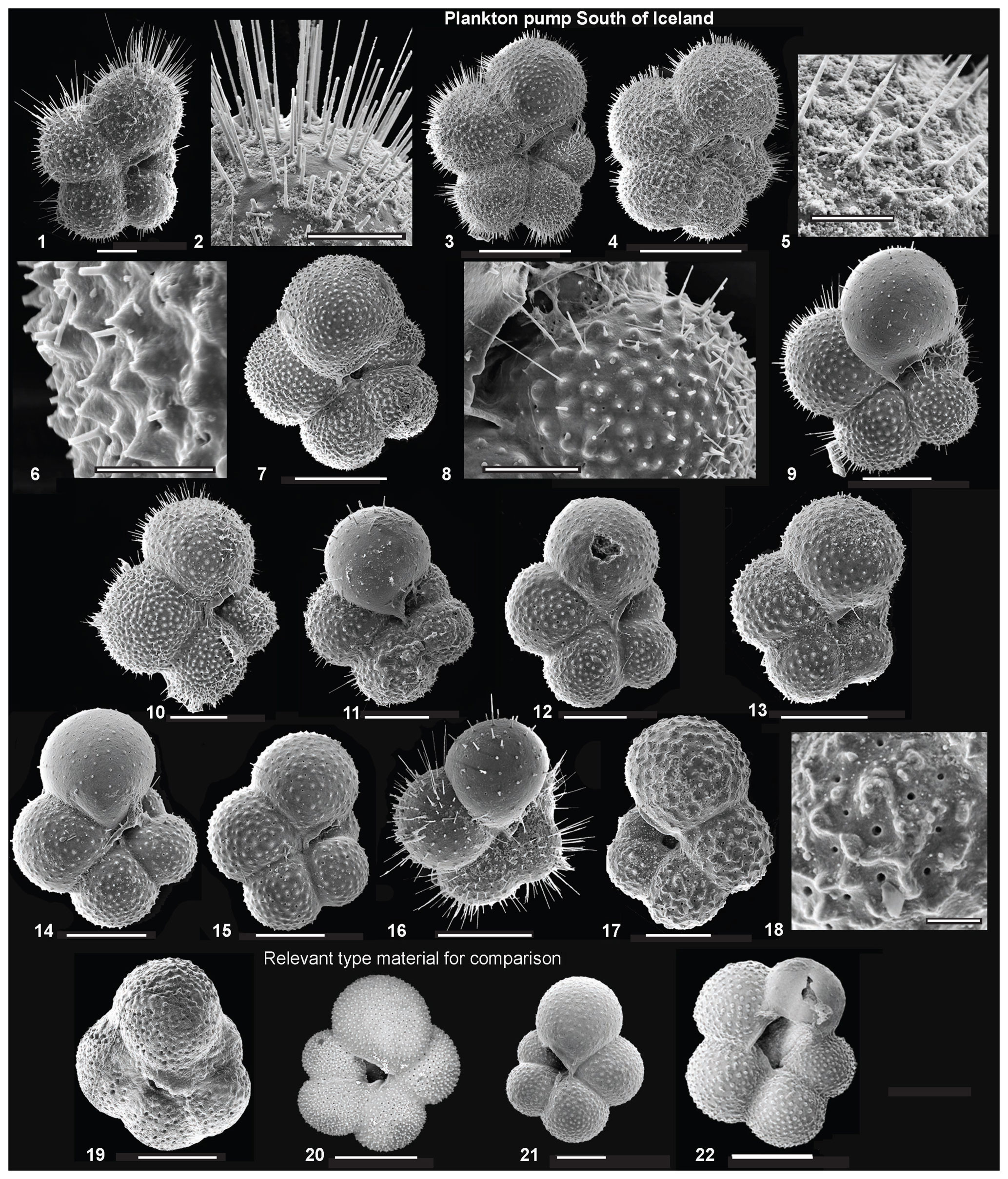
Plate 4SEM images of recent T. quinqueloba and comparative morphotypes from the plankton, together with relevant type specimens for references. Figures (1)–(18), living planktonic foraminifera recovered in 2002 during RRV Discovery cruise D262-Pump 8 south of Iceland (fig. 2), during the early spring bloom (see Methods; Darling and Wade (2008); figs. (1)–(16), T. quinqueloba; figs. (2), (5), (6), and (8), close-up views of spines and spine bases of specimens 1, 4, 7, and 9, respectively. All T. quinqueloba specimens shown are left coiling due to an accidental consequence of targeting left-coiling N. pachyderma during picking; some T. quinqueloba were picked incidentally. In nature, T. quinqueloba occurs roughly 50:50 right and left coiling. Figures (17), (18), N. incompta and close-up of wall texture illustrating the reticulate pustulose, non-spinose wall texture. Figure (19), Globigerina egelida holotype USNM PP22559; fig. (20), G. egelida USNM 179188 paratype; fig. (21), G. egelida USNM 179187 paratype; fig. (22), G. exumbilicata holotype USNM 186540. Scale bars: figs. (1), (5), (9)–(17), (21) = 50 µm; (2), (8) = 20 µm; (5), (7), (18) = 10 µm. Type specimen images are now available at the US National Museum of Natural History, Smithsonian Institution.
Comparing the wall texture of the netted forms with and without spines confirms that the evenly distributed bumps are spine bases. All specimens lack test thickening seen in sedimented T. quinqueloba from the Nordic Seas (Plate 1). Importantly, among the water column specimens, we see differences in the shape of the final chamber, which is typically rounded and rarely ampullate or overhanging the umbilicus. This emphasizes how one of the defining features of T. quinqueloba is limited to adult and terminal ontogenetic stages. Comparison of a right-coiling neogloboquadrinid from the plankton pump, which could be a right-coiling N. pachyderma or an N. incompta (Plate 4, figs. 17, 18), emphasizes the difference in wall texture between Turborotalita and Neogloboquadrina – Neogloboquadrina has pores and “bumps”: these are not spine bases as in T. quinqueloba (there are no spines or spine holes) but solid pustules that become more abundant with increasing test size, joining and coalescing to produce the characteristic thickened reticular texture typical of Neogloboquadrina.
Table 3Morphometric traits measured on the three Arctic and sub-Arctic samples. Measurements were made on SEM images, except for proloculus diameter*, which was measured on light microscope images. See Appendix Figs. A1 and A2.
3.2 Sedimented Pleistocene spinose planktonic foraminifera from the CAO (75–90° North): qualitative and quantitative morphological analysis
The investigated central Arctic material includes core top (Holocene) and subsurface samples. To provide stratigraphic context, we refer to the distribution of planktonic foraminifera in the three exemplary CAO cores, summarized together with other lithological data (Fig. 1). Our preliminary observations suggest that the Morphotype-2 zone marks a faunal transition from dominantly agglutinated foraminifers to calcareous-rich assemblages that predates the dominance of N. pachyderma in CAO sediments, although this interpretation requires further testing and refinement as additional records become available. The selected cores include published records from the “Drifting Ice Station T-3”, where the Arctic subpolar invasions were first documented on the Mendeleev Ridge (Herman, 1970, 1974), Alpha Ridge core AO16-8GC (Vermassen et al., 2021), and LOMROG07-4PC on the Lomonosov Ridge north of Greenland (Hanslik, 2011) (Fig. 2, Table 1). These cores span the Amerasian and Eurasian basins. As is typical for Pleistocene-age CAO strata, the cored lithologies involve alternations of brown (manganese-rich) bioturbated and microfossil-rich intervals, and lighter-colored intervals devoid of microfossils, interpreted to be interglacial and glacial periods, respectively (O'Regan et al., 2008; Löwemark et al., 2014).
Due to the challenges of dating Arctic sediments, including the lack of a continuous oxygen stable isotope record, debates persist over the sequence of MIS stages captured in recurrent sedimentological variations beyond the range of radiocarbon dating (Razmjooei et al., 2023; Knies et al., 2025; O'Regan et al., 2026). Nonetheless, at least three discrete correlative subpolar plankton acmes are widely reported from across the CAO (Fig. 2). A first-order stratigraphic interpretation is based on occurrences above or below the proposed last occurrence (LO) of the nannofossil P. lacunosa or its correlative horizon in cores where it has not been directly identified. This species, only recently recognized in CAO sediments (O'Regan et al., 2020; Razmjooei et al., 2023), became globally extinct during MIS 12 (424–478 ka) (Raffi et al., 2006). In the absence of further constraints, we infer that the multiple horizons of subpolar species in the younger interval (post-MIS 12) are dominated by populations of Morphotype-1. By contrast, the older interval (pre-MIS 12) is notable for the presence of Morphotype-2, although some specimens attributable to Morphotype-1 may also occur. Neogloboquadrina pachyderma is present throughout the studied horizons to varying degrees; however it is notably less common and even absent in some cores during Morphotype-2 acmes. Our preliminary observations suggest that the Morphotype-2 zone marks a faunal transition from dominantly agglutinated foraminifers to calcareous-rich assemblages that predates the dominance of N. pachyderma in CAO sediments. This agglutinated to calcareous transition is recognized across the CAO and linked to a critical phase in Cenozoic Arctic Ocean climate evolution (Cronin et al., 2008) (Fig. 1). These intervals may even predate the dominance of N. pachyderma in the CAO, which is of great significance to Arctic marine geology and paleoceanography.
Our observations confirm that “modern” Holocene core top sediment samples from the CAO and the early Holocene, like the modern CAO water column beneath perennial sea ice, are devoid of subpolar species, including T. quinqueloba, with the exception of the occasional specimens considered expatriates from lower latitudes (O'Regan et al., 2019; Vermassen et al., 2025) (Plate 2, panel 1). The stratigraphically highest subpolar horizon, whose youngest age could be in MIS 5 (O'Regan et al., 2019; Vermassen et al., 2021; Razmjooei et al., 2023; Vermassen et al., 2023), yields a small spinose morphotype (63–125 µm fraction) with an ampullate final chamber, which corresponds to Morphotype-1. This morphotype has recently been reported as T. quinqueloba (Vermassen et al., 2023) (Plate 1, panel 4). The morphometric data exhibit approximately normal distributions, as shown in the histograms (Fig. 3).
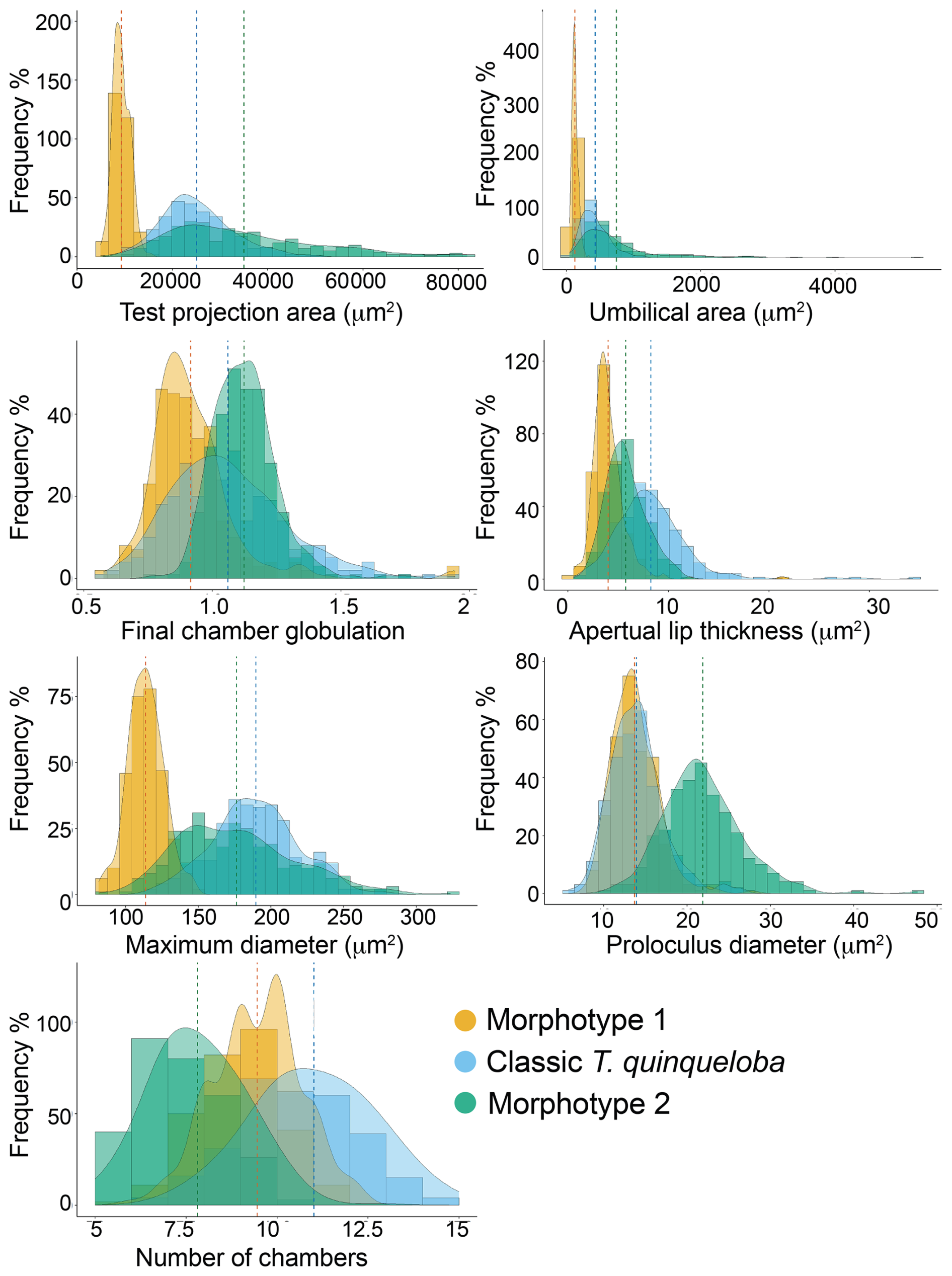
Figure 3Histograms showing frequency distributions for selected morphometric variables for the three morphotypes: Morphotype-1 (presumed T. quinqueloba, CAO, A016-8GC-2, 2.5–3.5 cm); “classic” T. quinqueloba (Nordic Sea, ODP 907A-1H-2, 1H-2, 37–39 cm) and Morphotype-2 (CAO, P1-92-AR-P40, 374–375 cm). Overlain density curves illustrate the shape of each distribution. Vertical dashed lines indicate population means.
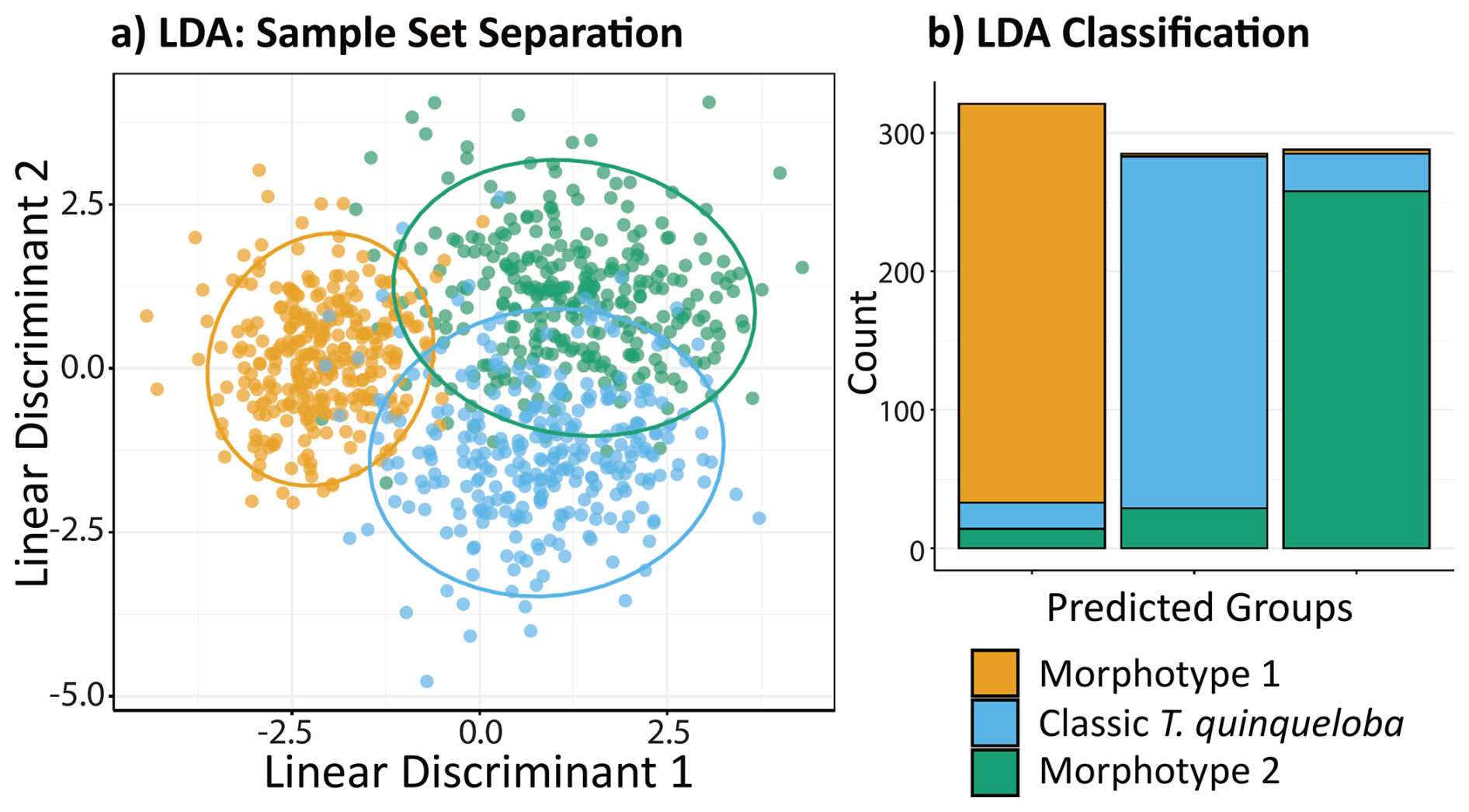
Figure 4Linear discriminant analysis (LDA) of the three morphotypes. (a) Scatter plot of LDA results showing sample separation along the first two linear discriminants (LD1 and LD2). (b) LDA classification bar chart, indicating the number of specimens assigned to each group. A016-8GC, Morphotype-1 (yellow), is well separated, while ODP 907A, “classic” T. quinqueloba (blue), and P1-92-AR-P40, Morphotype-2 (green), shows some overlap.
Our Morphotype-1 population (AO16-8GC-2, 2.5–3.5 cm, 68.5–69.5 cmbsf – Alpha Ridge), considered representative of this morphotype in the CAO, is readily identified in the 63–125 µm size fraction by its petaloid shape, distinctive ampullate final chamber and relatively smooth reflective test surface, which appears shiny in light microscope view compared to rough-surfaced, co-occurring N. pachyderma (Plate 1, panel 4), with sparse spine bases revealed in SEM images (Plate 5, figs. 1–13). The mean maximum test diameter is 113.8 µm (range: 82.3–146.9 µm) (Table 4, Fig. 4). This morphotype does not occur in the larger size fractions where N. pachyderma dominates (Plate 1, panel 3). SEM images provide detail of the ampullate final chamber and wall ultrastructure: well-preserved specimens reveal evenly distributed spine bases, often with spine holes (Plate 5, fig. 13). The juvenile whorls and proloculus are clearly visible in spiral views (Plate 5, figs. 9, 11; Appendix Fig. A1). In the CAO, Morphotype-1 attains between 30 %–60 % of the total planktonic foraminiferal assemblage in these stratigraphically higher acmes, the remainder being N. pachyderma (Herman, 1974; Vermassen et al., 2023). In contrast, T. quinqueloba in MIS 5 sediments from the Iceland Plateau (ODP 907A; 1H-2, 37–39 cm, 1.87 mbsf) (Clotten et al., 2018; West et al., 2023) exhibit the “classic” T. quinqueloba morphology, differing dramatically from CAO Morphotype-1 in size. The morphometric analysis comparing MIS-5-age turborotalitids from the Nordic Seas (the ODP 907 “classic” T. quinqueloba) and CAO Morphotype-1 (< MIS 12 – MIS age range), shows a clear difference in overall test size between Morphotype-1 and the other two morphotypes, with Morphotype-1 having smaller mean test diameters and a narrower range (mean 113.8 µm, range 82.3–146.9 µm) compared to “classic” T. quinqueloba (mean 189.6 µm, range 118.6–278.2 µm) and Morphotype-2 (mean 176.3 µm, range 81.5–323.4 µm) (Table 4). “Classic” T. quinqueloba also occurs in the > 125 µm fraction, while CAO Morphotype-1, being considerably smaller, is largely restricted to the 63–125 µm fraction. However, the range and mean of the proloculus size of the two morphotypes is almost identical (Fig. 3, Table 4).

Plate 5SEM images of subpolar planktonic foraminifera morphotypes from the central Arctic Ocean (CAO) and relevant type material. Figures (1)–(12), Morphotype-1 (T. quinqueloba) from the CAO identified by the overhanging ampullate final chamber (even in the “dwarf” state); figs. (1)–(4), Sample AO16-8GC-sec 1, 33.5–33.5 cm, Alpha Ridge, MIS 5; fig. (5), Sample LR12-7PC-3, 122–124 cm, MIS 5; figs. (6), (7), Sample LRG07-4PC, 98–99 cm below seafloor, showing test dissolution; figs. (8)–(13), Sample LRG12-7PC-2, 7–9 cm (0.88 mbsf), MIS 5, fig. (8) = spiral view of fig. (7). Figure (10) = the spiral view of figs. (9), (13). CAO T. quinqueloba are small (typically < 125 µm), relatively smooth walled and lack the surface thickening seen in Nordic Seas (classic) T. quinqueloba (Plate 1). High magnification reveals sparsely distributed pustules with a central hole. These are the spine bases, which, together with the ampullate final chamber, confirm Turborotalita genus assignment. Figure (15), Globigerina egelida paratype, USNM 179187, plankton net, south of Iceland. Figure (14), Globigerina exumbilicata holotype USNM 186540, Sample D. st. A-2-II, 144 cm, Alpha Ridge (mid-Pleistocene). Figures (16)–(34), “Morphotype-2” (“G.” exumbilicata): multiple specimens from widely separated localities (Eurasian end of Lomonosov Ridge to Alpha Ridge, Amerasian Basin). These specimens illustrate the relatively large test sizes, open umbilicus, unrolled coiling and spherical final chamber in “G.” exumblicata compared to T. quinqueloba. “Globigerina” exumblicata wall close-up views also reveal widely separated spine bases with spine holes, which are more heavily thickened than CAO T. quinqueloba from shallower/younger horizons (figs. (1)–(12)). Remnant spines can also be seen in some specimens (figs. (23), (27), (31)). Figures (28), (29), and (32)–(34) show pustules aligning to form costellae-like radiating ribs, which is a common feature in“G”. exumbilicata in spiral views; figs. (16)–(20), (30)–(32), Sample AO16-9-PC1-3, 60–62 cm, Alpha Ridge, “mid-Pleistocene”; fig. (21), Sample AO16-8-GC, 188–190 cm, Alpha Ridge, “mid-Pleistocene” (refigured from Vermassen et al., 2021); figs. (22)–(24), (33), (34), Sample LRG07-04, 288–289 cm, Lomonosov Ridge, “mid-Pleistocene”; fig. (25), Sample LRG07-04, 284-285 cm, Lomonosov Ridge, “mid-Pleistocene”; figs. (26)–(29), (35)–(41), Sample LRG07-04, 300-301 cm, Lomonosov Ridge, “mid-Pleistocene”. Figures (35)–(41), T. quinqueloba, from the fine fraction (63–125 mm) of a sample dominated by “G.” exumbilicata. These morphologies are intermediate between “G”. exumbilicata and T. quinqueloba in having a quinqueloba-like overhanging final chamber yet larger thicker spine bases than the MIS 5 T. quinqueloba. Scale bars: figs. (1)–(5), (7)–(11), (35)–(41) = 50 µm; (13)–(22), (24)–(26), (28), (30), (32), (33) = 100 µm; (27), (29), (34) = 20 µm; (12), (23), (31) = 10 µm. Type images courtesy of the US National Museum of Natural History, Smithsonian Institution.
Table 4Summary statistics of morphometric parameters for three populations (Morphotype-1 = T. quinqueloba, Morphotype-2 = “Globigerina” exumbilicata).
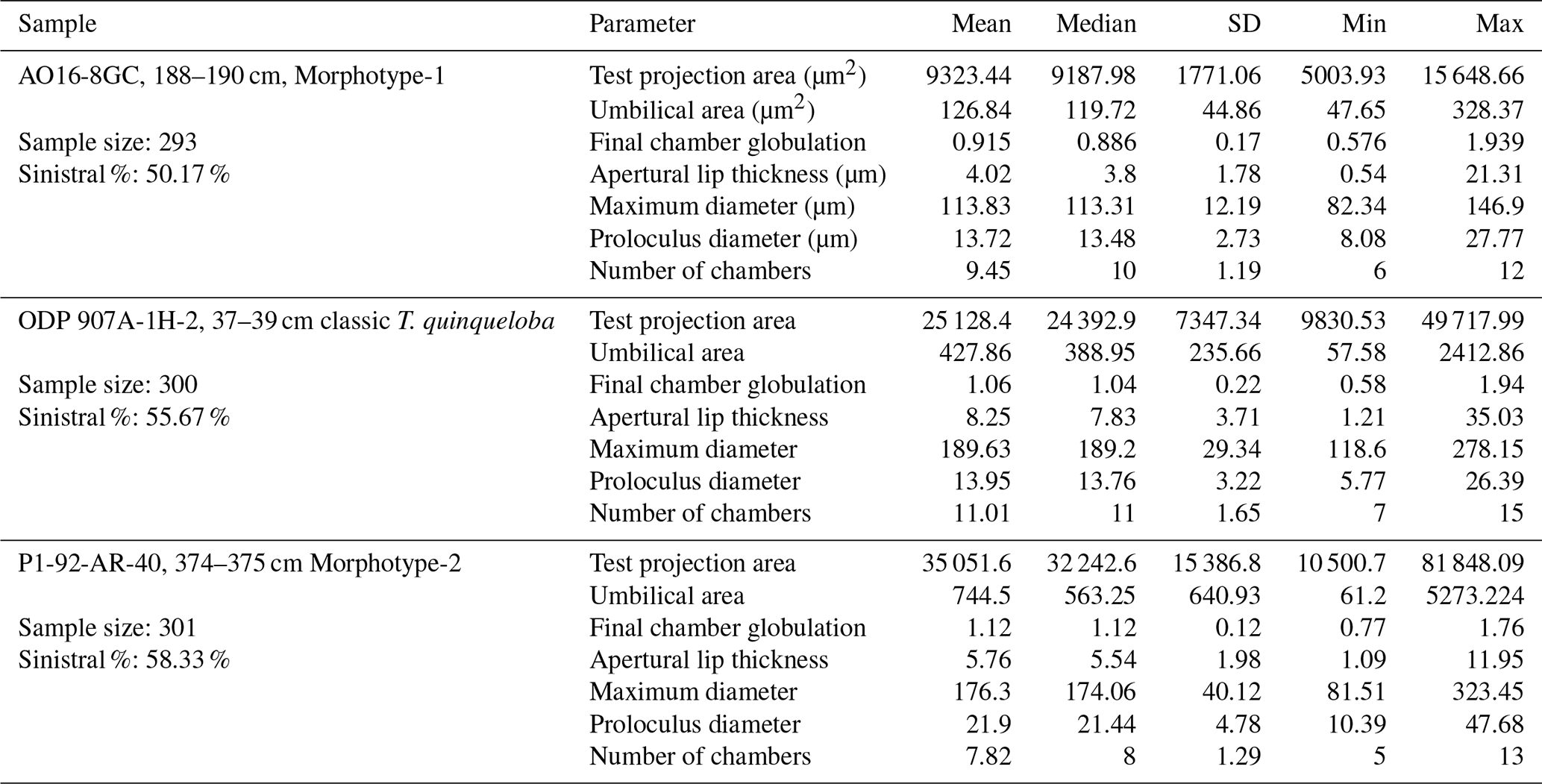
Planktonic foraminifera assemblages are dramatically different in the deeper bio-horizon (Fig. 1), both in Herman's (1974) T3 67-3 and T3 67-9 Mendeleev Ridge material and in our Lomonosov Ridge and Alpha Ridge stations (LRG07-PC04, AO16-9PC, and P1-92-AR-P40). Here they are dominated by Morphotype-2 (Plate 2, panels 2, 4–6). Notably, while N. pachyderma dominates in the corresponding core top samples (Plate 2, panels 1 and 3), N. pachyderma is significantly less abundant or absent where Morphotype-2 dominates. Specimens comparable to Morphotype-1, with a reduced final chamber encroaching the umbilicus, co-occur with Morphotype-2 (Plate 2; Plate 5, figs. 36, 37, 41); however, these are relatively few and are mostly restricted to the 63–125 µm fraction. The dominant Morphotype-2 exhibits shiny/reflective and slightly hispid tests, seen in light microscope view (Plate 2, panels 2, 4–6), a distinctly lobate periphery, evolute coiling, 4–6 chambers in the final whorl, and a globular final chamber with a pronounced apertural lip. The final chamber is often reduced in size compared to the previous chambers and typically does not overhang the umbilicus (Plate 5, figs. 14–34). The umbilicus is often open and maybe surrounded by the remnants of apertural lips from previous chambers. Morphotype-2 attains larger test sizes than Morphotype-1 (AO16-8GC), having a mean size of 176.3 µm in the morphometric sample (range: 81.5–323.5 µm) (Fig. 3, Table 4), occurring in both the 125–250 and the 63–125 µm fractions. There is considerable overlap between the mean and maximum test diameter of Morphotype-2 (P1-92-AR-P40) and “classic” T. quinqueloba from the Norwegian–Greenland Sea (ODP 907). The proloculus of Morphotype-2 is also often strikingly large (Plate 5, figs. 28, 33; Fig. 4). The total number of chambers varies from 6 to 12 in Morphotype-1, 5 to 13 in Morphotype-2, and 7 to 15 in “classic” T. quinqueloba (Table 4). The histogram of the total number of chambers per test shows three distinct distributions and peaks. Morphotype-2 exhibits the fewest chambers (mean = 7.82), followed by Morphotype-1 (mean = 9.45) and “classic” T. quinqueloba, which has the highest count (mean = 11.01) (Fig. 3, Table 4).
In terms of wall ornamentation morphology, Morphotype-1 is spinose, as demonstrated by the presence of spine bases, spine holes and/or the remains of broken spines (Plate 5, figs. 23, 27). Spine bases are also visible in Morphotype-2 but are broader and flatter. Spine bases of both Morphotype-1 and Morphotype-2 are sparsely distributed compared to “classic” T. quinqueloba, although this has not been quantified in this study. In spiral side view, Morphotype-2 often shows rows of small pustules that align to form linear ribs that radiate towards the periphery, most commonly on the spiral side (Plate 5, figs. 28, 29, 32–34, Plate 6, figs. 34, 35). These features are reminiscent of costellae, narrow, and ridge- or rib-like ornamentations, seen on test surfaces in some Cretaceous planktonic foraminifera species (Falzoni et al., 2014). To our knowledge, they are not seen in Morphotype-1 or “classic” T. quinqueloba. Coiling ratios in the three populations (% sinistral), are ca. 50 %, 58 %, and 56 % for Morphotype-1, Morphotype-2, and “classic” T. quinqueloba, respectively (Table 4).

Plate 6Turbororotalita type material. All SEM images unless otherwise stated. Figures (1)–(3), light microscope images (three views) of the Globigerina quinqueloba holotype, USNM PP22559, recent, off Long Beach, California, margin Natland (1938); figs. (4)–(6), SEM images (three views) of G. quinqueloba holotype (new and improved images, this study); figs. (7), (8), type illustration of the Globigerina egelida holotype, refigured from Cifelli and Smith, 1970 (two views), USNM 1791866, recent, plankton tow, ca. 47° N, east of Flemish Cap, North Atlantic; fig. (9), SEM image of the holotype of G. egelida (spiral view), captured for the first time in this study. Unfortunately, the specimen was lost during repositioning. Figures (10)–(12), G. egelida paratype (three views), USNM 179188, recent, plankton tow, south of Iceland; figs. (13)–(15) G. egelida paratype (three views), USNM 179187, recent, plankton tow, south of Iceland; figs. (16)–(18), G. egelida paratype USNM 179190, SEM images (three views), recent, plankton tow, south of Iceland; figs. (19)–(21), Globigerina atlantisae Cifelli and Smith (1970), holotype SEM images, USNM 179172, imaged and captured for the first time in this study (two views and close-up to show the microperforate wall), recent, plankton tow, south of Iceland. Note that this form is now considered to be Tenuitellita iota (Brummer and Kučera, 2022). Figures (22)–(24), Globigerina atlantisae Cifelli and Smith (1970), paratype, USNM 179173, recent, plankton tow, south of Iceland; figs. (25), (26), “Globigerina quinqueloba”, refigured from Herman, 1974, Sample T3-66-S-8, 8–10 cm, likely mid-Pleistocene, Alpha Ridge, central Arctic Ocean, reproductions of pl. 16, fig. 1 (mag. x 351), and fig. 3 (mag. x 396). Figure (27), Globigerina quinqueloba wall close-up (of fig. 25, penultimate chamber) showing spine bases, reproduction of p. 314, pl. 16, fig. 5, mag. x 1800); figs. (28)–(30), Globigerina exumbilicata Herman (1974), holotype, USNM 186540 (3 views), captured for the first time in this study, Sample D. st. A 2 II, 144 cm, likely mid-Pleistocene, Alpha Ridge, central Arctic Ocean; Fig. 31, Globigerina exumbilicata, Sample T3-67-12, 192 cm, likely mid-Pleistocene, Mendeleev Ridge, central Arctic Ocean, reproduction of pl. 18, fig. 5 (mag x 383), Herman (1974). Figures (31)–(36), new G. exumbilicata paratype images (3 of a total of 5 designated paratypes), all from Sample T3-67-12, 25 cm, Mendeleev Ridge; figs. (31)–(33), USNM 186539C; figs. (34)–(35), USNM 186539E, and fig. (36), USNM 186539B. Figure (36), paratype, USNM 186539E. Note the exceptionally large proloculus and linear alignments of pustules commonly seen in spiral views of “Globigerina” exumbilicata, which is a common feature of both the original type material and our observed populations (Morphotype-2). Scale bars: = 100 µm, except figs. (22) = 20 µm, (33) = 2 µm, and (35) = 50 µm.
3.3 Multivariate statistical analysis of morphometric variables
The MANOVA and LDA multivariate statistical approaches further explore morphological differentiation among populations. MANOVA evaluates whether the overall multivariate shell morphology differed among the three predefined groups. Accordingly, it tests the null hypothesis of no significant difference in the centroids (multivariate means) of the three populations. The analysis, based on five log-transformed and standardized traits (maximum test diameter, proloculus diameter, maximum and minimum final chamber diameter, and apertural lip thickness), implies that the centroids of the three populations occupy significantly different positions in multivariate morphospace, demonstrated by the high value of the generally robust Pillai's Trace statistic (1.1763), with a very high approximate F(10 1776) = 253.61 and significance (p<0.001).
LDA identifies the linear combinations of variables that best separate predefined groups and evaluates how reliably individual specimens can be assigned to them. The analysis revealed visual separation among all three samples, aligning with the statistically significant separation of centroids shown by MANOVA (Fig. 4a, Table 5). Visually, distinction is particularly strong for Morphotype-1 (AO16-8-GC1). Prior probabilities were nearly identical among groups (AO16-8-GC1 Morphotype-1 = 0.328, ODP 151/907A Morphotype-1 = 0.336, and P1-92-AR-40 Morphotype-2 = 0.337), reflecting the balanced sample sizes and ensuring an unbiased classification model (Table 6).
Table 5Linear discriminant analysis (LDA) results showing standardized linear morphological parameters, standardized group means, and discriminant function coefficients (LD1 and LD2) for the three morphometric populations. D = diameter.
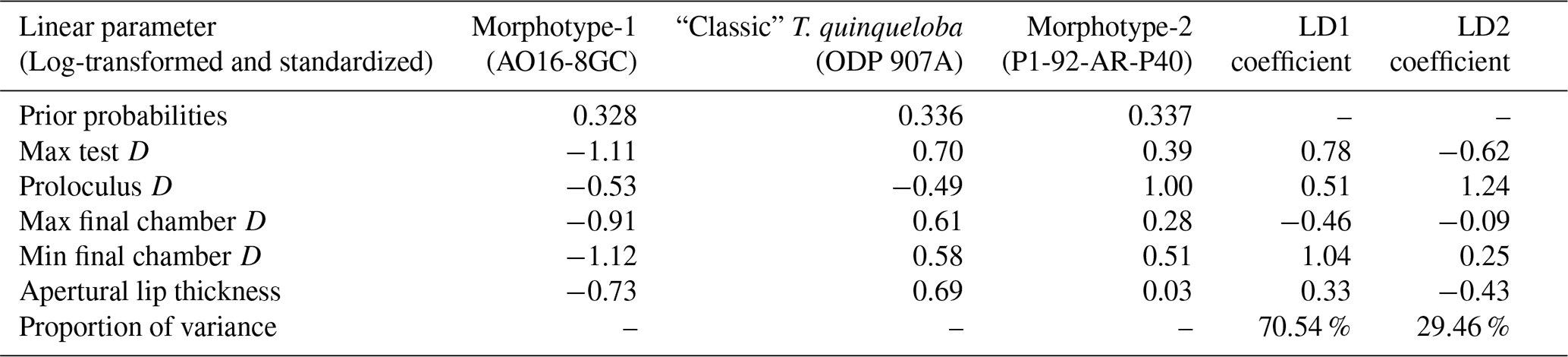
Table 6Predicted classification matrix of individual foraminiferal specimens into three predefined groups using leave-one-out cross-validation (LOOCV) within the performed LDA. Rows represent the actual assigned morphotypes/locations, while columns represent the groups predicted by the model based on five log-transformed and standardized morphometric parameters. Values on the diagonal (bold) indicate correctly classified specimens, while off-diagonal values represent misclassifications. The overall cross-validated accuracy is 88.93 %.

The first linear discriminant (LD1) explains 70.54 % of the between-group variance, while LD2 explains the remaining 29.46 %. LD1 was primarily driven by the minimum final chamber diameter (LD1 coefficient = 1.04), maximum test diameter (0.78), and proloculus diameter (0.51), indicating that overall shell size and final chamber geometry represent the principal axes of morphological separation. LD2 was strongly influenced by proloculus diameter (1.24), with additional contributions from maximum test diameter (−0.62) and apertural lip thickness (−0.43), highlighting proloculus size as an important secondary discriminator among the three populations (Table 5). Group means on the standardized scale indicate that Morphotype-1 from AO16-8-GC1 consistently occupies the “smallest end” of morphospace across all measured traits, with strongly negative mean values for the maximum test diameter (−1.11), minimum final chamber diameter (−1.12), and lip thickness (−0.73). In contrast, “classic” T. quinqueloba exhibits the largest average dimensions, particularly for maximum test diameter (0.70) and lip thickness (0.69). Morphotype-2 displays intermediate overall test size but a notably large proloculus (1.00), separating it clearly from the other two groups in the second discriminant dimension (LD2).
The predicted classification of individual specimens into the three groups (Fig. 4b) showed high discriminatory success with minimal misclassification. Cross-validated classification accuracy reached 88.93 %, demonstrating that the selected morphometric parameters are sufficient for robust specimen-level discrimination (Table 6). Morphotype-1 was particularly distinct, with 98.3 % of specimens correctly classified, forming a compact and isolated cluster with minimal overlap. In contrast, moderate overlap was observed between “classic” T. quinqueloba and Morphotype-2, indicating closer morphometric affinity between these two groups based on the compared traits.
The inter-group morphological differences, including size, are also clearly visible in the individual histograms (Fig. 3). “Classic” T. quinqueloba and Morphotype-2 reach similar overall test sizes and show comparable size variance, although “classic” T. quinqueloba exhibits the highest mean test size (189.63 µm; Table 4). Umbilical area shows distinct distributions for each sample, with Morphotype-2 being the most variable and showing a distinct right-skewed distribution with a long upper tail, a pattern similarly observed in the “Test projection area”. “Final chamber globulation” also displays three distinct peaks, consistent with separation into distinct populations. Of particular importance is the distribution of proloculus diameter, which emerged as one of the strongest discriminating variables in the LDA, especially LD2 (Table 5). Morphotype-1 and “classic” T. quinqueloba, both dated to MIS 5, show nearly identical proloculus sizes (means of 13.72 and 13.95 µm, respectively) despite very different overall test sizes (means of 113.8 and 189.6 µm, respectively) (Fig. 5). In contrast, Morphotype-2 from the older (> MIS 12) CAO horizon has a substantially larger mean proloculus diameter (21.90 µm) and greater variance. Further, “classic” T. quinqueloba and Morphotype-2 show greater visual separation along the LD2 axis (Fig. 4a), where separation is predominantly driven by proloculus diameter (Table 5). Hence, using histogram observations and the results of LDA, we observe that proloculus size is a critical feature that unites Morphotype-1 and “classic” T. quinqueloba and distinguishes them from Morphotype-2.
To summarize, across all analyses, the morphometric data reveal consistent and statistically robust differentiation among the three microfossil populations. Univariate histograms show distinct and often non-overlapping distributions in key traits (e.g., test size, chamber number, and proloculus diameter), while multivariate analyses (MANOVA and LDA) confirm that the populations occupy significantly different regions of morphospace, with high classification accuracy and clear separation primarily driven by overall size and proloculus–chamber geometry.
3.4 Potential for confusion with a smooth-walled Neogloboquadrina pachyderma morphotype
A fourth morphotype, which under the light microscope can resemble a small Turborotalita, must be considered for accurate identification of subpolar taxa in the central Arctic realm. This form corresponds to a morphotype of N. pachyderma, referred to as “Nps-5” (Eynaud et al., 2009; El Bani Altuna et al., 2018; Vermassen et al. 2025; Weitkamp et al., 2025a). It occurs in all samples where N. pachyderma is common, especially in the > 125 µm sieve fractions. These specimens display a petaloid outline similar to Turborotalita-like morphotypes, with five slightly globular chambers in the final whorl and an apertural lip. They also appear shiny and reflective under reflected light (Plate 1, panels 5 and 6). They are usually smaller than Morphotype-2 (Plate 7, figs. columns A–C) but can also appear in the 125–250 µm fraction, in the water column, at the core top, and in older samples where typical N. pachyderma are common (Plates 1 and 2). Coiling direction is both sinistral and dextral (Plate 1, panel 6). Under SEM, the test wall exhibits irregularly distributed, slightly angular bumps. Importantly, there are no signs of spine holes or broken spine bases, indicating a non-spinose wall and clearly distinguishing this morphotype from Turborotalia or other spinose taxa. Examination of multiple specimens reveals a gradation in wall texture, from isolated bumps to coalescing structures and eventually to coarse reticulating ridges characteristic of N. pachyderma. This non-spinose wall character is clear under SEM, but it can be difficult to resolve under the optical microscope. These have not been included in our morphometric analyses. Despite their striking gross test homeomorphy, the contrasting wall textures confirm their phylogenetic difference.

Plate 7SEM images contrasting Arctic planktonic foraminifera morphotypes that can be confused under the optical light microscope (see Plates 1 and 2 for light microscope comparisons). Row 1 (figs. (1)–(4)): key morphotypes mentioned in this study that may be misidentified: Fig. 1, N. pachyderma morphotype Nps-5 of Eynaud (2011) (reproduced from Eynaud, 2011; pl. 4, fig. 1, central Arctic Ocean); (2) N. pachyderma “Nps-5” (reproduced from Elbani Altuna et al., 2018, pl. 2, fig. 1, Canadian Arctic archipelago, Site 4); (3) “G. pachyderma form 3” of Stehmen, 1972 (reproduced from Stehmen and Gregory, 1973; pl. 1, fig. 3, “N. pachyderma form −3”); (4) holotype of G. exumbilicata Herman, USNM 186540. The rest of the plate presents categories of morphospecies and their wall texture close-ups arranged in columns (A–D). Columns A, B, and C = N. pachyderma. Columns D and E = Turborotalita. Figures (5)–(7), (10), (15), (20), (25), and (30), N. pachyderma “Nps-5”, Sample SWERUS L2-34-MC4, 0–1 cm, Holocene, Lomonosov Ridge; figs. (8), (9), (13), and (14), “G.” exumbilicata, AO16-9-PC1-3, 60–62 cm, “mid”-Pleistocene, Alpha Ridge; figs. (11), (12), (26), (27), (31), and (32), N. pachyderma Nps-5, core top JM08-P-343 MC, Holocene, Nordic Seas; figs. (16), (17), N. pachyderma, PS2644-5, 261 cm, Denmark Strait; figs. (18), (19), “G.” exumbilicata, LRG07-04, 300–301 cm, “mid-Pleistocene”, Lomonosov Ridge; figs. (21), (22), N. pachyderma, PS2644-5, 330 cm, Denmark Strait, 23, 24) T. quinqueloba, LRG12-7PC-2, 7–9 cm (0.88 mbsf), Lomonosov Ridge; figs. (28), (29), T. quinqueloba, LR12-7PC-3, 122–124 cm, Lomonosov Ridge; figs. (33), (34), T. quinqueloba, core top, JM08 005 BC, eastern Norwegian Sea. Scale bars: umbilical views, 100 mm, except (24), (29) = 50 µm; wall texture views = 10 µm.
3.5 Calcareous nannofossils
Consistent with previous analyses of CAO cores, nannofossil occurrences are extremely scarce (Appendix Table A1). They occur primarily within dark brown finer-grained intervals typically associated with bioturbation and the presence of other calcareous microfossils (benthic and planktonic foraminifera) (Hanslik et al., 2013; Razmjooei et al., 2023). Preservation was moderate to poor. Sampling focused on intervals with high abundances of T. quinqueloba (Morphotype-1) and Morphotype-2, in the hope of identifying key nannofossil taxa such as Gephyrocapsa huxleyi and P. lacunosa. These have proved valuable for anchoring recent biostratigraphic chronologies in other CAO cores from the central Lomonosov Ridge and Alpha Ridge (Razmjooei et al., 2023).
LOMROG07-PC04 (Lomonosov Ridge) contained the highest number of nannofossil counts, but no G. huxleyi and P. lacunosa were recorded (Appendix Table A1). The most common species were “small” indiscriminate Gephyrocapsa species and G. caribbeanica, both members of the family Noelaerhabdaceae and indicative generally of a Quaternary age. Gephyrocapsa muellerae and Coccolithus pelagicus are extremely rare, each observed in only two samples. Gephyrocapsa caribbeanica occurs in all samples containing T. quinqueloba but is not present in samples below 185 cm where Morphotype-2 occurs.
On the Mendeleev and Northwind ridges, samples were mainly taken from cores where the Morphotype-2 horizon had been identified (Cronin et al., 2014). In core P1-94-AR-P9 (Mendeleev Ridge), this horizon lies between the 413–427 cm subsurface. No G. huxleyi were found in this core, but a single P. lacunosa was identified at 435 cm. G. caribbeanica occurs in two samples above the Morphotype-2 horizon, and a single nannofossil (Reticulofenestra asanoi) was identified in one of the three samples from the Morphotype-2 horizon.
All but one sample from the other Northwind cores were barren of nannofossils (Appendix Table A1). These cores spanned water depths of 700–1470 m. In P1-92-AR-P40, 17 samples were analyzed, with 13 being from the Morphotype-2 interval, identified between 340–410 cm by Cronin et al. (2014). In P1-92-AR-30, 10 samples were analyzed from the Morphotype-2 interval, identified between 585–625 cm core depth. In P1-93-AR-P21, 2 of the 5 samples were from the Morphotype-2 interval between 200–210 cm. A single specimen of G. caribbeanica was recorded in the lowermost of these samples (210 cm).
Our qualitative and quantitative morphologic observations imply distinct differences between the studied subpolar morphotypes in time and space. We discuss these differences in the context of taxonomy, stratigraphy, and ecology and argue that they warrant formal taxonomic consideration.
4.1 Morphotype-1: Turborotalita quinqueloba
In CAO core material, the stratigraphically upper subpolar planktonics (Morphotype-1), found in horizons dated to interglacials between MIS 5 and 11 (Vermassen et al., 2021; Razmjooei et al., 2023; Vermassen et al., 2023), have an enrolled, laterally compressed test and a reduced or tear-drop-shaped final chamber covering the umbilicus. They are clearly spinose, as shown by the regularly distributed spine bases from which spines would have emerged in life. The tear-drop-shaped final chamber is a “classic” T. quinqueloba trait. However, Morphotype-1 differs from classic Nordic Seas/North Atlantic T. quinqueloba, from both core tops (Holocene) and an < MIS 12–MIS 5 horizon, in several ways: the distinctly smaller test size (Fig. 3, mean = 113.8 µm, compared to 189.6 µm in “classic” T. quinqueloba), fewer chambers in the whole test (9.45 compared to 11.01, respectively), more sparsely distributed pores, and a lack of late-stage surface thickening, seen in our sedimented sub-Arctic (Nordic Seas) examples (Plates 1 and 3, figs. 4–5).
Although Morphotype-1 (AO16-8GC-2, 2.5–3.5 cm, Alpha Ridge) and “classic” T. quinqueloba from the MIS 5 samples in the Iceland Sea (ODP 907A-1H-2, 37–39 cm) are statistically distinguishable and fall into separate groups, this alone does not justify their designation as distinct morphotypes or species, since test size is known to vary substantially within planktonic foraminifera in response to environmental and climatic conditions and stress (Bauch, 1994; Schmidt et al., 2003; Todd et al., 2020; Martinelli et al., 2026). Instead, we argue that key taxonomic traits, such as tendency to have an ampullate final chamber, enrolled coiling, and a compressed test, define T. quinqueloba (Natland 1938; Brummer and Kučera 2022) and unite both “classic” T. quinqueloba and Morphotype-1 as a single species. Notably, these diagnostic traits do not appear to be optimally represented or detected in our choice of traits in the quantitative morphometric analysis. In the case of the ampullate final chamber, this may be due to limitations in how we parameterized the variable “final chamber globularity” or to a high degree of intra-population variability that obscures this feature at the population level.
A further striking similarity between Morphotype-1 and “classic” T. quinqueloba is their near-identical mean proloculus size and variance, which contrasts strongly with the consistently larger mean size and broader range in Morphotype-2 (Fig. 3). Proloculus size should be treated cautiously as a taxonomic character because it can exhibit substantial intraspecific variability, including due to reproductive dimorphism (Keating-Bitonti and Payne, 2018; Darling et al., 2023; Meilland et al., 2023). Indeed, wide ranges in proloculus size have been documented in several planktonic foraminifera species, including N. pachyderma from the Greenland Sea and Baffin Bay (ca. 7–40 µm; Meilland et al., 2023) and the CAO (ca. 6–34 µm; Weitkamp et al., 2025a), as well as Globigerina aequilateralis (ca. 10–30 µm; Brummer et al., 1987). Notably, laboratory cultures of both species show that offspring produced in the lab exhibit similar proloculus size ranges to field collections, confirming a broad and stable intraspecific range in these species (Brummer et al., 1987; Meilland et al., 2023; Weitkamp et al., 2025a). However, other taxa exhibit consistently narrow proloculus size ranges; G. ruber (pink and white forms) both have proloculus diameters in the ca. 8–16 µm range compared to G. sacculifer, showing a range of ca. 12–19 µm (Brummer et al., 1987). This indicates that, while variability exists, some species nevertheless express relatively characteristic proloculus size ranges, suggesting a biologically constrained component of variation that may be detectable at the population level. We therefore interpret the close match in proloculus size range between Morphotype-1 and “classic” T. quinqueloba from different regions as supporting their conspecificity. In this context, differences in adult size and other test features are interpreted as environmentally driven, likely reflecting differing or suboptimal growth conditions in the central Arctic Ocean compared to the Iceland Sea. In contrast, we argue that the consistently larger mean proloculus sizes and broader size range observed in Morphotype-2 are unlikely to be explained by ontogenetic stage alone. We therefore interpret proloculus size range as a meaningful biological signal in this context. Together with other morphological traits, this pattern supports interpreting Morphotype-2 as a distinct morphospecies and likely a separate biological taxon, rather than an ontogenetic or ecophenotypic variant of T. quinqueloba.
Based on this evidence, we remain confident in assigning Morphotype-1 to T. quinqueloba, recognizing its morphological and developmental continuity with the “classic” form. Similar morphological variability in Arctic-realm T. quinqueloba has previously been linked to polar environmental gradients. For example, under polar conditions and ice cover of the southern Nansen Basin (north of Svalbard, > 85° N), which is the modern northern limit of the species, relatively small test sizes in water column T. quinqueloba were observed (modal class size ca. 90–120 µm) (Carstens and Wefer, 1992; Jensen, 1998; Stangeew 2001; Meilland et al., 2020; Greco et al., 2022) compared to relatively larger tests ranging from 110 to 140 µm in the subpolar zone (Norwegian Sea) (Stangeew, 2001). Considered “pre-adult” stages, the Nansen Basin specimens were interpreted to be transported individuals, expatriated from their production habitats further south by north-flowing Atlantic Water (West Spitsbergen Current) (Fig. 2) (Carstens and Wefer 1992). Significant expatriation via Atlantic currents was also invoked to explain increasing T. quinqueloba abundance in the Fram Strait over recent decades (Greco et al., 2022). Images of the collected specimens were not included in either of these studies, preventing morphologic comparisons with our CAO Morphotype-1 assemblages.
Variability in T. quinqueloba size is also reported in down-core assemblages in the Nordic Seas (Bauch, 1994). Microscope imagery is again lacking, but the simple sketch included in this study implies a morphology comparable to our CAO Morphotype-1, involving a dwarf form that retains the diagnostic ampullate final chamber covering the umbilicus. Importantly, this study found that Holocene (core top) T. quinqueloba in the vicinity of incoming Atlantic waters (eastern Nordic Seas, “Atlantic domain”) had larger mean test sizes than those from the western part of the Nordic Seas (Greenland Sea, “Arctic domain”) (210 µm versus 140 µm median test sizes, respectively), consistent with a stronger polar influence in the west from the East Greenland Current (Bauch, 1994). It is unclear whether these small polar specimens also had fewer chambers in the final test as seen in our CAO populations. Turborotalita quinqueloba was largely absent from the Nordic Seas during Pleistocene glacials, while N. pachyderma persisted. The former reappeared during the glacial-termination but tests were initially small (100–125 µm) in both the eastern Atlantic and western polar Nordic Seas domains, enlarging, especially on the eastern side, only when full interglacial conditions were established (Bauch, 1997). A similar pattern occurred during the previous termination and the transition into the MIS 5 interglacial (Bauch, 1997). Thus, reduced test size in T. quinqueloba has been broadly linked with cooler waters (Bauch, 1994), though in reality, size (and numbers of chambers in the test) likely reflects multiple interacting factors including temperature, stratification, sea ice, salinity and food availability. At its modern northern limit, a stable ice margin, along which high primary production occurs, may also play a role (Johannessen et al., 1994; Carstens et al., 1997).
Importantly, T. quinqueloba does not currently occur in the water column north of 83° N (Carstens and Wefer, 1992; Volkmann 2000; Snoeijs-Leijonmalm and Party, 2022; Vermassen et al., 2025; Weitkamp et al., 2025a). The similarity in test sizes between our CAO Morphotype-1 T. quinqueloba and glacial-termination or Arctic-domain populations from the Nordic Seas (Plates 1 and 3) suggests parallels in the environmental conditions that shaped their morphology.
4.2 The status and taxonomy of Morphotype-2
Morphotype-2 attains a similar size range to “classic” T. quinqueloba, and the multivariate plots imply some overlap in morphospace. However, there are also clearly different morphological traits, both in the morphometric data and SEM observations of the test ultrastructures. Our microscope images illustrate how Morphotype-2 deviates from Morphotype-1 (T. quinqueloba) in the systematically larger test area, more evolute coiling, a more open umbilicus with distinct apertural lips, and a more rounded final chamber that typically does not extend into the umbilical region. This is supported by the morphometric data, which highlight both the overall larger test size range and the significantly larger proloculus in Morphotype-2 (Fig. 3), compared to CAO T. quinqueloba, leading to a distinct cluster in the LDA (Fig. 4). The low average number of chambers in the whole test of Morphotype-2 (median 8) compared to “classic” T. quinqueloba (11) is likely a function of the typically larger proloculus, as shown in other species (Brummer et al., 1987). The Morphotype-2 state likely reflects a different life strategy or ecological adaptation compared to T. quinqueloba, including more resources allocated to initial growth, possibly linked to different reproductive modes or an overwintering strategy. Fewer chambers with a larger initial chamber might suggest faster early growth or a life cycle adapted to short periods of favorable conditions.
Although our metric for “final chamber globularity” does not appear to fully distinguish the distinctive ampullate/tear-drop shape of the T. quinqueloba final chamber concept, Morphotype-2 exhibits a markedly narrower variance in this parameter (Fig. 3). This suggests a more consistent, rounded chamber shape in Morphotype-2, particularly when compared to the “classic” T. quinqueloba, which shows more variability. In contrast, the umbilical area in Morphotype-2, intended to capture the loose coiling and large umbilicus, shows no clear separation from “classic” T. quinqueloba, although Morphotype-2 does show a right-skewed distribution and a long tail toward larger umbilical areas, consistent with observations. This indicates that while most specimens have moderate-sized umbilical areas, a subset exhibits much larger ones, reflecting substantial coiling variability within the morphospecies and a capacity to have very large open umbilici. This could reflect real biological variability, perhaps related to developmental plasticity or opportunistic ecology/growth. That our measurements do not clearly differentiate the umbilical characteristics of Morphotype-2 may be a consequence of the “umbilical area” metric used: delineation of the umbilical boundary can be subjective and can blur the differences between morphotypes. Instead, measuring the “umbilicus maximum diameter” may better capture these differences and could be explored in future work. Importantly, the use of area does not affect the distinction between morphotypes or the study's conclusions.
Based on the combination of Morphotype-2's distinct and consistent final chamber morphology, proloculus, and growth patterns; its unusually high variability in umbilical area; and its restricted occurrence in deeper stratigraphic levels, together with additional surface texture features not captured by our morphometric analysis, such as the broad spine bases and costellae-like linear alignments of pustules common in spiral view (Plate 5, figs. 28, 29, 32–34; Plate 6, figs. 34, 35), we conclude that Morphotype-2 deserves taxonomic differentiation. This is consistent with previous work that utilizes the occurrence of the morphotype as a stratigraphic marker with paleoceanographic value (Cronin et al., 2013, 2014, 2019; Xiao et al., 2020; Jang et al., 2026). Lumping these forms with T. quinqueloba would result in a loss of important biostratigraphic and paleoceanographic information. In this study, our morphometric populations are limited to single locations. Whether the same conclusions would apply if we repeated the experiments with populations from other stations in the CAO is unknown, although the SEM images of specimens from these different regions imply that the morphologies are similar across the region.
The following question then arises: what name should be applied to Morphotype-2? Although the designation T. egelida has been widely used in recent years, lending its name to the “T. egelida zone” (Cronin et al., 2019), our investigations reveal that this assignment rests on a rather insecure taxonomic foundation. This requires a comprehensive reassessment. In the following sections, we detail the ambiguities and reconsider the taxonomic framework for subpolar planktonic foraminiferal invasions, beginning with a critical review of the Turborotalita in northern polar and subpolar regions.
4.3 High-latitude North Atlantic Turborotalita: ecology and taxonomic history
Since early plankton surveys, T. quinqueloba, originally described as Globigerina quinqueloba Natland (Natland, 1938), has been recognized as a key component of high-latitude North Atlantic and sub-Arctic planktonic foraminifera assemblages (Bé and Hamlin, 1967; Cifelli and Smith, 1970), where it is now known to occur as genetic Types IIa and IIb (Darling et al., 2007, 2017; Morard et al., 2024). High T. quinqueloba abundance is linked to northward-flowing Atlantic surface waters in the eastern Nordic Seas, Barents Sea, and Laptev Sea, where it thrives under “open water” and “sea-ice edge” conditions (Carstens and Wefer, 1992; Bauch 1994; Johannessen et al., 1994; Carstens et al., 1997; Volkmann, 2000; Simstich et al., 2003; Jonkers et al., 2010; Werner et al., 2011; Husum and Hald, 2012; Zamelczyk et al., 2018; O'Regan et al., 2019; Anglada-Ortiz et al., 2025). Turborotalita quinqueloba has long been regarded as a symbiotic surface dweller due to its spinose habit (Hemleben et al., 1989), although its small size has hindered culturing efforts, leaving this interpretation uncertain. Recent plankton net observations, however, report no evidence of algal symbiosis in T. quinqueloba from the mid-latitude western North Pacific (Takagi et al., 2019) or the high-latitude North Atlantic (Armitage et al., 2026), although it remains possible that some subtropical or tropical genotypes host facultative symbionts. The occurrence of significant proportions (ca. > 10 %) of T. quinqueloba, and/or diagnostic N. pachyderma–T. quinqueloba δ18O offsets, is commonly used as paleoceanographic tracers, including mapping of sub-Arctic frontal systems; the sea-ice edge; the strength of seasonality; and, more recently, evidence of increasing “Atlantification” of sub-Arctic and Arctic regions (Johannessen et al., 1994; Alonso-Garcia et al., 2011; Bauch et al., 2012; Husum and Hald 2012; Moffa-Sánchez et al., 2014; Mokeddem et al., 2014; Zhuravleva et al., 2017; Tesi et al., 2021; Greco et al., 2022; Vermassen et al., 2023). The Atlantic Water connection seems robust: today, north of Svalbard, T. quinqueloba quickly disappears as Atlantic Water subsides beneath the strong Arctic halocline, and it is entirely absent from the CAO water column (Carstens and Wefer 1992; Volkmann 2000; Nørgaard-Pedersen et al., 2007; Ding et al., 2014; Vermassen et al., 2025), making the observed fossil T. quinqueloba occurrences in the CAO all the more significant.
The discovery of subpolar plankton invasions in the CAO dates back to the surveys of the 1950s–1970s, notably “Fletcher's Ice Island (T-3)” and the “Arlis and Alpha Ice Island” expeditions, which marked the earliest Arctic marine geology investigations (Schindler, 1968). Yvonne Herman, who led many of the pioneering sedimentological and micropaleontological studies of the time, identified distinct horizons of “subpolar planktonic foraminifera” in multiple sediment cores, including T3 67-3, T3 67-9, and DA2-II from the Mendeleev and Alpha ridges, respectively (Herman, 1974) (Fig. 1). Originally referred to as the “G. quinqueloba complex”, the multiple horizons variably comprised G. quinqueloba and a second morphotype at deeper horizons, which Herman initially referred to as “Globigerina sp., cf. G. quinqueloba” (Herman, 1970) and later named Globigerina exumbilicata (Herman, 1974). Globigerina exumbilicata was described as differing from G. quinqueloba in the spherical shape of the final chamber, which does not overhang the umbilicus, and by having a more distinct apertural lip and a deep and open umbilicus, often surrounded by umbilical teeth. This description is consistent with the holotype (Plate 6, figs. 28–30) and paratypes (Plate 6, figs. 31–36) of the species, illustrated here for the first time, as well as our Morphotype-2 assemblages from cores in the Eurasian and Amerasian basins. We find multiple examples of “Morphotype-2” that bear a striking resemblance to the holotype of G. exumbilicata (Plate 5, figs. 14, 19, 20).
4.4 From Globigerina exumbilicata to Turborotalita egelida: a confusing history
As the first central Arctic studies were unfolding during the 1970s, Herman was contacted by Richard Cifelli regarding the taxonomy of G. exumbilicata. He sent Herman comparative specimens of his species G. egelida, described from his North Atlantic plankton net studies (37–47° N; Fig. 2) (Cifelli and Smith, 1970), and suggested that her Arctic morphotype was conspecific with his egelida. Herman accepted Cifelli's interpretation and, since G. egelida had priority, she recognized exumbilicata as its junior synonym and referred to the Arctic material as G. egelida. This classification was later adopted by Cronin et al. (2013), in the combination Turborotalita egelida. As part of our assessment of subpolar species in the CAO, we revisited this synonymization to address two questions: (1) what was the original concept of G. egelida and (2) is the synonymy of G. exumbilicata with it justified?
Critical to Cifelli and Smith's (1970) work is how they classified quinqueloba. From their descriptions and illustrations, it is apparent that they recognized quinqueloba-like forms in their North Atlantic water column assemblages. However, they proposed that these Atlantic occurrences differed from Natland's species described from California margin sediments and suggested that the Atlantic morphotype should instead be referred to as a new subspecies, which they named G. quinqueloba egelida (Cifelli and Smith). The argument was that the Pacific forms have a thicker test, more compact form, less depressed sutures, and a less lobulate periphery compared to the Atlantic occurrences (Plate 3). The holotypes and paratypes of egelida have been imaged for the first time as part of this study (Plate 6, figs. 7–18). Unfortunately, the holotype of egelida was lost during imaging, and only the spiral view was captured. Nevertheless, we consider the paratype images, together with the original illustration of the umbilical side of the holotype, sufficient to illustrate the range of morphological variability attributable to the taxon. The implications of this are significant: in Cifelli and Smith's classification, the “true” Globigerina quinqueloba (i.e., Natland's nominal species) was implicitly restricted to the Pacific, while the Atlantic and Arctic forms were treated as a different taxon, i.e. G. quinqueloba egelida. Cifelli and Smith's Atlantic vs. Pacific quinqueloba classification was never adopted. Kennett and Srinivasan (1983) considered egelida to be a “phenotypic variant of quinqueloba”. Recently, Brummer and Kučera (2022) also placed egelida in synonymy with T. quinqueloba, concluding that since it was recovered from the water column, it was likely a growth stage of this species.
When comparing the type material, we recognize the broad similarities between Cifelli and Smith's (1970) egelida and Herman's (1974) exumbilicata, particularly the rounded final chambers and open umbilicus, which contrast with the classic ampullate final chamber of T. quinqueloba, in both the “classic” and the dwarf CAO populations recovered from sediments (Plates 3 and 5). However, we point out that these egelida specimens are from the water column, not sedimented. Therefore, we argue that Cifelli and Smith's egelida represents a sub-adult form and are thus not an appropriate reference for comparing the mostly mature, sedimented shells described by Herman (1974) and referred to as the taxon Globigerina exumbilicata. SEM images of live T. quinqueloba from our northern North Atlantic plankton pump samples, confirmed to be a known genotype of T. quinqueloba (Type IIb, Kucera and Darling 2002), support this: the identified specimens, pumped from 5 m subsurface, are concluded to largely represent juvenile specimens that lack a well-developed ampullate final chamber (Plate 4). Since the ampullate overhanging final chamber generally appears only in sedimented populations, this must be a final-stage adult feature occurring in individuals that have reached full maturity. Our plankton material in fact closely resembles the G. egelida-type specimens (Plate 4; Plate 6, figs. 7–18). Ambiguous identification of immature planktonic foraminifera in the water is a general challenge for many species, as the final-stage chamber morphologies and test ornamentations useful for taxonomy are often added only in the terminal stages (Hemleben et al., 1989). From these arguments, we assert that central Arctic exumbilicata Herman, as sedimented fossils, should not be referred to as Cifelli and Smith's taxon “G. egelida”; the former represents a mature morphotype, while the latter is an immature form (Kennett and Srinivasan, 1983; Brummer and Kučera, 2022). Since our morphometric and SEM analyses find clear differences between Morphotype-1 (T. quinqueloba) and Morphotype-2 in the CAO, they require taxonomic differentiation. We therefore reinstate exumbilicata Herman as the most appropriate name for Morphotype-2.
Of relevance here is another species described from the same study, Globigerina atlantisae Cifelli and Smith, also SEM illustrated here for the first time (Plate 6, figs. 19–24). Although outwardly similar to T. quinqueloba in its tight coiling and ampullate final chamber, Cifelli and Smith distinguished G. atlantisae by its more curved sutures, elongate chambers (umbilical view), and consistently umbilicus-covering final chamber. There are also fewer total numbers of chambers (10–11 vs. 13–14) in G. quinqueloba egelida, with generally only 4 chambers in the final whorl of G. atlantisae. Our new SEM images show that G. atlantisae lacks pores and bears randomly distributed small pustules rather than spine bases, indicating a non-spinose, microperforate wall (Plate 6, fig. 22). This confirms its affinity with Tenuitellita iota (Parker, 1962), as proposed by Brummer and Kučera (2022). Notably, Cifelli and Smith's taxonomic checklist (fig. 4, p. 7, Cifelli and Smith, 1970) lists atlantisae as “Globigerinita atlantisae”, reflecting uncertainty about its generic assignment. We therefore exclude atlantisae from further discussion of Arctic Turborotalita, although we note that T. iota may be mistaken for small T. quinqueloba.
4.4.1 Herman's “egelida”–pachyderma mix-up
A further complication arises from misidentification of a smooth-walled, five-chambered, globular morphotype of N. pachyderma, corresponding to morphotype “Nps-5” described by Eynaud et al. (2009) and El Bani Altuna et al. (2018). This confusion followed the synonymization of G. exumbilicata with living G. egelida (Herman, 1983), leading Herman to conflate fossil and modern forms and to apply inferred morphological and ecological traits interchangeably. Herman had originally interpreted the central Arctic exumbilicata invasions (later referred to as “egelida”) as indicative of low-salinity (high river/meltwater runoff) surface conditions, with absent sea ice and high iceberg activity interpreted from abundant ice-rafted debris (“temperate-sub-Arctic, eurythermal and euryhaline” conditions) (Herman, 1964, 1970; Herman and O'Neil, 1975; Herman and Hopkins, 1980). In her later work, she extended this ecological interpretation to all cases where “G. egelida” was recorded. This included the living plankton of Cifelli and Smith, her fossil assemblages in the Arctic (exumbilicata), and also plankton tow populations in northern Baffin Bay that she elaborated on in a paper from 1983 (Herman, 1983).
The Baffin Bay interpretation is especially problematic. This relied on a re-evaluation by Herman of SEM images originally published by Stehman (1972) and reillustrated by Stehman and Gregory (1973). Stehman had identified three N. pachyderma morphotypes in plankton-net samples collected from Baffin Bay (“Forms 1–3”) and noted dominance of a five-chambered morphotype (“Form 3”) in the northernmost region of the study. Although the SEM images are of low quality (reproduced here in Appendix Fig. A3), it is apparent that Stehman's Form 3 does bear some resemblance to Cifelli and Smith's (1970) G. egelida. However, we concur with Stehman's taxonomic identifications that his SEM figures depict morphotypes of N. pachyderma, not other species: his “Form 3” is comparable to the recent concepts of Nps-5 (Eynaud et al., 2009; Weitkamp et al., 2025a) in having a somewhat open umbilicus, smooth wall, and rounded final chamber. Thus, in our opinion, Stehman's “Form 3” is not conspecific with “exumbilicata” or “T. quninqueloba”. Subsequent plankton and sediment studies have confirmed the dominance of N. pachyderma and scarcity/absence of T. quinqueloba in Baffin Bay (Aksu, 1983; Jennings et al., 2018; Knutz et al., 2025), reinforcing our interpretation that Herman misclassified a morphotype of N. pachyderma.
Herman's blending of Stehman's observations and her central Arctic “exumbilicata” (i.e., our Morphotype-2) we now know was incorrect. Neogloboquadrina pachyderma and Morphotype-2 are unrelated, and any similarities are due to homeomorphy. Herman is not alone in misidentifying these forms. Viewed under a light microscope, these forms can be difficult to differentiate, especially in the CAO where both Nps-5 and T. quinqueloba are small and shiny. Similar misidentifications occurred in central Arctic sediment cores (CESAR-83-102, CESAR-83-103) near Herman's Alpha Ridge stations (Aksu 1985) (their plate 8.2, figs. 5–8), where SEM images labeled G. egelida appear to depict Nps-5 morphotypes. SEM documentation of wall textures is critical, as Nps-5 walls have pustules distinct from the subpolar species, which have spine collars. What is clear from the literature, and personal communication with other workers, is that confusion of small turborotalitids with the more lightly calcified tests of N. pachyderma Nps-5 is widespread. To illustrate this potential for confusion, and to hopefully prevent it, we present a suite of whole-specimen and wall texture views of morphotypes Nps-5 together with specimens of Arctic T. quinqueloba and Morphotype-2 (exumbilicata) (Plate 7). The relatively smooth neogloboquadrinid walls of Nps-5 have raised bumps, but these are solid and irregularly distributed, which is quite different from the spine collars of T. quinqueloba and exumbilicata (Morphotype-2), which, where preservation suffices, can be seen to have a diagnostic central hole (spine cavity) and a more regular distribution pattern. These images underscore the importance of SEM-based documentation of wall textures. Understanding of “Nps-5” is continuously expanding: recent work shows that Nps-5 in the water column represents a combination of immature specimens that will eventually mature into morphotypes Nps-1–4 (majority), plus a small fraction of asexually reproducing “mother cells” involved in an asexual reproduction cycle, which will retain the Nps-5 morphology in sediments (Davis et al., 2020; Meilland et al., 2023, 2024; Weitkamp et al., 2025a).
4.5 A taxonomic framework for Pleistocene Arctic and sub-Arctic morphotypes
After Herman's work during the 1980s, no further reports of egelida were published until the 2010s when new findings of subpolar planktonic foraminifera invasions at relatively deep subseafloor depths (several meters) were reported and referred to as the “egelida zone” (Cronin et al., 2014). Cronin et al. (2013) were the first to use the binomial Turborotalita egelida, later illustrated with SEM images in Cronin et al. (2014). We interpret Cronin et al.'s (2013) assertion that “T. egelida-dominated … assemblages have no known modern analogue” as correct. In contrast, Herman implied that egelida is extant and can be differentiated from quinqueloba (Herman and Hopkins, 1980; Herman, 1983), an interpretation that is inconsistent with Cifelli and Smith's concept and the synonymization of egelida under quinqueloba.
The complex history of the application of egelida, quinqueloba, and exumbilicata in the Arctic and sub-Arctic Atlantic, as outlined here, reveals significant confusion and misapplication of these taxa. This underscores the need for taxonomic clarification to advance stratigraphic and paleoenvironmental interpretations of subpolar planktonic foraminifera occurrences in the central Arctic. With our accompanying image catalogue – featuring whole-specimen and wall texture SEMs that underpin higher taxonomy – alongside new morphometric data, we propose a path forward toward improved classification and taxonomic resolution. To summarize, the key issues that we have unearthed are the following.
In the CAO, at least two stratigraphic horizons can be recognized involving acmes of species other than N. pachyderma: the stratigraphically upper (younger) horizons (Morphotype-1) involve acmes of dwarf T. quinqueloba, whereas the deeper (older) horizons involve a different morphotype (Morphotype-2), which was originally named G. exumbilicata Herman 1974 but was subsequently synonymized under a poorly known species, G. egelida Cifelli and Smith 1970, to which it bears some resemblance.
Cifelli and Smith (1970) had established egelida as a subspecies of G. quinqueloba from living plankton samples in the North Atlantic. It was differentiated from Natland's (1938) species G. quinqueloba described from the Pacific Ocean, on the grounds that the Atlantic forms lack the elongate final chamber typical of G. quinqueloba. The intention was that “egelida” should be a general replacement for occurrences of G. quinqueloba in the North Atlantic. This is not consistent with the subsequent usage of egelida in the context of its application in Arctic Pleistocene sediments (Herman, 1974; Aksu, 1985; Cronin et al., 2019; Vermassen et al., 2021).
Our new SEM images of “live” T. quinqueloba from the water column south of Iceland closely match the morphology of Cifelli and Smith's egelida-type material in lacking the elongated final chamber typical of the species. As acknowledged previously, the presence of an elongate, embracing final chamber thus represents a mature stage seen in sediment specimens (Brummer and Kučera, 2022). DNA analysis of the netted immature T. quinqueloba imaged herein also supports the morphotype being T. quinqueloba (Type IIb) (Kucera and Darling, 2002; Darling and Wade, 2008). We therefore conclude that the concept of egelida is (a) not appropriate for defining a new species that will largely be identified in sediments and (b) should not replace G. exumbilicata Herman 1974 as the valid prior synonym.
The consistent morphological differences observed between Morphotype-2, in particular the larger proloculus, more open umbilicus, and differing wall texture and ornamentation, provide strong support for biological and taxonomic differentiation from Morphotype-1 (T. quinqueloba). Combined qualitative, quantitative, and stratigraphic evidence confirms that they represent separate morphospecies.
There is a potential to confuse both CAO T. quinqueloba and Morphotype-2 with a smooth-walled open-coiling morphotype of N. pachyderma (Nps-5), leading to the potential for misinterpretation in paleoceanographic reconstructions. Comparative wall texture SEM analysis can easily resolve this.
Given the stratigraphic and morphologic arguments for taxonomically differentiating Morphotype-1 and Morphotype-2 and the unavailability of egelida (being a growth stage of T. quinqueloba), we reinstate Herman's (1974) species name exumbilicata for Morphotype-2, replacing the current usage of T. egelida. Although no image of the holotype was provided in the original description, a type specimen and repository were designated (Herman, 1974, p. 300), satisfying the requirements of the International Code of Zoological Nomenclature (Article 10.1); the taxon is therefore available.
The generic placement of exumbilicata is less straightforward. Both the original and the emended definitions of the genus Turborotalita focus on the presence of an ampullate final chamber (originally described as a bulla) that extends into the umbilicus, variously described as “encroaching”, or “adumbilically displaced”, and the potential to be covered by a thick calcite crust (Blow and Banner, 1962; Pearson and Kucera, 2018; Brummer and Kučera, 2022). Systematic absence of these features in the populations of exumbilicata investigated in this study suggests that the morphospecies does not belong in Turborotalita but instead may be better placed in Globigerina. The species “exumbilicata” broadly satisfies the criteria for Globigerina in having a “bulloides-type” wall, although modified and more similar to that seen in e.g. Oligocene Globigerina officinalis (Spezzaferri et al., 2018) (plate 6.3), and with broader spine bases. The costellae-like pustule ridges may also be significant. This feature has, to our knowledge, not been observed in any species of Turborotalita. However, similar features have been illustrated in some specimens of Globigerina falconensis (e.g., Schiebel and Hemleben, 2017, pl. 2.4, fig. 4) and G. neofalconensis (Fabbrini et al., 2023, pl. 4, fig. f). Morphologically, exumbilicata also shares a lobulate outline and apertural lip development with members of the G. falconensis group, although its wall is generally less reticulate. On the other hand, the umbilical–extraumbilical aperture of “exumbilicata” is inconsistent with the current genus level definition of Globigerina, which has an umbilical aperture (Fabbrini et al., 2023).
Moreover, as discussed above, the distinction between Turborotalita and Globigerina is complicated by ontogenetic variability. In T. quinqueloba, final chamber elongation, umbilical overhang, possession of a terminal flap, and encrustation develop late in ontogeny. As a result, “simplified” T. quinqueloba specimens can resemble exumbilicata, highlighting a broader issue in planktonic foraminiferal taxonomy: key diagnostic taxonomic characters often emerge during ontogeny and are variably represented, making their recognition dependent on sampling. This challenge is widespread, with immature specimens of many spinose genera, including Globigerina, Globigerinoides (and Trilobatus), and Orbulina being difficult to distinguish (Brummer et al., 1987). In addition, as reported here, statistical analyses of morphological traits show that different taxa commonly occupy partially overlapping regions of morphospace (Tabachnick and Bookstein, 1990; Malmgren et al., 1983; Pearson, 1993; Ezard et al., 2010; Pearson and Ezard, 2014). Consequently, even genus-level boundaries, such as those between Turborotalita and Globigerina, become less distinct when juvenile and ecophenotypic variability are taken into account and are most robust when based on adult (sedimented) population morphologies.
We thus conclude that within this framework, exumbilicata forms a consistent and distinct population-level morphology in CAO sediment assemblages, characterized by a globular final chamber, wide umbilicus, umbilical–extraumbilical aperture, non-encrusted wall, pustulose ridges, and a commonly large proloculus and variable proloculus. This repeated association across sites indicates a coherent morphotype that is not fully explained by incidental overlap with immature T. quinqueloba. Moreover, it lacks many of the diagnostic traits that would support assignment to genus Turborotalita. We therefore adopt a conservative approach and refer to this taxon as “Globigerina” exumbilicata, recognizing that a definitive generic assignment will require broader comparative analyses of globigerinid and turborotalitid morphology and test ultrastructure, extending beyond the central Arctic Ocean. In this respect, the co-occurrence of Morphotype-2 and T. quinqueloba observed in some of our assemblages also warrants further investigation. This provisional nomenclature is presented in the “Systematic taxonomy” section below.
Thus far, “G.” exumbilicata has not previously been reported outside the CAO. A morphotype bearing a striking resemblance to it was recorded as abundant by Poore (1979) in samples biostratigraphically dated as “late Pliocene to mid-Quaternary age” (nannofossil zone range N16/N19) (Bukry, 1979; Martini, 1979; Poore, 1979; Steinmetz, 1979), from DSDP Site 409, south of Iceland. Referred to as “Globigerina sp. A”, Poore's SEM images (pl. 19, figs. 5–12 of Poore, 1979) reveal various features common to “G.” exumbilicata, including open coiling, multiple relict apertural lips, a large proloculus, and linear pustulose ridges, suggesting the morphotypes are conspecific. Likewise, Globigerina antarctica Keany and Kennett 1972, a little-known taxon that briefly appeared as an acme species in the southern Indian Ocean Antarctic polar frontal system during the mid-Pleistocene (Matuyama magnetic reversal chron), represents a potential southern high-latitude analogue that warrants further investigation. This species has long been regarded as a junior synonym of Globigerina falconensis (Kennett and Srinivasen, 1983) although this was rejected by Fabbrini et al. (2023).
4.6 Constraints on the age of the “Globigerina” exumbilicata interval
With our revised taxonomy providing a new framework for differentiating subpolar species in the CAO, we return briefly to the question of the timing of the enigmatic “G.” exumbilicata acmes. Herman (1974) had originally assigned it to the Matuyama magnetic chron based on the paleomagnetic reversal stratigraphy of Clark (1970). This implied an age in the range of 2.595 Ma–773 ka (Ogg, 2020), which spans MIS 104 to MIS 19 of the global benthic δ18O chemostratigraphy (Lisiecki and Raymo, 2005). These initial paleomagnetic-based age assignments in Arctic sediments have been questioned, and subsequent age models, which utilized biostratigraphy and cyclostratigraphy, assigned the exumbilicata horizon to MIS 11 (Jakobsson et al., 2001; Cronin et al., 2013; Cronin et al., 2014; Xiao et al., 2020).
In 2020, the calcareous nannofossil Pseudoemiliana huxleyi was first identified in marine sediment cores from the CAO (O'Regan et al., 2020). The relative of P. huxleyi, P. lacunosa went extinct globally during MIS 12 (424–478 ka) and now provides an important middle Pleistocene biostratigraphic age constraint for CAO sediments. Shortly after its discovery in the CAO, Vermassen et al. (2021) showed, through stratigraphic correlation between the LOMROG12-3PC record containing P. lacunosa and the AO16-8GC record containing “G.” exumbilicata, that the “G.” exumbilicata horizon occurred below the highest occurrence (HO) of P. lacunosa, indicating that it was not an MIS 11 (424–374 ka) marker but must, therefore, be older than MIS 12 (434–432 ka). At the time they suggested an age of MIS 15/MIS 17 (> 580 ka).
Subsequently, Razmjooei et al. (2023) provided a detailed nannofossil biostratigraphy for AO16-8GC and, in doing so, revised the stratigraphic placement for the HO of P. lacunosa, placing it higher in the lithostratigraphic column than previously suggested. In AO16-8GC, the HO of P. lacunosa is at 138 cm, and the highest level containing “G.” exumbilicata is 187–198 cm (Vermassen et al., 2021) (Fig. 1), indicating that the “G.” exumbilicata interval is “considerably” older than MIS 12. Surprisingly, AO16-8GC is the only reported record from the CAO containing both “G.” exumbilicata and P. lacunosa. None of our new nannofossil studies on the Northwind Ridge, Mendeleev Ridge, or the Lomonosov Ridge provide further constraints on the age of this zone. In fact, our new nannofossil observations presented here indicate that, despite the distinct nature and remarkably good carbonate preservation of the “G.” exumbilicata interval, the nannofossil assemblage is unremarkable, being characterized by extremely low abundance and diversity or complete absence of nannofossils.
Tentatively, a “younger-than age” is suggested by the dinoflagellate cyst biostratigraphy from IODP Expedition 302 (Arctic Coring Expedition), where the correlative horizon for “G.” exumbilicata occurs above the acme of Filisphaera filifera and the highest persistent occurrence of Habibacysta tectata. These events, when correlated to records from the Nordic Seas and Barents Sea margin, are argued to be > 1.8 and 2.0 Ma, respectively (Matthiessen et al., 2018). This suggests that the “G.” exumbilicata interval is older than MIS 12 (ca. 0.44 Ma) and younger than 1.8 Ma. This age framework is broadly consistent with recent stratigraphic interpretations (Jang et al., 2026), although resolving the age of the “G.” exumbilicata event remains a major question in Arctic paleoceanography. Addressing this uncertainty will require multidisciplinary efforts integrating stratigraphy, geochronology, and paleoenvironmental analysis to better understand Pleistocene climatic and biotic transitions both within and outside of the CAO, where more diverse dating tools, including robust paleomagnetic reversal and oxygen isotope stratigraphy, are available. This is a priority for future research.
The presence of subpolar morphospecies in the CAO during the Pleistocene documents periods of markedly different paleoenvironmental conditions. Sediment cores from across the Arctic reveal multiple invasion events involving two different morphotypes, separated stratigraphically by decimeters of sediment, potentially representing hundreds of thousands of years. These episodes have been identified in numerous sites across the CAO and are assumed to be correlative, yet a clear taxonomic framework for consistently naming the invaders was lacking. Three previously described species are central to the story: quinqueloba (Natland), egelida (Cifelli and Smith), and exumbilicata (Herman). The latter two have traditionally been synonymized under T. quinqueloba. However, the central Arctic occurrences and confusing taxonomic usage warranted a new evaluation. Using light and SEM microscope images, we confirm the macroperforate, spinose nature of both morphotypes. Our morphometric analysis further supports their distinction by quantifying key differences in final chamber shape, test size, proloculus size, chamber number, and wall texture.
We conclude that the younger (stratigraphically upper) subpolar invasions involve small (dwarf) T. quinqueloba, at times before MIS 12 and including the interglacial MIS 5. This is highly significant since T. quinqueloba is not present at the scale of reproducing populations in the CAO during the Holocene. The stratigraphically deeper, potentially middle to early Pleistocene-age biohorizons involve a different morphospecies. Most recently referred to as T. egelida, we expose reasons why this name is not appropriate and reinstate the morphotype's original name, exumbilicata Herman. We further suggest that exumbilicata may be more appropriately placed within the genus Globigerina rather than Turborotalita on the grounds that it lacks primary qualifying features of the latter. However, we emphasize that a definitive generic placement remains problematic at present and that the proposed attribution to Globigerina should be regarded as tentative. Accordingly, we provisionally reinstate a modified version of Herman's (1974) original designation, “Globigerina” exumbilicata, recognizing that its generic assignment remains uncertain pending broader comparative morphological and ultrastructural investigations.
“Globigerina” exumbilicata flourished in the CAO during the mid-Pleistocene, in some regions as monospecific assemblages. If the Globigerina affiliation can be substantiated, our results imply an early attempt by a member of the Globigerina lineage to colonize the polar Arctic domain, potentially prior to ecological dominance by N. pachyderma. This contrasts with the distribution of modern Globigerina bulloides, whose high-latitude presence is largely limited to the southern reaches of the Arctic gateways, highlighting the fundamentally different ecological conditions that allowed “G.” exumbilicata to thrive. These findings provide a novel perspective on Arctic planktonic foraminiferal biogeography and evolution. Further morphometric data would be valuable to better constrain the morphological variability in T. quinqueloba and “G”. exumbilicata with respect to umbilical configuration, final chamber shape, proloculus size, and wall texture and conclude the question of Turborotalita vs. Globigerina generic assignment. Ideally this would include a broader, global perspective, including subpolar to temperate populations of T. quinqueloba in the North Atlantic and North Pacific oceans, as well as a follow-up on possible occurrences of “G”. exumbilicata documented in the northern North Atlantic. At this stage, we cannot confidently determine the taxonomic significance of the pustulose ridges observed in “G.” exumbilicata. However, we consider them to be a potentially important morphological feature that warrants further investigation. Systematic observations of wall textures in Globigerina, Turborotalita, and Globigerinella will be worthwhile in this respect.
Our taxonomic analysis establishes a species-level framework for identification of key Arctic planktonic foraminifera while resolving decades of taxonomic confusion. This foundation is critical for reconstructing past ecosystem changes, assessing the CAO's sensitivity to environmental perturbations, and interpreting Pleistocene Arctic history with broad implications for Arctic marine geology. It is currently unclear how this taxonomy applies beyond the CAO. Our findings emphasize that mixing species definitions from living plankton and sedimented specimens can create taxonomic complications because plankton samples often contain immature individuals that may differ in test wall characteristics and final chamber morphology – traits fundamental to classification. Taxonomic updates must account for life stage, and species should not be split based on differences that simply reflect development, ensuring a robust and consistent link between living and fossil taxa. This study emphasizes the necessity to document species using SEM imaging, which should be considered primary data.
The following systematic taxonomy section focuses on the key taxa relevant to this study, with a special focus on “G.” exumbilicata. Associated synonymy lists are selective and include Neogene to Quaternary northern high-latitude occurrences of the relevant taxa. An extended species description is presented only for “G.” exumbilicata.
-
Genus Turborotalita Blow and Banner (1962)
Type species. Truncatulina humils Brady (1884)
Description. Amended herein after Pearson and Kucera (2018)
Type of wall. Normal perforate, spinose in life, may be covered with a thick calcite crust, which, when present, can greatly modify the test outline
Test morphology. Low trochospiral, relatively flattened, lobate or petaloid in outline (when not encrusted); final chamber may be reduced in size, may be displaced towards the umbilicus, or may be ampullate or rounded in shape, with a distinct lip, sometimes extending into a flap that may cover the entire umbilicus and end with tunnel-like extensions with one or more openings. Primary aperture umbilical to extraumbilical, narrow to wide, commonly hidden in umbilical view beneath the extended apertural flap of the final chamber but may be open where the coiling is evolute.
Size. Generally small.
-
Turborotalita quinqueloba (Natland, 1938)
Plate 3, figs. 1–26, Plate 4, figs. 1–16, Plate 5, figs. 1–13. (Plate 6, figs. 1–6: new light microscope and SEM images of the holotype of Globigerina quinqueloba Natland, 1938) -
Globigerina quinqueloba Natland, 1938, p. 149, pl. 6, figs. 7a–c [recent, 152 m depth off Long Beach, California]. Herman, 1974, p. 305, pl. 14 [Pleistocene, Sample T3-66-S.8, 8–10 cm, Mendeleev Ridge, Arctic Ocean]. Poore, 1979, p. 473, pl. 15, figs. 9-10 [Upper Pliocene, Zone N21, DSDP Sample 407-7R-4, 15–15 cm, Irminger Sea, North Atlantic Ocean]. Saito, 1981, p. 48, pl. 10, figs. 1a–c, 2a–c.
-
Globigerina groenlandica Stschedrina, 1946, p. 145 (English p. 148), pl. 4, figs. 23a–b [recent, Station 4 (1935), “Lat. 76°21′ N, Long. 358°37′ E”, 3000 m, Greenland Sea]
-
Globigerina quinqueloba (Natland) – Aksu, 1985, p. 117, pl. 8.2, figs. 1–4 [Quaternary, Cesar Core 83–103, Alpha Ridge, central Arctic Ocean] – Saito, 1981, pl. 10, figs. 1a–c, 2a–c.
-
Globigerina quinqueloba egelida Cifelli and Smith, 1970, p. 32, pl. 3, figs. 4a–c [recent, plankton tow Station 26, Atlantis Ii Cruise 13, North Atlantic Ocean].
-
Turborotalita quinqueloba (Natland) – Jenkins, 1977, p. 312, pl. 5, fig. 9 [Lower Miocene, Wimpy Sealab Trial borehole, English Channel, North Atlantic Ocean]. This seems to be the first usage of the combination Turborotalita quinqueloba.
-
Globigerina (Globigerina) quinqueloba Natland, Srinivasan and Kennett, 1985, p. 32, pl. 5, figs. 4–6 [Pleistocene, Globorotalia truncatulinoides Zone, DSDP Site 284-1-2, 25 cm, southwest Pacific Ocean].
Description. Modified herein.
Type of wall. Normal perforate, spinose, with a tendency for heavy late-stage gametogenic calcification.
Test morphology. Low, flat trochospiral coiling, peripheral margin petaloid; in spiral view 4.5–5.5 moderately rounded chambers in the final whorl, increasing gradually in size, sutures radial or slightly curved, depressed; in edge view biconvex, lenticular; in umbilical view 4.5–6 chambers, final chamber commonly reduced in size ampullate, with a flap often developing into a broad extension towards the umbilicus, usually with a prominent lip; sutures radial, depressed; umbilicus narrow, commonly obscured by encroaching final chamber; aperture umbilical, a low arch, usually obscured. The wall may be smooth or thickened with additional calcite layers. When heavily calcified the outline is compact, and the sutures may be largely obscured.
Size. Diameter of holotype: approximately 0.24 mm (Natland, 1938). A small variant occurs in the central Arctic Ocean during past interglacials (this study) and in the Nordic Seas during the deglacial period after Termination 1 (Bauch, 1994).
Comments. Based on our CAO observations we find large variability in test size and surface texture in this species, with the central Arctic variant being consistently smaller and smooth walled compared to specimens from the Nordic Seas, where the species can be very common. Cifelli and Smith's (1970) G. egelida, collected from plankton tows in the North Atlantic, is confirmed to be a growth stage of T. quinqueloba, having not yet added an elongate final chamber. This is supported by our new plankton-net specimens that have an identical morphology to Cifelli and Smith's G. egelida and whose genetic analysis was confirmed to be T. quinqueloba (Type IIb, Kucera and Darling, 2002), one of six genetic types of this species recognized, based on small subunit (SSU) ribosomal (r) rDNA sequencing (Morard et al., 2024). This implies that the elongate final chamber, present even in dwarf CAO T. quinqueloba, is a terminal feature.
-
Genus Globigerina d'Orbigny 1826
Type species. Globigerina bulloides d'Orbigny, 1826
Description. Fabbrini et al. (2023)
Diagnosis. Normal perforate, spinose bulloides-type and pseudocancellate wall structure. Aperture umbilical with no supplementary apertures present.
Test morphology. Low trochospiral, lobulate outline, chambers globular; 3–5 slightly embracing chambers in ultimate whorl, increasing slowly in size, sutures straight and moderately depressed; umbilicus large, open, enclosed by surrounding chambers; aperture umbilical, a broad arch, which may be bordered by an imperforate thin rim or lip.
Remarks. The first representative of the genus is G. officinalis, emerging in middle Eocene Zone E10 (Olsson et al., 2006). The genus diversified in the Oligocene (Wade et al., 2018).
Range. Eocene–present.
-
“Globigerina” exumbilicata Herman, 1974 (provisional generic assignment)
(pl. 6, figs. 28–30: new SEMs of holotype of Globigerina exumbilicata Herman, 1974; paratypes pl. 6, figs. 31–36)
-
Globigerina sp. cf. Globigerina quinqueloba Herman, 1970: fig. 3b, d, e [Pleistocene, Sample T3-67-9, 220 cm, Alpha Ridge, Arctic Ocean].
-
Globigerina exumbilicata Herman, 1974: no original holotype figure, Holotype figure published for the first time herein, pl. 6, figs. 28–30 [Pleistocene, Sample D.st.A. 2 II, 144 cm, Alpha Ridge, central Arctic Ocean], pl. 18, figs. 1–5 [Pleistocene, Sample T3-67-12, 192 cm, North Wind Ridge, Arctic Ocean]. Herman and O'Neil, 1975: 593 [Pleistocene, Sample D.st.A. 2 II, 144 cm, Alphas Ridge, central Arctic Ocean). Saito, 1981: 37 [pl. 6, fig. 3a–c, reproduction of Herman specimen].
-
Globigerina sp. “A” Poore, 1979: pl. 19, figs. 5–12 [Upper Pliocene–lower Quaternary, Zones N21(?)-N22, DSDP Site 409, northern North Atlantic Ocean].
-
Globigerina egelida (Cifelli and Smith) Herman, 1980, Herman and Hopkins, 1980: 559
-
Non. Globigerina egelida (Cifelli and Smith), Herman, 1983 (“Globigerina pachyderma form 3” of Stehman and Gregory, 1973): 358, fig. 2c [recent, plankton tow, Baffin Bay, North Atlantic Ocean] = [Neogloboquadrina pachyderma, morphotype Nps-5].
-
Non. Globigerina egelida (Cifelli and Smith) Aksu, 1985: pl. 8.2, figs. 5–8 [Quaternary, Cesar Core 83-103, Alpha Ridge, central Arctic Ocean] = [Neogloboquadrina pachyderma, morphotype Nps-5].
-
Turborotalita egelida (Cifelli and Smith), Cronin et al., 2013, 2014, 2019; O'Regan et al., 2019; Vermassen et al., 2021: pl. 1, figs. a–e [> MIS 12, Sample AO16-8GC, 1.88–1.90 mbsf; pl. 2, figs. a–d, > MIS 12, Sample AO16-9-PC1-3, 60–62 cm, Alpha Ridge, central Arctic Ocean].
Description. –
Type of wall. Perforate, thin, and spinose, with relatively broad, flat-topped spine collars, commonly with fine, costellae-like linear alignments of pustules forming narrow ridges. The wall texture is consistent with a spinose globigerinid morphology, showing features comparable to the Globigerina bulloides group.
Test morphology. The low-trochospiral test has a rounded lobate periphery; chambers are spherical, enlarging gradually, arranged in 2 to 2.5 whorls; there are generally 4 to 5 chambers in the last whorl. The final chamber is spherical and possesses a thin but distinct lip. The umbilicus is open and deep and surrounded by umbilical teeth. The aperture of the last chamber is a low arch, umbilical–extraumbilical. Sutures are distinct, narrow, and depressed. The proloculus is commonly large, and the average number of chambers in the final whorl is relatively low (average 7–8). Radial lineations of pustules into ridges is a feature commonly seen on the spiral side. The coiling direction is random.
Size. Small, sometimes medium to large (100–300 µm).
Distinguishing features. This species may be confused with “simplified” pre-adult specimens of T. quinqueloba, as well as sedimented T. quinqueloba that lack an elongated, overhanging final chamber and late-stage test encrustation. The key differences between the taxa are the lobulate, more globular morphology of “G” exumbilicata, characterized by a more globular final chamber, typically looser coiling resulting in a more open umbilicus, a higher spire, and a larger overall size. The wall texture of the new taxon also differs from that of T. quinqueloba, in having broader and flatter spine bases and a tendency to develop linear alignments of pustules radiating on the spiral side; in contrast to T. quinqueloba, it never shows late-stage test thickening/encrustation. An unusually large proloculus and proloculus size range are also key features, whereas T. quinqueloba typically has a smaller and narrower proloculus size range. “Globigerina” exumbilicata may also be confused with the lightly calcified four- to five-chambered N. pachyderma morphotype Nps-5, from which it can be clearly distinguished under SEM in having a distinctly spinose wall.
Discussion. The morphospecies exumbilicata is here tentatively placed in genus Globigerina due to the absence of the typical features of Turborotalita in sedimented, assumed mature, populations. A potential challenge to this placement in Globigerina is the presence of an umbilical–extraumbilical aperture, which differs from the typical apertural configuration currently used to define the genus. We therefore take a conservative approach and refer to “Globigerina” exumbilicata, recognizing that broader evaluation of globigerinid and turborotalitid test morphology and ultrastructure across subpolar to temperate regions is required before a definitive generic-level taxonomic assignment can be made. We here follow Herman's (1974) original genus–species combination while enclosing the generic name in quotation marks to denote uncertainty.
Prior to its formal description in 1974 by Herman, “G” exumbilicata was included with the counts of “G. quinqueloba” and was also referred to as Globigerina sp., cf. G. quinqueloba (Herman, 1970). Although a holotype specimen of G. exumbilicata was designated at the time of description and deposited in the USNM Cushman Collection, no accompanying holotype image was originally provided (Herman, 1974). The SEM images of the G. exumbilicata holotype specimen presented here were obtained through our request for SEM imaging of the type material from the Cushman Collection and therefore represent the first published images of this taxon. This does not affect the availability of this name, since Article 10.1 (and related clauses) of the International Code of Zoological Nomenclature states that the description and holotype designation (collection number, institution) is sufficient to confer availability (ICZN, 2012). This species has previously been referred to as Turborotalita egelida, but, based on the arguments made herein, it is here referred to as its original species name and tentatively to the full original combination Globigerina exumbilicata. The wall texture of the “G.” exumbilicata differs from that of T. quinqueloba, as illustrated in Plates 3–6. Herman (1974) observed that electron-probe analyses revealed a test composed of three discrete layers: an outer and inner Mg-rich layer and an intermediate Ca-rich layer. This may be consistent with observations of high test calcite trace Mg concentrations found in sedimented foraminifera generally across the central Arctic ridges and is believed to be a consequence of diagenetic processes (Barrientos, 2018) (PhD thesis).
Phylogenetic relationships. “Globigerina” exumbilicata has previously been considered a relative of T. quinqueloba (Herman, 1980; Saito, 1981). However, we suggest its phylogenetic affinities lie Globigerina. One possibility is that the species is related to G. falconensis, with which it shares some common features, as observed in published images of G. falconensis (or G. neofalconensis), including a well-developed apertural lip and linear pustulate ridges, the latter seen thus far only in occasional specimens (Schiebel and Hemleben, 2017). Globigerina antarctica Keany and Kennett, described from mid-Pleistocene-age sediments from the Antarctic polar front region (Keany and Kennett, 1972), and currently regarded as a junior synonym of G. falconensis, also warrants reconsideration in this context. A potential problem with a Globigerina assignment is that exumbilicata has an umbilical–extraumbilical aperture, which is inconsistent with the current definition of Globigerina. Further investigations of wall texture and aperture morphology across relevant spinose genera will help resolve these phylogenetic relationships.
Type level. Core D. st. A 2 II, 144 cm, 83°52′ N, 168°12′ W, Alpha Rise, central Arctic Ocean. The “G.” exumbilicata type level was originally assigned to the “Matuyama reversed polarity epoch” (Herman, 1974) (Clark, 1970; Herman, 1974) and initially considered to be of Pliocene age (Herman, 1970, 1974). However, views on this have changed significantly over the past 50 years. Reinterpretations of the paleomagnetic reversal stratigraphy and sediment accumulation models of the early 2000s argued for a mid-Pleistocene MIS 11 age (Cronin et al., 2019), whilst the latest constraints imply that“G” exumbilicata horizons are older than MIS 12 (> 478 ka) (Razmjooei et al., 2023). Work is ongoing to resolve this question.
Stratigraphic range. Pleistocene, older than MIS 12, younger than 1.8 Ma (best estimate, this study). To be confirmed. “Globigerina” exumbilicata is presumed extinct.
Geographic distribution. Currently confirmed only in the central Arctic Ocean. Abundant“G”. exumbilicata have been found on the central Arctic Ocean ridges in the Amerasian Basin and on the Greenland-margin end of the Lomonosov Ridge. At the time of writing, there are no confirmed occurrences of the species outside the central Arctic region, although a morphotype illustrated from the northern North Atlantic may turn out to be conspecific (Poore, 1979: “Globigerina sp.-A”), suggesting a potentially wider distribution.
Paleobiology. Described as being characteristic of “eurythermal and euryhaline conditions”, i.e. tolerant of variable temperatures and salinities by Herman (1974). No stable isotope data are currently available.
Repository. Holotype: (figured) dimension: diameter 0.2 mm. The holotype specimen is from sample D.st.A. 2 II, 144 cm, Alpha Ridge, central Arctic Ocean. USNM no. 186540 (catalog no. 36). Paratypes: (figured) dimensions: Diameter range 0.18 to 0.33 mm. The paratype specimens are from sample D.st.A. 2 II, 144 cm, USNM no. 186539 (catalog no. 36).
-
Genus Neogloboquadrina Bandy, Frerichs and Vincent, 1967
Type species. Neogloboquadrina dutertrei (d'Orbigny, 1839) (in de la Sagra, Histoire physique, politique et naturelle de I'lle de Cuba, Bertrand, Paris, p. 84 (plates published separately, vol. 8, pl. 4, figs. 19–21)
Description. Emended herein
Type of wall. Neogloboquadrina type, non-spinose with elongate parallel ridges with short connecting ridges which appear more prominent on the umbilical surface. Tendency to develop a thick (gametogenic) crust with euhedral crystals forming a rosette pattern, particularly in high-latitude species. Smoother-walled morphotypes lacking the strong textural ridges and reticulations also occur.
Test morphology. Low trochospiral, globular to lobulate in outline, with 4 to 7 chambers in the final whorl; chambers subspherical to ovate, moderately to strongly inflated, closely appressed and increasing gradually or rapidly in size as added. Equatorial periphery lobulate to compressed, axial periphery broadly rounded. Sutures radial and depressed on both spiral and umbilical sides, sometimes slightly curved on the umbilical side. Surface cancellate to reticulate with distinct pores and pore pits; wall calcareous, moderately thickened, sometimes with a covering of euhedral calcite crystals appearing as blunt “spines” concentrated around the umbilicus. Umbilicus narrow to moderately broad and deep, varying from circular to subquadrate in shape. Aperture interiomarginal, umbilical–extraumbilical or umbilical, generally with a low to medium arch, bordered by a continuous lip. Additional apertural modifications, such as tooth-like flaps or umbilical plates, may occur. Coiling is predominantly sinistral or dextral, depending on the species.
Size. Small to large, depending on species.
-
Neogloboquadrina pachyderma (Ehrenberg, 1861)
-
Aristospira pachyderma Ehrenberg, 1861: 303, illustrations, Ehrenberg, 1863, figs. 6a–b North Atlantic, southwest of Iceland [62°40′ N/29°0′ W at 1000 fathoms].
-
Globigerina bulloides var. Borealis Brady, 1881: 412, 69 [Franz-Josef Land and the Novaya-Zemlya Sea], illustration by Ehrenberg (1873, pl. 1, fig. 4), lectotype designated by Banner and Blow 1960. Globigerina bulloides var. borealis Brady, 1881: p. 412 [Franz-Josef Land and the Novaya-Zemlya Sea]. Banner and Blow, 1960: p. 4, pl. 3, figs. 4a–c (lectotype).
-
Globigerina occlusa Herman, 1974: 300, pl. 10, figs. 3 and 4 [Pleistocene, Core T66, Mendeleev Rise, central Arctic Ocean].
-
Globigerina cryophila Herman, 1980: pl. 10, figs. 3 and 4 [Pleistocene, Core T66, Mendeleev Rise, central Arctic Ocean].
-
Globigerina pachyderma (Ehrenberg). Parker, 1962: 224, pl. 1, figs. 26–30 [NEL 394: 63°13′ S, 147°45′ E, Antarctica], figs. 31, 33, 34 [Downwind BG 62: 47°37′ S, 121°02′ W, 3800 M] pl. 2, fig. 2 [Downwind BG 61: 46°44′ S, 123°01′ W, 4250 M], figs. 3–6 [Scruton E 180: 52°13′ N, 173°35′ E, 137 m]. Berggren, 1972: 978, pl. 2, figs. 1–3 [Early Pleistocene, DSDP Site 113, southern Labrador Sea, North Atlantic].
-
Neogloboquadrina pachyderma (Ehrenberg) sinistral. Kennett, 1973: 599, pl. 1, figs. 5, 6 [Late Pliocene, DSDP Site 207, South Lord Howe Rise, South Pacific]. Weaver, 1987: 725, pl. 1, figs. 3, 4 [Pleistocene, Zone N22, DSDP Site 610, Feni Drift, North Atlantic Ocean]. Spiegler and Jansen, 1989, pl. 2, figs. 1–4, 7 [Pleistocene, ODP Hole 642B, Vøring Plateau, Nordic Seas]. Spiegler, 1996: 166, pl. 1, figs. 1–2 [Pleistocene, Zone N22, ODP Hole 910C, Fram Strait, Nordic Seas].
-
Neogloboquadrina pachyderma (Ehrenberg), Nps-1 morphotype Eynaud et al., 2009: 105, pl. 2, fig. a. Weitkamp et al., 2025b: 40, pl. 16, figs. 3–5 [Pleistocene, DSDP Site 407, Irminger Basin, North Atlantic Ocean]. Weitkamp et al., 2025a: 4, pl. 1, figs. 1–3 [plankton net sample, SAS ODEN Expedition 2021, central Arctic Ocean]; pl. 2, figs. 1–3 [surface sediment sample, SAS ODEN Expedition 2021, central Arctic Ocean].
-
Neogloboquadrina pachyderma (Ehrenberg), Nps-2 morphotype Eynaud et al., 2009: 105, pl. 2, fig. b. Weitkamp et al., 2025b: 40, pl. 16, figs. 6, 7 [Pleistocene, DSDP Site 407, Irminger Basin, North Atlantic Ocean]. Weitkamp et al., 2025a: 4, pl. 1, figs. 4–6 [plankton net sample, SAS ODEN Expedition 2021, central Arctic Ocean]; pl. 2, figs. 4–6 [surface sediment sample, SAS ODEN Expedition 2021, central Arctic Ocean].
-
Neogloboquadrina pachyderma (Ehrenberg), Nps-3 morphotype Eynaud et al., 2009: 105, pl. 2, fig. c. Weitkamp et al., 2025b: 40, pl. 16, fig. 8 [Pleistocene, DSDP Site 407, Irminger Basin, North Atlantic Ocean]. Weitkamp et al., 2025a: 4, pl. 1, figs. 7–9 [plankton net sample, SAS ODEN Expedition 2021, central Arctic Ocean]; pl. 2, figs. 7–9 [surface sediment sample, SAS ODEN Expedition 2021, central Arctic Ocean].
-
Neogloboquadrina pachyderma (Ehrenberg), Nps-4 morphotype Eynaud et al., 2009: 105, pl. 2, fig. d. Weitkamp et al., 2025b: 40, pl. 16, figs. 9, 10 [Pleistocene, DSDP Site 407, Irminger Basin, North Atlantic Ocean]. Weitkamp et al., 2025a: 4, pl. 1, figs. 10–11 [plankton net sample, SAS ODEN Expedition 2021, central Arctic Ocean]; pl. 2, figs. 10–12 [surface sediment sample, SAS ODEN Expedition 2021, central Arctic Ocean].
-
Neogloboquadrina pachyderma (Ehrenberg), Nps-5 morphotype Eynaud et al., 2009: 105, pl. 2, fig. e. Stehman, 1972: (“Globigerina pachyderma form 3”), [recent, Baffin Bay plankton tow]. Weitkamp et al., 2025a: 40, pl. 16, figs. 11, 12 [Pleistocene, DSDP Site 407, Irminger Basin, North Atlantic Ocean]. Aksu, 1985: 117, pl. 8.2, figs. 5–8 [Quaternary, Cesar Core 83-103, Alpha Ridge, central Arctic Ocean]. Weitkamp et al., 2025a: 4, pl. 1, figs. 12–14 [plankton net sample, SAS ODEN Expedition 2021, central Arctic Ocean]; pl. 2, figs. 13–15 [surface sediment sample, SAS ODEN Expedition 2021, central Arctic Ocean].
-
Neogloboquadrina pachyderma (Ehrenberg), Npd morphotype (dextral coiling) Eynaud et al., 2009: 105, pl. 2, fig. f. Weitkamp et al., 2025a: 4, pl. 1, figs. 16–20 [plankton net sample, SAS ODEN Expedition 2021, central Arctic Ocean].
Description. –
Type of wall. Neogloboquadrina type
Test morphology. Test low trochospiral, equatorial periphery slightly lobulate axial periphery rounded; chambers spherical to ovate, 4–5 chambers in the final whorl, increasing rapidly in size as added; closely embracing, final chamber commonly irregular, often kummerform; sutures on both spiral and umbilical sides radial, depressed; depending on the morphotype, surface is either distinctly cancellate, thickened specimens have surface covered with euhedral calcite crystals giving rosette pattern surface, or relatively smooth with irregularly distributed pustules, isolated or coalescing into ridges; umbilicus narrow, deep; aperture interiomarginal, umbilical–extraumbilical, a rather low arch with a thick apertural rim. Coiling, predominantly sinistral, typically 3 % aberrant coiling (dextral) in sedimented populations. Multiple morphotypes are recognized.
Size In Arctic sediments relatively small (> 125 µm).
Distinguishing features. Test low trochospiral, quadrate (4 to 4.5 chambers in the final whorl) umbilicus narrow, deep; Predominantly sinistral coiling.
Discussion. This species is widely used in paleoceanography, especially as a proxy for past glacial ocean conditions. It is particularly valuable because of its distinct ecological preferences and morphologies. At least 5 morphotypes of N. pachyderma morphotypes have been described from the Arctic region (Eynaud et al., 2009). The four- to five-chambered relatively smooth-walled form Nps-5 can be confused with Turborotalita or small “G.” exumbilicata due to the shiny appearance in light microscope view, and petaloid shape, involving 4–5 chambers in the final whorl. Nps-5 can be distinguished from Turborotalita and “G.” exumbilicata by its non-spinose wall, visible under SEM as having irregular, slightly angular bumps, but lacking spine holes and spine bases. Nps-5 also overlaps in size with the small T. quinqueloba that appear during certain interglacials in the CAO, being most common in the 125–250 µm fraction. Both sinistral and dextral coiling occurs in N. pachyderma. The typical frequency of right-coiling specimens in sedimented N. pachyderma assemblages is 3 %–5 % (Darling et al., 2006, 2023), although as much as 30 % dextral coilers have been detected in CAO water column populations in association with likely asexual reproductive events (Weitkamp et al., 2025a). SEM imaging reveals a gradation in wall texture, from isolated bumps to coarse reticulating ridges, diagnostic of N. pachyderma. Following Eynaud et al. (2009), our taxonomy recognizes multiple morphotypes of N. pachyderma in the Arctic, reflecting variation in chamber number, coiling and wall texture/degree of encrustation. The forms range from reticulated, tightly coiled four- to five-chambered forms to relatively smooth-walled individuals (e.g., Nps-5), with both sinistral and dextral coiling represented. Genetic data, based on small subunit (SSU) ribosomal (r) rDNA sequencing, detect 7 genotypes of N. pachyderma in the modern ocean (Morard et al., 2024), with a single type (Type Ia) still currently dominating in the CAO (Weitkamp et al., 2025a).
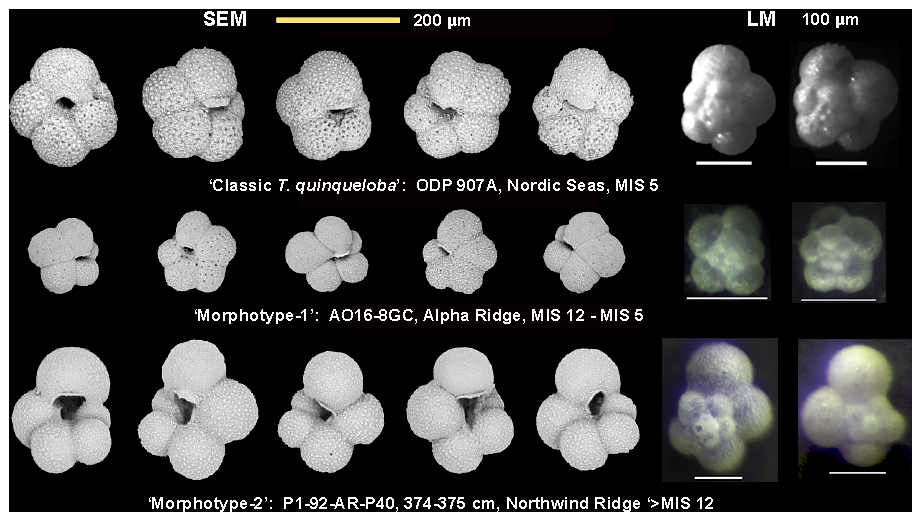
Figure A1Examples of subpolar planktonic foraminiferal morphometric populations and imaging types. SEM – scanning electron microscope. LM – light microscope.
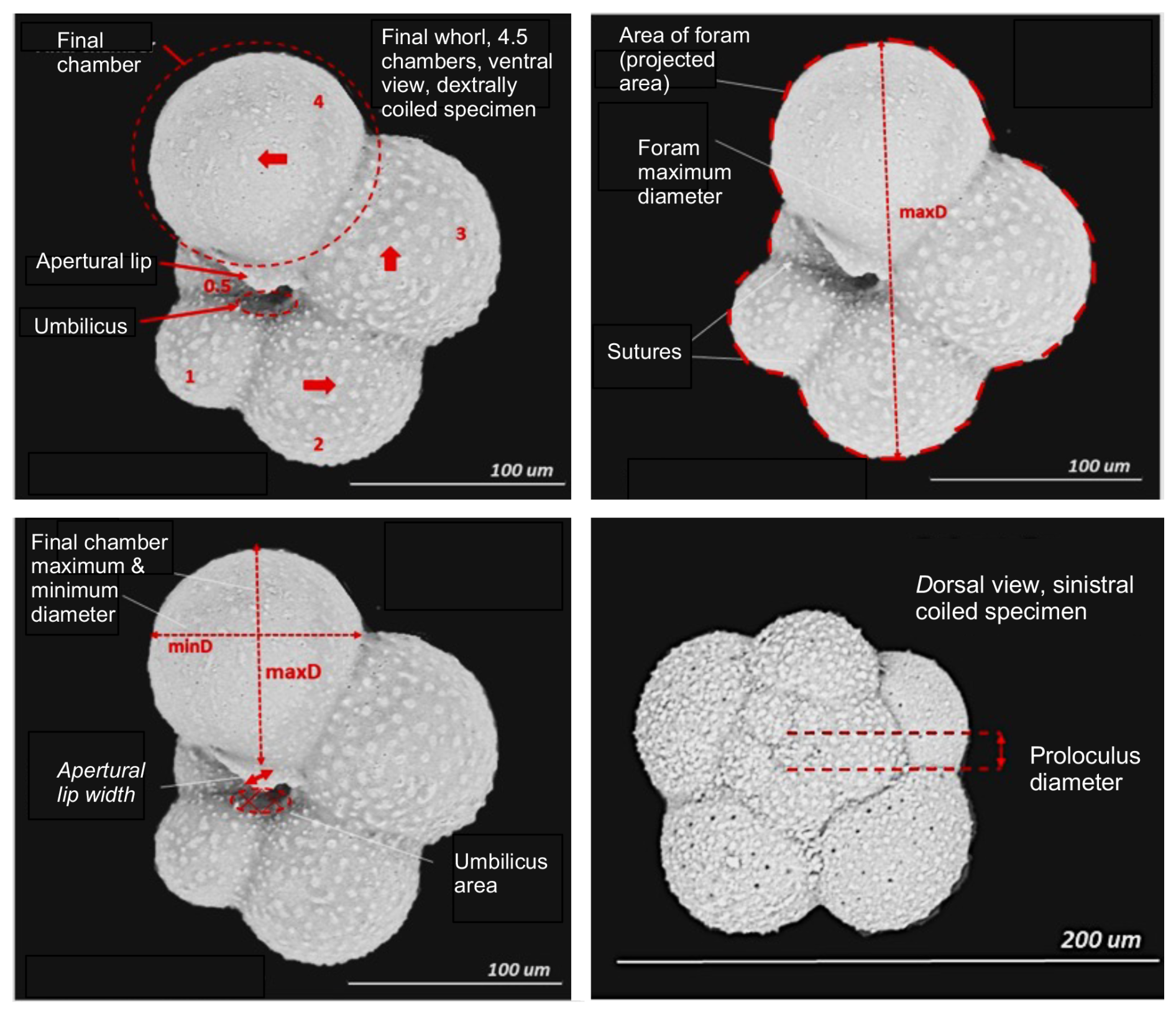
Figure A2Morphometric traits measured and other foraminifera anatomical features important for taxonomy. Examples are of T. quinqueloba Morphotype-1, Sample AO16-8GC-2, 2.5–3.5 cm, Alpha Ridge, central Arctic Ocean.
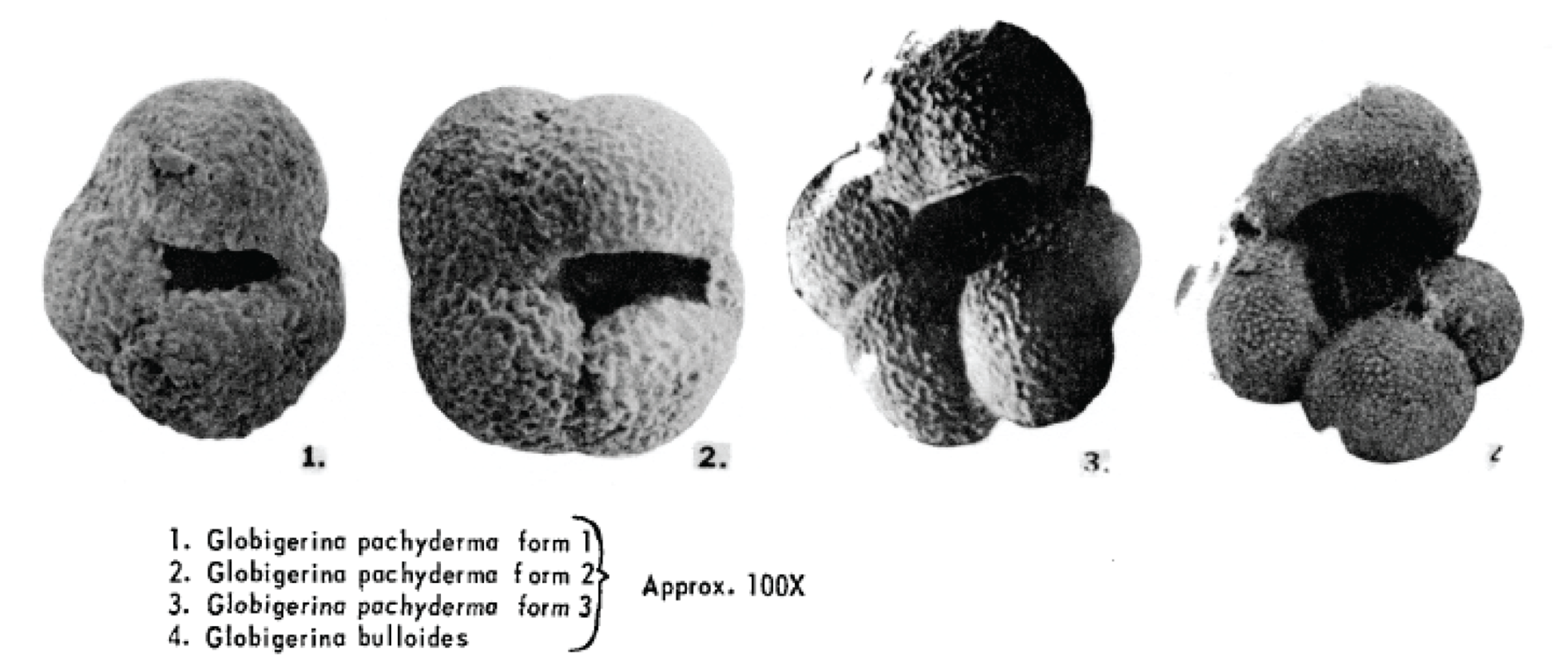
Figure A3Reproduction of Stehman's (1972) plate (Stehman, 1972, Fig. 7), illustrating his classification of planktonic foraminifera morphotypes recognized from plankton net tows and surface sediment samples in Baffin Bay. Stehman (1972) recognized three distinctive forms of “G. pachyderma”, which he illustrated along with a representative specimen of Globigerina bulloides from the study area. These G. pachyderma morphotypes, referred to as “forms 1, 2, and 3”, were characterized as follows: – Form 1, compact with small aperture and heavy calcification, which masks any pore structure at high magnifications; – Form 2, quadrate or square appearance of the classic pachyderma form; – Form 3, five chambers on the dorsal side, an arched sinuous lip around the aperture, and much less calcification. This form was documented as being “quite predominant in the northern part of the survey area (Baffin Bay)” and “In the sediment samples … there is a much more widespread distribution of form 3”. Based on recent understanding of the wide morphological variation in N. pachyderma (El Bani Altuna et al., 2018; Eynaud, 2011; Eynaud et al., 2009), we interpret form 3 as being an N. pachyderma Nps-5 (more globular, often 4.5 chambers, not encrusted).
Table A1Results of new targeted nannofossil biostratigraphy. Stratigraphic distribution of nannofossil taxa observed in the 5 sites analyzed in this study (see main text Table 1), with sample-selection focusing on horizons containing Morphotype-1 (M-1) and Morphotype-2 (M-2). FOV: field of view. “Gephyrocapsa small” = Gephyrocapsa specimens < 2 mm. G. ex = “Globigerina” exumbilicata. T. q. = Turborotalita quinqueloba.
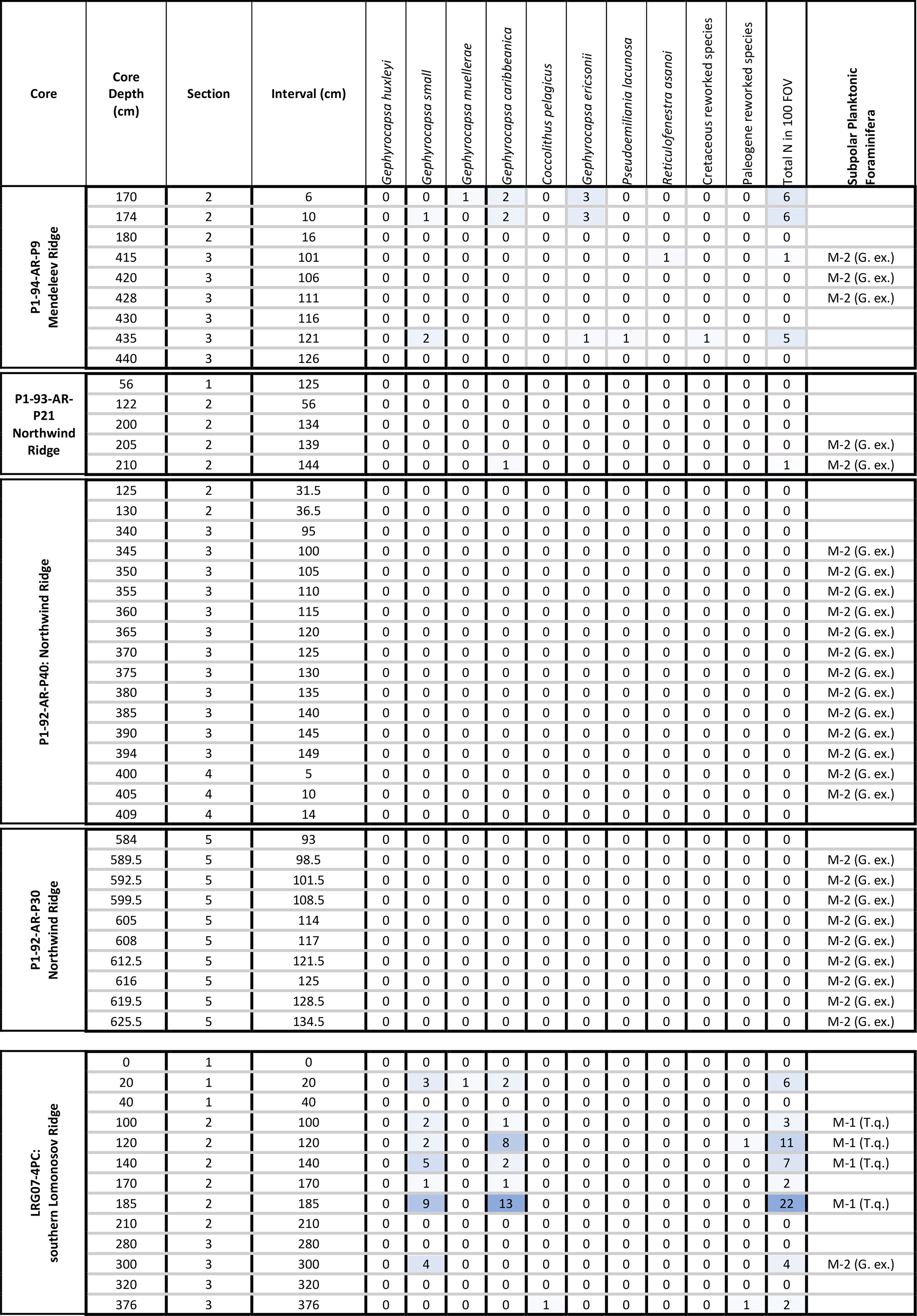
The contact author has declared that none of the authors has any competing interests.
Publisher's note: Copernicus Publications remains neutral with regard to jurisdictional claims made in the text, published maps, institutional affiliations, or any other geographical representation in this paper. The authors bear the ultimate responsibility for providing appropriate place names. Views expressed in the text are those of the authors and do not necessarily reflect the views of the publisher.
Specimens originate from curated sediment samples stored at Stockholm University, Department of Geological Sciences (Sweden) (contacts H. Coxall/M. O'Regan). SEM-imaged specimens and metadata are traceable via sample and SEM image file names, the lists of which are archived in the Bolin Centre for Climate Research Database, Stockholm University (https://doi.org/10.17043/coxall-2026-arctic-spinose-foraminifers-1). A subset of SEM-imaged specimens is stored at the Instituto Português do Mar e da Atmosfera (IPMA), Divisão de Geologia e Georecursos Marinhos, Portugal (A. Voelker). Type material can be traced through the listed USNM collection numbers, accessible at https://collections.nmnh.si.edu/search/paleo/ (last access: 14 August 2025). Morphometric data are also available at the Bolin Centre database (https://doi.org/10.17043/coxall-2026-arctic-spinose-foraminifers-1).
HKC and MO conceptualized the work. TM and FM were responsible for morphometric data collection and experimental methods. MO managed the stratigraphic and age constraints. MR performed the nannofossil analysis. MMK performed the final statistical analyses, drafted the relevant figures, and curated the data. KH, AV, and TMC supplied relevant Nordic Seas, North Atlantic Ocean, and central Arctic Ocean foraminiferal material and SEM images. BTH managed imaging of the relevant type material. KD supplied recent plankton net sample material and provided input for foraminiferal molecular constraints. TMW co-constructed the systematic taxonomy section. HKC prepared the paper with contributions from all co-authors.
The Stockholm University team members gratefully acknowledge Marianne Ahlbom (Department of Geological Sciences), Kjell Jansson (Department of Materials Science), and Hans Christian (Gamma Data, Uppsala) for their assistance with SEM analysis. We also acknowledge James Cater (Stockholm University), whose bachelor thesis work provided a “dry run” for the morphometric experiments. At the Smithsonian Institution, Department of Paleobiology, we thank Jo Ann Sanner for some of the type material imaging. TMC was funded by the USGS Climate Research and Development Program. Any use of trade, firm, or product names is for descriptive purposes only and does not imply endorsement by the US Government. This work was supported by logistics and infrastructure provided through the Swedish icebreaker Oden expeditions to the central Arctic Ocean, coordinated by the Swedish Polar Secretariat. AI-assisted language tools were used for editorial support during paper preparation. The authors thank Flavia Boscolo-Galazzo and the anonymous reviewer for their thorough and constructive reviews, which significantly improved the paper.
HKC acknowledges financial support from the Swedish Research Council (VR, DNR 2019-03757 and DNR 2023-03792) and the Bolin Centre for Climate Research, who supported networking meetings within this project. MO and MR acknowledge support from VR grant DNR 2020-04379. AV acknowledges SEM access provided through the EMSO-GOLD infrastructure (funded by POCI-01-0145-FEDER-022157) and national funding from the Portuguese Foundation for Science and Technology (FCT) through contracts UID/04326/2025, UID/PRR/04326/2025 and LA/P/0101/2020 (DOI: 10.54499/LA/P/0101/2020). KFD acknowledges the Natural Environment Research Council (NERC) of the United Kingdom grants NER/J/S/2000/00860 and NE/D009707/1.
The publication of this article was funded by the Swedish Research Council, Forte, Formas, and Vinnova.
This paper was edited by Moriaki Yasuhara and reviewed by Flavia Boscolo Galazzo and one anonymous referee.
Adler, R. E., Polyak, L., Ortiz, J. D., Kaufman, D. S., Channell, J. E. T., Xuan, C., Grottoli, A. G., Sellén, E., and Crawford, K. A.: Sediment record from the western Arctic Ocean with an improved Late Quaternary age resolution: HOTRAX core HLY0503-8JPC, Mendeleev Ridge, Global Planet. Change, 68, 18–29, https://doi.org/10.1016/j.gloplacha.2009.03.026, 2009.
Aksu, A. E.: Holocene and Pleistocene dissolution cycles in deep-sea cores of Baffin Bay and Davis Strait: Palaeoceanographic implications, Mar. Geol., 53, 331–348, https://doi.org/10.1016/0025-3227(83)90049-X, 1983.
Aksu, A. E.: Paleomagnetic stratigraphy of the CESAR cores, in: Initial geological report on CESAR: the Canadian expedition to study the Alpha Ridge, edited by: Jackson, H. R., Mudie, P. J., and Blasco, S. M., Arctic Ocean Geological Survey of Canada, Paper 84-22, 101–114, https://doi.org/10.4095/120315, 1985.
Alonso-Garcia, M., Sierro, F. J., and Flores, J. A.: Arctic front shifts in the subpolar North Atlantic during the Mid-Pleistocene (800–400 ka) and their implications for ocean circulation, Palaeogeogr. Palaeoclim., 311, 268–280, https://doi.org/10.1016/j.palaeo.2011.09.004, 2011.
Anglada-Ortiz, G., Rasmussen, T. L., Chierici, M., Fransson, A., Ziveri, P., Thomsen, E., Zamelczyk, K., Meilland, J., Ezat, M. M., and Garcia-Orellana, J.: Changes in Planktic Foraminiferal Distribution, Productivity, and Preservation in the Barents Sea During the Last Three Millennia, Paleoceanogr. Paleoclim., 40, e2024PA004989, https://doi.org/10.1029/2024PA004989, 2025.
Armitage, D. V., Glock, N., Weiss, T. L., Ezat, M. M., Westgård, A., Sykes, F. E., Meilland, J., de la Vega, E., Fabbrini, A., Babila, T. L., and Morley, A.: The impact of essential climate variables on respiration rates in subpolar and polar planktonic foraminifera, Biogeosciences, 23, 3655–3673, https://doi.org/10.5194/bg-23-3655-2026, 2026.
Barrientos, N.: Arctic Ocean benthic foraminifera preservation and Mg/Ca ratios: Implications for bottom water palaeothermometry, Ph.D. thesis, Stockholm University, Sweden, 165 pp., ISBN (electronic): 978-91-7797-176-4, 2018.
Bauch, H. A.: Significance of variability in Turborotalita quinqueloba (Natland) test size and abundance for paleoceanographic interpretations in the Norwegian-Greenland Sea, Mar. Geol., 121, 129–141, https://doi.org/10.1016/0025-3227(94)90162-7, 1994.
Bauch, H. A.: Paleoceanography of the North Atlantic Ocean (68°–76°N) during the past 450 ky deduced from planktic foraminiferal assemblages and stable isotopes, in: Contributions to the Micropaleontology and Paleoceanography of the Northern North Atlantic, edited by: Hass, H. C. and Kaminski, M. A., Grzybowski Foundation Special Publication, Krakow, 83–100, 1997.
Bauch, H. A., Kandiano, E. S., and Helmke, J. P.: Contrasting ocean changes between the subpolar and polar North Atlantic during the past 135 ka, Geophys. Res. Lett., 39, https://doi.org/10.1029/2012GL051800, 2012.
Bé, A. W. H. and Hamlin, W. H.: Ecology of Recent Planktonic Foraminifera: Part 3: Distribution in the North Atlantic during the Summer of 1962, Micropaleontology, 13, 87–106, 1967.
Blow, W. H. and Banner, F. T.: The mid-Tertiary (upper Eocene to Aquitanian) Globigerinacae, in: Fundamentals of mid-Tertiary stratigraphical correlation, edited by: Eames, F. E., Banner, F. T., Blow, W. H., and Clarke, W. J., Cambridge University Press, London, 61-151, ISBN: 978-0-521-17229-5, 1962.
Bown, P. R. and Young, J. R.: Techniques, in: Calcareous nannofossil biostratigraphy, edited by: Bown, P. R., Cambridge, Chapman and Hall, London, 16–28, https://doi.org/10.1007/978-94-011-4902-0_2, 1998.
Brummer, G. J. A. and Kroon, D.: Planktonic foraminifers as tracers of ocean-climate history: ontogeny, relationships and preservation of modern species and stable isotopes, phenotypes and assemblage distribution in different water masses, Free University Press, 346 pp., ISBN 90-6256-744-4, 1988.
Brummer, G.-J. A. and Kučera, M.: Taxonomic review of living planktonic foraminifera, J. Micropalaeontol., 41, 29–74, https://doi.org/10.5194/jm-41-29-2022, 2022.
Brummer, G. J. A., Hemleben, C., and Spindler, M.: Ontogeny of extant spinose planktonic foraminifera (Globigerinidae): A concept exemplified by Globigerinoides sacculifer (Brady) and G. ruber (d'Orbigny), Mar. Micropaleontol., 12, 357–381, 1987.
Bukry, D.: Coccolith and Silicoflagellate Stratigraphy, Northern Mid-Atlantic Ridge and Reykjanes Ridge, Deep Sea Drilling Project Leg 49, in: Initial Reports of the Deep Sea Drilling Project, edited by: Luyendyk, B. P., Cann, J. R., and Sharman, G. S., US Government Printing Office, 551–581, https://doi.org/10.2973/dsdp.proc.49.118.1979, 1979.
Carstens, J. and Wefer, G.: Recent distribution of planktonic foraminifera in the Nansen Basin, Arctic Ocean, Deep-Sea Res. Pt. A, 39, S507–S524, https://doi.org/10.1016/S0198-0149(06)80018-X, 1992.
Carstens, J., Hebbeln, D. and Wefer, G.: Distribution of planktic foraminifera at the ice margin in the Arctic (Fram Strait), Mar. Micropaleontol., 29, 257–269, https://doi.org/10.1016/S0377-8398(96)00014-X, 1997.
Cifelli, R. and Smith, R. K.: Distribution of planktonic Foraminifera in the vicinity of the North Atlantic Current, Smithsonian Contributions to Paleobiology, 4, 359–866, 1970.
Clark, D. L.: Magnetic reversals and sedimentation rates in the Arctic Basin, Geol. Soc. Am. Bull., 81, 3129–3134, https://doi.org/10.1130/0016-7606(1970)81[3129:MRASRI]2.0.CO;2, 1970.
Clotten, C., Stein, R., Fahl, K., and De Schepper, S.: Seasonal sea ice cover during the warm Pliocene: Evidence from the Iceland Sea (ODP Site 907), Earth Planet. Sc. Lett., 481, 61–72, https://doi.org/10.1016/j.epsl.2017.10.011, 2018.
Cronin, T. M., Smith, S. A., Eynaud, F., O'Regan, M., and King, J.: Quaternary paleoceanography of the central Arctic based on Integrated Ocean Drilling Program Arctic Coring Expedition 302 foraminiferal assemblages, Paleoceanography, 23, https://doi.org/10.1029/2007PA001484, 2008.
Cronin, T. M., Polyak, L., Reed, D., Kandiano, E. S., Marzen, R. E., and Council, E. A.: A 600-ka Arctic sea-ice record from Mendeleev Ridge based on ostracodes, Quaternary Sci. Rev., 79, 157–167, https://doi.org/10.1016/j.quascirev.2012.12.010, 2013.
Cronin, T. M., DeNinno, L. H., Polyak, L., Caverly, E. K., Poore, R. Z., Brenner, A., Rodriguez-Lazaro, J., and Marzen, R. E.: Quaternary ostracode and foraminiferal biostratigraphy and paleoceanography in the western Arctic Ocean, Mar. Micropaleontol., 111, 118–133, https://doi.org/10.1016/j.marmicro.2014.05.001, 2014.
Cronin, T. M., Keller, K. J., Farmer, J. R., Schaller, M. F., O'Regan, M., Poirier, R., Coxall, H., Dwyer, G. S., Bauch, H. Kindstedt, I. G., Jakobsson, M., Marzen, R., and Santin, E.: Interglacial Paleoclimate in the Arctic, Paleoceanogr. Paleoclim., 34, 1959–1979, https://doi.org/10.1029/2019PA003708, 2019.
Darling, F. K., Kucera, M., Pudsey, C. J., and Wade, C. M.: Molecular evidence links cryptic diversification in polar planktonic protists to Quaternary climate dynamics, P. Natl. Acad. Sci. USA, 101, 7657–7662, https://doi.org/10.1073/pnas.0402401101, 2004.
Darling, K. F. and Wade, C. M.: The genetic diversity of planktic foraminifera and the global distribution of ribosomal RNA genotypes, Mar. Micropaleontol., 67, 216–238, https://doi.org/10.1016/j.marmicro.2008.01.009, 2008.
Darling, K. F., Kucera, M., Kroon, D., and Wade, C. M.: A resolution for the coiling direction paradox in Neogloboquadrina pachyderma, Paleoceanography, 21, 1–14, 2006.
Darling, K. F., Kucera, M., and Wade, C. M.: Global molecular phylogeography reveals persistent Arctic circumpolar isolation in a marine planktonic protist, P. Natl. Acad. Sci. USA, 104, https://doi.org/10.1073/pnas.0700520104, 2007.
Darling, K. F., Wade, C. M., Siccha, M., Trommer, G., Schulz, H., Abdolalipour, S., and Kurasawa, A.: Genetic diversity and ecology of the planktonic foraminifers Globigerina bulloides, Turborotalita quinqueloba and Neogloboquadrina pachyderma off the Oman margin during the late SW Monsoon, Mar. Micropaleontol., 137, 64–77, https://doi.org/10.1016/j.marmicro.2017.10.006, 2017.
Darling, K. F., Husum, K., and Fenton, I. S. The biphasic life cycle of the non-spinose planktonic foraminifera is characterised by an aberrant coiling signature, Mar, Micropaleontol,, 185, 102295, https://doi.org/10.1016/j.marmicro.2023.102295, 2023.
Davis, C. V., Livsey, C. M., Palmer, H. M., Hull, P. M., Thomas, E., Hill, T. M., and Benitez-Nelson, C. R.: Extensive morphological variability in asexually produced planktic foraminifera, Sci. Adv., 6, eabb8930, https://doi.org/10.1126/sciadv.abb8930, 2020.
Ding, X., Wang, R., Zhang, H., and Tao, Z.: Distribution, ecology, and oxygen and carbon isotope characteristics of modern planktonic foraminifers in the Makarov Basin of the Arctic Ocean, Chinese Sci. Bull., 59, 674–687, https://doi.org/10.1007/s11434-013-0082-8, 2014.
El Bani Altuna, N., Pieńkowski, A. J., Eynaud, F., and Thiessen, R.: The morphotypes of Neogloboquadrina pachyderma: Isotopic signature and distribution patterns in the Canadian Arctic Archipelago and adjacent regions, Mar. Micropaleontol., 142, 13–24, https://doi.org/10.1016/j.marmicro.2018.05.004, 2018.
Eynaud, F.: Planktonic foraminifera in the Arctic: potentials and issues regarding modern and quaternary populations, IOP Conference Series: Earth and Environmental Science, 14, 012005, https://doi.org/10.1088/1755-1315/14/1/012005, 2011.
Eynaud, F., Cronin, T. M., Smith, S. A., Zaragosi, S., Mavel, J., Mary, Y., Mas, V., and Pujol, C.: Morphological variability of the planktonic foraminifer Neogloboquadrina pachyderma from ACEX cores: Implications for Late Pleistocene circulation in the Arctic Ocean, Micropaleontology, 55, The Arctic Coring Expedition (IODP 302): Micropaleontology at the North Pole, 101–116, https://doi.org/10.47894/mpal.55.2.02, 2009.
Ezard, T. H., Pearson, P. N., and Purvis, A.: Algorithmic approaches to aid species' delimitation in multidimensional morphospace, BMC Evol. Biol., 10, 175, https://doi.org/10.1186/1471-2148-10-175, 2010.
Fabbrini, A., Greco, M., Iacoviello, F., Kucera, M., Ezard, T. H. G., and Wade, B. S.: Bridging the extant and fossil record of planktonic foraminifera: implications for the Globigerina lineage, Palaeontology, 66, e12676, https://doi.org/10.1111/pala.12676, 2023.
Falzoni, F., Petrizzo, M. R., Huber, B. T., and MacLeod, K. G.: Insights into the meridional ornamentation of the planktonic foraminiferal genus Rugoglobigerina (Late Cretaceous) and implications for taxonomy, Cretaceous Res., 47, 87–104, https://doi.org/10.1016/j.cretres.2013.11.001, 2014.
Greco, M., Jonkers, L., Kretschmer, K., Bijma, J., and Kucera, M.: Depth habitat of the planktonic foraminifera Neogloboquadrina pachyderma in the northern high latitudes explained by sea-ice and chlorophyll concentrations, Biogeosciences, 16, 3425–3437, https://doi.org/10.5194/bg-16-3425-2019, 2019.
Greco, M., Morard, R., and Kucera, M.: Single-cell metabarcoding reveals biotic interactions of the Arctic calcifier Neogloboquadrina pachyderma with the eukaryotic pelagic community, J. Plankton Res., 43, 113–125, https://doi.org/10.1093/plankt/fbab015, 2021.
Greco, M., Werner, K., Zamelczyk, K., Rasmussen, T. L., and Kucera, M.: Decadal trend of plankton community change and habitat shoaling in the Arctic gateway recorded by planktonic foraminifera, Glob. Change Biol., 28, 1798–1808, https://doi.org/10.1111/gcb.16037, 2022.
Hanslik, D.: Late Quaternary biostratigraphy and paleoceanography of the central Arctic Ocean, Ph.D. Thesis, Stockholm University, Sweden, ISBN 978-91-7447-311-7, 2011.
Hanslik, D., Löwemark, L. and Jakobsson, M.: Biogenic and detrital-rich intervals in central Arctic Ocean cores identified using x-ray fluorescence scanning, Polar Res., 32, 18386, https://doi.org/10.3402/polar.v32i0.18386, 2013.
Hemleben, C., Spindler, M., and Anderson, O. R.: Modern planktonic foraminifera, Springer-Verlag, New York, 363 pp., ISBN 3-540-96815-6, 1989.
Hemleben, C. H., Olsson, R. K., Premec Fucek, V., and Hernández Fernández, M.: Wall textures of Oligocene normal perforate planktonic foraminifera, in: Atlas of Oligocene Planktonic Foraminifera, edited by: Wade, B., Olsson, R. K., Pearson, P. N., Huber, B. T., and Berggren, W. A., Cushman Foundation Special Publication, Washington D.C., 46, 55–78, ISBN (electronic volume): 978-1-970168-41-9, 2018.
Herman, Y.: Temperature water planktonic foraminifer in Quaternary sediments of the Arctic Ocean, Nature, 201, 386–387, 1964.
Herman, Y.: Arctic Paleo-Oceanography in Late Cenozoic Time, Science, 169, 474, https://doi.org/10.1126/science.169.3944.474, 1970.
Herman, Y.: Arctic Ocean sediments, microfauna, and the climatic record in late Cenozoic time, in: Marine geology and oceanography of the Arctic seas, edited by: Herman, Y., Springer, Berlin, 283–348, ISBN (Volume): 3-540-06628-4, 1974.
Herman, Y.: Globigerina exumbilicata Herman, 1974, a Synonym of G. quinqueloba egelida Cifelli and Smith, 1970, J. Paleontol., 54, 631, 1980.
Herman, Y.: Baffin Bay: present-day analog of the central Arctic during late Pliocene to mid-Pleistocene time, Geology, 11, 356–359, https://doi.org/10.1130/0091-7613(1983)11<356:BBPAOT>2.0.CO;2, 1983.
Herman, Y. and Hopkins, D. M.: Arctic Oceanic Climate in Late Cenozoic Time, Science, 209, 557, https://doi.org/10.1126/science.209.4456.557, 1980.
Herman, Y. and O'Neil, J. R.: Arctic palaeosalinities during late Cainozoic time, Nature, 258, 591–595, https://doi.org/10.1038/258591a0, 1975.
Hillaire-Marcel, C., Ghaleb, B., de Vernal, A., Maccali, J., Cuny, K., Jacobel, A., Le Duc, C., and McManus, J.: A New Chronology of Late Quaternary Sequences From the Central Arctic Ocean Based on “Extinction Ages” of Their Excesses in 231Pa and 230Th, Geochem. Geophy., Geosy., 18, 4573–4585, https://doi.org/10.1002/2017GC007050, 2017.
Huber, R., Meggers, H., Baumann, K.-H., Raymo, M. E., and Henrich, R.: Shell size variation of the planktonic foraminifer Neogloboquadrina pachyderma sin. in the Norwegian–Greenland Sea during the last 1.3 Myrs: implications for paleoceanographic reconstructions, Palaeogeogr, Palaeoclim., 160, 193–212, https://doi.org/10.1016/S0031-0182(00)00066-3, 2000.
Husum, K. and Hald, M.: Arctic planktic foraminiferal assemblages: Implications for subsurface temperature reconstructions, Mar. Micropaleontol., 99, 8–17, https://doi.org/10.1016/j.marmicro.2013.03.012, 2012.
ICZN (International Code of Zoological Nomenclature): International Code of Zoological Nomenclature, Fourth Edition, The Natural History Museum London, London, 306 pp., ISBN 0-85301-006-4, 2012.
Jakobsson, M., Løvlie, R., Arnold, E. M., Backman, J., Polyak, L., Knutsen, J. O., and Musatov, E.: Pleistocene stratigraphy and paleoenvironmental variation from Lomonosov Ridge sediments, central Arctic Ocean, Global Planet. Change, 31, 1–22, https://doi.org/10.1016/S0921-8181(01)00110-2, 2001.
Jakobsson, M., Mayer, L. A., Bringensparr, C., Castro, C. F., Mohammad, R., Johnson, P., Ketter, T., Accettella, D., Amblas, D., An, L., Arndt, J. E., Canals, M., Casamor, J. L., Chauché, N., Coakley, B., Danielson, S., Demarte, M., Dickson, M.-L., Dorschel, B., Dowdeswell, J. A., Dreutter, S., Fremand, A. C., Gallant, D., Hall, J. K., Hehemann, L., Hodnesdal, H., Hong, J., Ivaldi, R., Kane, E., Klaucke, I., Krawczyk, D. W., Kristoffersen, Y., Kuipers, B. R., Millan, R., Masetti, G., Morlighem, M., Noormets, R., Prescott, M. M., Rebesco, M., Rignot, E., Semiletov, I., Tate, A. J., Travaglini, P., Velicogna, I., Weatherall, P., Weinrebe, W., Willis, J. K., Wood, M., Zarayskaya, Y., Zhang, T., Zimmermann, M., and Zinglersen, K. B.: The International Bathymetric Chart of the Arctic Ocean Version 4.0, Sci. Data, 7, 176, https://doi.org/10.1038/s41597-020-0520-9, 2020.
Jang, K., Bayon, G., Han, Y., Joe, Y. J., Jun, S.-Y., Son, Y. J., Matthiessen, J., O’Regan, M., Vogt, C., Stein, R., Sakamoto, T., Byun, E., Woo, K. S., and Nam, S.-I.: The potential role of Arctic seaway expansion in driving the Mid-Pleistocene Transition, Commun. Earth Environ., 7, 449, doi.org/10.1038/s43247-026-03570-4, 2026.
Jansen, E., Fronval, T., Rack, F., and Channell, J. E. T.: Pliocene-Pleistocene ice rafting history and cyclicity in the Nordic Seas during the last 3.5 Myr, Paleoceanography, 15, 709–721, https://doi.org/10.1029/1999PA000435, 2000.
Jennings, A. E., Andrews, J. T., Ó Cofaigh, C., St-Onge, G., Belt, S., Cabedo-Sanz, P., Pearce, C., Hillaire-Marcel, and Calvin Campbell, D.: Baffin Bay paleoenvironments in the LGM and HS1: Resolving the ice-shelf question, Mar. Geol., 402, 5–16, https://doi.org/10.1016/j.margeo.2017.09.002, 2018.
Jensen, S.: Planktonforaminiferen im Europäischen Nordmeer: Verbreitung und Vertikalfluß sowie ihre Entwicklung während der letzten 15 000 Jahre, Berichte aus dem Sonderforschungsbereich, Ph.D. thesis, University Kiel, Germany, 105 pp., https://doi.org/10.2312/reports-sfb313.1998.75, 1998.
Johannessen, T., Jansen, E., Flatøy, A., and Ravelo, A.-C.: The Relationship between Surface Water Masses, Oceanographic Fronts and Paleoclimatic Proxies in Surface Sediments of the Greenland, Iceland, Norwegian Seas, in: Carbon Cycling in the Glacial Ocean: Constraints on the Ocean's Role in Global Change, edited by: Zahn, R., Pedersen, T. F., Kaminski, M. A., and Labeyrie, L., Springer Berlin Heidelberg, Berlin, Heidelberg, 61–85, ISBN 978-3-540-57594-8, 1994.
Jonkers, L., Brummer, G.-J. A., Peeters, F. J. C., van Aken, H. M., and De Jong, M. F.: Seasonal stratification, shell flux, and oxygen isotope dynamics of left-coiling N. pachyderma and T. quinqueloba in the western subpolar North Atlantic, Paleoceanography, 25, https://doi.org/10.1029/2009PA001849, 2010.
Keany, J. and Kennett, J. P.: Pliocene-early Pleistocene paleoclimatic history recorded in Antarctic-Subantarctic deep-sea cores, Deep-Sea Res., 19, 529–548, https://doi.org/10.1016/0011-7471(72)90038-1, 1972.
Keating-Bitonti, C. R. and Payne, J. L.: Environmental influence on growth history in marine benthic foraminifera, Paleobiology, 44, 736–757, https://doi.org/10.1017/pab.2018.19, 2018.
Kennett, J. P. and Srinivasan, M. S.: Neogene planktonic foraminifera: a phylogenetic atlas, Hutchinson Ross, Stroudsburg, Penn., 265 pp., ISBN 978-0879330705, 1983.
Knies, J., O'Regan, M., and Marcel, C. H.: Finding consensus on Arctic Ocean climate history, EOS T. Am. Geophys. Un., 106, https://doi.org/10.1029/2025EO250230, 2025.
Knutz, P. C., Jennings, A. E., Childress, L. B., and Scientists, E. (Eds.): NW Greenland Glaciated Margin. International Ocean Discovery Program, College Station, TX, https://doi.org/10.14379/iodp.proc.400.2025, 2025.
Kucera, M. and Darling, K. F.: 2002: Cryptic species of planktonic foraminifera: their effect on palaeoceanographic reconstructions, P. Trans. R. Soc. Lond. A, 360, https://doi.org/10.1098/rsta.2001.0962, 2002.
Lisiecki, L. E. and Raymo, M. E.: A Pliocene-Pleistocene stack of 57 globally distributed benthic δ18O records, Paleoceanography, 20, PA1003, https://doi.org/10.1029/2004PA001071, 2005.
Löwemark, L., März, C., O'Regan, M., and Gyllencreutz, R.: Arctic Ocean Mn-stratigraphy: Genesis, synthesis and inter-basin correlation, Quaternary Sci. Rev., 92, 97–111, https://doi.org/10.1016/j.quascirev.2013.11.018, 2014.
Malmgren, B. A., Berggren, W. A., and Lohmann, G. P.: Evidence for punctuated gradualism in the Late Neogene Globorotalia tumida lineage of planktonic foraminifera, Paleobiology, 9, 377–389, https://doi.org/10.1017/S0094837300007843, 1983.
Martinelli, P., Cacho, I., Cavallero, E., Cascella, A., Di Bella, L., Lirer, F., Selvaggi, M., and Gennari, R.: Increase the magnification, they are shrinking! Morphometric variations of the planktic foraminifera Globigerina bulloides in response to environmental changes over the last 27.4 ka in the Ligurian Sea, Mar. Micropaleontol., 203, 102552, https://doi.org/10.1016/j.marmicro.2026.102552, 2026.
Martini, E.: Calcareous Nannoplankton and Silicoflagellate Biostratigraphy at Reykjanes Ridge, Northeastern North Atlantic (DSDP Leg 49, Sites 407 and 409), in: Initial Reports of the Deep Sea Drilling Project, edited by: Luyendyk, B. P., Cann, J. R., and Sharman, G. S., US Government Printing Office, 49, 533–549, https://doi.org/10.2973/dsdp.proc.49.117.1979, 1979.
Matthiessen, J., Schreck, M., De Schepper, S., Zorzi, C., and de Vernal, A.: Quaternary dinoflagellate cysts in the Arctic Ocean: Potential and limitations for stratigraphy and paleoenvironmental reconstructions, Quaternary Sci. Rev., 192, 1–26, https://doi.org/10.1016/j.quascirev.2017.12.020, 2018.
Meilland, J., Howa, H., Hulot, V., Demangel, I., Salaün, J., and Garlan, T.: Population dynamics of modern planktonic foraminifera in the western Barents Sea, Biogeosciences, 17, 1437–1450, https://doi.org/10.5194/bg-17-1437-2020, 2020.
Meilland, J., Ezat, M. M., Westgård, A., Manno, C., Morard, R., Siccha, M., and Kucera, M.: Rare but persistent asexual reproduction explains the success of planktonic foraminifera in polar oceans, J. Plankton Res., 45, 15–32, https://doi.org/10.1093/plankt/fbac069, 2023.
Meilland, J., Siccha, M., Morard, R., and Kucera, M.: Continuous reproduction of planktonic foraminifera in laboratory culture, J. Eukaryot. Microbiol., e13022, https://doi.org/10.1111/jeu.13022, 2024.
Moffa-Sánchez, P., Hall, I. R., Barker, S., Thornalley, D. J. R., and Yashayaev, I.: Surface changes in the eastern Labrador Sea around the onset of the Little Ice Age, Paleoceanography, 29, 160–175, https://doi.org/10.1002/2013PA002523, 2014.
Mokeddem, Z., McManus, J. F., and Oppo, D. W.: Oceanographic dynamics and the end of the last interglacial in the subpolar North Atlantic, P. Natl. Acad. Sci. USA, 111, 11263–11268, https://doi.org/10.1073/pnas.1322103111, 2014.
Morard, R., Darling, K. F., Mahé, F., Audic, S., Ujiié, Y., Weiner, A. K., André, A., Seears, H. A., Wade, C. M., Quillévéré, F., Douady, C. J., Escarguel, G., de Garidel-Thoron, T., Siccha, M., Kucera, M., and de Vargas, C.: PFR2: a curated database of planktonic foraminifera 18S ribosomal DNA as a resource for studies of plankton ecology, biogeography and evolution, Mol. Ecol. Resour., 15, 1472–1485, https://doi.org/10.1111/1755-0998.12410, 2015.
Morard, R., Darling, K. F., Weiner, A. K. M., Hassenrück, C., Vanni, C., Cordier, T., Henry, N., Greco, M., Vollmar, N. M., Milivojevic, T., Rahman, S. N., Siccha, M., Meilland, J., Jonkers, L., Quillévéré, F., Escarguel, G., Douady, C. J., de Garidel, Thoron, T., de Vargas, C., and Kucera, M.: The global genetic diversity of planktonic foraminifera reveals the structure of cryptic speciation in plankton, Biol. Rev., 99, 1218–1241, https://doi.org/10.1111/brv.13065, 2024.
Natland, M. L.: New Species of foraminifera from off the west coast of North America and from the later Tertiary of the Los Angeles Basin, Bulletin of the Scripps Institution of Oceanography of the University of California La Jolla, California, Technical Series, 4, 137–164, 1938.
Norris, R. D., Wilson, P. A., Blum, P., and Scientists, E.: Proc. IODP, 342, http://https://doi.org/10.2204/iodp.proc.342.106.2014, 2014.
Nørgaard-Pedersen, N., Mikkelsen, N., Lassen, S. J., Kristoffersen, Y. and Sheldon, E.: Reduced sea ice concentrations in the Arctic Ocean during the last interglacial period revealed by sediment cores off northern Greenland, Paleoceanography, 22, PA1218, https://doi.org/10.1029/2006PA001283, 2007.
Ogg, J. G.: Geomagnetic Polarity Time Scale, in: Geologic Time Scale 2020, edited by: Gradstein, F. M., Ogg, J. G., Schmitz, M. D., and Ogg, G. M., Elsevier, 159–192, https://doi.org/10.1016/B978-0-12-824360-2.00005-X, 2020.
Olsson, R. K., Hemleben, C., Huber, B. T., and Berggren, W. A.: Taxonomy, biostratigraphy and phylogeny of Globigerina, Globoturborotalita, Subbotina, and Turborotalita, in: Atlas of Eocene planktonic foraminifera, Cushman Foundation of Foraminiferal Research, Special Publication no. 41, edited by: Pearson, P. N., Olsson, R. K., Hemleben, C., Huber, B. T., and Berggren, W. A., Allen Press, Lawrence, Kansas, 111–168, ISBN (electronic): 9781970168365, 2006.
O'Regan, M., King, J., Backman, J., Jakobsson, M., Pälike, H., Moran, K., Heil, C. Sakamoto, T. Cronin, T. M., and Jordan, R. W.: Constraints on the Pleistocene chronology of sediments from the Lomonosov Ridge, Paleoceanography, 23, PA1S19, https://doi.org/10.1029/2007PA001551, 2008.
O'Regan, M., Backman, J., Fornaciari, E., Jakobsson, M., and West, G.: Calcareous nannofossils anchor chronologies for Arctic Ocean sediments back to 500 ka, Geology, 48, 1115–1119, https://doi.org/10.1130/G47479.1, 2020.
O'Regan, M., Coxall, H. K., Cronin, T. M., Gyllencreutz, R., Jakobsson, M., Kaboth, S., Löwemark, L., Wiers, S., Löwemark, and West, G.: Stratigraphic Occurrences of Sub-Polar Planktic Foraminifera in Pleistocene Sediments on the Lomonosov Ridge, Arctic Ocean, Front. Earth Sci., 7, https://doi.org/10.3389/feart.2019.00071, 2019.
O'Regan, M., Jakobsson, M., and Moran, K.: Did the central Arctic become a sediment-starved basin in the Quaternary?, Mar. Geol., 494, 107729, https://doi.org/10.1016/j.margeo.2026.107729, 2026.
Parker, F. L.: Planktonic Foraminiferal Species in Pacific Sediments, Micropaleontology, 8, 219–254, 1962.
Pearson, P. N.: A lineage phylogeny for the Paleogene planktonic foraminifera, Micropaleontology, 39, 193–232, 1993.
Pearson, P. N. and Ezard, T. H. G.: Evolution and speciation in the Eocene planktonic foraminifer Turborotalia, Paleobiology, 40, 130–143, https://doi.org/10.1666/13004, 2014.
Pearson, P. N. and Kucera, M.: Taxonomy, biostratigraphy, and phylogeny of Oligocene Turborotalita, in: Atlas of Oligocene Planktonic Foraminifera, edited by: Wade, B., Olsson, R. K., Pearson, P. N., Huber, B. T., and Berggren, W. A., Cushman Foundation Special Publication, Washington D.C., 46, 385–392, 2018.
Perch-Nielsen, K.: Mesozoic calcareous nannofossils, in: Plankton stratigraphy, Cambridge University Press, edited by: Bolli, H. M., Saunders, J. B., and Perch-Nielsen, K., Cambridge University Press, UK, 329–426, ISBN 978-0521367196, 1985.
Polyak, L., Curry, W. B., Darby, D. A., Bischof, J., and Cronin, T. M.: Contrasting glacial/interglacial regimes in the western Arctic Ocean as exemplified by a sedimentary record from the Mendeleev Ridge. Palaeogeography, Palaeoclimatology, Palaeoecology, 203, 73–93, https://doi.org/10.1016/S0031-0182(03)00661-8, 2004.
Polyak, L., Alley, R. B., Andrews, J. T., Brigham-Gretted, J., Cronin, T. M., Darby, D. A., Dyke, A. S., Fitzpatrick, J. J., Funder, S., Holland, M. M., Jennings, A. E., Miller, G. H. , O'Regan, M., Savellel, J., Serreze, M., St. John, K., James, W. C., and Whitec, E. W.: History of sea ice in the Arctic, Quaternary Sci. Rev., 29, 1757–1778, 2010.
Polyak, L., Best, K. M., Crawford, K. A., Council, E. A., and St-Onge, G.: Quaternary history of sea ice in the western Arctic Ocean based on foraminifera, Quaternary Sci. Rev., 79, 145–156, https://doi.org/10.1016/j.quascirev.2012.12.018, 2013.
Poore, R. Z.: Oligocene through quaternary planktonic foraminiferal biostratigraphy of the North Atlantic: DSDP Leg 49, in: Initial Reports of the Deep Sea Drilling Project, edited by: Luyendyk, B. P., Cann, J. R., and Sharman, G. S., US Government Printing Office, 49, 447–571, https://doi.org/10.2973/dsdp.proc.49.115.1979, 1979.
Raffi, I., Backman, J., Fornaciari, E., Pälike, H., Rio, D., Lourens, L., and Hilgen, F.: A review of calcareous nannofossil astrobiochronology encompassing the past 25 million years, Quaternary Sci. Rev., 25, 3113–3137, https://doi.org/10.1016/j.quascirev.2006.07.007, 2006.
Razmjooei, M. J., Henderiks, J., Coxall, H. K., Baumann, K.-H., Vermassen, F., Jakobsson, M., Niessen, F., and O'Regan, M.: Revision of the Quaternary calcareous nannofossil biochronology of Arctic Ocean sediments, Q. Sci. Rev., 321, 108382, https://doi.org/10.1016/j.quascirev.2023.108382, 2023.
Saito, T. (Ed.): Micropaleontology, petrography and lithostratigraphy of Cenozoic rocks of the Yogyakarta region, Central Java, Dept of Earth Sciences, Yamagata University, 1981.
Schiebel, R. and Hemleben, C.: Planktic Foraminifera in the Modern Ocean, Springer, 358 pp., https://doi.org/10.1007/978-3-662-50297-6, 2017.
Schindler, J. F.: The impact of ice island-the story of Arlis II and Fletcher's Ice-Island, T-3, since 1962, in: Arctic Drifting Stations, edited by: Sater, J. E., Arctic Institute of North America, 49–78, 1968.
Schmidt, D. N., Renaud, S., and Bollmann, J.: Response of planktic foraminiferal size to late Quaternary climate change, Paleoceanography, 18, 12 pp., 2003.
Schneider, C. A., Rasband, W. S., and Eliceiri, K. W.: NIH Image to ImageJ: 25 years of image analysis, Nat. Meth., 9, 671–675, https://doi.org/10.1038/nmeth.2089, 2012.
Shipboard Scientific Party: Site 907, in: Proceedings of the ODP, Initial Reports 151, edited by: Myhre, A. M., Thiede, J., Firth, J. V., et al., 57–111, Ocean Drilling Program, College Station, TX, https://doi.org/10.2973/odp.proc.ir.151.105.1995, 1995.
Simstich, J., Sarnthein, M., and Erlenkeuser, H.: Paired δ18O signals of Neogloboquadrina pachyderma (s) and Turborotalita quinqueloba show thermal stratification structure in Nordic Seas, Mar. Micropaleontol., 48, 107–125, https://doi.org/10.1016/S0377-8398(02)00165-2, 2003.
Snoeijs-Leijonmalm, P. and the SAS-Oden 2021 Scientific Party: Expedition Report SWEDARCTIC: Synoptic Arctic Survey 2021 with icebreaker Oden, 300, ISBN (electronic): 978-91-519-3672-7, 2022.
Spezzaferri, S., Coxall, H. K., Olsson, R. K., and Hemleben, C. H.: Taxonomy, biostratigraphy, and phylogeny of Oligocene Globigerina, Globigerinella, and Quiltyella n. gen., in: Atlas of Oligocene Planktonic Foraminifera, edited by: Wade, B., Olsson, R. K., Pearson, P. N., Huber, B. T., and Berggren, W. A., Cushman Foundation Special Publication, Washington D.C., 46, 179–214, 2018.
Spiegler, D.: Planktonic foraminifer Cenozoic biostratigraphy of the Arctic Ocean, Fram Strait (Sites 908-909), Yermak Plateau (sites 910-912), and East Greenland Margin (Site 931), in: Proceedings of the Ocean Drilling Program, Scientific Results, edited by: Thiede, J., Myhre, A. M., Firth, J. V., Johnson, G. L., and Ruddiman, W. F., Ocean Drilling Program, College Station, TX, 151, 153–167, https://doi.org/10.2973/odp.proc.sr.151.104.1996, 1996.
Stangeew, E.: Distribution and isotopic composition of living planktonic foraminifera N. pachyderma (sinistral) and T. quinqueloba in the high latitude North Atlantic, Ph.D. dissertation, Christian-Albrechts-Univ., Kiel, Germany, 2001.
Stehman, C. F.: Planktonic foraminifera in Baffin Bay, Davis Strait and the Labrador Sea, Maritime Sediments, 8, 13–19, 1972.
Stehman, C. F. and Gregory, M.: A preliminary account of benthonic and planktonic foraminifera in Baffin Bay, Davis Strait and the Labrador Sea, in Earth science symposium on offshore eastern Canada, Geological Survey of Canada Paper, 71–23, 499–507, 1973.
Steinmetz, J. C.: Calcareous Nannofossils from the North Atlantic Ocean, Leg 49, Deep Sea Drilling Project, in: Initial Reports of the Deep Sea Drilling Project, edited by: Luyendyk, B. P., Cann, J. R., and Sharman, G. S., US Government Printing Office, 49, 519–531, https://doi.org/10.2973/dsdp.proc.49.116.1979, 1979.
Tabachnick, R. E. and Bookstein, F. L.: The structure of individual variation in Miocene Globorotalia, Evolution, 44, 416–434, https://doi.org/10.1111/j.1558-5646.1990.tb05209.x, 1990.
Takagi, H., Kimoto, K., Fujiki, T., Saito, H., Schmidt, C., Kucera, M., and Moriya, K.: Characterizing photosymbiosis in modern planktonic foraminifera, Biogeosciences, 16, 3377–3396, https://doi.org/10.5194/bg-16-3377-2019, 2019.
Tesi, T., Muschitiello, F., Mollenhauer, G., Miserocchi, S., Langone, L., Ceccarelli, C., Panieri, G., Chiggiato, J., Nogarotto, A., Hefter, J., Ingrosso, G., Giglio, F., Giordano, P., and Capotondi, L.: Rapid Atlantification along the Fram Strait at the beginning of the 20th century, Sci. Adv., 7, eabj2946, https://doi.org/10.1126/sciadv.abj2946, 2021.
Todd, C. L., Schmidt, D. N., Robinson, M. M., and De Schepper, S.: Planktic Foraminiferal Test Size and Weight Response to the Late Pliocene Environment, Paleoceanogr. Paleoclim., 35, e2019PA003738, https://doi.org/10.1029/2019PA003738, 2020.
Vermassen, F., O'Regan, M., West, G., Cronin, T. M., and Coxall, H. K.: Testing the stratigraphic consistency of Pleistocene microfossil bioevents identified on the Alpha and Lomonosov Ridges, Arctic Ocean, Arct. Antarct. Alp. Res., 53, 309–323, https://doi.org/10.1080/15230430.2021.1988356, 2021.
Vermassen, F., O'Regan, M., de Boer, A., Schenk, F., Razmjooei, M., West, G., Cronin, T. M., Jakobsson, M., and Coxall, H. K.: A seasonally ice-free Arctic Ocean during the Last Interglacial, Nat. Geosci., 16, 723–729, https://doi.org/10.1038/s41561-023-01227-x, 2023.
Vermassen, F., Bird, C., Weitkamp, T. M., Darling, K. F., Farnelid, H., Heuzé, C., Hsiang, A. Y., Karam, S., Stranne, C., Sundbom, M., and Coxall, H. K.: The distribution and abundance of planktonic foraminifera under summer sea ice in the Arctic Ocean, Biogeosciences, 22, 2261–2286, https://doi.org/10.5194/bg-22-2261-2025, 2025.
Volkmann, R.: Planktic foraminifers in the outer Laptev Sea and the Fram Strait – Modern distribution and ecology, J. Foramin. Res., 30, 157–176, https://doi.org/10.2113/0300157, 2000.
Wade, B. S., Olsson, R. K., Pearson, P. N., Huber, B. T., and Berggren, W. A.: Atlas of Oligocene Planktonic Foraminifera, Cushman Foundation Special Publication No. 46, Cushman Foundation Special Publication, Washington D.C., 528 pp., 2018.
Wang, R., Polyak, L., Xiao, W., Wu, L., Zhang, T., Sun, Y., and Xu, X.: Late-Middle Quaternary lithostratigraphy and sedimentation patterns on the Alpha Ridge, central Arctic Ocean: Implications for Arctic climate variability on orbital time scales, Quaternary Sci. Rev., 181, 93–108, https://doi.org/10.1016/j.quascirev.2017.12.006, 2018.
Wang, R., Polyak, L., Zhang, W., Yu, X., Ye, L., Dong, L., Liu, Y., Wang, W. and Diekmann, B.: Glacial-interglacial sedimentation and paleocirculation at the Northwind Ridge, western Arctic Ocean, Quaternary Sci. Rev., 258, https://doi.org/10.1016/j.quascirev.2021.106882, 2021.
Weitkamp, T. M., Bird, C., Darling, K. F., Hsiang, A. Y., Ramsay, J., Vermassen, F., and Coxall, H. K.: Aberrant coiling signatures reveal the specialised reproductive strategy of the planktonic foraminifera Neogloboquadrina pachyderma under Central Arctic perennial sea ice, Mar. Micropaleontol., 102503, https://doi.org/10.1016/j.marmicro.2025.102503, 2025a.
Weitkamp, T. M., Razmjooei, M. J., Pearson, P. N., and Coxall, H. K.: Upper Oligocene to Pleistocene planktonic foraminifera stratigraphy at North Atlantic DSDP Site 407, Reykjanes Ridge: diversity trends and biozonation using modern Neogene taxonomic concepts, J. Micropalaeontol., 44, 1–78, https://doi.org/10.5194/jm-44-1-2025, 2025b.
Werner, K., Spielhagen, R. F., Bauch, D., Hass, H. C., Kandiano, E., and Zamelczyk, K.: Atlantic Water advection to the eastern Fram Strait – Multiproxy evidence for late Holocene variability, Palaeogeogr. Palaeoclim., 308, 264–276, https://doi.org/10.1016/j.palaeo.2011.05.030, 2011.
West, G., Kaufman, D. S., Jakobsson, M., and O'Regan, M.: Amino acid racemization in Neogloboquadrina pachyderma and Cibicidoides wuellerstorfi from the Arctic Ocean and its implications for age models, Geochronology, 5, 285–299, https://doi.org/10.5194/gchron-5-285-2023, 2023.
Xiao, W., Polyak, L., Wang, R., Löwemark, L., Mei, J., You, D., Wang, W., Wu, L., and Jin, X.: Middle to Late Pleistocene Arctic paleoceanographic changes based on sedimentary records from Mendeleev Ridge and Makarov Basin, Quaternary Sci. Rev., 228, https://doi.org/10.1016/j.quascirev.2019.106105, 2020.
Young, J. R.: Neogene, in: Calcareous Nannofossil Biostratigraphy, edited by: Bown, P. R., British Micropalaeontological Society Publication Series, Chapman and Hall, Berlin, 225–265, ISBN: 10 0412789701, 1998.
Young, J. R., Bown, P. R., and Lees, J. A.: Nannotax3 website, International Nannoplankton Association, https://www.mikrotax.org/Nannotax3 (last access: 2 February 2026), 2022.
Zamelczyk, K., Rasmussen, T. L., Raitzsch, M., and Chierici, M.: Planktic foraminifera and structure of surface water masses at the SW Svalbard margin in relation to climate changes during the last 2000 years, Clim. Past Discuss. [preprint], https://doi.org/10.5194/cp-2018-93, 2018.
Zamelczyk, K., Fransson, A., Chierici, M., Jones, E., Meilland, J., Anglada-Ortiz, G., and Lødemel, H. H.: Distribution and Abundances of Planktic Foraminifera and Shelled Pteropods During the Polar Night in the Sea-Ice Covered Northern Barents Sea, Front. Mar. Sci., 8, https://doi.org/10.3389/fmars.2021.644094, 2021.
Zhuravleva, A., Bauch, H. A., and Spielhagen, R. F.: Atlantic water heat transfer through the Arctic Gateway (Fram Strait) during the Last Interglacial, Global and Planetary Change, 157, 232–243, https://doi.org/10.1016/j.gloplacha.2017.09.005, 2017.