the Creative Commons Attribution 4.0 License.
the Creative Commons Attribution 4.0 License.
 | 26 Jan 2026
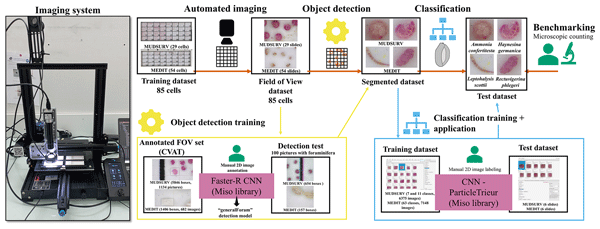
Automated identification of fossil benthic foraminifera from the Peruvian margin using convolutional neural networks
Sikandar Hayat
Meryem Mojtahid
Mary Elliot
Jorge Cardich
Emmanuelle Geslin
Thibault de Garidel-Thoron
Matthieu Carré
Christine Barras
Related authors
No articles found.
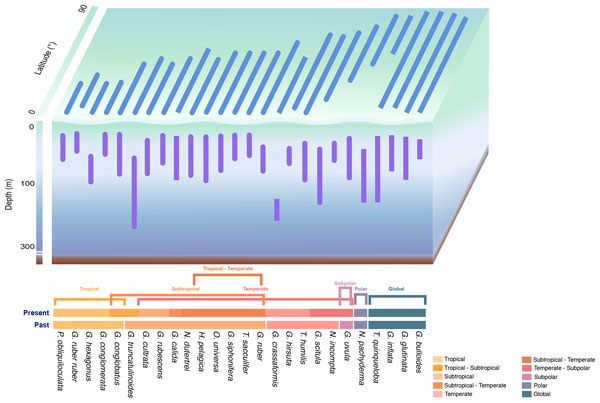
Using the FORCIS database, we mapped the distribution of planktonic goraminifera that record past ocean conditions. Our study reveals that these species mostly inhabit the upper ocean and thrive in waters ranging from −2 °C to over 31 °C. Their range is shifting, with species once limited to warm regions now appearing in cooler areas and smaller species increasing in number. This work refines our view of their biogeography and how climate change is reshaping ocean life.

We studied how tiny shelled organisms called foraminifera living in coastal mudflats respond to changes in their microscopic algae food. By monitoring a French mudflat every month for 3 years, we showed that seasonal environmental changes strongly shape both algae and foraminifera. Using simple algae traits such as size and shape explained feeding patterns better than identifying algae species, offering a clearer way to predict ecosystem responses to environmental change.