
Articles | Volume 45, issue 1
https://doi.org/10.5194/jm-45-359-2026
© Author(s) 2026. This work is distributed under
the Creative Commons Attribution 4.0 License.
the Creative Commons Attribution 4.0 License.
https://doi.org/10.5194/jm-45-359-2026
© Author(s) 2026. This work is distributed under
the Creative Commons Attribution 4.0 License.
the Creative Commons Attribution 4.0 License.
Research article
| 
18 May 2026
Research article |
| 18 May 2026
| 18 May 2026
Testing the applicability of automated size and shape analyses in non-marine ostracods – a case study from the Tibetan Plateau
Marlene Hoehle
CORRESPONDING AUTHOR

Institute for Geography and Geology, University of Greifswald, Greifswald, Germany
Torsten Haberzettl
Institute for Geography and Geology, University of Greifswald, Greifswald, Germany
Peter Frenzel
Institute of Geosciences, Friedrich Schiller University Jena, Jena, Germany
Antje Schwalb
Institute of Geosystems and Bioindication, Technische Universität Braunschweig, Braunschweig, Germany
Junbo Wang
Institute of Tibetan Plateau Research, Chinese Academy of Sciences, Beijing, P. R. China
Liping Zhu
Institute of Tibetan Plateau Research, Chinese Academy of Sciences, Beijing, P. R. China
Claudia Wrozyna
Institute for Geography and Geology, University of Greifswald, Greifswald, Germany
Related authors
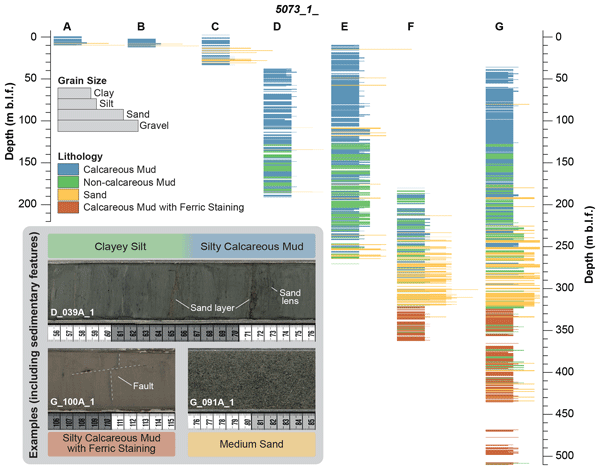
Marie-Luise Adolph, Junbo Wang, Liping Zhu, Leon J. Clarke, Andrew C. G. Henderson, Hendrik Vogel, Gerhard Daut, Peter Frenzel, Jianting Ju, Qiangqiang Kou, Dierk Michaelis, Olga Schmitz, Anja Schwarz, Volkhard Spiess, Arne Ulfers, Cidan Zhaxi, Daniel Ariztegui, Natasha Barbolini, Thorsten Bauersachs, Erwin Braun, Giulia Ceriotti, Brian Grivna, Marlene Hoehle, Rolf Kipfer, Wilhelmine Klamt, Cindy Kunkel, Aliisa Laakkonen, Minghui Li, Qingfeng Ma, Paul Moser Röggla, Kaja Müller, Anders Noren, Ryan O'Grady, Santiago Otero, Maïlys Picard, Anna Pint, Camille Thomas, Jerome Van der Woerd, Mathias Vinnepand, Claudia Wrozyna, Christian Zeeden, Xinghuan Zhu, and Torsten Haberzettl
Sci. Dril., 35, 99–117, https://doi.org/10.5194/sd-35-99-2026, https://doi.org/10.5194/sd-35-99-2026, 2026
Short summary
Short summary
We drilled deep into sediments beneath a large lake on the Tibetan Plateau, Nam Co, to learn how climate and environments have changed over multiple ice age cycles. The recovered sediments show repeated shifts between major changes in lake conditions, water chemistry, and ecosystems. These findings help clarify how wind systems responded to natural climate cycles and improve understanding of how high mountain regions may react to future climate change and environmental stress.
Floriane Guillevic, Renaldo Gastineau, Olivier Evrard, Pierre Sabatier, Amaury Bardelle, Pierre-Alexis Chaboche, Anthony Foucher, Romina Achaga, Ana Carolina Ruiz-Fernández, Joan-Albert Sanchez-Cabeza, Marcos Tassano, Mirel Cabrera, Juan A. Quicke, Guillermo Chalar, Maarten Van Daele, Valentina Moreno-Allende, Jasper Moernaut, Torsten Haberzettl, José A. Corcho Alvarado, Stefan Röllin, Hans Sahli, Judith Kobler, Gerald Dicen, and Christine Alewell
EGUsphere, https://doi.org/10.5194/egusphere-2026-3019, https://doi.org/10.5194/egusphere-2026-3019, 2026
Short summary
Short summary
Long-lived isotopes (239Pu and 240Pu), primarily produced during past nuclear weapon testing (1945-1974), are present globally in trace amounts on terrestrial surfaces. By analysing South American lake sediments, we identified three testing periods using the 240Pu/239Pu ratio analysis and observed discrepancies in the distribution of 137Cs and 239+240Pu activity concentration. This will improve the temporal precision of environmental reconstructions from the last century.
Marie-Luise Adolph, Junbo Wang, Liping Zhu, Leon J. Clarke, Andrew C. G. Henderson, Hendrik Vogel, Gerhard Daut, Peter Frenzel, Jianting Ju, Qiangqiang Kou, Dierk Michaelis, Olga Schmitz, Anja Schwarz, Volkhard Spiess, Arne Ulfers, Cidan Zhaxi, Daniel Ariztegui, Natasha Barbolini, Thorsten Bauersachs, Erwin Braun, Giulia Ceriotti, Brian Grivna, Marlene Hoehle, Rolf Kipfer, Wilhelmine Klamt, Cindy Kunkel, Aliisa Laakkonen, Minghui Li, Qingfeng Ma, Paul Moser Röggla, Kaja Müller, Anders Noren, Ryan O'Grady, Santiago Otero, Maïlys Picard, Anna Pint, Camille Thomas, Jerome Van der Woerd, Mathias Vinnepand, Claudia Wrozyna, Christian Zeeden, Xinghuan Zhu, and Torsten Haberzettl
Sci. Dril., 35, 99–117, https://doi.org/10.5194/sd-35-99-2026, https://doi.org/10.5194/sd-35-99-2026, 2026
Short summary
Short summary
We drilled deep into sediments beneath a large lake on the Tibetan Plateau, Nam Co, to learn how climate and environments have changed over multiple ice age cycles. The recovered sediments show repeated shifts between major changes in lake conditions, water chemistry, and ecosystems. These findings help clarify how wind systems responded to natural climate cycles and improve understanding of how high mountain regions may react to future climate change and environmental stress.
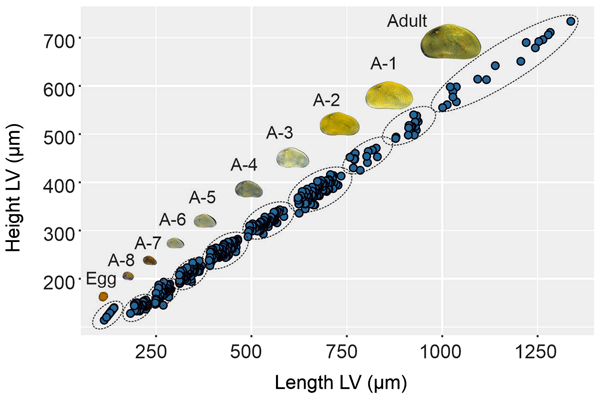
Mauricio Bonilla-Flores, Liseth Pérez, Peter Frenzel, Paula Echeverría-Galindo, Junbo Wang, and Antje Schwalb
J. Micropalaeontol., 45, 429–453, https://doi.org/10.5194/jm-45-429-2026, https://doi.org/10.5194/jm-45-429-2026, 2026
Short summary
Short summary
We grew three species of freshwater ostracods in the laboratory to document their development from eggs to adults. By comparing each stage of growth, we found significant differences in body shape, egg size, and growth patterns that help distinguish closely related species. Since their shells are often preserved in lake and pond sediments, our results provide useful reference data for studies of modern aquatic ecosystems and past environmental changes.
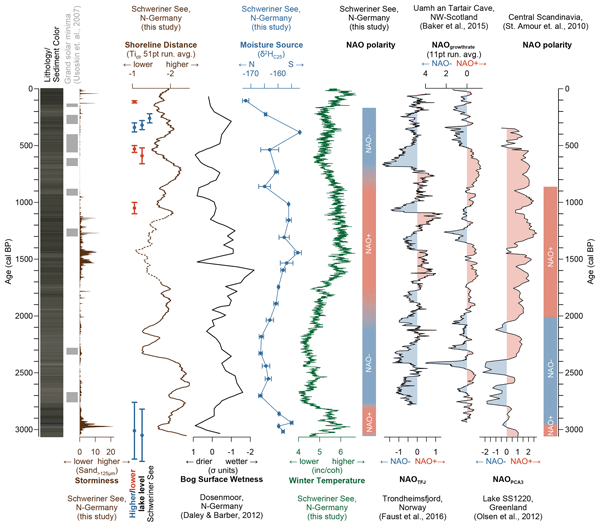
Marie-Luise Adolph, Sambor Czerwiński, Mirko Dreßler, Paul Strobel, Marcel Bliedtner, Sebastian Lorenz, Maxime Debret, and Torsten Haberzettl
Clim. Past, 20, 2143–2165, https://doi.org/10.5194/cp-20-2143-2024, https://doi.org/10.5194/cp-20-2143-2024, 2024
Short summary
Short summary
We reconstruct environmental changes derived from sediments of Schweriner See, a large lake in NE Germany, for the past 3000 years. We infer variations in North Atlantic large-scale atmospheric circulation systems, namely the North Atlantic Oscillation (NAO), by combining sedimentological, geochemical, and biological parameters. Our results suggest distinct shifts between positive and negative NAO phases affecting winter temperatures, precipitation, and westerly wind strength at our study site.
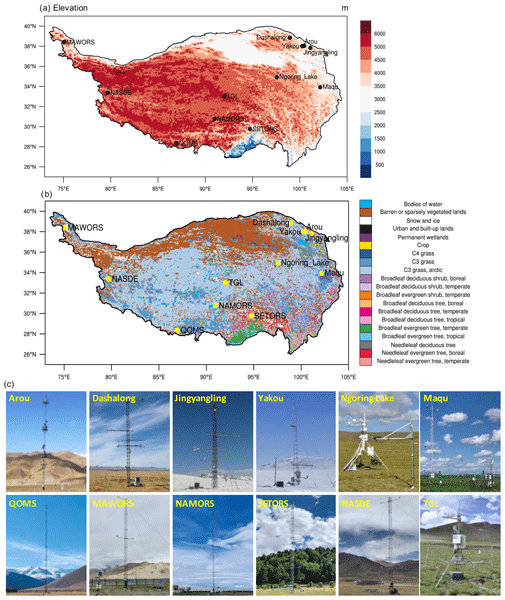
Yaoming Ma, Zhipeng Xie, Yingying Chen, Shaomin Liu, Tao Che, Ziwei Xu, Lunyu Shang, Xiaobo He, Xianhong Meng, Weiqiang Ma, Baiqing Xu, Huabiao Zhao, Junbo Wang, Guangjian Wu, and Xin Li
Earth Syst. Sci. Data, 16, 3017–3043, https://doi.org/10.5194/essd-16-3017-2024, https://doi.org/10.5194/essd-16-3017-2024, 2024
Short summary
Short summary
Current models and satellites struggle to accurately represent the land–atmosphere (L–A) interactions over the Tibetan Plateau. We present the most extensive compilation of in situ observations to date, comprising 17 years of data on L–A interactions across 12 sites. This quality-assured benchmark dataset provides independent validation to improve models and remote sensing for the region, and it enables new investigations of fine-scale L–A processes and their mechanistic drivers.
Qingfeng Ma, Liping Zhu, Jianting Ju, Junbo Wang, Yong Wang, Lei Huang, and Torsten Haberzettl
Earth Syst. Sci. Data, 16, 311–320, https://doi.org/10.5194/essd-16-311-2024, https://doi.org/10.5194/essd-16-311-2024, 2024
Short summary
Short summary
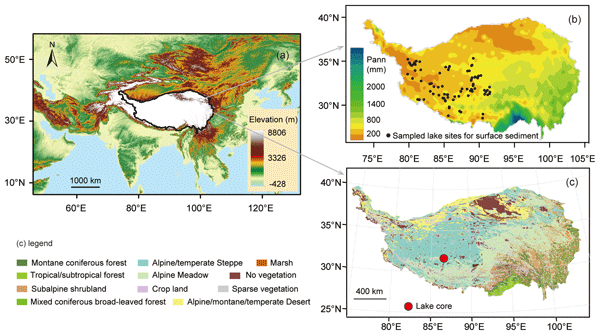
Modern pollen datasets are essential for pollen-based quantitative paleoclimate reconstructions. Here we present a modern pollen dataset from lake surface sediments on the central and western Tibetan Plateau. This dataset can be used not only for quantitative precipitation reconstructions on the central and western Tibetan Plateau, but can also be combined with other pollen datasets to improve the reliability of quantitative climate reconstructions across the entire Tibetan Plateau.
Sudip Acharya, Maximilian Prochnow, Thomas Kasper, Linda Langhans, Peter Frenzel, Paul Strobel, Marcel Bliedtner, Gerhard Daut, Christopher Berndt, Sönke Szidat, Gary Salazar, Antje Schwalb, and Roland Zech
E&G Quaternary Sci. J., 72, 219–234, https://doi.org/10.5194/egqsj-72-219-2023, https://doi.org/10.5194/egqsj-72-219-2023, 2023
Short summary
Short summary
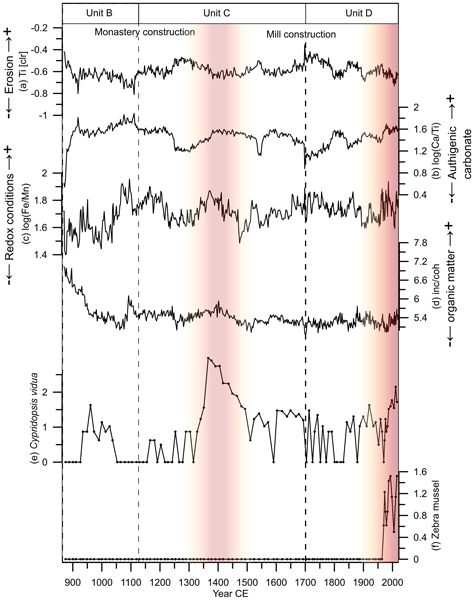
This study presents a palaeoenvironmental record from Lake Höglwörth, Bavaria, Germany. Before 870 CE peat deposits existed. Erosion increased from 1240 to 1380 CE, followed by aquatic productivity and anoxia from 1310 to 1470 CE. Increased allochthonous input and a substantial shift in the aquatic community in 1701 were caused by construction of a mill. Recent anoxia has been observed since the 1960s.
Steffen Kutterolf, Mark Brenner, Robert A. Dull, Armin Freundt, Jens Kallmeyer, Sebastian Krastel, Sergei Katsev, Elodie Lebas, Axel Meyer, Liseth Pérez, Juanita Rausch, Armando Saballos, Antje Schwalb, and Wilfried Strauch
Sci. Dril., 32, 73–84, https://doi.org/10.5194/sd-32-73-2023, https://doi.org/10.5194/sd-32-73-2023, 2023
Short summary
Short summary
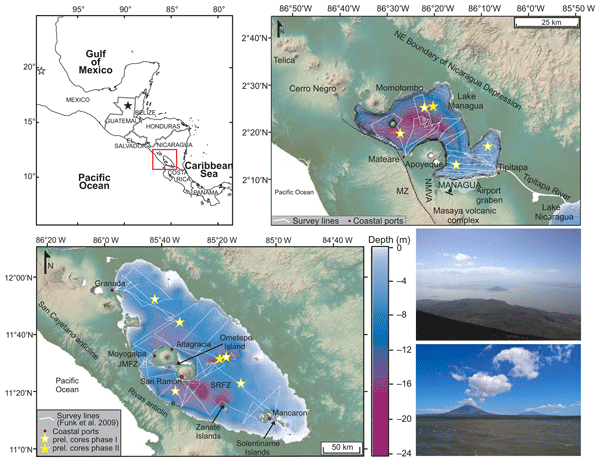
The NICA-BRIDGE workshop proposes a milestone-driven three-phase project to ICDP and later ICDP/IODP involving short- and long-core drilling in the Nicaraguan lakes and in the Pacific Sandino Basin to (1) reconstruct tropical climate and environmental changes and their external controlling mechanisms over several million years, (2) assess magnitudes and recurrence times of multiple natural hazards, and (3) provide
baselineenvironmental data for monitoring lake conditions.
Rodrigo Martínez-Abarca, Michelle Abstein, Frederik Schenk, David Hodell, Philipp Hoelzmann, Mark Brenner, Steffen Kutterolf, Sergio Cohuo, Laura Macario-González, Mona Stockhecke, Jason Curtis, Flavio S. Anselmetti, Daniel Ariztegui, Thomas Guilderson, Alexander Correa-Metrio, Thorsten Bauersachs, Liseth Pérez, and Antje Schwalb
Clim. Past, 19, 1409–1434, https://doi.org/10.5194/cp-19-1409-2023, https://doi.org/10.5194/cp-19-1409-2023, 2023
Short summary
Short summary
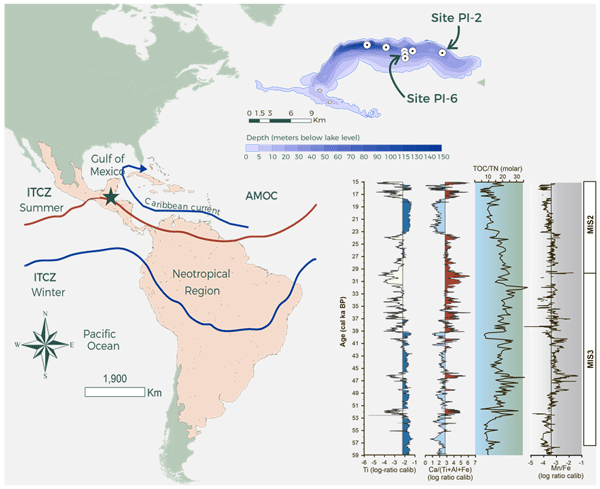
Lake Petén Itzá, northern Guatemala, is one of the oldest lakes in the northern Neotropics. In this study, we analyzed geochemical and mineralogical data to decipher the hydrological response of the lake to climate and environmental changes between 59 and 15 cal ka BP. We also compare the response of Petén Itzá with other regional records to discern the possible climate forcings that influenced them. Short-term climate oscillations such as Greenland interstadials and stadials are also detected.
Laura Macario-González, Sergio Cohuo, Philipp Hoelzmann, Liseth Pérez, Manuel Elías-Gutiérrez, Margarita Caballero, Alexis Oliva, Margarita Palmieri, María Renée Álvarez, and Antje Schwalb
Biogeosciences, 19, 5167–5185, https://doi.org/10.5194/bg-19-5167-2022, https://doi.org/10.5194/bg-19-5167-2022, 2022
Short summary
Short summary
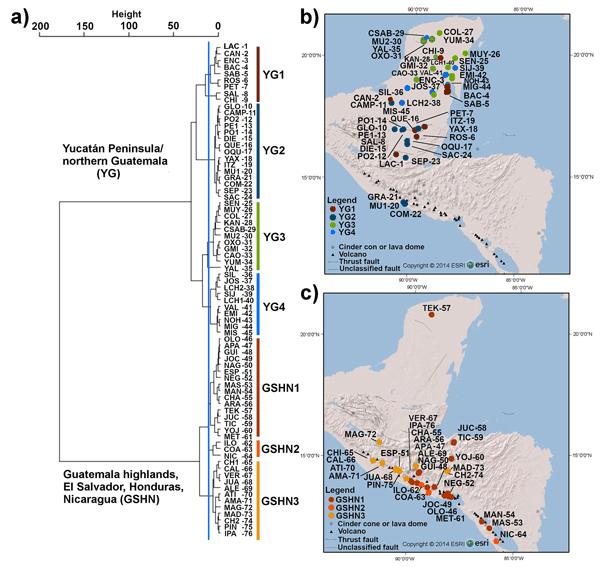
We evaluate the relationships between geodiversity, limnological conditions, and freshwater ostracodes from southern Mexico to Nicaragua. Geological, limnological, geochemical, and mineralogical characteristics of 76 systems reveal two main limnological regions and seven subregions. Water ionic and sediment composition are the most influential. Geodiversity strongly influences limnological conditions, which in turn influence ostracode composition and distribution.
Linan Guo, Hongxing Zheng, Yanhong Wu, Lanxin Fan, Mengxuan Wen, Junsheng Li, Fangfang Zhang, Liping Zhu, and Bing Zhang
Earth Syst. Sci. Data, 14, 3411–3422, https://doi.org/10.5194/essd-14-3411-2022, https://doi.org/10.5194/essd-14-3411-2022, 2022
Short summary
Short summary
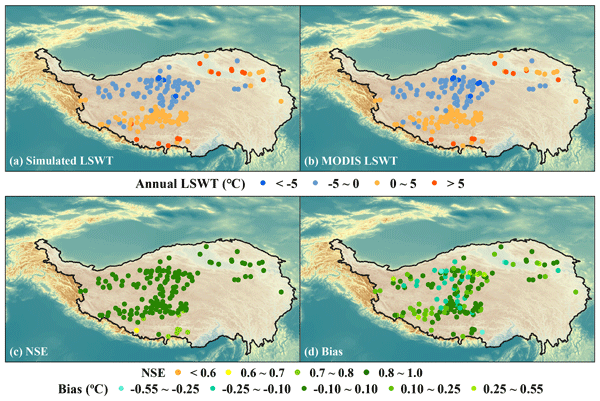
Lake surface water temperature (LSWT) is a critical physical property of the aquatic ecosystem and an indicator of climate change. By combining the strengths of satellites and models, we produced an integrated dataset on daily LSWT of 160 large lakes across the Tibetan Plateau (TP) for the period 1978–2017. LSWT increased significantly at a rate of 0.01–0.47° per 10 years. The dataset can contribute to research on water and heat balance changes and their ecological effects in the TP.
Liuming Wang, Junxiao Wang, Mengyao Li, Liping Zhu, and Xingong Li
Earth Syst. Sci. Data Discuss., https://doi.org/10.5194/essd-2021-331, https://doi.org/10.5194/essd-2021-331, 2021
Manuscript not accepted for further review
Short summary
Short summary
This research provides a comprehensive census on water volume change for the lakes greater than or equal to 1 km2 in the EBTP from 1989–2019 using Landsat imagery and digital elevation data. Our annual dataset, compared with satellite altimetry and other existing data, covers more lakes, especially small lakes in 1–10 km2, and longer time period. The dataset is valuable in studying the impacts of climate change and water balance in the region.
Cited articles
Adams, D., Collyer, M., Kaliontzopoulou, A., and Baken, E.: Geomorph: Software for geometric morphometric analyses, R package version 4.0.10, https://cran.r-project.org/package=geomorph (last access: 13 January 2026), 2025.
Adolph, M., Wang, J., Zhu, L., Clarke, L., C., Henderson, A. C. G., Vogel, H., Daut, G., Frenzel, P., Ju, J., Kou, Q., Michaelis, D., Schmitz, O., Schwarz, A., Spiess, V., Ulfers, A., Zhaxi, C., Ariztegui, D., Barbolini, N., Bauersachs, T., Braun, E., Ceriotti, G., Grivna, B., Hoehle, M., Kipfer, R., Klamt, W., Kunkel, C., Laakkonen, A., Li, M., Ma, Q., Moser-Röggla, P., Müller, K., Noren, A., O'Grady, R., Otero, S., Picard, M., Pint, A., Thomas, C., Van der Woerd, J., Vinnepand, M., Wrozyna, C., Zeeden, C., Zhu, X., and Haberzettl, T.: The ICDP Nam Co Drilling Project (NamCore), Tibet: A 510.2-m sedimentary record from the Third Pole, Sci. Drill., accepted, 2026.
Akita, L. G., Frenzel, P., Wang, J., Börner, N., and Peng, P.: Spatial distribution and ecology of the Recent Ostracoda from Tangra Yumco and adjacent waters on the southern Tibetan Plateau: A key to palaeoenvironmental reconstruction, Limnologica, 59, 21–43, https://doi.org/10.1016/j.limno.2016.03.005, 2016.
Alivernini, M., Lai, Z., Frenzel, P., Fürstenberg, S., Wang, J., Guo, Y., Peng, P., Haberzettl, T., Börner, N. and Mischke, S.: Late quaternary lake level changes of Taro Co and neighbouring lakes, southwestern Tibetan Plateau, based on OSL dating and ostracod analysis, Global Planet. Change, 166, 1–18, https://doi.org/10.1016/j.gloplacha.2018.03.016, 2018.
Baken, E. K., Collyer, M. L., Kaliontzopoulou, A., and Adams, D. C.: geomorph v4.0 and gmShiny: Enhanced analytics and a new graphical interface for a comprehensive morphometric experience, Meth. Ecol. Evol., 12, 2355–2363, https://doi.org/10.1111/2041-210X.13723, 2021.
Baltanás, A. and Danielopol, D. L.: Geometric Morphometrics and its use in ostracod research: a short guide, Joannea Geol. Paläont, 235–272, https://api.semanticscholar.org/CorpusID:56082804 (last access: 11 May 2026), 2011.
Baltanás, A., Alcorlo, P., and Danielopol, D. L.: Morphological disparity in populations with and without sexual reproduction: A case study in Eucypris virens (Crustacea: Ostracoda), Biol. J. Linnean Soc., 75, 9–19, https://doi.org/10.1046/j.1095-8312.2002.00001.x, 2002.
Baltanás, A., Brauneis, W., Danielopol, D. L., and Linhart, J.: Morphometric Methods for Applied Ostracodology: Tools for Outline Analysis of Nonmarine Ostracodes, Paleontolog. Soc. Pap., 9, 101–118, https://doi.org/10.1017/s1089332600002175, 2003.
Bookstein, F. L.: Biometrics, biomathematics and the morphometric synthesis, Bull. Math. Biol., 58, 313–365, 1996.
Börner, N., De Baere, B., Akita, L. G., Francois, R., Jochum, K. P., Frenzel, P., Zhu, L., and Schwalb, A.: Stable isotopes and trace elements in modern ostracod shells: implications for reconstructing past environments on the Tibetan Plateau, China, J. Paleolimnol., 58, 191–211, https://doi.org/10.1007/s10933-017-9971-1, 2017.
Burge, D. R. L., Edlund, M. B., and Frisch, D.: Paleolimnology and resurrection ecology: The future of reconstructing the past, Evol. Appl., 11, 42–59, https://doi.org/10.1111/eva.12556, 2018.
Chen, Z., Guo, L., Wu, Y., Zhang, B., Chen, P., Yang, X., and Guo, J.: A high-resolution dataset of water bodies distribution over the Tibetan Plateau, Sci. Data, 11, https://doi.org/10.1038/s41597-024-03290-4, 2024.
Cooke, S. B. and Terhune, C. E.: Form, Function, and Geometric Morphometrics, Anatom. Rec., 298, 5–28, https://doi.org/10.1002/ar.23065, 2015.
Danielopol, D. L., Ito, E., Wansard, G., Kamiya, T., Cronin, T. M., and Baltanas, A.: Techniques for Collection and Study of Ostracoda, in: The Ostracoda:Applications in Quaternary Research, edited by: Chivas, A. R. and Holmes, J. A., Ostracoda, 131, 65–97, https://doi.org/10.1029/131GM04, 2002.
Elder, L. E., Hsiang, A. Y., Nelson, K., Strotz, L. C., Kahanamoku, S. S., and Hull, P. M.: Data descriptor: Sixty-one thousand recent planktonic foraminifera from the Atlantic Ocean, Sci. Data, 5, https://doi.org/10.1038/sdata.2018.109, 2018.
Fox, N. S., Veneracion, J. J., and Blois, J. L.: Are geometric morphometric analyses replicable? Evaluating landmark measurement error and its impact on extant and fossil Microtus classification, Ecol. Evol., 10, 3260–3275, https://doi.org/10.1002/ece3.6063, 2020.
Fürstenberg, S., Frenzel, P., Peng, P., Henkel, K., and Wrozyna, C.: Phenotypical variation in Leucocytherella sinensis Huang, 1982 (Ostracoda): a new proxy for palaeosalinity in Tibetan lakes, Hydrobiologia, 751, 55–72, https://doi.org/10.1007/s10750-014-2171-3, 2015.
Gross, M., Minati, K., Danielopol, D. A. N. L., and Piller, W. E.: Environmental changes and diversification of Cyprideis in the Late Miocene of Styrian Basin (Lake Pannon, Austria), Senckenbergiana Lethaea, 88, 161–181, 2008.
Haberzettl, T., Daut, G., Schulze, N., Spiess, V., Wang, J., Zhu, L., St-Onge, G., Chen, F., Liu, X., Lyu, X., Ju, J., Ma, Q., Wu, Z., Wünnemann, B., Yan, D., Yi, S., Zhang, H., Zhao, Y., Zhao, H., Buylaert, J. P., Murray, A., van der Woerd, J., Frenzel, P., Gleixner, G., Harms, U., Reicherter, K., Schwalb, A., Ulfers, A., Újvári, G., Mehrotra, N., Waldmann, N., Lami, A., Ariztegui, D., Barbolini, N., Ascough, P., Clarke, L., Henderson, A., Staff, R., Noren, A., Spanbauer, T., and Stoner, J.: ICDP workshop on scientific drilling of Nam Co on the Tibetan Plateau: 1 million years of paleoenvironmental history, geomicrobiology, tectonics and paleomagnetism derived from sediments of a high-altitude lake, Sci. Drill., 25, 63–70, https://doi.org/10.5194/sd-25-63-2019, 2019.
Hall, B. K.: Evo-Devo: evolutionary developmental mechanisms, Int. J. Dev. Biol., 47, 491–495, 2003.
Hall, B. K.: Evolutionary Developmental Biology (Evo-Devo): Past, Present, and Future, Evolution, 5, 184–193, https://doi.org/10.1007/s12052-012-0418-x, 2012.
Hill, B. L.: Reclassification of winged Cythereis and winged Brachycythere, J. Paleontol., 28, 804–826, 1955.
Hoehle, M.: Morphometric Raw Data [Data set], Zenodo [data set], https://doi.org/10.5281/zenodo.18887817, 2026.
Hoehle, M., Brachert, T., Piller, W. E., and Wrozyna, C.: Scale-dependent size variability of Cyprideis torosa (Ostracoda), Limnology, 26, 55–74, https://doi.org/10.1007/s10201-024-00761-w, 2025a.
Hoehle, M., Methner, K., Hunt, G., Piller, W. E., and Wrozyna, C.: Temporal and spatial variation of sexual size and shape dimorphism of Cyprideis torosa (Ostracoda), Zool. J. Linn. Soc., 204, https://doi.org/10.1093/zoolinnean/zlaf049, 2025b.
Horne, D. J.: Ostracoda, in: Encyclopedia of Geology, edited by: Selley, R. C., Cocks, L. R. M., and Plimer, I. R., Elsevier Academic, Amsterdam, 453–463, https://doi.org/10.1016/B0-12-369396-9/00511-6, 2005.
Hsiang, A. Y., Nelson, K., Elder, L. E., Sibert, E. C., Kahanamoku, S. S., Burke, J. E., Kelly, A., Liu, Y., and Hull, P. M.: AutoMorph: Accelerating morphometrics with automated 2D and 3D image processing and shape extraction, Meth. Ecol. Evol., 9, 605–612, https://doi.org/10.1111/2041-210X.12915, 2018.
Hsiang, A. Y., Brombacher, A., Rillo, M. C., Mleneck-Vautravers, M. J., Conn, S., Lordsmith, S., Jentzen, A., Henehan, M. J., Metcalfe, B., Fenton, I. S., Wade, B. S., Fox, L., Meilland, J., Davis, C. V., Baranowski, U., Groeneveld, J., Edgar, K. M., Movellan, A., Aze, T., Dowsett, H. J., Miller, C. G., Rios, N., and Hull, P. M.: Endless Forams: > 34,000 Modern Planktonic Foraminiferal Images for Taxonomic Training and Automated Species Recognition Using Convolutional Neural Networks, Paleoceanogr. Paleoclimatol., 34, 1157–1177, https://doi.org/10.1029/2019PA003612, 2019.
Huang, B.: 1982 Ostracods from surface deposits of Recent lakes in Xizang, Ac. Micropalaeontol. Sin., 2, 369–376, 1982.
Hunt, G., Martins, M. J. F., Puckett, T. M., Lockwood, R., Swaddle, J. P., Hall, C. M. S., and Stedman, J.: Sexual dimorphism and sexual selection in cytheroidean ostracodes from the Late Cretaceous of the U.S. Coastal Plain, Paleobiology, 43, 620–641, https://doi.org/10.1017/pab.2017.19, 2017.
Jones, T. R.: A Monograph of the Tertiary Entomostraca of England, Palaeontogr. Soc. Lond. Monogr., 9, 1–68, 1857.
Ju, J. T., Zhu, L. P., Feng, J. L., Wang, J. B., Wang, Y., Xie, M. P., Peng, P., Zhen, X. L., and Lü, X. M.: Hydrodynamic process of Tibetan Plateau lake revealed by grain size: Case study of Pumayum Co, Chinese Sci. Bull., 57, 2433–2441, https://doi.org/10.1007/s11434-012-5083-5, 2012.
Jurine, L.: Histoire des Monocles, qui se trouvent aux environs de Genéve, Paschoud, Genéve, Paris, 1–260, https://doi.org/10.5962/bhl.title.10137, 1820.
Kahanamoku-Meyer, S. S., Samuels-Fair, M., Kamel, S. M., Stewart, D., Wu, B., Kahn, L. X., Titcomb, M., Mei, Y. A., Bridge, R. C., Li, Y. S., Sinco, C., Moreno, J., Epino, J. T., Gonzalez-Marin, G., Latt, C., Fergus, H., Duijnstee, I. A. P., and Finnegan, S.: An 800-year record of benthic foraminifer images and 2D morphometrics from the Santa Barbara Basin, Sci. Data, 11, https://doi.org/10.1038/s41597-024-02934-9, 2024.
Karanovic, I., Pham, H. T. M., and Sitnikova, T.: Diversification of the shell shape and size in Baikal Candonidae ostracods inferred from molecular phylogeny, Sci. Rep., 13, 1–12, https://doi.org/10.1038/s41598-023-30003-5, 2023.
Keil, A., Berking, J., Mügler, I., Schütt, B., Schwalb, A., and Steeb, P.: Hydrological and geomorphological basin and catchment characteristics of Lake Nam Co, South-Central Tibet, Quatern. Int., 218, 118–130, https://doi.org/10.1016/j.quaint.2009.02.022, 2010.
Koenders, A., Schön, I., Halse, S., and Martens, K.: Valve shape is not linked to genetic species in the Eucypris virens (Ostracoda, Crustacea) species complex, Zool. J. Linn. Soc., 180, 36–46, https://doi.org/10.1111/zoj.12488, 2017.
Korkmaz, S., Goksuluk, D., and Zararsiz, G.: MVN: An R Package for Assessing Multivariate Normality, Part of the Numerical Analysis and Scientific Computing Commons, and the Programming Languages and Compilers Commons, https://doi.org/10.32614/rj-2014-031, 2014.
Krause, P., Biskop, S., Helmschrot, J., Flügel, W. A., Kang, S., and Gao, T.: Hydrological system analysis and modelling of the Nam Co basin in Tibet, Adv. Geosci., 27, 29–36, https://doi.org/10.5194/adgeo-27-29-2010, 2010.
Li, B., Zhou, S., Murray, A. P., and Subsol, G.: Shape-changing chains for morphometric analysis of 2D and 3D, open or closed outlines, Sci. Rep., 11, https://doi.org/10.1038/s41598-021-00911-5, 2021.
Martens, K., Schön, I., Meisch, C., and Horne, D. J.: Global diversity of ostracods (Ostracoda, Crustacea) in freshwater, Hydrobiologia, 595, 185–193, https://doi.org/10.1007/s10750-007-9245-4, 2008.
Mischke, S.: Quaternary Ostracods from the Tibetan Plateau and Their Significance for Environmental and Climate-Change Studies, in: Developments in Quaternary Science, vol. 17, Elsevier Ltd, 263–279, https://doi.org/10.1016/B978-0-444-53636-5.00015-9, 2012.
Mischke, S., Herzschuh, U., Massmann, G., and Zhang, C.: An ostracod-conductivity transfer function for Tibetan lakes, J. Paleolimnol., 38, 509–524, https://doi.org/10.1007/s10933-006-9087-5, 2007.
Mitteroecker, P. and Schaefer, K.: Thirty years of geometric morphometrics: Achievements, challenges, and the ongoing quest for biological meaningfulness, Am. J. Biol. Anthropol., 178, 181–210, https://doi.org/10.1002/ajpa.24531, 2022.
Mulqueeney, J. M., Searle-Barnes, A., Brombacher, A., Sweeney, M., Goswami, A., and Ezard, T. H. G.: Smarter segmentation: Deep learning accelerates 3D morphological analysis of fossils, Past Global Changes Mag., 33, 68–69, https://doi.org/10.22498/pages.33.2.68, 2025.
Murakami, T., Terai, H., Yoshiyama, Y., Tezuka, T., Zhu, L., Matsunaka, T., and Nishimura, M.: The second investigation of Lake Puma Yum Co located in the Southern Tibetan Plateau, China, Limnology, 8, 331–335, https://doi.org/10.1007/s10201-007-0208-2, 2007.
Oksanen, J., Simpson, G., Blanchet, F., Kindt, R., Legendre, P., Minchin, P., O'Hara, R., Solymos, P., Stevens, M., Szoecs, E., Wagner, H., Barbour, M., Bedward, M., Bolker, B., Borcard, D., Borman, T., Carvalho, G., Chirico, M., De Caceres, M., Durand, S., Evangelista, H., FitzJohn, R., Friendly, M., Furneaux, B., Hannigan, G., Hill, M., Lahti, L., Martino, C., McGlinn, D., Ouellette, M., Ribeiro Cunha, E., Smith, T., Stier, A., Ter Braak, C., Weedon, J.: vegan: Community Ecology Package, R package version 2.8-0, https://vegandevs.github.io/vegan/ (last access: 13 January 2026), 2026.
PalaeolabGreifswald: PalaeolabGreifswald/AutoMorph-Ostracods: AutoMorph-Ostracods, Zenodo [code], https://doi.org/10.5281/zenodo.20120602, 2026.
Peng, P., Zhu, L., Frenzel, P., Wrozyna, C., and Ju, J.: Water depth related ostracod distribution in Lake Pumoyum Co, southern Tibetan Plateau, Quatern. Int., 313–314, 47–55, https://doi.org/10.1016/j.quaint.2013.08.054, 2013.
Qiao, B., Wang, J., Huang, L., and Zhu, L.: Characteristics and seasonal variations in the hydrochemistry of the Tangra Yumco basin, central Tibetan Plateau, and responses to the Indian summer monsoon, Environ. Earth Sci., 76, https://doi.org/10.1007/s12665-017-6479-y, 2017.
Raff, R. A.: Evo-devo: the evolution of a new discipline, Nat. Rev. Genet. 1, 74–79, https://doi.org/10.1038/35049594, 2000.
Rohlf, F. J.: The tps series of software, Hystrix, 26, 1–4, https://doi.org/10.4404/hystrix-26.1-11264, 2015.
Slice, D. E.: Geometric morphometrics, Annu. Rev. Anthropol., 36, 261–281, https://doi.org/10.1146/annurev.anthro.34.081804.120613, 2007.
Smith, A. J., Horne, D. J., Martens, K., and Schön, I.: Class Ostracoda, in: Thorp and Covich's Freshwater Invertebrates, vol. 1, edited by: Thorp, J. H. and Rogers, C. D., Academic Press, Cambridge, Massachusetts, 757–780, https://doi.org/10.1016/B978-0-12-385026-3.00030-9, 2015.
Verpoorter, C., Kutser, T., Seekell, D. A., and Tranvik, L. J.: A global inventory of lakes based on high-resolution satellite imagery, Geophys. Res. Lett., 41, 6396–6402, https://doi.org/10.1002/2014GL060641, 2014.
von Daday, E.: Untersuchungen über die Süßwasser-Mikrofauna Paraguays, Zoologica, 44-IV, 243–270, 1905.
von Grafenstein, U., Erlernkeuser, H., and Trimborn, P.: Oxygen and carbon isotopes in modern fresh-water ostracod valves: Assessing vital offsets and autecological effects of interest for palaeoclimate studies, Palaeogeogr. Palaeocl. Palaeoecol., 148, 133–152, https://doi.org/10.1016/S0031-0182(98)00180-1, 1999.
von Oheimb, P. V., Albrecht, C., Riedel, F., Du, L., Yang, J., Aldridge, D. C., Bößneck, U., Zhang, H., and Wilke, T.: Freshwater biogeography and limnological evolution of the tibetan plateau – insights from a plateau-wide distributed gastropod taxon (radix spp.), PLoS One, 6, https://doi.org/10.1371/journal.pone.0026307, 2011.
Wang, C., Kuang, X., Shan, J., Zhang, Q., Zhou, Z., Tong, Y., and Zou, Y.: Recent ostracods as ecological indicators and its applications: An example from the southern Tibetan Plateau, Ecol. Indicat., 143, 109326, https://doi.org/10.1016/j.ecolind.2022.109326, 2022.
Wang, J., Huang, L., Ju, J., Daut, G., Ma, Q., Zhu, L., Haberzettl, T., Baade, J., Mäusbacher, R., Hamilton, A., Graves, K., Olsthoorn, J., and Laval, B. E.: Seasonal stratification of a deep, high-altitude, dimictic lake: Nam Co, Tibetan Plateau, J. Hydrol., 584, https://doi.org/10.1016/j.jhydrol.2020.124668, 2020.
Watanabe, A.: How many landmarks are enough to characterize shape and size variation?, PLoS One, 13, https://doi.org/10.1371/journal.pone.0198341, 2018.
Wrozyna, C., Frenzel, P., Steeb, P., Zhu, L., and Schwalb, A.: Recent lacustrine Ostracoda and a first transfer function for palaeo-water depth estimation in Nam Co, southern Tibetan Plateau, Revista Espanola de Micropaleontologia, 41, 1–20, 2009.
Wrozyna, C., Piller, W. E., and Gross, M.: Morphotypes of Cytheridella ilosvayi (Ostracoda) detected by soft and hard part analyses, Crustaceana, 87, 1043–1071, https://doi.org/10.1163/15685403-00003342, 2014.
Wrozyna, C., Neubauer, T. A., Meyer, J., and Piller, W. E.: Shape variation in neotropical Cytheridella (Ostracoda) using semilandmarks-based geometric morphometrics: A methodological approach and possible biogeographical implications, PLoS One, 11, 1–16, https://doi.org/10.1371/journal.pone.0168438, 2016.
Wrozyna, C., Meyer, J., Gross, M., Ramos, M. I. F., and Piller, W. E.: Definition of regional ostracod (Cytheridella) morphotypes by use of landmark-based morphometrics, Freshwater Sci., 37, 573–592, https://doi.org/10.1086/699482, 2018a.
Wrozyna, C., Neubauer, T. A., Meyer, J., Ramos, M. I. F., and Piller, W. E.: Significance of climate and hydrochemistry on shape variation – A case study on Neotropical cytheroidean Ostracoda, Biogeosciences, 15, 5489–5502, https://doi.org/10.5194/bg-15-5489-2018, 2018b.
Wrozyna, C., Meyer, J., Gross, M., Ramos, M. I. F., and Piller, W. E.: Sexual, ontogenetic, and geographic variation of the Neotropical freshwater ostracod Cytheridella ilosvayi, BMC Zool., 4, 1–19, https://doi.org/10.1186/s40850-019-0042-0, 2019.
Wrozyna, C., Mischke, S., Hoehle, M., Gross, M., and Piller, W. E.: Large-Scale Geographic Size Variability of Cyprideis torosa (Ostracoda) and Its Taxonomic and Ecologic Implications, Front. Ecol. Evol., 10, 1–16, https://doi.org/10.3389/fevo.2022.857499, 2022.
Zhang, W., Mischke, S., Zhang, C., Gao, D., and Fan, R.: Ostracod distribution and habitat relationships in the Kunlun Mountains, northern Tibetan Plateau, Quatern. Int., 313–314, 38–46, https://doi.org/10.1016/j.quaint.2013.06.020, 2013.
Zhu, L., Ju, J., Wang, Y., Xie, M., Wang, J., Peng, P., Zhen, X., and Lin, X.: Composition, spatial distribution, and environmental significance of water ions in Pumayum Co catchment, southern Tibet, J. Geogr. Sci., 20, 109–120, https://doi.org/10.1007/s11442-010-0109-x, 2010.
Short summary
Evolutionary developmental biology aims to uncover mechanisms behind how species change over time, with shape analysis being a key tool. To address slow, manual data collection, we tested AutoMorph, a high-throughput imaging pipeline, on two ostracod species from six Tibetan Plateau lakes. The pipeline successfully extracted size and shape data automatically, reducing processing time and minimizing bias, enabling large-scale datasets for investigating evolutionary and ecological processes.
Evolutionary developmental biology aims to uncover mechanisms behind how species change over...


