
the Creative Commons Attribution 4.0 License.
the Creative Commons Attribution 4.0 License.
 | 06 May 2026
Can the distribution of foraminifera locate the Early Eocene Climatic Optimum (EECO) and Middle Eocene Climatic Optimum (MECO) events in the Eocene succession of the Isle of Wight (UK)?
Mark E. A. Alex-Sanders
Christopher W. Smart
A zonation for the London Clay Formation, based on foraminifera, is presented for the first time, and the assemblage is used to determine the palaeoecological changes recorded in the succession. Within the lower Eocene there is evidence of a sea level rise and fall within the Early Eocene Climatic Optimum (EECO), indicating that this might potentially be a glacio-eustatic response to the EECO warming. The occurrence of larger foraminifera in the Lutetian–Bartonian interval of the Whitecliff Bay, Selsey Bill, offshore Jersey, and Cotentin Peninsula (France) successions also indicates a warming event (Late Lutetian Thermal Event and Middle Eocene Climatic Optimum, MECO) that may also have generated a glacio-eustatic response.
- Article
(17538 KB) - Full-text XML
- BibTeX
- EndNote


Whitecliff Bay, at the eastern end of the Isle of Wight (IoW), is one of the most complete Paleogene successions in Europe and has been studied by a range of geoscientists for over 200 years (Fig. 1). The first reported description of “Tertiary” geology in England was the monograph by Solander (in Brander, 1766), which described a collection of fossils from the cliffs near Barton-on-Sea and which were subsequently deposited in the collections of the newly opened British Museum. The first account of the English “Lower Tertiaries” was provided by Webster (1814) using the IoW successions. This was followed by Bowerbank (1842), who focussed on the London Clay. The first relatively complete account of the Whitecliff Bay succession was given by Prestwich (1846), although he modified the names of the various formations in the following years (Prestwich, 1847a, b, 1850, 1852, 1853, 1854a, b, 1855); some of the beds were also assigned Roman numerals. It was during this time that Carpenter (1850) described the larger foraminifera of the Tertiary succession, including Nummulina. In the same year, Dixon (1850) described both the larger foraminifera (including Alveolina and Nummularia) and the smaller foraminifera (including Quinqueloculina, Triloculina, and Biloculina) of the Bracklesham Beds in Sussex. The Bracklesham Beds were later described by Fisher (1862), who applied Roman numerals to his various subdivisions (both lithological and palaeontological). These Roman numerals (i–xix) were still in use during the 20th century (Curry, 1965, 1967; Curry et al., 1968; Murray and Wright, 1974) and are often used up to the present day. In the same paper, Fisher (1862) used Arabic numbers for the Bracklesham Beds at Bracklesham and Selsey Bill, and while he defined the base of his Bracklesham Beds, he did not define the base of the overlying Barton Beds, possibly because of poor exposure at the time. The base of the Barton Beds was eventually defined by Keeping (1887), using the first appearance of Nummulites prestwichianus, with Gardner et al. (1888) providing further comment on the possible sub-division of the Barton Beds. The problems of the global stratigraphic section and point (GSSP) for the Bartonian stage have recently been discussed by Hooker and King (2019). The overlying succession of the Headon Beds was described by Bristow et al. (1889) with further clarifications being provided by Stamp (1921), White (1921), Bhatia (1955, 1957), and Stinton (1971). The seminal publications of Dennis Curry (1965, 1967) were the result of his two presidential addresses to the Geologists' Association and remain important references to this day. The most comprehensive investigation of the foraminifera was provided by Murray and Wright (1974), with much of the information in that account being the foundation for the later Stratigraphical Index of Fossil Foraminifera (Murray et al., 1981, 1989). In their research on the Paleogene succession, John Murray and Chris Wright shared the workload, with the former investigating the younger strata and the latter having more responsibility for the London Clay Formation and the Bracklesham Group sediments. Ahead of the Murray and Wright (1974) publication, Wright (1972) described a distinctive influx of planktic foraminifera within the London Clay Formation, describing it as a “planktonic datum”. Wright (1972) demonstrated the value of this “event” and used it in his correlation of the London Clay Formation across the Hampshire Basin. The London Clay Formation was also the subject of a major study by Chris King (1981) and the recently published update (King, 2016) on the Cenozoic.
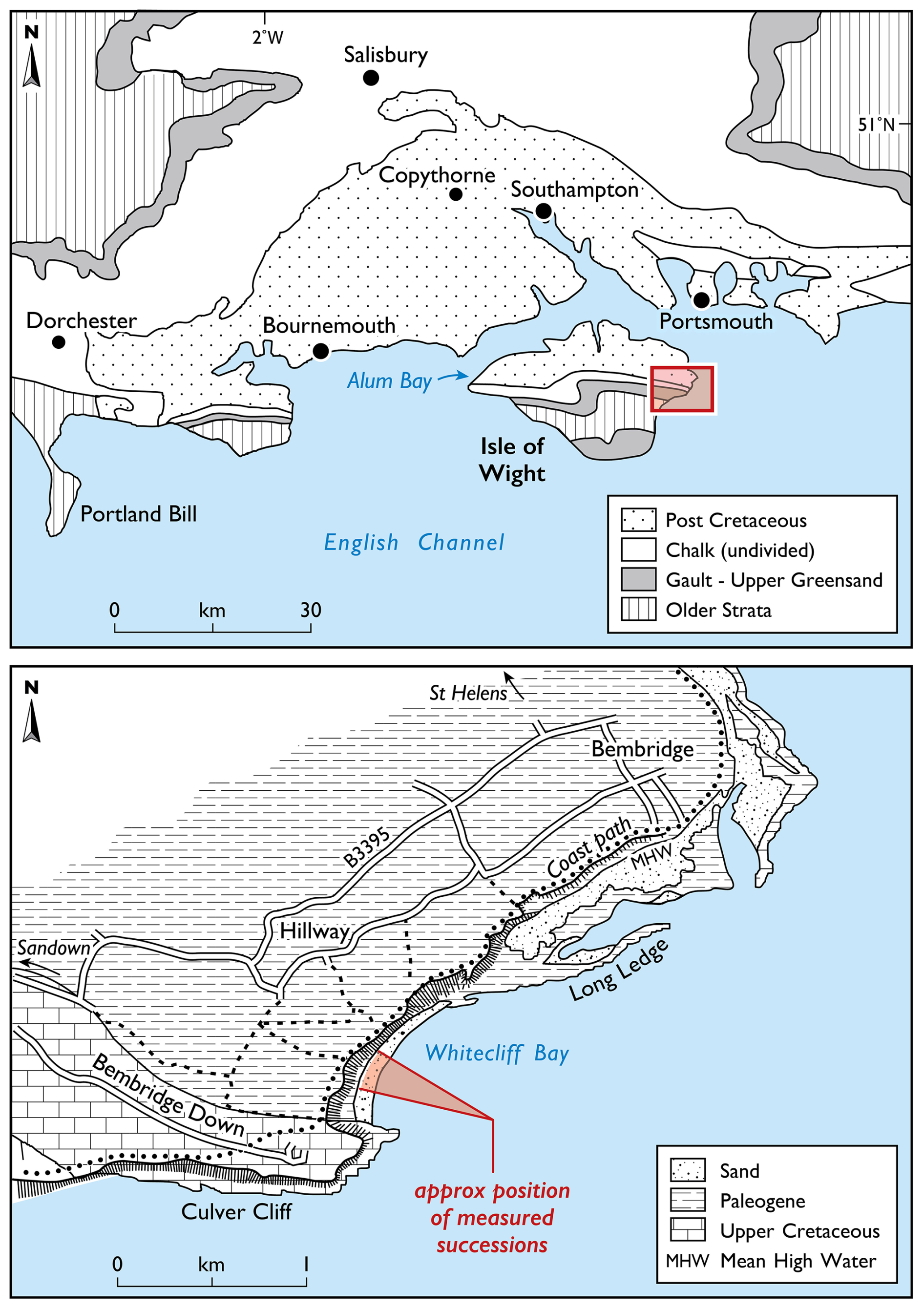
Figure 1Locality map of Whitecliff Bay and other sections mentioned on the Isle of Wight.
Whitecliff Bay, along with other locations on the Isle of Wight, has also been a popular destination for geological field excursions (e.g., Herries and Monckton, 1895; Curry, 1954, 1966; Stinton, 1971; Lord and Bown, 1987). Some of these excursion guides provide additional stratigraphical information and documentation of the fossil assemblages. The Whitecliff Bay succession has also featured in many sedimentological and palaeontological papers in recent years and remains, therefore, an important reference section for much work on the UK Cenozoic (e.g., Gale et al., 1999).
At the eastern extremity of the IoW, the chalk promontory of Culver Cliff is a distinctive feature, marking the boundary between the upper Cretaceous succession and that of the Cenozoic. This headland, and the contact between the chalk succession and the overlying Reading Beds, forms the southern end of the bay (Fig. 2a). The northern end of the bay is marked by Foreland, near Bembridge. Within Whitecliff Bay, the greater part of the Paleocene–Eocene succession is vertically dipping, with the Barton Sands and Lower Headon Beds gradually becoming less inclined. The Bembridge Limestone is almost horizontal with, at low tide, the closure of the Hampshire Basin syncline being visible on the foreshore.
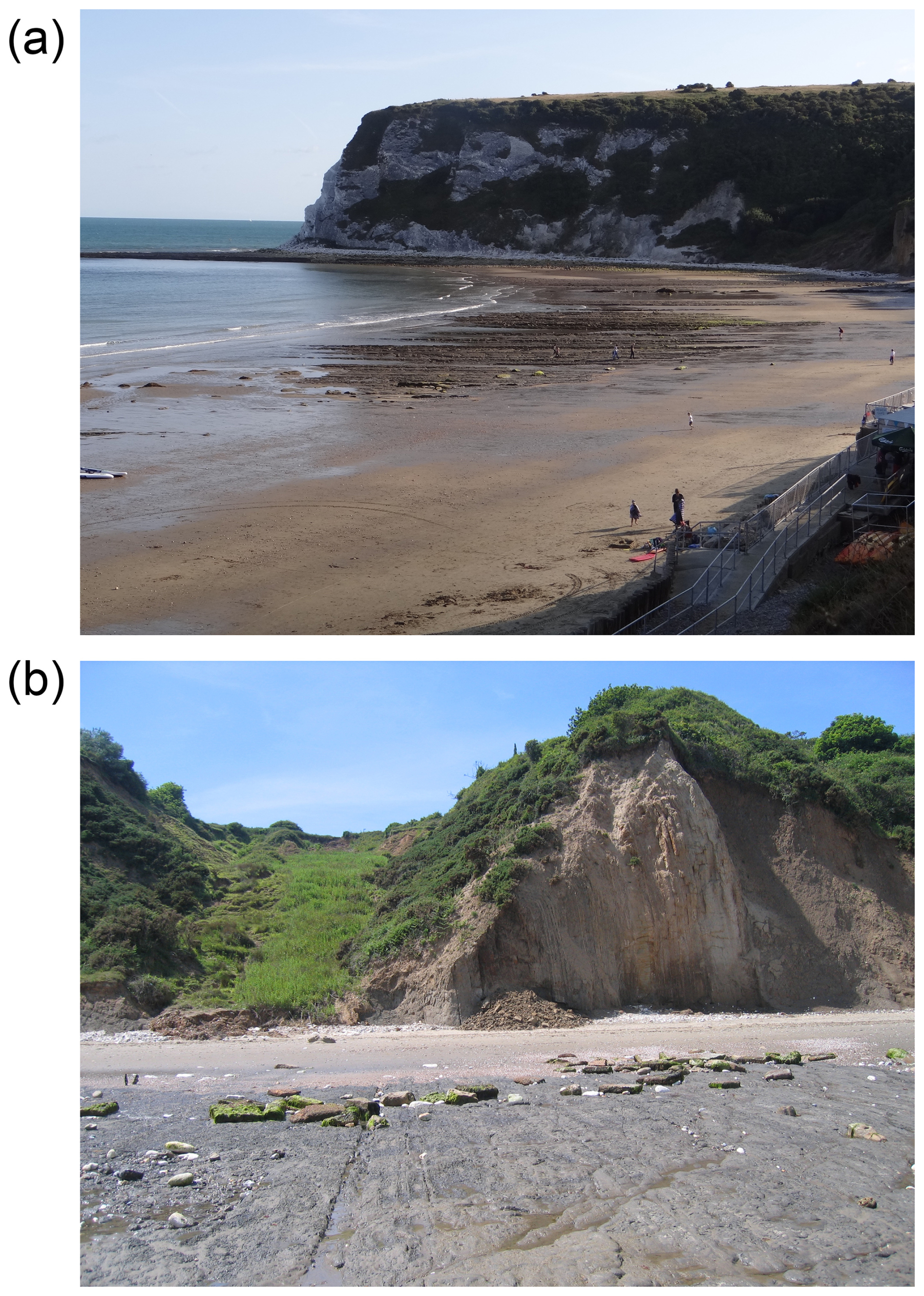
Figure 2(a) View of Whitecliff Bay showing exposed strata following removal of superficial sediments. The chalk of Culver Cliff marks the southern limit of the Bay. (b) Comparison of the London Clay Formation in the cliffs of Whitecliff Bay, in front of which is a foreshore exposure of the same part of the succession, showing how gaps in the cliff profile can be sampled on the foreshore.
The cliff succession is unstable, with silt-rich and sand-rich parts of the succession often standing up against the slumps and mudflows within the more clay-rich units (Fig. 2b). One can never, therefore, guarantee access to the complete succession at the time of any visit. It is also known that weathering profiles, affecting the vertical strata, may selectively remove some of the fossil assemblages, as was reported by De Jonghe et al. (2011) in an investigation of the Marsh Farm Formation. After some storm events, the bay can become stripped of sediment and the foreshore fully exposed, providing unparalleled access to the vertically dipping strata (Fig. 2a, b). It is also our experience that samples collected from the foreshore often contain better preserved, and probably more complete, microfossil assemblages. During investigations of the foreshore (Fig. 2b), erosion surfaces, often overlain by mudstone clasts and small phosphatic nodules, were located, and these indicate potential hiatuses and non-sequences. Assessing the scale of these gaps in the overall succession is, therefore, quite challenging and indicates that the London Clay succession in Whitecliff Bay (and Alum Bay) may be incomplete; such features are probably the norm, though rarely described.
During the last 20 years, the Paleogene has been recognised as containing a number of significant hyperthermal events, including the Palaeocene/Eocene Thermal Maximum (PETM); see Zachos et al. (2001, 2008), Bijl et al. (2009), Westerhold and Röhl (2009), Lauretano et al. (2015), and Westerhold et al. (2020) for important summaries of both the events themselves and the methodologies employed in their documentation. Westerhold (2020, fig. 1) clearly identifies (1) the PETM at the Thanetian/Ypresian boundary in the lower part of magnetic event Chron C24; (2) the Early Eocene Climatic Optimum (EECO) – which includes a number of minor hyperthermals – between mid-Chron C24 and lowermost Chron C21; (3) the Late Lutetian Thermal Event; and (4) the Middle Eocene Climatic Optimum (MECO), which is a short-duration event (ca. 500 kyr; Giorgioni et al., 2019) within the lower part of the Barton Clay Formation, low in Chron C18. The MECO event is clearly preceded by the Late Lutetian Thermal Maximum, and the presence of all these events raises questions about their impact on the following:
-
the possibility of glacio-eustatic sea level changes (associated with raised global temperatures) being recorded in the Isle of Wight succession;
-
the northward migration of larger foraminifera into the Isle of Wight (and Selsey) that may be recording warming events; and
-
changes in palaeogeography that may also influence the distribution of key microfossils, especially foraminifera.
This paper aims to investigate the above by assessing the distribution of foraminifera within the Eocene succession and consideration of their palaeoecological importance.
In this work, samples (ca. 2 kg) collected from Whitecliff Bay have been recorded accurately against the lithological succession and processed using the white spirit method (see Brasier, 1980). This method, though requiring careful preparation within a fume hood, was found to be extremely effective in the 100 % breakdown of claystone and siltstone samples from Whitecliff Bay and other Hampshire Basin localities with no damage to the foraminifera or other microfossils being detected. All samples, after breakdown, were washed on a deep 63 µm sieve; dried in a cool oven (< 40 °C); and investigated in the >500, 500–250, 250–150, and 150–63 µm size fractions.
Foraminifera are protists (single-celled organisms) that secrete a carbonate shell (test) or create a structure from sedimentary particles using organic fibres or cement that may be carbonate based or siliceous (rare). Micropalaeontologists classify foraminifera using wall structure and the organisation of the chambers but also use an “informal” set of groupings based on a planktic mode of life (PL) or benthic taxa that are described as “larger” (LBF) or “smaller” (SBF). The LBF are grouped, not by wall structure but by their relatively large size and complex internal structures. Many of the LBF can only be identified at the species level by the use of oriented thin sections, while the SBF are normally identified by external, microscopic examination or scanning electron microscopy. In the Eocene succession of Whitecliff Bay, SBF are most commonly recorded, being used in both biostratigraphy and palaeoecological analysis (e.g., Murray and Wright, 1974). In the mid-Eocene, however, LBF are found to be associated with assemblages of SBF, and this is quite unusual for such clay-rich sediments at relatively northern palaeolatitudes. LBF are typical of shallow-water carbonate-rich shelves and are usually recorded in tropical or sub-tropical environments (Langer and Hottinger, 2000; Simmons, 2020). The internally complex LBF often contain algal or diatom symbionts (Hallock, 2003; Lee, 2011; Eder et al., 2016), and this limits their occurrence to > 120–130 m in clear waters and relatively shallower depths in more turbid environments.
The LBF often display complex life histories with the megalospheric (A) forms and the microspheric (B) forms. The (A) forms produce gametes which merge sexually to create the microspheric (B) forms, which, in turn, undergo cellular division (asexually) to generate the larger (A) forms: see Hallock (1985) and Hohenegger et al. (2019). SBF may also display A and B forms, though descriptions of such life histories are relatively rare, especially in the geological record. In the Eocene sediments of the Isle of Wight, the LBF are represented by a limited number of genera, including the nummulitids (large discoidal foraminifera) and the alveolinids (globular to fusiform miliolids with a porcelaneous wall structure that appears distinctly white in colour). The alveolinids appear in the Thanetian, reaching a maximum size in the mid-Eocene and disappearing in the Bartonian together with the large nummulitids. In the following discussion, it is the occurrence of the alveolinids and nummulitids in the mid-Eocene (Lutetian and lowermost Bartonian) that will be important in our palaeoenvironmental interpretations.
The Reading Formation (Lambeth Group) is thought to be Palaeocene in age (Hopson, 2011, fig. 8), though the stable isotope excursion that marks the PETM (e.g., Westerhold et al., 2020) has not yet been located within the Isle of Wight succession. The boundary with the overlying London Clay Formation (Thames Group) in Whitecliff Bay is invariably exposed, either in the cliffs or on the foreshore (Fig. 2a, b). The outcrop of the London Clay Formation is often poorly exposed, with the cliffs often intersected by several mudslides. In order to both measure and collect a complete succession of the London Clay Formation, it has been necessary to make return visits to the area in order to benefit from times when the foreshore has been stripped of sediment and the complete succession is exposed.
In their major investigation of the London Clay Formation, Murray and Wright (1974, p. 8) indicate that they collected their samples in January 1969 when the Reading Formation was obscured by landslides and mudflows and significant parts of the London Clay Formation succession were also obscured. They record a thickness of 89.0 m, which is only slightly different from the measurements of other authors and probably reflects the problems of dealing with the incomplete exposure of the succession. They also record that significant parts of the succession were barren of foraminifera, especially in the lowest 38.0 m. In our work, both in the London Clay Formation and in the Bracklesham Group, it has been noted that foreshore samples often yielded microfossil assemblages when comparable samples from the cliff were either barren or contained foraminifera with significantly poorer preservation. It seems certain that the vertical nature of the beds has allowed much greater water penetration and that this has resulted in significant modern or sub-recent in situ weathering.
5.1 Collection of London Clay Formation samples
The London Clay Formation was sub-divided into Divisions A–F by King (1981) and also given some formal lithostratigraphical terminology. Exposure of the outcrop in Whitecliff Bay is best described as variable, with bluffs separated by mudflows that occasionally extend out onto the foreshore. The loci of the mudflows tend to remain in the same place over a period of years, leaving the up-standing bluffs roughly intact. At times, however, storms remove the modern beach sediments, and, in recent years, there have been a number of occasions when the foreshore presents almost 100 % exposure of the vertically dipping strata (Fig. 2a). This has allowed collection of complete suites of samples and direct measurement of both the thickness of the succession and the individual sediment packages. This was the situation when MBH collected some of the samples with geologists from UNOCAL (Union Oil of California, Brea, California) that are used in this investigation and was also the case when MBH and Dr Stephen Grimes (University of Plymouth) collected another suite of samples almost 20 years later (Fig. 2b). The suites of samples from the cliff and the foreshore were processed using the white spirit method described above, though the UNOCAL samples were processed separately by the company but using the same methods. It was this combined suite of samples that were investigated by MA-S and MBH for their foraminiferal content.
5.2 Foraminifera of the London Clay Formation
The foraminifera of the London Clay Formation were initially described by Sherborn and Chapman (1886, 1889) and Chapman and Sherborn (1889). In these two papers, over 100 species are mentioned, but the authors noted that regional variability was so pronounced that accurate identification was almost impossible, leading them to state (Sherborn and Chapman, 1886) the following:
except in rare cases … the word species should be [replaced by] variety.
Over 60 years later, Bowen (1954) observed that many of their identifications had been inaccurate, but even he stated the following:
it is evident that no zonal scheme can be advanced for the [London Clay] formation base upon foraminifera.
The next, and most significant, advance in our understanding of London Clay foraminifera was that of Kaasschieter (1961), who described the foraminiferal assemblages of Belgium and provided a correlation across the Anglo-Paris Basin. In the 1960s and 1970s, two PhD theses were presented to the University of London by Martin Norvick (1969) and Graham Williams (1971), though neither resulted in any publications.
5.2.1 Zonation of the London Clay Formation using foraminifera
After the initial identification of all the species of foraminifera present in the London Clay Formation samples, the stratigraphical ranges of the taxa were determined using normal biostratigraphical procedures. The distribution of the key species in the Whitecliff Bay succession is shown in Fig. 3. The “planktonic datum”, first described by Wright (1972), is also confirmed within the succession. The same procedures were applied to the samples from Alum Bay and the ranges of key taxa shown in Fig. 4.
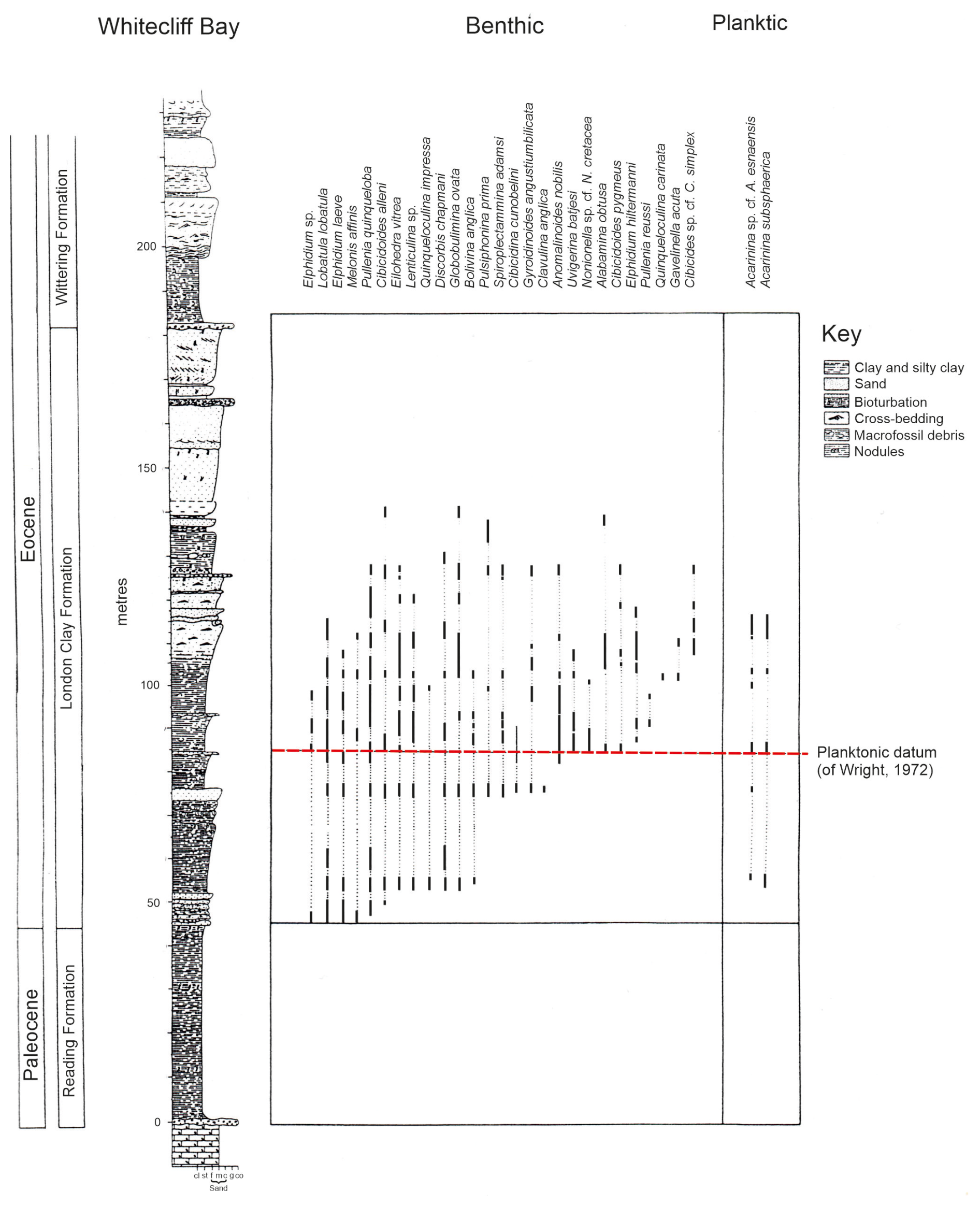
Figure 3Stratigraphical ranges of diagnostic benthic and planktic foraminifera in the London Clay Formation of the Whitecliff Bay succession. The “planktonic datum” of Wright (1972) is indicated.
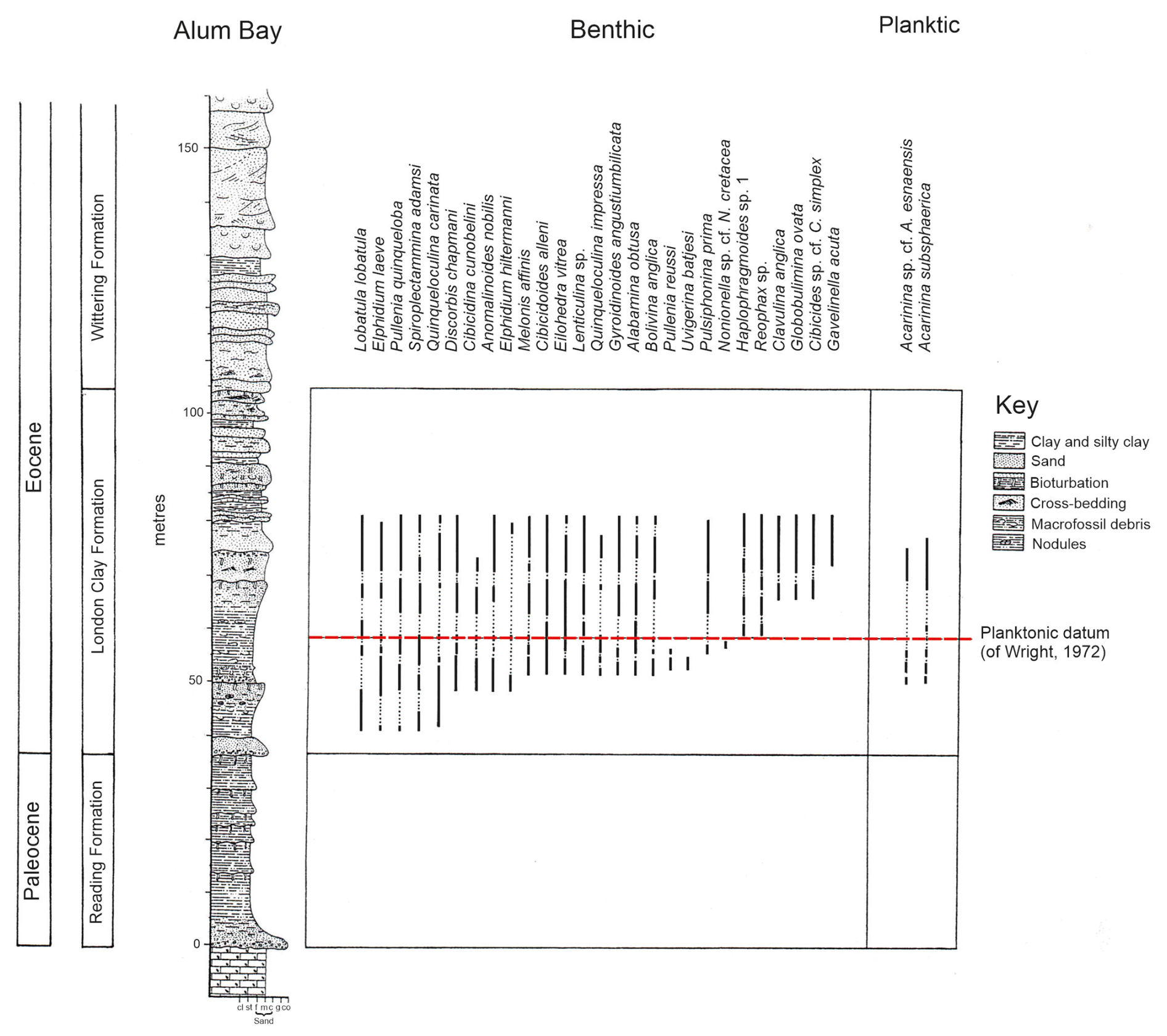
Figure 4Stratigraphical ranges of diagnostic benthic and planktic foraminifera in the London Clay Formation of the Alum Bay succession. The “planktonic datum” of Wright (1972) is indicated.
5.2.2 Correlation of the London Clay Formation using foraminifera
Using a graphical correlation approach (Alex-Sanders, 1992), the distribution of selected foraminifera in the Whitecliff Bay succession was used to generate a zonation (HBB 1–HBB 8) based on first/last appearances of key taxa (Fig. 5). All the taxa used in this zonal scheme are listed in the Appendix. This provides information on the various species in lieu of a full taxonomic treatment. The zones, identified below, are based on benthic foraminifera and named Hampshire Basin Benthic (HBB) zones 1–8 as they appear only to be applicable in that area. The other important London Clay Formation descriptions (Kaasschieter, 1961; Williams, 1971) do not have comparable ranges for the relevant taxa, and the HBB zonation is, therefore, only of local application.
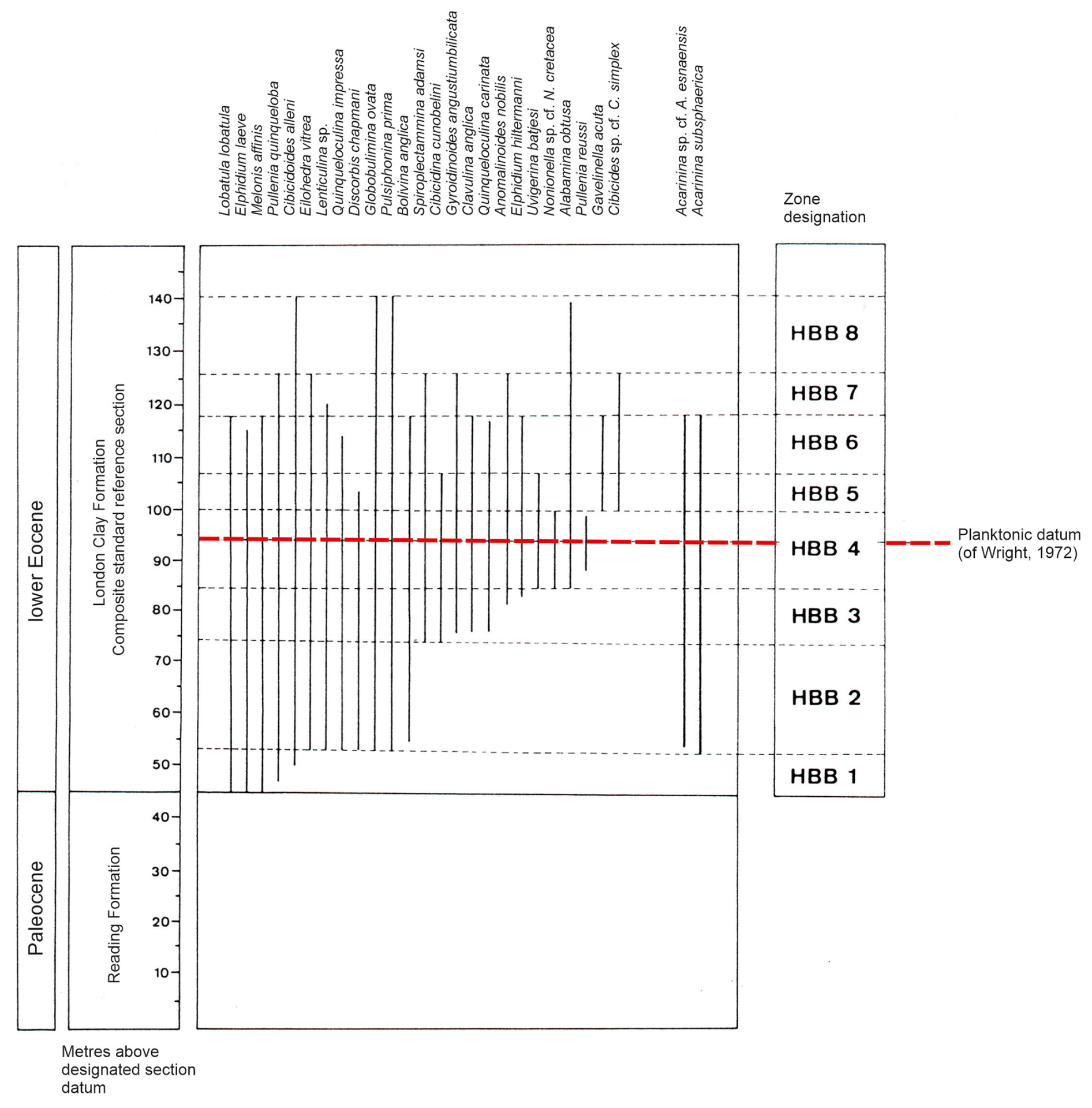
Figure 5Hampshire Basin benthic (HBB) zonation of the London Clay Formation and the location of the “planktonic datum” of Wright (1972).
All the species used in this research are illustrated in Alex-Sanders (1992, pls. 2–6), which is available online (https://primo.plymouth.ac.uk, last access: 10 December 2025). Unfortunately, following the untimely death of Mark Alex-Sanders, the scanning electron microscope negatives have been lost, and only the plates in his thesis are currently available.
Zone HBB 1: Lobatula lobatula (Walker & Jacob) interval zone. This is based on the first appearance of Lobatula lobatula to the first appearance of Eilohedra vitrea (Parker, 1953). Species diversity within this zone is low, and the great majority of the specimens from this interval are poorly preserved. This zone is equivalent to the “Basement Bed unit” of the London Clay Formation, as defined by Edwards et al. (1987).
Zone HBB 2: Eilohedra vitrea (Parker, 1953) interval zone. This interval zone is defined by the first appearance of the nominate species up to the first appearance of Spiroplactammina adamsi Lalicker, 1935. This zone is typified by a significant increase in species diversity compared to the zone below. The nominate species was selected because of its relative abundance and ease of identification.
Zone HBB 3: Spiroplectammina adamsi Lalicker, 1935, interval zone. This interval zone is defined by the first appearance of the nominate species up to the first appearance of Uvigerina batjesi Kaaschieter, 1961. The base of this zone is characterised by the abrupt appearance of agglutinated benthic foraminifera, specifically S. adamsi. In conjunction with the planktonic datum of Wright (1972), this marks a distinctive horizon – the Agglutinated Benthic Foraminiferal Datum.
Zone HBB 4: Nonionella sp. cf. N. cretacea Cushman taxon range zone. This taxon range zone is based on the distribution of the nominate species, which can sometimes be found in flood abundance. Nonionella cretacea Cushman, 1931, is more elliptical in outline, and the test is quite compressed. Recorded from the Selma Chalk (upper Cretaceous) of Tennessee, the forms from the London Clay Formation are unlikely to be this species. The planktonic datum (Wright, 1972) is located within this zone.
Zone HBB 5: Cibicides sp. cf. C. simplex Brotzen, 1948, interval zone. This interval zone is defined by the first appearance of the nominate species up to the last appearance of Uvigerina batjesi Kaaschieter, 1961. This zone relies on two species that are relatively easy to identify even though it may represent a quite short interval of geological time. Cibicides simplex Brotzen, 1948, was first recorded from the Danian (Palaeocene) of Scania (Ystad, southern Sweden), and the type figures show a poorly preserved specimen which is difficult to compare accurately to the present taxon.
Zone HBB 6: Elphidium hiltermanni Hagn, 1952, interval zone. This interval zone is based on the last appearance of Uvigerina batjesi Kaaschieter, 1961, up to the last appearance of the nominate species. While there is a distinctive reduction in species diversity within this zone, the abundance of E. hiltermanni is also low, but it is consistently present.
Zone HBB 7: Pullenia quinqueloba (Reuss) interval zone. This interval zone is defined by the last appearance of Melonis affinis (Reuss) to the last appearance of the nominate species. This zone continues the reducing trend of species diversity. The nominate species ranges throughout most of the London Clay Formation and is one of the few species found consistently at this level.
Zone HBB 8: Cibicidoides alleni (Plummer, 1927) interval zone. This interval zone is defined by the last appearance of Anomalinoides nobilis Brotzen, 1948, to the last appearance of the nominate species.
The zones proposed here have been selected to provide the highest possible resolution whilst still permitting the individual zones to retain practical validity. All the species used in the zonal scheme are present in sufficient numbers and were also selected for their ease of identification. These zones are recognisable within the London Clay Formation of both Whitecliff Bay and Alum Bay (Fig. 6). The exception was that of HBB 1. In the Alum Bay succession, post-depositional decalcification has rendered the sediments at this level barren of biogenic material.
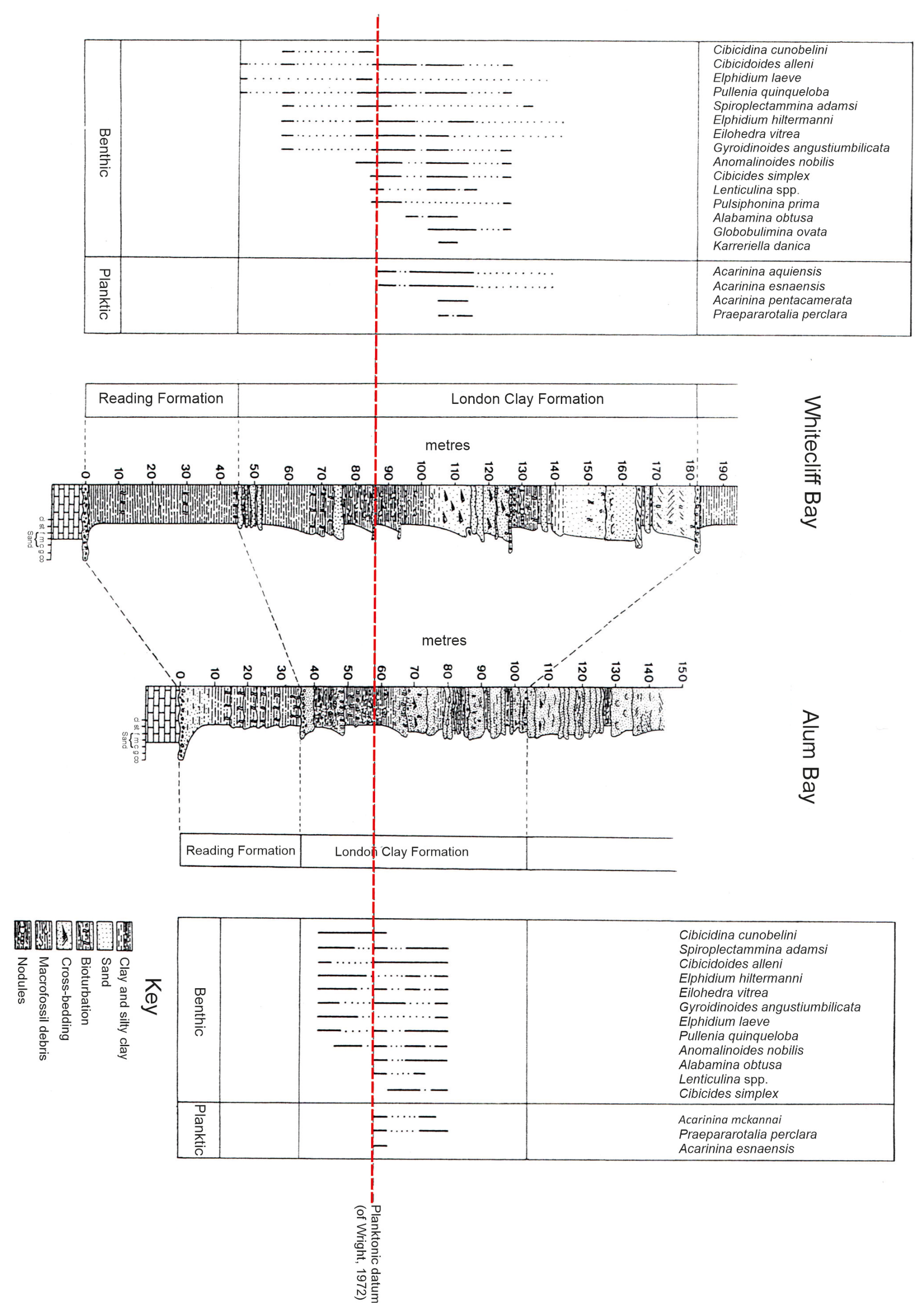
Figure 6Proposed correlation of the Whitecliff Bay and Alum Bay successions using benthic foraminifera and the “planktonic datum” of Wright (1972). As the “planktonic datum” appears to be a synchronous event, it is used as a cross-basin datum. Praepararotalia perclara (Loeblich & Tappan, 1957), on the basis of stable isotope data (δ18O and δ13C) presented by Liu et al. (1998) and Pirkenseer and Spezzaferri (2009), is now regarded as a benthic species. Murray and Wright (1974, pl. 14, figs. 3, 6) illustrated this species from Swanwick (near Southampton), and, in an SEM image, it appears to be very like a planktic species. Their image is close to the rare specimen found in our research, but no stable isotope work was done on the limited material. The location used for some of their material by Liu et al. (1998) at Miller's Ferry (Alabama) was a hydro-electric power station construction site and is now under water. The species has been found in other exposures of the Clayton Formation at Braggs and Mussell Creek (both near Miller's Creek in Alabama) by MBH.
5.2.3 Palaeoecology of the London Clay Formation
The London Clay Formation is estimated at a duration of 4.25 million years (Harland et al., 1989), and this is a relatively brief interval for significant evolutionary changes in the assemblage. In a more recent publication, Friedman et al. (2016) give the duration of the London Clay Formation as 4.0 Ma (based on a range of 54–50 Ma). The duration of the Ypresian (online, http://www.stratigraphy.org, last access: 20 January 2026) is given as 7.93 Ma (based on a range of 56.0–48.07 Ma), which is significantly larger than that given in earlier publications. While many of the recorded taxa range through much of the succession, it does mean that the benthic and planktic foraminifera can be used to determine the palaeoenvironments represented by the mudstone-rich succession.
The assemblage has been used in the construction of qualitative information based on morphogroup analysis (e.g., Koutsoukos and Hart, 1990). Assemblages also used by Alex-Sanders (1992) – and many other micropalaeontologists – have been the following:
-
Planktic : benthic ratios. These ratios are calculated as a percentage of the planktic taxa compared to the total assemblage.
-
Agglutinated calcareous ratios. These ratios are calculated as the percentage of agglutinated benthic species within a zone compared to the total benthic assemblage.
-
Percentage dominance index. This index was taken as the number of species within a sample required to constitute 80 % of the total number of specimens picked.
-
Diversity index. This index is the statistical ratio of the number of individuals to species found, using the methodology of Fisher et al. (1943) and widely known as the α (alpha) diversity index. This index has been used frequently by Murray (1968, 1991, 2006). From the work of Murray (and many other micropalaeontologists), it is generally accepted that the value α = 5 separates normal marine environments from both hyposaline (< 32 ‰) and some hypersaline (>37 ‰) environments.
-
Triangular plot diagram. This diagram plots the percentage abundance of each of the three sub-orders of foraminifera (Textulariina, Milioliina, and Rotaliina). This format was first devised by Murray (1968) and has been used extensively by micropalaeontologists since then.
-
Similarity index. This index is the ratio of the percentage abundance data for each species found in a compared sample. Where a species was found to be common to both, the smaller abundance was noted. The total of the minimum percentage values for the species common to both samples compared is the similarity index. Given as a percentage, in practice values of >80 % were taken to indicate “identical” assemblages.
In the application of all these methods, quality of preservation was used to confirm that each sample was a genuine reflection of the environment of deposition and not affected by, for example, dissolution or excessive weathering.
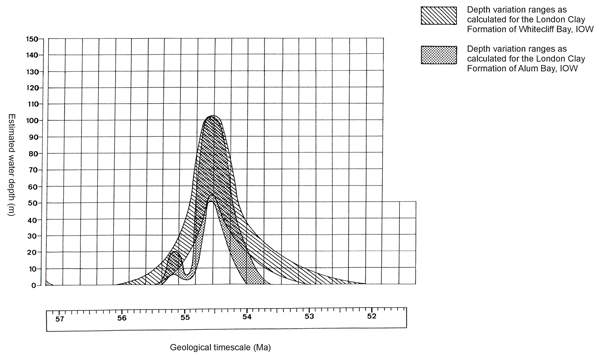
In their analysis of the Whitecliff Bay succession, Murray and Wright (1974, text figs. 6, 8, 9, 10) used a similar approach and, in the London Clay Formation, suggested that the environment(s) of deposition ranged from hyposaline, fluvial (river mouth?) conditions to an open hyposaline shelf with cool water of 20–100 m water depth. Our interpretation of the succession (Fig. 7) is quite comparable, extending from 5–105 m. The maximum depths, which represent a shelf or neritic environment, are recorded from the same levels. Following the maximum water depth, the environment returns to sub-littoral conditions. As indicated in Fig. 7, our data do not allow the recognition of minor oscillations within the overall single cycle of water depth change. Westerhold et al. (2020, fig. 1) indicate – on the basis of stable isotope data – that there may have been a number of “hyperthermals” within EECO, but our data cannot resolve a response to each of these events with normal sampling intervals. With our water depth changes being within the EECO hyperthermal event, it is possible that we are recording a glacio-eustatic change, especially as the maximum water depth is almost precisely coincident with that recorded for the Alum Bay succession (Fig. 8). When the two depth curves are superimposed (Fig. 9), there is a clear overlap even though there is a greater range of possible water depths (maximum value between 48–100 m). In both the Alum Bay and the Whitecliff Bay successions, the planktonic datum (Wright, 1972) is coincident with the suggested level of maximum water depth, although, with near-shore transport of the planktic foraminifera a strong possibility, the occurrence of this assemblage is probably not accurately depth diagnostic.
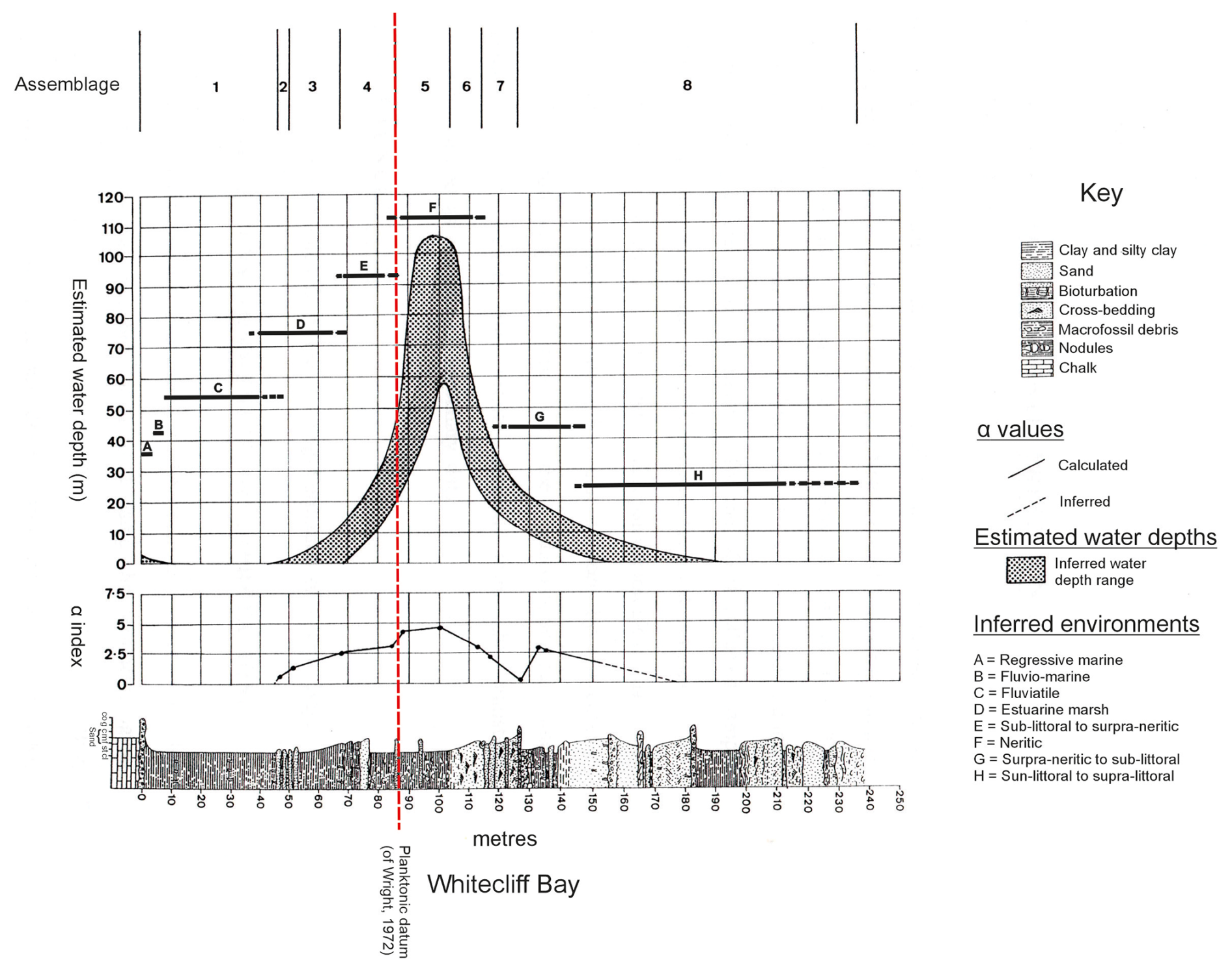
Figure 7Palaeoecological interpretation of the foraminiferal assemblages in the London Clay Formation of the Whitecliff Bay succession. The inferred palaeoenvironments (A–H) are based on the criteria explained in the text, especially the α diversity. The level of the “planktonic datum” is indicated.
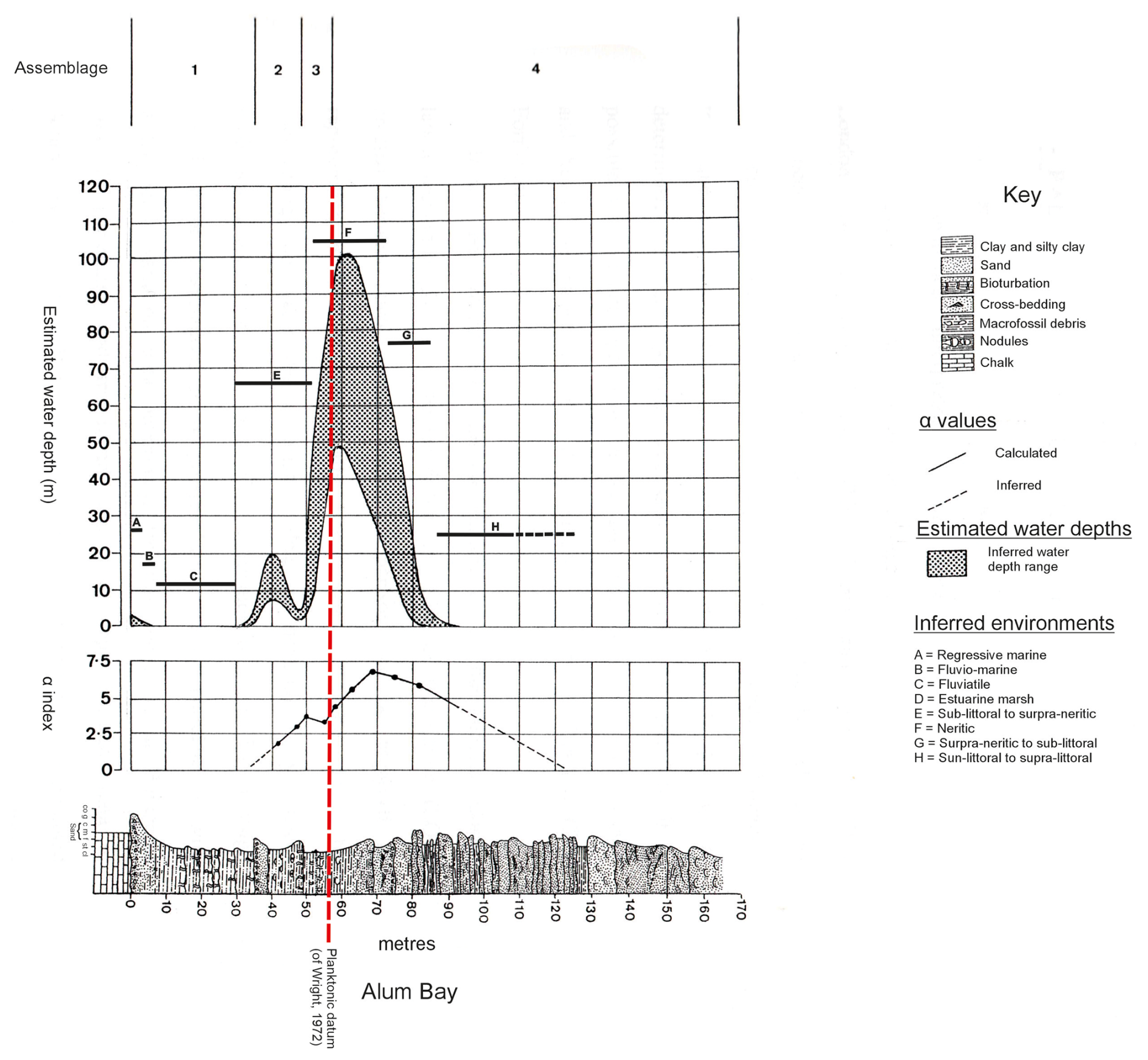
Figure 8Palaeoecological interpretation of the foraminiferal assemblages in the London Clay Formation of the Alum Bay succession. The inferred palaeoenvironments (A–H) are based on the criteria explained in the text, especially the α diversity. The level of the “planktonic datum” is indicated.
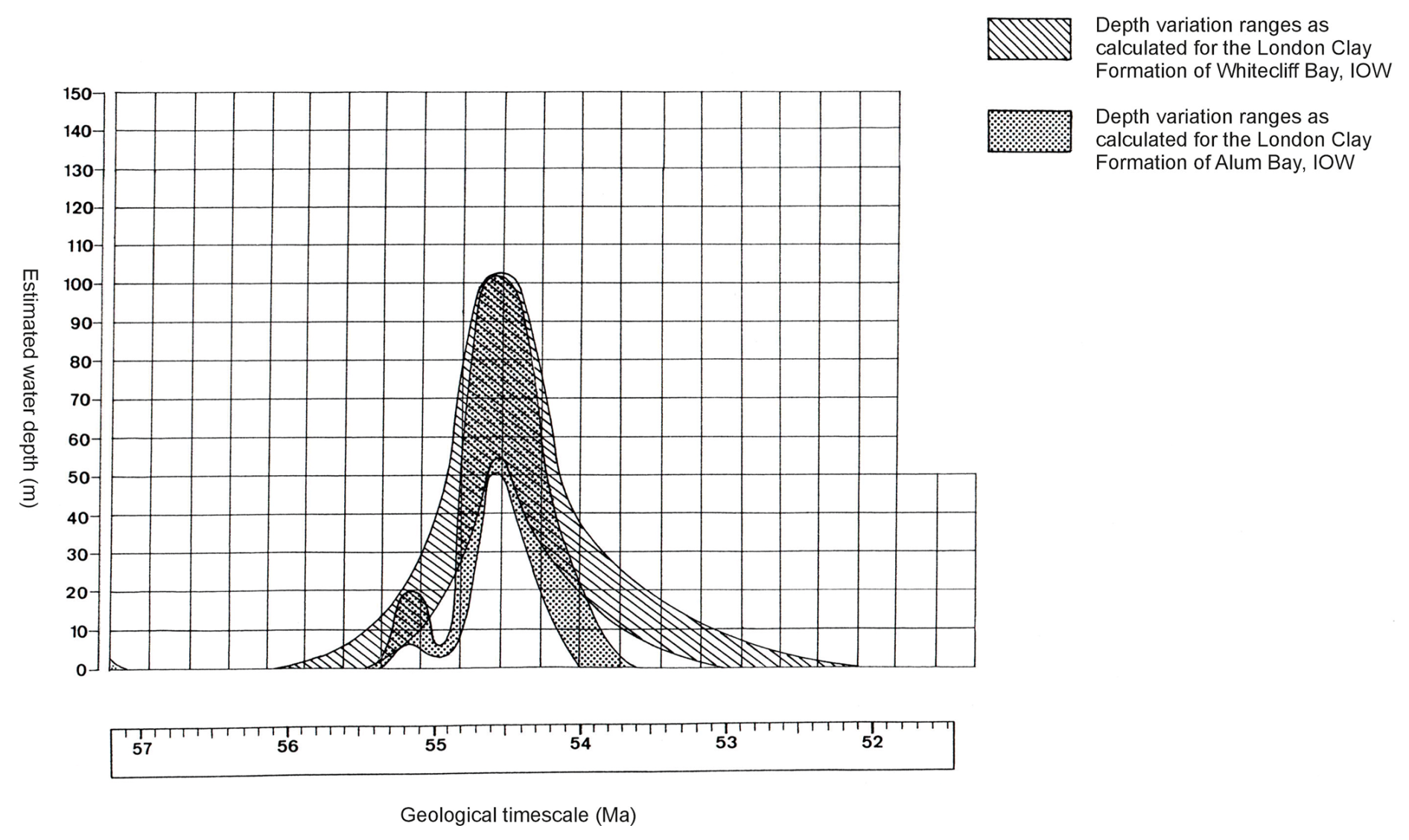
Figure 9Interpretation of sea level changes in the Whitecliff Bay and Alum Bay successions, superimposed to demonstrate synchroneity. The timescale is that of Harland et al. (1989), although, as discussed in the text, more recent versions of this timescale are available (although none refer specifically to the London Clay Formation).
The problem with the interpretation of this change in water depth being associated with glacio-eustasy is that EECO is close (in time) to the PETM, which is thought to have occurred in an ice-free world (McInerney and Wing, 2011; Scotese et al., 2024), though Dawber et al. (2011) have attributed the Late Lutetian Thermal Maximum (LLTM) and MECO events to glacio-eustatic control. Rae et al. (2021) indicate that the PETM and EECO events occurred in a “hothouse” world, with the LLTM and MECO events indicating a “warmhouse” world. In such a scenario, can one also invoke thermal expansion of the oceans to create changes in sea level? In recent research, Wigley and Raper (1987) and Liang et al. (2025) have used NASA/NOAA data to calculate the impact of thermal expansion on modern sea level changes. In the last 25 years, thermal expansion may have accounted for half of the 7.1 cm global sea level rise. Between 1880 and 1985, thermal expansion is calculated as 2–5 cm, and in the last 40 years (1985–2025), the estimated rise would be 4–8 cm for the 0.6–1.0 °C greenhouse-gas-induced warming. Allowing for sediment compaction in the Eocene mudstones of the Isle of Wight, such low figures of sea level change would not be detected.
Rae et al. (2021, figs. 4, 5 and 6) show that the EECO event (ca. 54–48 Ma) was marked by a series of closely related peaks, a feature also recorded by Inglis et al. (2023, fig. 2). The microfossil record in the London Clay Formation appears to indicate the presence of a single, quite prominent event rather than a longer-lasting, more diffuse feature. Tripati et al. (2005), using evidence from marine cores near Greenland, suggested that glacially derived sediments were present in the mid-Eocene back to ∼ 42 Ma, which Tripati et al. (2008) extended back to ∼ 44 Ma. While such data might enable the MECO event to be glacio-eustatic (Dawber et al., 2011), it would not really include the LLTM and EECO events.
If our rather marked sea level event in the early Eocene is not glacio-eustatic, then the alternative mechanism could be tectonic, with Stamp (1921) suggesting that the cyclicity recorded within the Eocene succession was caused by movements on the Sandown Pericline (Gale et al., 1999). Within the London Clay Formation, our early Eocene event is not associated with any significant change in facies or sedimentation that might indicate a significant tectonic control. There are changes in facies associated with the LLTM and MECO events, including the distinctive pebble bed at the base of the Barton Clay Formation at Alum Bay.
More recently, Gale and Lovell (2020) have suggested that both the Iceland mantle plume and the Massif Central hotspot may have controlled sea level changes in the Anglo-Paris Basin. The Iceland mantle plume appears to have continued through to the Lutetian (ca. 43 Ma) and may have been the driver of our recorded events in the early and mid-Eocene (Mudge and Bujak, 1996, fig. 5; White and Lovell, 1997).
Westerhold et al. (2020, fig. 1) indicate the presence of a warming event in the late Lutetian (ca. 43 Ma) – slightly earlier than the Middle Eocene Climatic Optimum (MECO) at ca. 40 Ma. These two “events”, which straddle the Bracklesham Group–Barton Group transition, are characterised by the presence of both LBF and SBF. Aside from an isolated occurrence of Nummulites planulatus within glauconite-rich sand in the Wittering Formation, the LBF are only present in the Whitecliff Bay succession in the Earnley Sand Formation to the Barton Clay Formation: an interval that embraces the uppermost Lutetian and the lowermost Bartonian. This occurrence of LBF has been known for some time, with Keeping (1887) using the first occurrence of N. prestwichianus to define the base of the Barton succession. The first significant occurrence of LBF is in the N. laevigatus Bed of the Earnley Sand Formation. Between these two horizons there is a complex of inter-related Nummulites species – including N. variolarius (e.g., Curry, 1962) – with a number of morphotypes being described by Norvick (1969, fig. 13, p. 62). The horizon with abundant N. variolarius is the most widespread, being found across a large area of the Hampshire Basin, including the well-known succession on Hengistbury Head. Just above the N. prestwichianus Bed there is a distinctive occurrence of N. rectus, from the highest stratigraphical level at which Nummulites are recorded in the UK.
Associated with Nummulites are other genera and species of LBF – a feature noted by Curry (1967, fig. 3) and, to a lesser degree, Dixon (1850). While a number of genera (and species) were noted by Curry (1967), the most important is the occurrence of alveolinids. These internally complex miliolids are cigar-shaped and visible in the field with a hand lens or even the naked eye. Alveolinids are known only from three locations in England and some marine sampling sites offshore of Jersey (see later).
The best-known localities are Fisher's Beds 21 and 22 (Fisher, 1862, p. 74), with Bed 22 being known locally as the Clibs, which is on the foreshore at Selsey (Bracklesham Bay), Sussex (Fig. 10). This is the locality mentioned by Dixon (1850) and is accessible only at low tide on the west side of Selsey Bill (Curry et al., 1969). In an offshore reef (Mixon Rocks) about one mile (1609 m) south of Selsey Bill is an outcrop that is only available at low spring tides (Bone and Bone, 2014, figs. 1, 2). This is a miliolid/alveolinid limestone that was described by Dixon (1850, p. 13) as follows:
calcareous rocks that are situated opposite Selsey and Bracklesham are composed almost entirely of these minute shells being analogous to the Milliolite limestone of the Paris basin
and goes on to indicate (Dixon, 1850, pp. 9–10), while discussing Selsey (or Sealsea), the following:
houses built of an arenaceous limestone, similar to the Milliolite limestone of Paris, almost entirely made up of microscopical shells; which was formerly procured in great abundance at a moderate expense from a ledge of rocks off Selsey Bill extending some distance to the east and west.
It was noted that demand was so great that they began to prevent removal in 1830 as the reef was thought to be protecting the shoreline (Bone and Bone, 2014). It is well known that pebbles of the limestone can be collected on the foreshore, and one of us (MBH) was fortunate to find some examples of this limestone in 1968, but, of course, the relationship between this rock and Fisher's Beds 21 and 22 is impossible to determine. This limestone was also the source of Alveolina fusiformis, which was described by J. de C. Sowerby (Dixon, 1850, p. 162, pl. ix, fig. 5) as a new species (and form the “microscopical shells” described above). This pale-weathering limestone was likened to the Calcaire Grossier of the Paris Basin. The final locality known for the presence of abundant alveolinids is within the uppermost part of the Selsey Sand Formation in Whitecliff Bay on the Isle of Wight (Beds xvi and xvii).
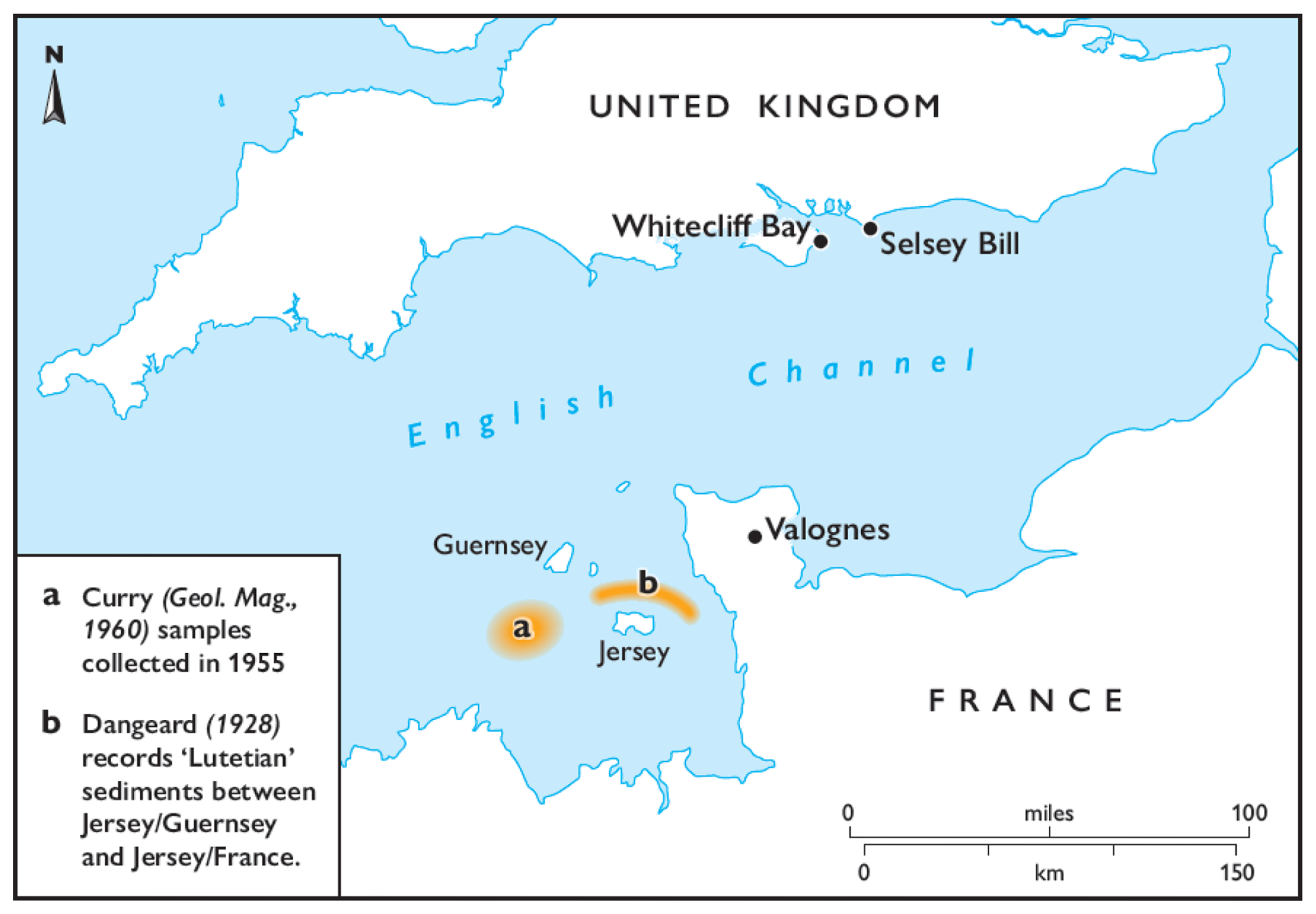
Figure 10Map of localities in the Hampshire Basin, the marine areas near Jersey and the Cotentin Peninsula. In the Whitecliff Bay succession (Curry, 1966), there is a distinctive assemblage of characteristic middle Eocene larger foraminifera that is known from the Bracklesham Group. Offshore Selsey Bill there are known locations of Alveolina limestone on the Clibs and Mixon rocks. Curry (1960) records a number of locations (a) from which samples of pale buff/cream, fossiliferous middle Eocene limestone were collected during a cruise in 1955. Dangeard (1928) recorded “Lutetian” sediments (b) between Jersey/Guernsey and Jersey/France. In the same area core O-VC18 (between Jersey and France), one horizon contains foraminifera that appear abraded and broken and which is probably indicative of reworking and derivation from in situ middle Eocene, possibly in the area around Valognes, on the Cotentin Peninsula, where there is a diverse middle Eocene assemblage in the Calcaire Grossier.
These three locations are, collectively, the northernmost occurrences of Alveolina in northwestern Europe, and this is important to interpretations of palaeogeography. In a lengthy taxonomic discussion, Adams (1962) indicated that the two species present in the UK are Alveolina fusiformis and Alveolina sp. cf. A. elongata, based on a detailed assessment of the internal structure and, in particular, the dimensions of the proloculus and the first, post-embryonic chamber. Adams (1962) noted that the external shape was not 100 % diagnostic of the species (A. fusiformis and A. elongata) despite the names applied to these taxa. Hottinger (1980, p. 149) records that A. bosci is present in the lower and middle Lutetian and is recorded in the Lutetian across the Paris Basin. The species of Alveolina recorded in areas around Jersey and in core O-VC18, may, therefore, be any of the three species, and only detailed thin-section or micro-CT analysis can confirm the actual species present.
The other species listed by Curry (1967, fig. 3) as occurring in the Hampshire Basin include Halkyardia minima, Linderina brugesi, Fabularia bella, Fabularia ovata, Orbitolites sp., Cuvillierina sp., and Asterocyclina sp. These are smaller members of the LBF, except Asterocyclina, which belongs to a large group of discocyclinids and is typical of warm, shallow-water environments. Many of these taxa, as noted by Curry (1967, pp. 444–446), are also known from the Sables de Cuise and Calcaire Grossier of the Paris Basin, and all are typical of mid-Eocene successions.
6.1 Distribution of LBF in the English Channel and offshore Jersey
While the southern fringes of the Hampshire Basin are the northern limit of this warm-water assemblage of alveolinids and other LBF, there are several other parts of the English Channel area where this assemblage is known. One such location is between Jersey and the French coastline near Saint-Germain-sur-Ay. In 2009 a series of 48 vibro-cores were drilled on a transect from Grouville Bay (Jersey) to Saint-Germain-sur-Ay (Cotentin Peninsula). In one of these cores (O-VC18), Eocene sediments were recovered between the metamorphic basement and the overlying Holocene sediments. As the foraminifera are rather worn, and in places consisting of broken fragments, it is possible that this may be a transported assemblage and not in situ. Associated with the cigar-shaped alveolinids, there are many specimens of the middle Eocene Rotalia trochidiformis (revised by Haynes and Whittaker, 1990). Significantly, there are no microfossils that are not of Eocene age, and, if transported, the sediments and the enclosed fossil assemblages must have been derived from a very local mid-Eocene source.
The discovery of potential Eocene sediments with LBF in the O-VC18 core is unsurprising as such sediments had been described in the results of a major marine survey by Dangeard (1928). This survey was quite comprehensive, with numerous sampling stations extending around the Channel Islands, the Baie de St Malo, and westwards along the coast of northern France. The resulting maps indicated that a large number of the stations had recovered (by dredging) carbonate-rich rocks of Eocene age – mainly, if not exclusively, assigned to the Lutetian. The data from Dangeard (1928) were discussed by Bignot and Hommeril (1964) and used in the production of a series of Cretaceous and Cenozoic palaeogeographical maps by Hommeril (1967).
To confirm the Dangeard (1928) data, Dennis Curry undertook a marine sampling campaign in June 1955, using the Marine Biological Association's R.V. Sarsia. A number of the sampling stations to the west of Jersey are a direct replicate of a few of the Dangeard samples. Curry (1960, 1964) and Curry and Smith (1975) described the marine sampling and the subsequent processing of the recovered material, most of which was pale, cream-coloured, fossiliferous limestone. Many of the samples were determined as being of Eocene (Lutetian) age, and these data clearly contributed to the geological map of the English Channel published by Curry et al. (1970, fig. 3, 1971) and the palaeogeographical map (Curry, 1967, fig. 2), which showed a clear shallow sea in that part of the English Channel (especially around the Channel Islands).
The samples collected by R.V. Sarsia are held by the British Geological Survey (nos. MR22584–MR22595), and these have been reinvestigated by MBH. Unfortunately, we were unable to prepare thin sections of the neatly trimmed limestone blocks or even prepare small sub-samples for microfossil analysis. This meant only undertaking a visual inspection of the external surfaces of the samples. The samples were confirmed as (1) highly fossiliferous, with (2) the majority containing foraminifera (mainly miliolids) and (3) some with clearly visible alveolinids (in samples MR22584, MR22586, and MR22591).
The distinct “lobe” of Eocene sediments recorded on the sea floor to the north and northeast of Jersey by Dangeard (1928), Mourant (1965, 1966), and Hommeril (1967) is particularly interesting, as is the relationship between this area of Eocene (Lutetian) sea floor and what is recorded in vibro-core O-VC18. While the Eocene sediments in O-VC18 may be in situ, or even slightly transported, it is evident that they are close to known in situ sediments of, as far as can be determined, the same age. The offshore occurrences of Eocene sediments are also close to known onshore successions of comparable age near Valognes (Cotentin Peninsula) as reported by Bignot et al. (1968) and Dugué et al. (2007). This succession – which is ∼ 20 m thick – is represented by the “Falun de Fresville Formation” of middle Lutetian to Bartonian age and rests on a basement succession (Dugué et al., 2007, fig. 2). These bioclastic and pelletoidal sands represent sub-tidal sand waves and were dated by Le Calvez and Pareyn (1976) and Dugué et al. (2005). These sub-tidal sediments were noted as being present in the Normany–Brittany Gulf and around the Channel Islands (including Jersey and Guernsey).
6.2 Mid-Eocene palaeogeography
There is widespread evidence of the occurrence of mid-Eocene carbonate sediments with abundant foraminifera around Jersey; in the southern part of the English Channel; on the Cotentin Peninsula; and, in a thin succession, offshore Selsey Bill. A near-identical assemblage of foraminifera with LBF is known from mudstones at Bracklesham and Whitecliff Bay. As demonstrated by Dangeard (1928), Curry (1960, 1966), and Curry et al. (1965a, b), these Lutetian limestones are quite widespread and appear to represent a warm-water episode that is responding to the LLTE (Westerhold et al., 2020, fig. 1). The extension of the ranges of some LBF (e.g., Nummulites prestwichianus, N. rectus) into the lowermost Barton Clay Formation appears to suggest that the warm conditions in the UK, and other successions in the Anglo-Paris Basin, included the MECO event, the isotope signal for which appears to be in the lowermost part of the Barton Clay Formation (Dawber et al., 2011).
Both events (LLTE and MECO) may be recording a slight glacio-eustatic rise, as suggested by Dawber et al. (2011), and the presence of carbonate sediments resting on the basement succession of the Cotentian Peninsula (Dugué et al., 2007) is also suggestive of a transgressive event in a marginal setting.
A zonation for the London Clay Formation of the IoW based on foraminifera has been generated using well-known, identifiable taxa. Using palaeoecological information based on these species, a marked sea level change during the EECO event has been detected, though there are problems associated with the identification of this as being of glacio-eustatic origin. The occurrence of larger benthic foraminifera (LBF) in the LLTM and MECO events could also be attributed to sea level changes, especially as the same assemblages can be described from the sea area adjacent to Jersey and the adjacent English Channel.
List of foraminifera mentioned in the text in alphabetical rather than taxonomic order.
Larger benthic foraminifera (LBF)
-
Alveolina bosci (Defrance in Bronn, 1825) = Oryzaria bosci Defrance in Bronn, 1825, p. 44.
-
Alveolina elongata d'Orbigny, 1828, p. 234.
-
Alveolina fusiformis Sowerby, 1850.
-
Asterocyclina sp.
-
Cuvillierina sp.
-
Fabularia bella Kaasschieter, 1961.
-
Fabularia ovata Defrance in Bronn, 1825 = Fabularia discolithes Defrance in Bronn, p. 43 (Parker & Jones, p. 162).
-
Halkyardia minima (Liebus, 1911) = Cymbalopora radiata var. minima Liebus, 1911.
-
Linderina brugesi Schlumberger, 1893.
-
Nummulites laevigatus (Brugière) = Camerina laevigata Brugière, 1792.
-
Nummulites planulatus (Lamarck) = Lenticulites planulata Lamarck, 1804.
-
Nummulites prestwichianus (Jones); Nummulina planulata var. prestichiana Jones in Fisher, 1862, p. 93.
-
Nummulites rectus Curry, 1937, p. 241, pl. 20, figs. 1–3, pl. 21, fig. 11.
-
Nummulties variolarius (Lamarck); Lenticulites variolaria Lamarck, 1804, pp. 187–188.
-
Rotalia trochidiformis (Lamarck) = Rotalites trochidiformis Lamarck, 1804, emended Haynes and Whittaker (1990).
Smaller benthic foraminifera (SBF)
-
Alabamina obtusa (Burrows and Holland) = Pulvinulina exigua (Brady) var. obtusa Burrows and Holland, 1897.
-
Anomlinoides acuta (Plummer) = Anomalina ammonoides (Reuss) var. acuta Plummer, 1926.
-
Anomalinoides nobilis Brotzen, 1948.
-
Bolivinopsis adamsi (Lalicker) = Spiroplectammina adamsi Lalicker, 1935.
-
Brizalina anglica (Cushman) = Bolivina anglica Cushman, 1936.
-
Cibicides cunobelini Haynes, 1957.
-
Cibicidoides pygmeus (Hantken) = Pulvinulina pygmea Hantken, 1875.
-
Cibicides sp. cf. C. simplex Brotzen, 1948.
-
Cibicidoides alleni (Plummer, 1927) = Truncatulina alleni Plummer, 1927.
-
Clavulina anglica (Cushman, 1936) = Pseuoclavulina anglica Cushman, 1936.
-
Discorbis chapmani Bowen, 1954.
-
Eilohedra vitrea (Parker, 1953) = Epistominella vitrea Parker, 1953.
-
Elphidium hiltermanni Hagn, 1952.
-
Elphidium sp. (Manuscript name used in Williams, 1971).
-
Gyroidina angustiumbilicata Ten Dam, 1944.
-
Haplophragmoides sp. 1.
-
Lenticulina sp.
-
Lobatula lobatula (Walker and Jacob) = Nautilus lobatulus Walker and Jacob, 1798.
-
Melonis affinis (Reuss) = Nonionina affinis Reuss, 1851.
-
Elphidium leave (d'orbigny in Parker, Jones and Brady, 1865) = Nonion leave d'Orbigny in Parker, Jones and Brady, 1865.
-
Nonionella sp. cf. N. cretacea Cushman, 1931.
-
Praeglobobulimina ovata (d'Orbigny) = Bulimina ovata d'Orbigny, 1846.
-
Pullenia quinqueloba (Reuss) = Nonionina quinqueloba Reuss, 1851.
-
Pullenia reussi Cushman & Todd, 1943.
-
Pulsiphonia prima (Plummer) = Siphonina prima Plummer, 1927.
-
Quinqueloculina carinata d'Orbigny, 1826.
-
Quinqueloculina impressa Reuss, 1851.
-
Reophax sp.
-
Uvigerina batjesi Kaasschieter, 1961.
Planktic foraminifera (PF)
-
Acarinina esnaensis (LeRoy, 1953) = Globigerina esnaensis LeRoy, 1953.
-
Globigerina chascanona Loeblich & Tappan, 1957.
All the data are available in the thesis of Mark Alex Sanders (Alex-Sanders, 1992, https://primo.plymouth.ac.uk).
Fieldwork and sample collection, MBH; sample processing, MBH; microscope work, MA-S, MBH; analysis, MA-S, MBH, CWS; writing, MA-S, MBH, CWS; editorial work, MBH, CWS.
At least one of the (co-)authors is a guest member of the editorial board of Journal of Micropalaeontology for the special issue “Advances and challenges in modern and benthic foraminifera research: a special issue dedicated to Professor John Murray”. The peer-review process was guided by an independent editor, and the authors also have no other competing interests to declare.
Publisher's note: Copernicus Publications remains neutral with regard to jurisdictional claims made in the text, published maps, institutional affiliations, or any other geographical representation in this paper. The authors bear the ultimate responsibility for providing appropriate place names. Views expressed in the text are those of the authors and do not necessarily reflect the views of the publisher.
This article is part of the special issue “Advances and challenges in modern and benthic foraminifera research: a special issue dedicated to Professor John Murray”. It is not associated with a conference.
The authors dedicate this paper to the memory of John Murray who, while at Bristol University, studied the Cenozoic successions of the Isle of Wight and adjacent areas with Chris Wright. The paper is also dedicated to the memory of Mark Alex-Sanders who completed his M.Phil. on the London Clay foraminifera but, sadly, died before it could be prepared for publication. Dr. Paul Chambers (States of Jersey) is thanked for access to the cores, especially O-VC18, and the British Geological Survey (Keyworth) is thanked for the loan of the marine samples from the west of Jersey. Mr. James Quinn (cartographer, University of Plymouth) assisted with some of the figures.
This paper was edited by Babette Hoogakker and reviewed by Antonino Briguglio and Paul Pearson.
Adams, C. G.: Alveolina from the Eocene of England, Micropaleontology, 8, 45–54, 1962.
Alex-Sanders, M. E. A.: A micro-biostratigraphy and integrated palaeo-ecology for the Palaeocene and Early Eocene sediments of the Southern Hampshire Basin, unpublished M.Phil. Thesis, University of Plymouth, 418 pp. + Appendices, https://primo/plymouth.ac.uk (last access: 2 May 2026), 1992.
Bhatia, S. B.: The foraminiferal fauna of the Late Palaeogene sediments of the Isle of Wight, England, J. Paleontol., 29, 665–693, 1955.
Bhatia, S. B.: The paleoecology of the late Palaeogene sediments of the Isle of Wight, England, Contributions to the Cushman Foundation for Foraminiferal Research, 8, 11–28, 1957.
Bignot, G. and Hommeril, P.: Contribution à l'étude du Lutétien entre les îles Anglo-Normandes et le Cotentin, Revue des Sociétés Savantes de Haute Normandie, 36, 17–28, 1964.
Bignot, G., Hommeril, P., and Larsonneur, C.: Le Lutétien au large du Cotentin, in: Colloque sur l'Éocène, Paris, Mai 1968, Memoire Bureau de Recherches géologiques et miniéres, 58, 405–416, 1968.
Bijl, P. K., Schouten, S., Sluijs, A., Reichart, G.-J., Zachos, J. C., and Brinkhuis, H.: Early Paleogene temperature evolution of the southwest Pacific Ocean, Nature, 461, 776–779, https://doi.org/10.1038/nature08399, 2009.
Bone, D. and Bone, A.: Quarrying the Mixon Reef at Selsey, West Sussex, Sussex Archaeological Collections, 152, 95–116, 2014.
Bowen, R. N. C.: Foraminifera from the London Clay, P. Geologists' Assoc., 65, 125–174, https://doi.org/10.1016/S0016-7878(54)80004-6, 1954.
Bowerbank, J. S.: On the London and Clastic Clay Formation of the Isle of Wight, Transactions of the Geological Society, London, 6, 169–172, 1842.
Brander, G.: Fossilia Hantoniensia collecta, et in Musaeo Brittanico deposita, London, 1766.
Brasier, M. D.: Microfossils, George Allen & Unwin Ltd, London, 193 pp., ISBN 0412445700, 1980.
Bristow, H. W., Reid, C., and Strahan, A.: The geology of the Isle of Wight, 2nd Edn., Memoir Geological Survey of United Kingdom, 349 pp., HMSO, London, 1889.
Carpenter, W. B.: On the microscopic structure of Nummulina, Orbitolites, and Orbitoides, Quarterly Journal of the Geological Society, London, 6, 21–39, https://doi.org/10.1144/GSL.JGS.1850.006.01-02.08, 1850.
Chapman, F. and Sherborn, C. D.: Foraminifera from the London Clay at Sheppey, Geol. Mag., 3, 498–499, https://doi.org/10.1017/S001675680018954X, 1889.
Curry, D.: Field meeting at Whitecliff Bay, Isle of Wight, P. Geologists' Assoc., 65, 182–184, https://doi.org/10.1016/S0016-7878(54)80007-1, 1954.
Curry, D.: Eocene limestone to the west of Jersey, Geol. Mag., 97, 289–298, https://doi.org/10.1017/S0016756800061549, 1960.
Curry, D.: Sur la découverte de Nummulites variolarius (Lamarck) dans le Lutétien des bassins de Paris et du Hampshire, Compte-rendu sommaire des séances de la Société géologique de France, 1961, 247–248, 1962.
Curry, D.: Notes on the geology of the rock floor of the Western Approaches and the English Channel, Annual Meeting of the British Association for the Advancement of Science, Section C, Southampton, 1964.
Curry, D.: The Palaeogene Beds of South-East England, P. Geologists' Assoc., 76, 151–173, https://doi.org/10.1016/S0016-7878(65)80003-7, 1965.
Curry, D.: Itinerary 1 – Whitecliff Bay, in: Geologists' Association Guide No. 25, edited by: Curry, D., Middlemiss, F. A., and Wright, C. W., The Isle of Wight, 4–7, Geologists' Association Field Guide 25, 2nd Edn., 26 pp., 1966.
Curry, D.: Problems of correlation in the Anglo-Paris-Belgian Basi, P. Geologists' Assoc., 77, 437–467, https://doi.org/10.1016/S0016-7878(66)80051-2, 1967 (for 1966).
Curry, D. and Smith, A. J.: New discoveries concerning the geology of the central and eastern parts of the English Channel, Philos. T. R. Soc. S.-A, 279, 155–167, https://doi.org/10.1098/rsta.1975.0048, 1975.
Curry, D., Hersey, J. B., Martini, E., and Whittard, W. F.: The geology of the Western Approaches of the English Channel. 2. Geological interpretation aided by boomer and sparker records, Philos. T. R. Soc. Lon. B, 248, 315–351, https://doi.org/10.1098/rstb.1965.0001, 1965a.
Curry, D., Murray, J. W., and Whittard, W. F.: The geology of the Western Approaches of the English Channel. 3. The Globigerina Silts and associated rocks, Proceedings of the 17th Symposium of the Colston Research Society, Butterworth Scientific, London, 239–264, 1965b.
Curry, D., Hodson, F., and West, I. M.: Eocene succession in the Fawley transmission tunnel, P. Geologists' Assoc., 79, 179–206, https://doi.org/10.1016/S0016-7878(68)80034-3, 1968.
Curry, D., Gulinck, M., and Pomerol, C.: Le Paléocène et l'Eocène dans les bassins de Paris, de Belgique et d'Angleterre, Mémoires du Bureau de recherches géologiques et minières, 69, 361–369, 1969.
Curry, D., Hamilton, D., and Smith A. J.: Geological and shallow subsurface geophysical investigations in the Western Approaches to the English Channel, Report of the Institute of Geological Sciences, 70/3, 1–12, 1970.
Curry, D., Hamilton, D., and Smith, A. J.: Geological evolution of the western English Channel basin and its relation to the nearby continental margin, in: The geology of the East Atlantic Continental Margin, Part 2: Europe, edited by: Delany, F. M., Report of the Institute of Geological Sciences, 70/14, 129–142, 1971.
Dangeard, L.: Observations de géologie sous-marine et d'océanographie relatives à la Manche, Annales de l'Institut océanographique (N.S.), Vol. Vl, fasc. 1, 295 pp., 8 pls, 18 gigs, maps, 1928.
Dawber, C. F., Tripati, A. K., Gale, A. S., MacNiocaill, C., and Hesselbo, S. P.: Glacioeustacy during the Middle Eocene? Insights from the stratigraphy of the Hampshire Basin, UK, Palaeogeogr. Palaeocl., 300, 84–100, https://doi.org/10.1016/j.palaeo.2010.12.012, 2011.
De Jonghe, A., Hart, M. B., Grimes, S. T., Mitlehner, A. G., Price, G. D., and Smart, C. W.: Middle Eocene diatoms from Whitecliff Bay, Isle of Wight, England: stratigraphy and preservation, P. Geologists' Assoc., 122, 472–483, https://doi.org/10.1016/j.pgeola.2011.02.003, 2011.
Dixon, F.: The Geology and Fossils of the Tertiary and Cretaceous Formations of Sussex, Longman, Brown, Green, and Longmans, London, 1850.
Dugué, O., Auffret, J.-P., and Poupinet, N.: Cenozoic shelly sands in the Cotentin (Armorican Massif, Normandy, France): A record of Atlantic transgressions and intraplate Cenozoic deformations, C.R. Geosci., 339, 110–120, https://doi.org/10.1016/j.crte.2007.01.001, 2007.
Dugué, O., Lautridou, J.-P., Quesnel, F., Poupinet, N., Clet, M., Camuzard, J.-P., Coutard, S., Bourdillon, C., Freslon, M., Auffret, J.-P., Laville, E., and Gain, O.: Le Cotentin du Mésozoïque au Cénozoïque, Bulletin d'information des géologiques du Bassin de Paris, 42, 6–68, insu-02274734, 2005.
Eder, W., Briguglio, A., and Hohenegger, J.: Growth of Heterostegina depressa under natural and laboratory conditions, Mar. Micropaleontol., 122, 27–43, https://doi.org/10.1016/j.marmicro.2015.11.005, 2016.
Edwards, R. A., Freshney, E. C., and Smith, I. F.: Geology of the Country Around Southampton: Memoir for 1 : 50,000 Geological Sheet 315 (England & Wales), HM Stationery Office, London, 1987.
Fisher, O.: On the Bracklesham Beds of the Isle of Wight Basin, Quarterly Journal of the Geological Society, London, 18, 65–94, https://doi.org/10.1144/GSL.JGS.1888.044.01-04.39, 1862.
Fisher, R. A., Corbet, A. S., and Williams, C. B.: The relation between the number of species and the number of individuals in a random sample of an animal population, J. Anim. Ecol., 42–58, https://doi.org/10.2307/1411, 1943.
Friedman, M., Beckett, H. T., Close, R. A., and Johanson, Z.: The English Chalk and London Clay, two remarkable bony fish Lagerstätten, in: Arthur Smith Woodward: His life and influence on modern vertebrate palaeontology, edited by: Johanson, Z., Barrett, P. M., Richter, M., and Smith, M., Geol. Soc. Lond. Spec. Publ., 430, 165–200, https://doi.org/10.1144/SP430.18, 2016.
Gale, A. S. and Lovell, B.: Control of the Paleogene sedimentary record of the Anglo-Paris Basin by both Iceland mantle plume and the Massif central hotspot, P. Geologists' Assoc., 131, 652–666, https://doi.org/10.1016/j.pgeola.2020.07.001, 2020.
Gale, A. S., Jefferey, P. A., Huggett, J. M., and Connolly, P.: Eocene inversion history of the Sandown Pericline, Isle of Wight, southern England, J. Geol. Soc. London, 156, 327–339, https://doi.org/10.1144/gsjgs.156.2.0327, 1999.
Gardner, J. S., Keeping, H., and Monckton, H. W.: The Upper Eocene comprising the Barton and Upper Bagshot Formations, Quarterly Journal of the Geological Society, London, 44, 578–635, https://doi.org/10.1144/GSL.JGS.1888.044.01-04.39, 1888.
Giorgioni, M., Jovane, L., Rego, E. S., Rodelli, D., Frontalini, F., Coccioni, R., Catanzariti, R., and Özcan, E.: Carbon cycle instability and orbital forcing during the Middle Eocene Climatic Optimum, Sci. Rep., https://doi.org/10.1038/s41598-019-45763-2, 2019.
Hallock, P.: Why are larger foraminifera large?, Paleobiology, 11, 195–208, https://doi.org/10.1017/S0094837300011507, 1985.
Hallock, P.: Symbiont-bearing foraminifera, in: Modern Foraminifera, edited by: Sen Gupta, B. K., Springer, Dordrecht, 123–139, https://doi.org/10.1007/0-306-48104-9_8, 2003.
Harland, W. B., Armstrong, R. L., Cox, A. V., Craig, L. E., Smith, A. G., and Smith, D. G.: A Geologic Time Scale. Cambridge, Cambridge University Press, ISBN 0 521 38361 7, 1989.
Haynes, J. R. and Whittaker, J. E.: The status of Rotalia Lamarck (Foraminifera) and of the Rotaliidae Ehrenberg, J. Micropalaeontol., 9, 95–106, https://doi.org/10.1144/jm.9.1.95, 1990.
Herries, R. S. and Monckton, F. L. S.: Excursion to the Tertiary Beds of the Isle of Wight, P. Geologists' Assoc., 14, 99–111, 1895.
Hohenegger, J., Kinoshita, S., Briguglio, A., Eder, W., and Woger, J.: Lunar cycles and rainy seasons drive growth and reproduction in nummulitid foraminifera, important producers of carbonate buildups, Sci. Rep., 9, 8286, https://doi.org/10.1038/s41598-019-44646-w, 2019.
Hommeril, P.: Étude de géologie marine concernant le littoral bas-normand et la zone pré-littorale de l'Archipel anglo-normand, Thèse d'État, universitéde Caen, France, 303 pp., 1967.
Hooker, J. J. and King, C.: The Bartonian unit stratotype (S. England): Assessment of its correlation problems and potential, P. Geologists' Assoc., 130, 157–169, https://doi.org/10.1016/j.pgeola.2018.08.005, 2019.
Hopson, P.: The geological history of the Isle of Wight: an overview of the “diamond in Britain's geological crown”, P. Geologists' Assoc., 122, 745–763, https://doi.org/10.1016/j.pgeola.2011.09.007, 2011.
Hottinger, L.: Repartition compare des grans Foraminifères de la Mer Rouge et de l'Océan Indien, Annali dell Universita di Ferrara (Nuova Serie) Geologiche e Paleontologiche, 7 Supplmento, 1–13, 1980.
Inglis, G. N., Bhatia, R., Evans, D., Zhu, J., Müller, W., Mattey, D., Thornalley, D. J. R., Stockley, R. G., and Wade, B. S.: Surface ocean cooling in the Eocene North Atlantic coincides with declining atmospheric CO2, Geophys. Res. Lett., 50, e2023GL.105448, https://doi.org/10.1029/2023GL105448, 2023.
Kaasschieter, J. P. H.: Foraminifera of the Eocene of Belgium, Institut royal des sciences naturelles de Belgique, Mémoire, 147, 351 pp., 16 pls., 1961.
Keeping, H.: On the discovery of the Nummulites elegans zone at Whitecliff Bay, Isle of Wight, Geol. Mag., 3, 70–72, 1887.
King, C.: The stratigraphy of the London Clay and associated deposits, Tertiary Research, Special Paper 6, 158 pp., ISBN 90 6279 019 4, 1981.
King, C.: A revised correlation of Tertiary rocks in the British Isles and adjacent areas of NW Europe, edited by: Gale, A. S. and Barry, T. L., Geological Society, London, Special Report 27, 724 pp., ISBN 978-1-86239-728-6, 2016.
Koutsoukos, E. A. and Hart, M. B.: Cretaceous foraminiferal morphogroup distribution patterns, palaeocommunities and trophic structures: a case study from the Sergipe Basin, Brazil, Earth Env. Sci. T. R. So., 81, 221–246, https://doi.org/10.1017/S0263593300005253, 1990.
Langer, M. and Hottinger, L.: Biogeography of selected “larger” foraminifera, Micropaleontology, 46, 105–127, 2000.
Lauretano, V., Littler, K., Polling, M., Zachos, J. C., and Lourens, L. J.: Frequency, magnitude and character of hyperthermal events at the onset of the Early Eocene Climatic Optimum, Clim. Past, 11, 1313–1324, https://doi.org/10.5194/cp-11-1313-2015, 2015.
Le Calvez, Y. and Pareyn, C.: Sur l'extension du Lutétien dans le Sud-Ouest du basin de Carentan (Manche), Bulletin d'information des géologiques du Bassin de Paris, 15, 21–32, 1976.
Lee, J. J.: Diatoms as endosymbionts, in: The Diatom World. Cellular origin, Life in Extreme Habitats and Astrobiology, edited by: Seckbach, J. and Kociolek, P., Vol. 19, Springer, Dordrecht, 437–464, https://doi.org/10.1007/978-94-007-1327-7_20, 2011.
Liang, T.-Y., Hsiao, S.-C., Wu, H.-L., Chen, H., and Chen, W.-B.: Accelerated ocean thermal expansion and its contribution to global sea level rise, J. Sea Res., 205, 102589, https://doi.org/10.1016/j.seares.2025.102589, 2025.
Liu, C., Olsson, R. K., and Huber, B. T.: A benthic paleohabitat for Praepararotalia gen. nov. and Antarcticella Loeblich and Tappan, J. Foramin. Res., 28, 3–18, 1998.
Lord, A. R. and Bown, P. R. (Eds.): Mesozoic and Cenozoic stratigraphical micropalaeontology of the Dorset Coast and Isle of Wight, Southern England. The Micropalaeontological Society, Field Guide prepared for the European Micropalaeontological Colloquium, 1987.
McInerney, F. A. and Wing, S. L.: The Paleocene-Eocene Thermal Maximum: a perturbation of carbon cycle, climate, and biosphere with implications for the future, Annual Review of Earth Planetary Sciences, 39, 489–516, https://doi.org/10.1146/annurev-earth-040610-133431, 2011.
Mourant, A. E.: Geology Section Annual Report for 1964, Annual Bulletin Société Jersiaise, 19, 19–23, 1965.
Mourant, A. E.: Geology Section Annual Report for 1965, Annual Bulletin Société Jersiaise, 19, 113–116, 1966.
Mudge, D. C. and Bujak, J. P.: An integrated stratigraphy for the Paleocene and Eocene of the North Sea, in: Correlation of the Early Paleogene in Northwest Europe, edited by: Knox, R. W. O. 'B., Corfield, R. M., and Dunay, R. E., Geol. Soc. Lond. Spec. Publ., 101, 91–113, https://doi.org/10.1144/GSL.SP.1996.101.01.08, 1996.
Murray, J. W.: Living foraminifers of lagoons and estuaries, Micropaleontology, 14, 435–455, 1968.
Murray, J. W.: Ecology and Palaeoecology of Benthic Foraminifera, Longman Group UK Limited, Harlow, 397 pp., ISBN 9781315846101, 1991.
Murray, J. W.: Ecology and Applications of Benthic Foraminifera, Cambridge University Press, Cambridge, 426 pp., ISBN 9780521828390, 2006.
Murray, J. W. and Wright, C. A.: Palaeogene Foraminiferida and palaeoecology, Hampshire and Paris Basin and the English Channel, Spec. Pap. Palaeontol., 14, 1–129, 20 pls., 1974.
Murray, J. W., Curry, D., Haynes, J. R., and King, C.: Palaeogene, in: Stratigraphical Atlas of Fossil Foraminifera, edited by: Jenkins, D. G. and Murray, J. W., Ellis Horwood (Chichester) for The British Micropalaeontological Society, 228–267, ISBN 0 7458 0153 6, 1981.
Murray, J. W. Curry, D., Haynes, J. R., and King, C.: Palaeogene, in: Stratigraphical Atlas of Fossil Foraminifera, edited by: Jenkins, D. G. and Murray, J. W., 2nd Edn., Ellis Horwood (Chichester) for The British Micropalaeontological Society, 490–536, ISBN 0 7458 0153 6, 1989.
Norvick, M. S.: An analysis of the microfauna and microflora of the upper Eocene of the Hampshire Basin, unpublished PhD Thesis, University of London, https://spiral.imperial.ac.uk (last access: 2 May 2026), 1969.
Pirkenseer, C. and Spezzaferri, S.: A reevaluation of the lineage development of Pararotalia and Praepararotalia including new material from the Rupelian of the southern Upper Rhine Graben, Geophys. Res. Abstr., EGU2009-10596, EGU General Assembly 2009, Vienna, Austria, 2009.
Prestwich, J.: On the Tertiary or Supracretaceous Formations of the Isle of Wight as exhibited in the sections of Alum Bay and White Cliff Bay, Quarterly Journal of the Geological Society, London, 2, 223–259, https://doi.org/10.1144/GSL.JGS.1846.002.01-02.42, 1846.
Prestwich, J.: On the probable age of the London Clay, and its relations to the Hampshire and Paris Tertiary Systems, Quarterly Journal of the Geological Society, London, 3, 354–377, https://doi.org/10.1144/GSL.JGS.1847.003.01-02.41, 1847a.
Prestwich, J.: On the main points of structure and the probable age of the Bagshot Sands and on their presumed equivalents in Hampshire and France, Quarterly Journal of the Geological Society, London, 3, 378–409, https://doi.org/10.1144/GSL.JGS.1847.003.01-02.42, 1847b.
Prestwich, J.: On the structure of the strata between the London Clay and the Chalk in the London and Hampshire Tertiary Systems, Quarterly Journal of the Geological Society, London, 6, 252–281, https://doi.org/10.1144/GSL.JGS.1850.006.01-02.27, 1850.
Prestwich, J.: On the structure of the strata between the London Clay and the Chalk in the London and Hampshire Tertiary Systems etc., Quarterly Journal of the Geological Society, London, 8, 235–264, https://doi.org/10.1144/GSL.JGS.1852.008.01-02.31, 1852.
Prestwich, J.: On the structure of the strata between the London Clay and the Chalk in the London and Hampshire Tertiary Systems, Quarterly Journal of the Geological Society, London, 9, 282, 1853.
Prestwich, J.: On the thickness of the London Clay; on the relative position of the Fossiliferous Beds of Sheppy, Highgate, Newnham, Bognor, &c.; and on the probable occurrence of the Bagshot Sands in the Isle of Sheppy, Quarterly Journal of the Geological Society, London, 10, 401–419, https://doi.org/10.1144/GSL.JGS.1854.010.01-02.10, 1854a.
Prestwich, J.: On the distinctive physical and palaeontological features of the London Clay and Bracklesham Sands; and on the independence of these two groups of strata, Quarterly Journal of the Geological Society, London, 10, 435–450, https://doi.org/10.1144/GSL.JGS.1854.010.01-02.50, 1854b.
Prestwich, J.: On the correlation of the Lower Tertiaries of England with those of France and Belgium, Quarterly Journal of the Geological Society, London, 10, 454–456, https://doi.org/10.1144/GSL.JGS.1855.011.01-02.32, 1855.
Rae, J. W. B., Zhang, Y. G., Liu, X., Foster, G. L., Stoll, H. M., and Whiteford, R. D. M.: Atmospheric CO2 over the past 66 million years from marine archives, Annu. Rev. Earth Pl. Sc., 49, 609–641, https://doi.org/10.1146/annurev-earth-082420-063026, 2021.
Scotese, C. R., Verard, C., Burgener, L., Elling, R. P., and Kocsis, A.: The Cretaceous World: plate tectonics, paleogeography and paleoclimate, in: The Cretaceous World, edited by: Hart, M. B., Batenburg, S. J., Huber, B. T., Price, G. D., Thibault, N., Walaszczyk, I., and Wagreich, M., Geol. Soc. Lond. Spec. Publ., 544, 31–202, https://doi.org/10.1144/SP544-2024-28, 2024.
Sherborn, C. D. and Chapman, F.: On some Microzoa from the London Clay exposed in the Drainage Works, Piccadilly, London, Journal of the Royal Microscopical Society, 2, 737–763, https://doi.org/10.1111/j.1365-2818.1886.tb02072.x, 1886.
Sherborn, C. D. and Chapman, F.: VIII. – Additional Note on the Foraminifera of the London Clay exposed in the Drainage Works, Piccadilly, London, in 1885, Journal of the Royal Microscopical Society, 9, 483–488, 1889.
Simmons, M. D.: Larger benthic foraminifera, in: GTS2020, edited by: Gradstein, F. and Ogg, J., Cambridge, Cambridge University Press, 88–98, 2020.
Stamp, L. D.: On cycles of sedimentation in the Eocene strata of the Anglo-Franco-Belgian Basin, Geol. Mag., 58, 146–157, https://doi.org/10.1017/S001675680009049X, 1921.
Stinton, F. C.: Easter Field Meeting in the Isle of Wight, P. Geologists' Assoc., 81, 269–274, https://doi.org/10.1016/S0016-7878(71)80018-4, 1971.
Tripati, A., Backman, J., Elderfield, H., and Ferretti, P.: Eocene bipolar glaciation associated with global carbon cycle changes, Nature, 436, 341–346, https://doi.org/10.1038/nature03874, 2005.
Tripati, A. K., Eagle, R. A., Morton, A., Dowdeswell, J. A., Atkinson, K. L., Bahé, Y., Dawber, C. F., Khadun, E., Shaw, R. M. H., Shorrtle, O., and Thanabalasundaram, L.: Evidence for glaciation in north hemisphere back to 44 Ma from ice-rafted debris in the Greenland Sea, Earth Planet. Sc. Lett., 265, 112–122, https://doi.org/10.1016/j.epsl.2007.09.045, 2008.
Webster, T.: On the freshwater foramations in the Isle of Wight, with some observations on the strata over the chalk in the south-east part of England, Transactions of the Geological Society, London, 2, 161–254, https://doi.org/10.1144/transgsla.2.161, 1814.
Westerhold, T. and Röhl, U.: High resolution cyclostratigraphy of the early Eocene – new insights into the origin of the Cenozoic cooling trend, Clim. Past, 5, 309–327, https://doi.org/10.5194/cp-5-309-2009, 2009.
Westerhold, T., Marwan, N., Drury, A. J., Liebrand, D., Agnini, C., Anagnostou, E., Barnet, J. S. K., Bohaty, S. M., De Vleeschouwer, D., Florindo, F., Frederichs, T., Hodell, D. A., Holbourn, A. E., Kroon, D., Lauretano, V., Littler, K., Lourens, L. J., Lyle, M., Pälike, H., Röhl, U., Tian, J., Wilkens, R. H., Wilson, P. A., and Zachos, J. C.: An astronomically dated record of Earth's climate and its predictability over the last 66 million years, Science, 369, 6509, https://doi.org/10.1126/science.aba6853, 2020.
White, H. J. O.: A short account of the geology of the Isle of Wight, HMSO, London, 1921.
White, N. and Lovell, B.: Measuring the pulse of a plume with the sedimentary record, Nature, 387, 888–891, https://doi.org/10.1038/43151, 1997.
Wigley, T. M. and Raper, S. C.: Thermal expansion of sea water associated with global warming, Nature, 330, 127–131, https://doi.org/10.1038/330127a0, 1987.
Williams, G. M.: The stratigraphy and micropalaeontology of the London Clay, unpublished PhD Thesis, University of London, 1971.
Wright, C. A.: The recognition of a planktonic foraminiferid datum in the London Clay of the Hampshire Basin, P. Geologists' Assoc., 83, 413–419, https://doi.org/10.1016/S0016-7878(72)80014-2, 1972.
Zachos, J., Pagani, M., Sloan, L., Thomas, E., and Billups, K.: Trends, rhythms, and aberrations in global climate 65 Ma to Recent, Science, 292, 686–693, https://doi.org/10.1126/science.1059412, 2001.
Zachos, J. C., Dickens, G. R., and Zeebe, R. E.: An early Cenozoic perspective on greenhouse warming and carbon-cycle dynamics, Nature, 451, 279–283, https://doi.org/10.1038/nature06588, 2008.
- Abstract
- Introduction
- Whitecliff Bay
- Paleogene climatic events
- Eocene foraminifera
- Early Eocene Climatic Optimum (EECO)
- Late Lutetian Thermal Maximum and MECO
- Conclusions
- Appendix A
- Data availability
- Author contributions
- Competing interests
- Disclaimer
- Special issue statement
- Acknowledgements
- Review statement
- References
- Abstract
- Introduction
- Whitecliff Bay
- Paleogene climatic events
- Eocene foraminifera
- Early Eocene Climatic Optimum (EECO)
- Late Lutetian Thermal Maximum and MECO
- Conclusions
- Appendix A
- Data availability
- Author contributions
- Competing interests
- Disclaimer
- Special issue statement
- Acknowledgements
- Review statement
- References