
Articles | Volume 45, issue 2
https://doi.org/10.5194/jm-45-763-2026
© Author(s) 2026. This work is distributed under
the Creative Commons Attribution 4.0 License.
https://doi.org/10.5194/jm-45-763-2026
© Author(s) 2026. This work is distributed under
the Creative Commons Attribution 4.0 License.
Research article
| 
27 Nov 2026
Research article |
| 27 Nov 2026
Reconstructing Ross Sea cryosphere–ocean variability during the Miocene Climatic Optimum using palynology

Department of Earth Sciences, Utrecht University, Utrecht, 3584 CB, the Netherlands
Joseph G. Prebble
GNS Science, Lower Hutt, New Zealand
Evi Wubben
Department of Earth Sciences, Utrecht University, Utrecht, 3584 CB, the Netherlands
Laura De Santis
National Institute of Oceanography and Applied Geophysics (OGS), Trieste, 34010, Italy
Robert McKay
Antarctic Research Centre, Victoria University of Wellington, Wellington 6012, New Zealand
Denise K. Kulhanek
Institute of Geosciences, Kiel University, 24118 Kiel, Germany
Department of Earth Sciences, Binghamton University, Binghamton, NY 13902, USA
Francesca Sangiorgi
Department of Earth Sciences, Utrecht University, Utrecht, 3584 CB, the Netherlands
Related authors

Suning Hou, Leonie Toebrock, Mart van der Linden, Fleur Rothstegge, Martin Ziegler, Lucas J. Lourens, and Peter K. Bijl
Clim. Past, 21, 79–93, https://doi.org/10.5194/cp-21-79-2025, https://doi.org/10.5194/cp-21-79-2025, 2025
Short summary
Short summary
Based on dinoflagellate cyst assemblages and sea surface temperature records west of offshore Tasmania, we find a northward migration and freshening of the subtropical front, not at the M2 glacial maximum but at its deglaciation phase. This oceanographic change aligns well with trends in pCO2. We propose that iceberg discharge from the M2 deglaciation freshened the subtropical front, which together with the other oceanographic changes affected atmosphere–ocean CO2 exchange in the Southern Ocean.

Lena Mareike Thöle, Peter Dirk Nooteboom, Suning Hou, Rujian Wang, Senyan Nie, Elisabeth Michel, Isabel Sauermilch, Fabienne Marret, Francesca Sangiorgi, and Peter Kristian Bijl
J. Micropalaeontol., 42, 35–56, https://doi.org/10.5194/jm-42-35-2023, https://doi.org/10.5194/jm-42-35-2023, 2023
Short summary
Short summary
Dinoflagellate cysts can be used to infer past oceanographic conditions in the Southern Ocean. This requires knowledge of their present-day ecologic affinities. We add 66 Antarctic-proximal surface sediment samples to the Southern Ocean data and derive oceanographic conditions at those stations. Dinoflagellate cysts are clearly biogeographically separated along latitudinal gradients of temperature, sea ice, nutrients, and salinity, which allows us to reconstruct these parameters for the past.
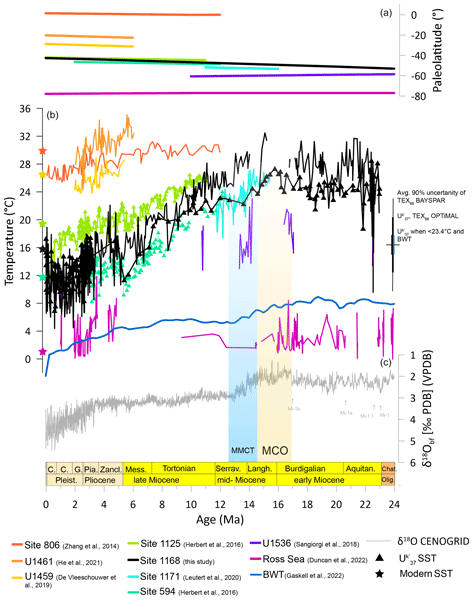
Suning Hou, Foteini Lamprou, Frida S. Hoem, Mohammad Rizky Nanda Hadju, Francesca Sangiorgi, Francien Peterse, and Peter K. Bijl
Clim. Past, 19, 787–802, https://doi.org/10.5194/cp-19-787-2023, https://doi.org/10.5194/cp-19-787-2023, 2023
Short summary
Short summary
Neogene climate cooling is thought to be accompanied by increased Equator-to-pole temperature gradients, but mid-latitudes are poorly represented. We use biomarkers to reconstruct a 23 Myr continuous sea surface temperature record of the mid-latitude Southern Ocean. We note a profound mid-latitude cooling which narrowed the latitudinal temperature gradient with the northward expansion of subpolar conditions. We surmise that this reflects the strengthening of the ACC and the expansion of sea ice.
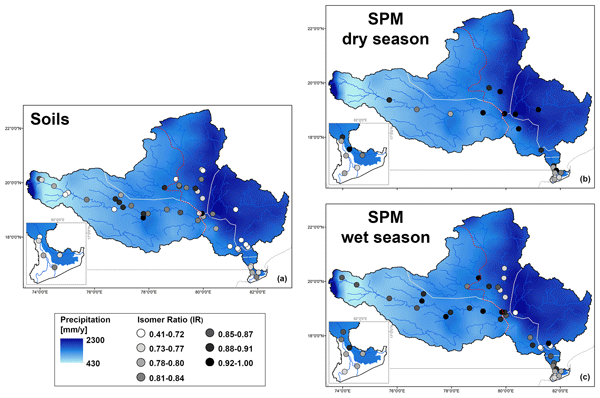
Frédérique M. S. A. Kirkels, Huub M. Zwart, Muhammed O. Usman, Suning Hou, Camilo Ponton, Liviu Giosan, Timothy I. Eglinton, and Francien Peterse
Biogeosciences, 19, 3979–4010, https://doi.org/10.5194/bg-19-3979-2022, https://doi.org/10.5194/bg-19-3979-2022, 2022
Short summary
Short summary
Soil organic carbon (SOC) that is transferred to the ocean by rivers forms a long-term sink of atmospheric CO2 upon burial on the ocean floor. We here test if certain bacterial membrane lipids can be used to trace SOC through the monsoon-fed Godavari River basin in India. We find that these lipids trace the mobilisation and transport of SOC in the wet season but that these lipids are not transferred far into the sea. This suggests that the burial of SOC on the sea floor is limited here.
Huw Joseph Horgan, Andrew Robert Gorman, J. Paul Winberry, Sridhar Anandakrishnan, Howard Conway, Gavin B. Dunbar, Tina van de Flierdt, Denise K. Kulhanek, Richard H. Levy, Molly O. Patterson, and Ilaria Santin
Earth Syst. Sci. Data Discuss., https://doi.org/10.5194/essd-2026-723, https://doi.org/10.5194/essd-2026-723, 2026
Preprint under review for ESSD
Short summary
Short summary
Knowledge of the past and future of Earth's ice sheets requires us to image beneath the ice surface and into the ice, water, sediment, and rock that lies beneath. An effective way of doing this uses active source seismology. Here we present active source seismic data imaging a diverse range of subglacial environments including subglacial lakes, sub-ice ocean cavities, and geological archives preserving the history of the ice sheets.
Alexandra Auderset, Xiaoqing Liu, Neeraj S. Shah, Sarah J. Feakins, Francesca Sangiorgi, Amelia Shevenell, Kasia K. Śliwińska, Appy Sluijs, Evi Wubben, Yi Ge Zhang, Sevasti Modestou, Sindia Sosdian, and Ann Holbourn
Earth Syst. Sci. Data Discuss., https://doi.org/10.5194/essd-2026-711, https://doi.org/10.5194/essd-2026-711, 2026
Preprint under review for ESSD
Short summary
Short summary
Climate models struggle to reproduce Miocene (23–5.3 million years ago) ocean temperatures, a period when CO2 levels overlapped near-future projections. Understanding this model–data mismatch requires evaluating available temperature records and uncertainties. We compiled MioTEX, a standardized global dataset of Miocene ocean temperatures from 46 sites using the TEX86 proxy. Calibration choices influence absolute temperatures. MioTEX is freely accessible via an interactive web platform.
Sindia M. Sosdian, Alexandra Auderset, Sevasti Modestou, Ann Holbourn, Flavia Boscolo-Galazzo, Anna Joy Drury, Anya V. Hess, Karlos G. D. Kochhann, Diederik Liebrand, Xiaoqing Liu, Jared Nirenberg, Neeraj S. Shah, Deborah Tangunan, Gerald Auer, Marcus P. S. Badger, Clara Bolton, Alexander Clark, Anya Crocker, David Evans, Sarah Feakins, Timothy Herbert, Emily Judd, Jennifer Kasbohm, David King, Wout Krijgsman, Wolfgang Kuhnt, Kira Lawrence, Caroline H. Lear, Kim Marshall-Mills, Erin McClymont, Nele Meckler, Paul Minton, Katrina Nilsson-Kerr, Diana Ochoa, Marci Robinson, Thamizharasan Sakthivel, Francesca Sangiorgi, Amelia E. Shevenell, Weimin Si, Elizabeth Sibert, Kasia K. Sliwinska, Appy Sluijs, Heather Stoll, Victoria Taylor, Tim van Peer, Bridget Wade, Thomas Westerhold, Evi Wubben, Yige Zhang, and Martin Ziegler
Earth Syst. Sci. Data Discuss., https://doi.org/10.5194/essd-2026-699, https://doi.org/10.5194/essd-2026-699, 2026
Preprint under review for ESSD
Short summary
Short summary
The MioOcean database hosts Miocene (23–5.3 million years ago) ocean temperatures, standardised and with updated age information, comprising 22,941 data points from 101 scientific studies. As parts of the Miocene were warmer than present, with estimated CO2 levels similar to those projected for the near future, this database enables assessment of how past oceans responded to climate variations, which may improve predictions of climate responses to anticipated future warming.
Cecile Sofie Hilgen, Gert-Jan Reichart, Wim Boer, Marcel T. J. van der Meer, Francesca Sangiorgi, and Rick Hennekam
EGUsphere, https://doi.org/10.5194/egusphere-2026-5785, https://doi.org/10.5194/egusphere-2026-5785, 2026
This preprint is open for discussion and under review for Climate of the Past (CP).
Short summary
Short summary
Marine algae growth in the surface ocean, so-called net primary productivity, is an important process to remove CO2 from Earth's atmosphere. Therefore, scientists are interested in ways to reconstruct this productivity in the past. We tested a relatively new method using organic bromine to reconstruct this productivity in a broad range of marine settings. We show that this method can be used to produce high-resolution estimates of marine productivity in the past.
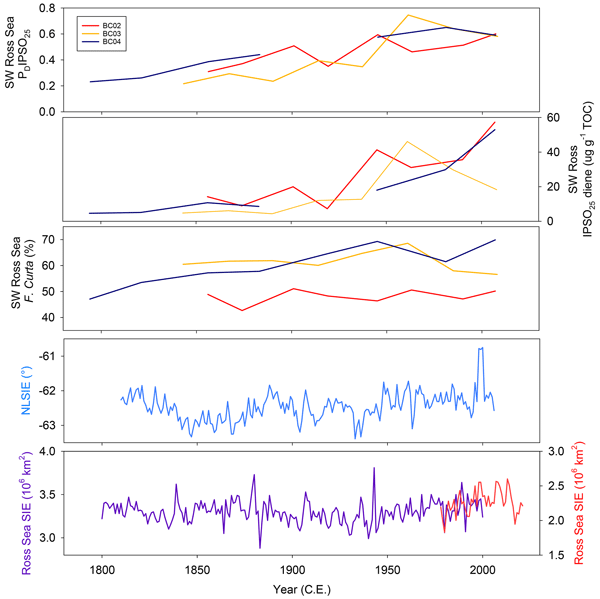
Emma M. de Jong, Xavier Crosta, Sebastian Naeher, Bella Duncan, Johan Etourneau, Jae Il Lee, Robert McKay, and V. Holly L. Winton
Biogeosciences, 23, 6979–7008, https://doi.org/10.5194/bg-23-6979-2026, https://doi.org/10.5194/bg-23-6979-2026, 2026
Short summary
Short summary
This study examines chemical and biological traces (biomarkers) of microscopic algae in Antarctic sediments. We show how sea ice conditions and different phytoplankton communities influence the types of biomarkers preserved on the seafloor, and how these records reveal an overall increase in sea ice duration in the Ross Sea over the past 200 years.
Simon M. Schad, Denise K. Kulhanek, Jiří Bárta, Stella Z. Buchwald, Sten-Andreas Grundvåg, William J. Foster, Mads E. Jelby, Morgan T. Jones, Luke Marsden, Sverre Planke, Kasia K. Śliwińska, Aleksandra Smyrak-Sikora, Lidya G. Tarhan, Madeleine L. Vickers, Valentin Zuchuat, and Kim Senger
Earth Syst. Sci. Data Discuss., https://doi.org/10.5194/essd-2026-487, https://doi.org/10.5194/essd-2026-487, 2026
Preprint under review for ESSD
Short summary
Short summary
This study gathers ancient climate data from Svalbard, a Norwegian Arctic archipelago. Its rocks preserve a 540-million-year record of major extinctions and warming events. Researchers compiled scattered data into organized, open-access packages covering chemical markers and fossils. These resources help scientists understand Arctic responses to rapid climate change, which is vital for improving future predictions and supporting new research.
Natalie J. Burls, Nicky M. Wright, R. Paul Acosta, Catherine D. Bradshaw, Edward Gasson, Lennert B. Stap, Gilles Ramstein, Anna Ruth W. Halberstadt, Agatha M. De Boer, Funda Akgün, David J. Cantrill, Manuel Casas-Gallego, Nela Doláková, Boglarka Erdei, Alex Farnsworth, Sarah Feakins, Ran Feng, Tamara Fletcher, Frédéric Fluteau, J. A. Mattias Green, Anna S. von der Heydt, Matthew Huber, David K. Hutchinson, Dimiter Ivanov, Mine Sezgül Kayseri-Özer, Gregor Knorr, Marianna Kováčová, Caroline H. Lear, Allegra N. LeGrande, Shufeng Li, Xiaoqing Liu, Daniel J. Lunt, Katrin Meissner, Yunfa Miao, Trusha J. Naik, Javier B. Navarro, Joseph B. Novak, Diana Ochoa, Guy J.G. Paxman, Matthew J. Pound, James W. B. Rae, Tammo Reichgelt, Martin Renoult, Francesca Sangiorgi, Anta-Clarisse Sarr, Diane Segalla, Pierre Sepulchre, Amelia Shevenell, Sebastian Steinig, Eivind Straume, Caroline A. E. Strömberg, Clay Tabor, Torsten Utescher, Julia E. Weiffenbach, Elżbieta Worobiec, Yurui Zhang, Feng Zhu, Jiang Zhu, Alexandra Auderset, Florence Colleoni, Aisling Dolan, Rachel Havranek, Ann Holbourn, Nicholas Herold, Daeun Lee, James W. Marschalek, Bryce Mitsunaga, Sevi Modestou, Lina Perez-Angel, Mae Saslaw, Sinda Sosdian, Elena Stiles, Yong Sun, Ning Tan, Zhongshi Zhang, and Yan Zhao
EGUsphere, https://doi.org/10.5194/egusphere-2026-3595, https://doi.org/10.5194/egusphere-2026-3595, 2026
Short summary
Short summary
Simulating warm paleoclimates increases our understanding of the mechanisms that drive climatic change and tipping points. The Miocene Epoch, specifically the Miocene Climatic Optimum, has been identified as a particularly valuable past warm climate to simulate, meriting the design of a coordinated Miocene Model Intercomparison Project. Here we synthesize the latest available literature and present the experimental design for coordinated Miocene simulations and sensitivity studies.
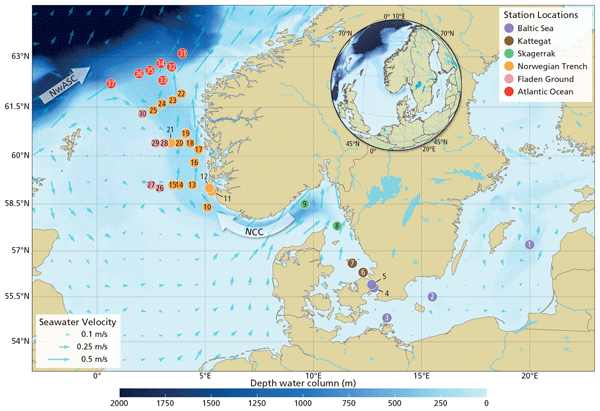
Cecile S. Hilgen, Rick Hennekam, Marcel T. J. van der Meer, Timme H. Donders, Gert-Jan Reichart, and Francesca Sangiorgi
J. Micropalaeontol., 45, 275–295, https://doi.org/10.5194/jm-45-275-2026, https://doi.org/10.5194/jm-45-275-2026, 2026
Short summary
Short summary
The Northwest European Shelf plays a key role in the global carbon cycle. To assess its past role, we want to reconstruct primary productivity using microfossils. By comparing surface sediment assemblages with sediment properties and modern environmental conditions, we found a good microfossil-based indicator for primary productivity. This indicator will be useful to reconstruct productivity in the past Northwest European Shelf.
Thibault Sutre, Johan Etourneau, Xavier Crosta, Nanako O. Ogawa, Robert McKay, Hisami Suga, Naohiko Ohkouchi, and Carlota Escutia
EGUsphere, https://doi.org/10.5194/egusphere-2026-1897, https://doi.org/10.5194/egusphere-2026-1897, 2026
Short summary
Short summary
Antarctic coastal waters are highly productive, but long-term changes in nutrient supply remain poorly understood. We present the first 2,000-year record of nitrogen isotopes in chlorophyll from Adélie Land, East Antarctica, to reconstruct this part of the nutrient cycle. The results suggest that changes in sea ice and climate influenced the supply of nitrate-rich deep waters and marine phytoplankton productivity.
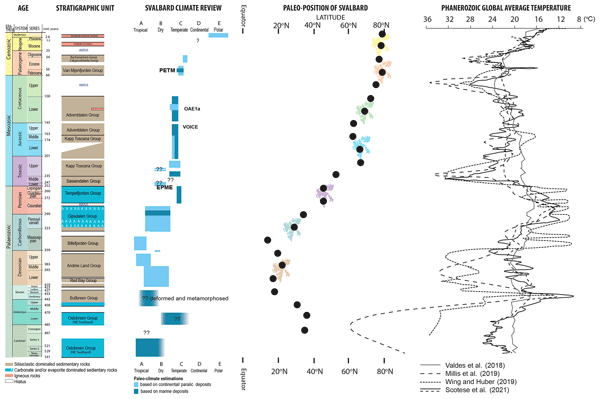
Aleksandra Smyrak-Sikora, Peter Betlem, Victoria S. Engelschiøn, William J. Foster, Sten-Andreas Grundvåg, Mads E. Jelby, Morgan T. Jones, Grace E. Shephard, Kasia K. Śliwińska, Madeleine L. Vickers, Valentin Zuchuat, Lars Eivind Augland, Jan Inge Faleide, Jennifer M. Galloway, William Helland-Hansen, Maria A. Jensen, Erik P. Johannessen, Maayke Koevoets, Denise Kulhanek, Gareth S. Lord, Tereza Mosociova, Snorre Olaussen, Sverre Planke, Gregory D. Price, Lars Stemmerik, and Kim Senger
Clim. Past, 21, 2133–2187, https://doi.org/10.5194/cp-21-2133-2025, https://doi.org/10.5194/cp-21-2133-2025, 2025
Short summary
Short summary
In this review article we present Svalbard’s unique geological archive, revealing its climate history over the last 540 million years. We uncover how this Arctic region recorded key global events, including the End-Permian Mass Extinction, and climate crises like the Paleocene–Eocene Thermal Maximum. The overall climate trend recorded in sedimentary successions in Svalbard is discussed in the context of global climate fluctuations and continuous drift of Svalbard from near equatorial to Arctic latitudes.
Suning Hou, Leonie Toebrock, Mart van der Linden, Fleur Rothstegge, Martin Ziegler, Lucas J. Lourens, and Peter K. Bijl
Clim. Past, 21, 79–93, https://doi.org/10.5194/cp-21-79-2025, https://doi.org/10.5194/cp-21-79-2025, 2025
Short summary
Short summary
Based on dinoflagellate cyst assemblages and sea surface temperature records west of offshore Tasmania, we find a northward migration and freshening of the subtropical front, not at the M2 glacial maximum but at its deglaciation phase. This oceanographic change aligns well with trends in pCO2. We propose that iceberg discharge from the M2 deglaciation freshened the subtropical front, which together with the other oceanographic changes affected atmosphere–ocean CO2 exchange in the Southern Ocean.
Bella J. Duncan, Robert McKay, Richard Levy, Joseph G. Prebble, Timothy Naish, Osamu Seki, Christoph Kraus, Heiko Moossen, G. Todd Ventura, Denise K. Kulhanek, and James Bendle
EGUsphere, https://doi.org/10.5194/egusphere-2024-4021, https://doi.org/10.5194/egusphere-2024-4021, 2025
Preprint archived
Short summary
Short summary
We use plant wax compound specific stable isotopes to investigate how ancient Antarctic vegetation adapted to glacial conditions 23 million years ago. We find plants became less water efficient to prioritise photosynthesis during short, harsh growing seasons. Ecosystem changes also included enhanced aridity, and a shift to a stunted, low elevation vegetation. This shows the adaptability of ancient Antarctic vegetation under atmospheric CO2 conditions comparable to modern.
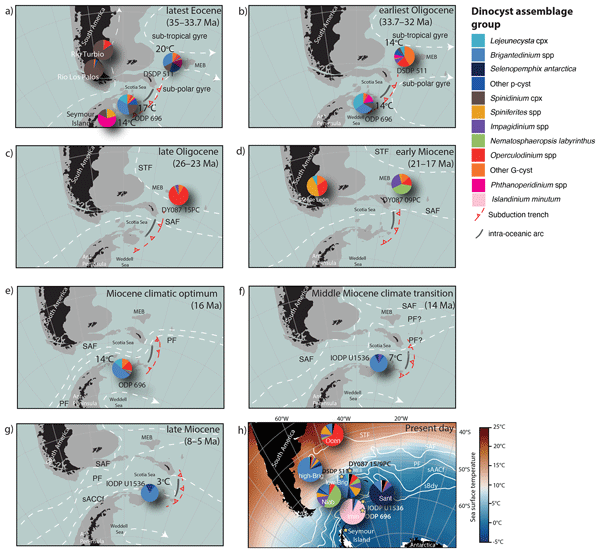
Frida S. Hoem, Karlijn van den Broek, Adrián López-Quirós, Suzanna H. A. van de Lagemaat, Steve M. Bohaty, Claus-Dieter Hillenbrand, Robert D. Larter, Tim E. van Peer, Henk Brinkhuis, Francesca Sangiorgi, and Peter K. Bijl
J. Micropalaeontol., 43, 497–517, https://doi.org/10.5194/jm-43-497-2024, https://doi.org/10.5194/jm-43-497-2024, 2024
Short summary
Short summary
The timing and impact of onset of Antarctic Circumpolar Current (ACC) on climate and Antarctic ice are unclear. We reconstruct late Eocene to Miocene southern Atlantic surface ocean environment using microfossil remains of dinoflagellates (dinocysts). Our dinocyst records shows the breakdown of subpolar gyres in the late Oligocene and the transition into a modern-like oceanographic regime with ACC flow, established frontal systems, Antarctic proximal cooling, and sea ice by the late Miocene.
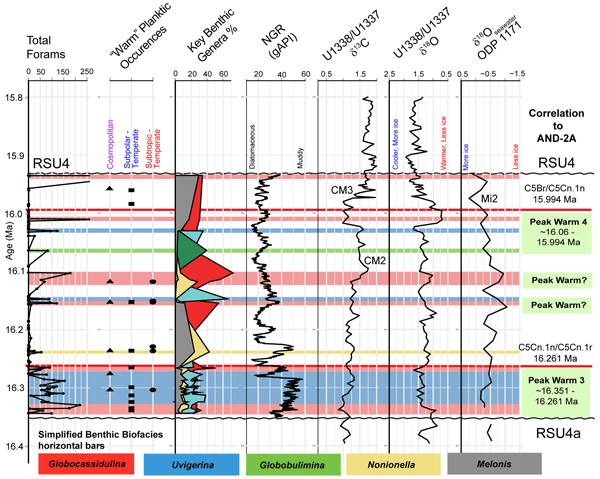
Samantha E. Bombard, R. Mark Leckie, Imogen M. Browne, Amelia E. Shevenell, Robert M. McKay, David M. Harwood, and the IODP Expedition 374 Scientists
J. Micropalaeontol., 43, 383–421, https://doi.org/10.5194/jm-43-383-2024, https://doi.org/10.5194/jm-43-383-2024, 2024
Short summary
Short summary
The Ross Sea record of the Miocene Climatic Optimum (~16.9–14.7 Ma) and the Middle Miocene Climate Transition (~14.7–13.8 Ma) can provide critical insights into the Antarctic ocean–cryosphere system during an ancient time of extreme warmth and subsequent cooling. Benthic foraminifera inform us about water masses, currents, and glacial conditions in the Ross Sea, and planktic foram invaders can inform us of when warm waters melted the Antarctic Ice Sheet in the past.
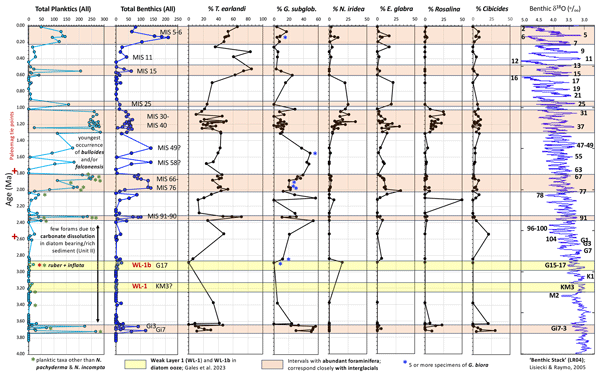
Julia L. Seidenstein, R. Mark Leckie, Robert McKay, Laura De Santis, David Harwood, and IODP Expedition 374 Scientists
J. Micropalaeontol., 43, 211–238, https://doi.org/10.5194/jm-43-211-2024, https://doi.org/10.5194/jm-43-211-2024, 2024
Short summary
Short summary
Warmer waters in the Southern Ocean have led to the loss of Antarctic ice during past interglacial times. The shells of foraminifera are preserved in Ross Sea sediment, which is collected in cores. Benthic species from Site U1523 inform us about changing water masses and current activity, including incursions of Circumpolar Deep Water. Warm water planktic species were found in sediment samples from four intervals within 3.72–1.82 million years ago, indicating warmer than present conditions.
Yord W. Yedema, Timme Donders, Francien Peterse, and Francesca Sangiorgi
J. Micropalaeontol., 42, 257–276, https://doi.org/10.5194/jm-42-257-2023, https://doi.org/10.5194/jm-42-257-2023, 2023
Short summary
Short summary
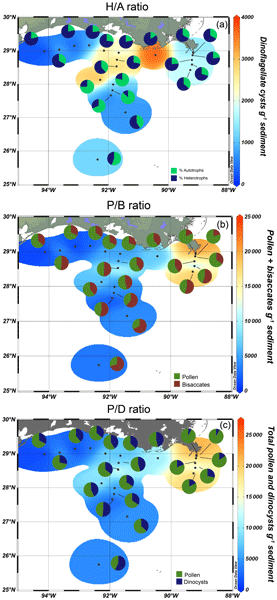
The pollen and dinoflagellate cyst content of 21 surface sediments from the northern Gulf of Mexico is used to test the applicability of three palynological ratios (heterotroph/autotroph, pollen/dinocyst, and pollen/bisaccate ratio) as proxies for marine productivity and distance to the coast/river. Redundancy analysis confirms the suitability of these three ratios, where the H/A ratio can be used as an indicator of primary production, and the P/B ratio best tracks the distance to the coast.
Kim Senger, Denise Kulhanek, Morgan T. Jones, Aleksandra Smyrak-Sikora, Sverre Planke, Valentin Zuchuat, William J. Foster, Sten-Andreas Grundvåg, Henning Lorenz, Micha Ruhl, Kasia K. Sliwinska, Madeleine L. Vickers, and Weimu Xu
Sci. Dril., 32, 113–135, https://doi.org/10.5194/sd-32-113-2023, https://doi.org/10.5194/sd-32-113-2023, 2023
Short summary
Short summary
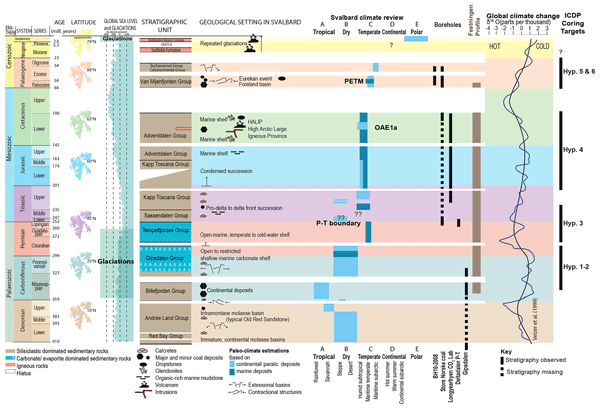
Geologists can decipher the past climates and thus better understand how future climate change may affect the Earth's complex systems. In this paper, we report on a workshop held in Longyearbyen, Svalbard, to better understand how rocks in Svalbard (an Arctic archipelago) can be used to quantify major climatic shifts recorded in the past.
Frida S. Hoem, Adrián López-Quirós, Suzanna van de Lagemaat, Johan Etourneau, Marie-Alexandrine Sicre, Carlota Escutia, Henk Brinkhuis, Francien Peterse, Francesca Sangiorgi, and Peter K. Bijl
Clim. Past, 19, 1931–1949, https://doi.org/10.5194/cp-19-1931-2023, https://doi.org/10.5194/cp-19-1931-2023, 2023
Short summary
Short summary
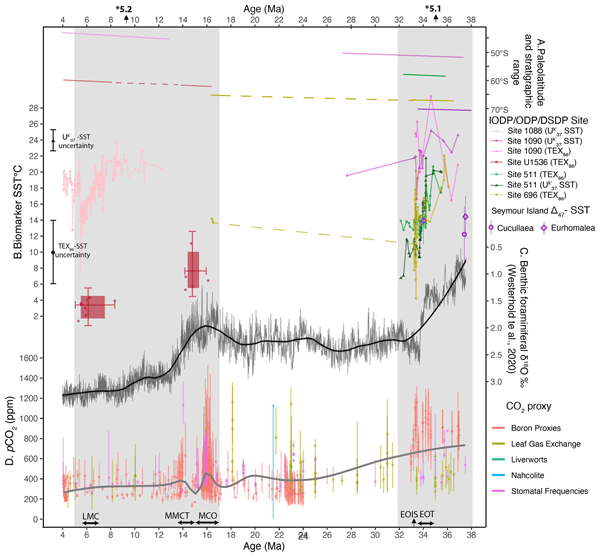
We present two new sea surface temperature (SST) records in comparison with available SST records to reconstruct South Atlantic paleoceanographic evolution. Our results show a low SST gradient in the Eocene–early Oligocene due to the persistent gyral circulation. A higher SST gradient in the Middle–Late Miocene infers a stronger circumpolar current. The southern South Atlantic was the coldest region in the Southern Ocean and likely the main deep-water formation location in the Middle Miocene.
Lena Mareike Thöle, Peter Dirk Nooteboom, Suning Hou, Rujian Wang, Senyan Nie, Elisabeth Michel, Isabel Sauermilch, Fabienne Marret, Francesca Sangiorgi, and Peter Kristian Bijl
J. Micropalaeontol., 42, 35–56, https://doi.org/10.5194/jm-42-35-2023, https://doi.org/10.5194/jm-42-35-2023, 2023
Short summary
Short summary
Dinoflagellate cysts can be used to infer past oceanographic conditions in the Southern Ocean. This requires knowledge of their present-day ecologic affinities. We add 66 Antarctic-proximal surface sediment samples to the Southern Ocean data and derive oceanographic conditions at those stations. Dinoflagellate cysts are clearly biogeographically separated along latitudinal gradients of temperature, sea ice, nutrients, and salinity, which allows us to reconstruct these parameters for the past.
Suning Hou, Foteini Lamprou, Frida S. Hoem, Mohammad Rizky Nanda Hadju, Francesca Sangiorgi, Francien Peterse, and Peter K. Bijl
Clim. Past, 19, 787–802, https://doi.org/10.5194/cp-19-787-2023, https://doi.org/10.5194/cp-19-787-2023, 2023
Short summary
Short summary
Neogene climate cooling is thought to be accompanied by increased Equator-to-pole temperature gradients, but mid-latitudes are poorly represented. We use biomarkers to reconstruct a 23 Myr continuous sea surface temperature record of the mid-latitude Southern Ocean. We note a profound mid-latitude cooling which narrowed the latitudinal temperature gradient with the northward expansion of subpolar conditions. We surmise that this reflects the strengthening of the ACC and the expansion of sea ice.
Yord W. Yedema, Francesca Sangiorgi, Appy Sluijs, Jaap S. Sinninghe Damsté, and Francien Peterse
Biogeosciences, 20, 663–686, https://doi.org/10.5194/bg-20-663-2023, https://doi.org/10.5194/bg-20-663-2023, 2023
Short summary
Short summary
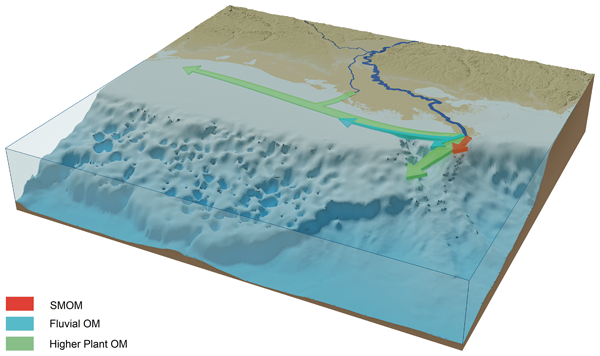
Terrestrial organic matter (TerrOM) is transported to the ocean by rivers, where its burial can potentially form a long-term carbon sink. This burial is dependent on the type and characteristics of the TerrOM. We used bulk sediment properties, biomarkers, and palynology to identify the dispersal patterns of plant-derived, soil–microbial, and marine OM in the northern Gulf of Mexico and show that plant-derived OM is transported further into the coastal zone than soil and marine-produced TerrOM.
Frédérique M. S. A. Kirkels, Huub M. Zwart, Muhammed O. Usman, Suning Hou, Camilo Ponton, Liviu Giosan, Timothy I. Eglinton, and Francien Peterse
Biogeosciences, 19, 3979–4010, https://doi.org/10.5194/bg-19-3979-2022, https://doi.org/10.5194/bg-19-3979-2022, 2022
Short summary
Short summary
Soil organic carbon (SOC) that is transferred to the ocean by rivers forms a long-term sink of atmospheric CO2 upon burial on the ocean floor. We here test if certain bacterial membrane lipids can be used to trace SOC through the monsoon-fed Godavari River basin in India. We find that these lipids trace the mobilisation and transport of SOC in the wet season but that these lipids are not transferred far into the sea. This suggests that the burial of SOC on the sea floor is limited here.
Carolien M. H. van der Weijst, Koen J. van der Laan, Francien Peterse, Gert-Jan Reichart, Francesca Sangiorgi, Stefan Schouten, Tjerk J. T. Veenstra, and Appy Sluijs
Clim. Past, 18, 1947–1962, https://doi.org/10.5194/cp-18-1947-2022, https://doi.org/10.5194/cp-18-1947-2022, 2022
Short summary
Short summary
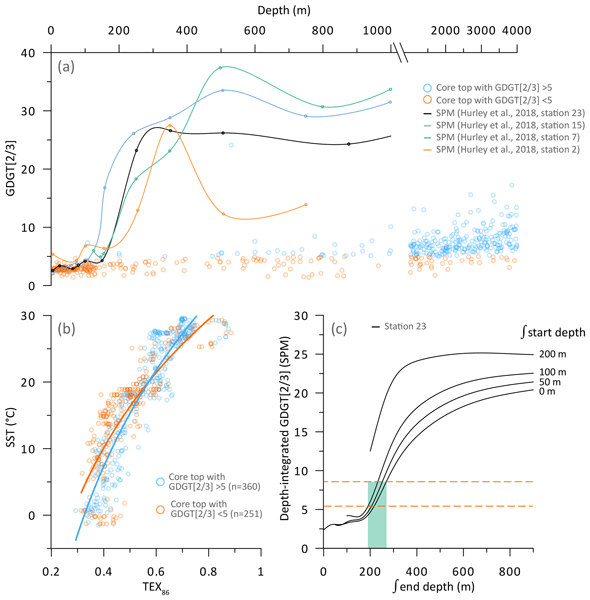
The TEX86 proxy is often used by paleoceanographers to reconstruct past sea-surface temperatures. However, the origin of the TEX86 signal in marine sediments has been debated since the proxy was first proposed. In our paper, we show that TEX86 carries a mixed sea-surface and subsurface temperature signal and should be calibrated accordingly. Using our 15-million-year record, we subsequently show how a TEX86 subsurface temperature record can be used to inform us on past sea-surface temperatures.
Xavier Crosta, Karen E. Kohfeld, Helen C. Bostock, Matthew Chadwick, Alice Du Vivier, Oliver Esper, Johan Etourneau, Jacob Jones, Amy Leventer, Juliane Müller, Rachael H. Rhodes, Claire S. Allen, Pooja Ghadi, Nele Lamping, Carina B. Lange, Kelly-Anne Lawler, David Lund, Alice Marzocchi, Katrin J. Meissner, Laurie Menviel, Abhilash Nair, Molly Patterson, Jennifer Pike, Joseph G. Prebble, Christina Riesselman, Henrik Sadatzki, Louise C. Sime, Sunil K. Shukla, Lena Thöle, Maria-Elena Vorrath, Wenshen Xiao, and Jiao Yang
Clim. Past, 18, 1729–1756, https://doi.org/10.5194/cp-18-1729-2022, https://doi.org/10.5194/cp-18-1729-2022, 2022
Short summary
Short summary
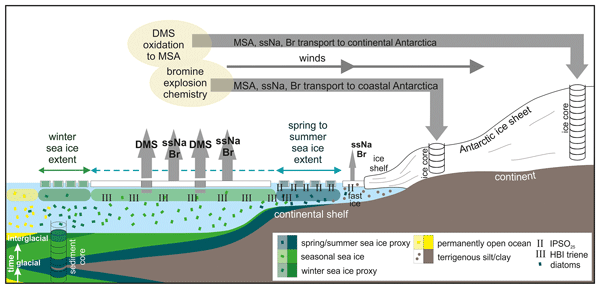
Despite its importance in the global climate, our knowledge of Antarctic sea-ice changes throughout the last glacial–interglacial cycle is extremely limited. As part of the Cycles of Sea Ice Dynamics in the Earth system (C-SIDE) Working Group, we review marine- and ice-core-based sea-ice proxies to provide insights into their applicability and limitations. By compiling published records, we provide information on Antarctic sea-ice dynamics over the past 130 000 years.
Carolien M. H. van der Weijst, Josse Winkelhorst, Wesley de Nooijer, Anna von der Heydt, Gert-Jan Reichart, Francesca Sangiorgi, and Appy Sluijs
Clim. Past, 18, 961–973, https://doi.org/10.5194/cp-18-961-2022, https://doi.org/10.5194/cp-18-961-2022, 2022
Short summary
Short summary
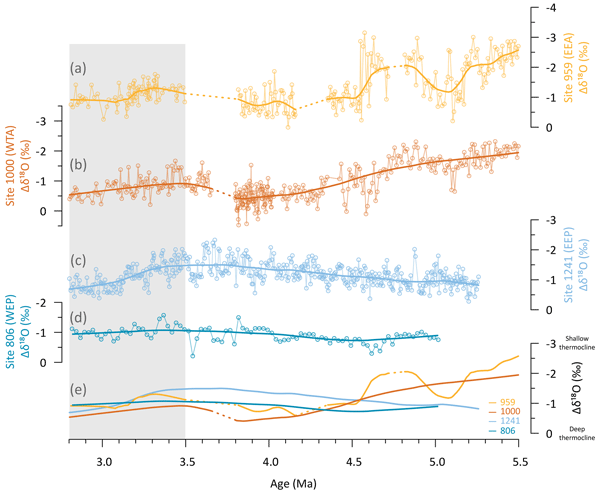
A hypothesized link between Pliocene (5.3–2.5 million years ago) global climate and tropical thermocline depth is currently only backed up by data from the Pacific Ocean. In our paper, we present temperature, salinity, and thermocline records from the tropical Atlantic Ocean. Surprisingly, the Pliocene thermocline evolution was remarkably different in the Atlantic and Pacific. We need to reevaluate the mechanisms that drive thermocline depth, and how these are tied to global climate change.
Molly O. Patterson, Richard H. Levy, Denise K. Kulhanek, Tina van de Flierdt, Huw Horgan, Gavin B. Dunbar, Timothy R. Naish, Jeanine Ash, Alex Pyne, Darcy Mandeno, Paul Winberry, David M. Harwood, Fabio Florindo, Francisco J. Jimenez-Espejo, Andreas Läufer, Kyu-Cheul Yoo, Osamu Seki, Paolo Stocchi, Johann P. Klages, Jae Il Lee, Florence Colleoni, Yusuke Suganuma, Edward Gasson, Christian Ohneiser, José-Abel Flores, David Try, Rachel Kirkman, Daleen Koch, and the SWAIS 2C Science Team
Sci. Dril., 30, 101–112, https://doi.org/10.5194/sd-30-101-2022, https://doi.org/10.5194/sd-30-101-2022, 2022
Short summary
Short summary
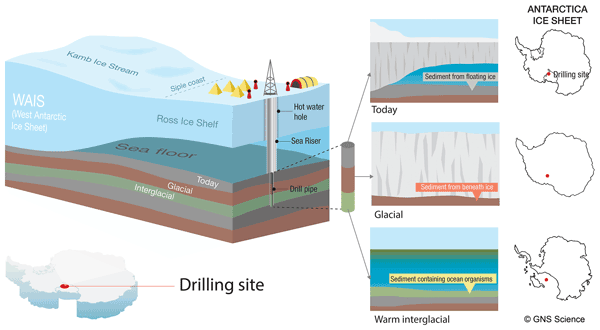
How much of the West Antarctic Ice Sheet will melt and how quickly it will happen when average global temperatures exceed 2 °C is currently unknown. Given the far-reaching and international consequences of Antarctica’s future contribution to global sea level rise, the SWAIS 2C Project was developed in order to better forecast the size and timing of future changes.
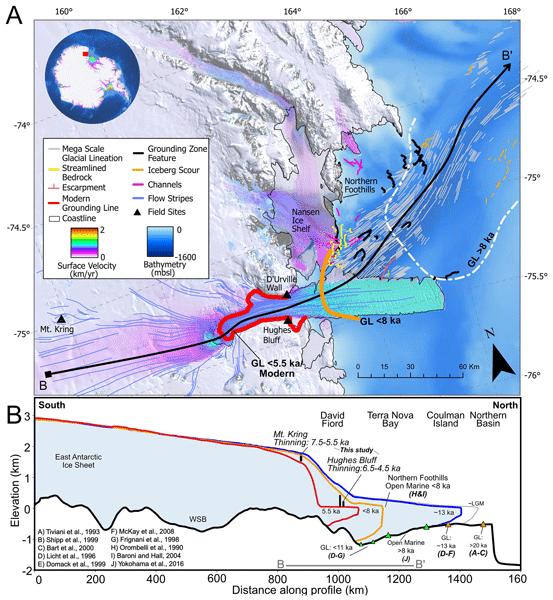
Jamey Stutz, Andrew Mackintosh, Kevin Norton, Ross Whitmore, Carlo Baroni, Stewart S. R. Jamieson, Richard S. Jones, Greg Balco, Maria Cristina Salvatore, Stefano Casale, Jae Il Lee, Yeong Bae Seong, Robert McKay, Lauren J. Vargo, Daniel Lowry, Perry Spector, Marcus Christl, Susan Ivy Ochs, Luigia Di Nicola, Maria Iarossi, Finlay Stuart, and Tom Woodruff
The Cryosphere, 15, 5447–5471, https://doi.org/10.5194/tc-15-5447-2021, https://doi.org/10.5194/tc-15-5447-2021, 2021
Short summary
Short summary
Understanding the long-term behaviour of ice sheets is essential to projecting future changes due to climate change. In this study, we use rocks deposited along the margin of the David Glacier, one of the largest glacier systems in the world, to reveal a rapid thinning event initiated over 7000 years ago and endured for ~ 2000 years. Using physical models, we show that subglacial topography and ocean heat are important drivers for change along this sector of the Antarctic Ice Sheet.
Cited articles
Acosta, R. P., Burls, N. J., Pound, M. J., Bradshaw, C. D., De Boer, A. M., Herold, N., Huber, M., Liu, X., Donnadieu, Y., Farnsworth, A., Frigola, A., Lunt, D. J., von der Heydt, A. S., Hutchinson, D. K., Knorr, G., Lohmann, G., Marzocchi, A., Prange, M., Sarr, A. C., Li, X., and Zhang, Z.: A Model-Data Comparison of the Hydrological Response to Miocene Warmth: Leveraging the MioMIP1 Opportunistic Multi-Model Ensemble, Paleoceanogr. Paleoclimatol., 39, e2023PA004726, https://doi.org/10.1029/2023PA004726, 2024.
Askin, R. A.: Spores and Pollen from the Mcmurdo Sound Erratics, Antarctica, in: Paleobiology and Paleoenvironments of Eocene Rocks: McMurdo Sound, East Antarctica, American Geophysical Union (AGU), 161–181, https://agupubs.onlinelibrary.wiley.com/doi/epdf/10.1029/AR076p0161 (last access: 26 November 2026), 2000.
Askin, R. A. and Raine, J. I.: Oligocene and early Miocene terrestrial palynology of the Cape Roberts drillhole CRP-2/2A, Victoria Land Basin, Antarctica, Terra Antartica, 7, 493–501, 2000.
Auderset, A., Moretti, S., Taphorn, B., Ebner, P.-R., Kast, E., Wang, X. T., Schiebel, R., Sigman, D. M., Haug, G. H., and Martínez-García, A.: Enhanced ocean oxygenation during Cenozoic warm periods, Nature, 609, 77–82, https://doi.org/10.1038/s41586-022-05017-0, 2022.
Bijl, P. K., Houben, A. J. P., Hartman, J. D., Pross, J., Salabarnada, A., Escutia, C., and Sangiorgi, F.: Paleoceanography and ice sheet variability offshore Wilkes Land, Antarctica – Part 2: Insights from Oligocene–Miocene dinoflagellate cyst assemblages, Clim. Past, 14, 1015–1033, https://doi.org/10.5194/cp-14-1015-2018, 2018.
Bombard, S. E., Leckie, R. M., Browne, I. M., Shevenell, A. E., McKay, R. M., Harwood, D. M., and the IODP Expedition 374 Scientists: Miocene Climatic Optimum and Middle Miocene Climate Transition: a foraminiferal record from the central Ross Sea, Antarctica, J. Micropalaeontol., 43, 383–421, https://doi.org/10.5194/jm-43-383-2024, 2024.
Bradshaw, C. D., Langebroek, P. M., Lear, C. H., Lunt, D. J., Coxall, H. K., Sosdian, S. M., and de Boer, A. M.: Hydrological impact of Middle Miocene Antarctic ice-free areas coupled to deep ocean temperatures, Nat. Geosci., 14, 429–436, https://doi.org/10.1038/s41561-021-00745-w, 2021.
Burls, N. J., Bradshaw, C. D., De Boer, A. M., Herold, N., Huber, M., Pound, M., Donnadieu, Y., Farnsworth, A., Frigola, A., Gasson, E., von der Heydt, A. S., Hutchinson, D. K., Knorr, G., Lawrence, K. T., Lear, C. H., Li, X., Lohmann, G., Lunt, D. J., Marzocchi, A., Prange, M., Riihimaki, C. A., Sarr, A. -C., Siler, N., and Zhang, Z.: Simulating Miocene Warmth: Insights From an Opportunistic Multi-Model Ensemble (MioMIP1), Paleoceanogr. Paleoclimatol., 36, https://doi.org/10.1029/2020PA004054, 2021.
CENCO2PIP CONSORTIUM: Toward a Cenozoic history of atmospheric CO2, Science, 382, eadi5177, https://doi.org/10.1126/science.adi5177, 2023.
Colleoni, F., De Santis, L., Montoli, E., Olivo, E., Sorlien, C. C., Bart, P. J., Gasson, E. G. W., Bergamasco, A., Sauli, C., Wardell, N., and Prato, S.: Past continental shelf evolution increased Antarctic ice sheet sensitivity to climatic conditions, Sci. Rep., 8, 11323, https://doi.org/10.1038/s41598-018-29718-7, 2018.
Duncan, B., McKay, R., Levy, R., Naish, T., Prebble, J. G., Sangiorgi, F., Krishnan, S., Hoem, F., Clowes, C., Dunkley Jones, T., Gasson, E., Kraus, C., Kulhanek, D. K., Meyers, S. R., Moossen, H., Warren, C., Willmott, V., Ventura, G. T., and Bendle, J.: Climatic and tectonic drivers of late Oligocene Antarctic ice volume, Nat. Geosci., 15, 819–825, https://doi.org/10.1038/s41561-022-01025-x, 2022.
Dunkley Jones, T., Eley, Y. L., Thomson, W., Greene, S. E., Mandel, I., Edgar, K., and Bendle, J. A.: OPTiMAL: a new machine learning approach for GDGT-based palaeothermometry, Clim. Past, 16, 2599–2617, https://doi.org/10.5194/cp-16-2599-2020, 2020.
Eayrs, C., Li, X., Raphael, M. N., and Holland, D. M.: Rapid decline in Antarctic sea ice in recent years hints at future change, Nat. Geosci., 14, 460–464, https://doi.org/10.1038/s41561-021-00768-3, 2021.
Feakins, S. J., Warny, S., and Lee, J.-E.: Hydrologic cycling over Antarctica during the middle Miocene warming, Nat. Geosci., 5, 557–560, https://doi.org/10.1038/ngeo1498, 2012.
Griener, K. W., Warny, S., Askin, R., and Acton, G.: Early to middle Miocene vegetation history of Antarctica supports eccentricity-paced warming intervals during the Antarctic icehouse phase, Global Planet. Change, 127, 67–78, https://doi.org/10.1016/j.gloplacha.2015.01.006, 2015.
Hannah, M. J.: The palynology of ODP site 1165, Prydz Bay, East Antarctica: A record of Miocene glacial advance and retreat, Palaeogeogr. Palaeoclim., 231, 120–133, https://doi.org/10.1016/j.palaeo.2005.07.029, 2006.
Hannah, M. J., Wrenn, J. H., and Wilson, G. J.: Preliminary Report on Early Oligocene and Latest Eocene Marine Palynomorphs from CRP-3 Drillhole, Victoria Land Basin, Antarctica, Terra Antartica, 8, 383–388, 2001.
Harland, R., Pudsey, C. J., Howe, J. A., and Fitzpatrick, M. E. J.: Recent dinoflagellate cysts in a transect from the Falkland trough to the Weddell Sea, Antarctica, Palaeontology, 41, 1093–1131, 1998.
Holbourn, A., Kuhnt, W., Clemens, S., Prell, W., and Andersen, N.: Middle to late Miocene stepwise climate cooling: Evidence from a high-resolution deep water isotope curve spanning 8 million years: MIOCENE BENTHIC ISOTOPES, Paleoceanography, 28, 688–699, https://doi.org/10.1002/2013PA002538, 2013.
Holbourn, A., Kuhnt, W., Kulhanek, D. K., Mountain, G., Rosenthal, Y., Sagawa, T., Lübbers, J., and Andersen, N.: Re-organization of Pacific overturning circulation across the Miocene Climate Optimum, Nat. Commun., 15, 8135, https://doi.org/10.1038/s41467-024-52516-x, 2024.
Hou, S., Lamprou, F., Hoem, F. S., Hadju, M. R. N., Sangiorgi, F., Peterse, F., and Bijl, P. K.: Lipid-biomarker-based sea surface temperature record offshore Tasmania over the last 23 million years, Clim. Past, 19, 787–802, https://doi.org/10.5194/cp-19-787-2023, 2023a.
Hou, S., Stap, L. B., Paul, R., Nelissen, M., Hoem, F. S., Ziegler, M., Sluijs, A., Sangiorgi, F., and Bijl, P. K.: Reconciling Southern Ocean fronts equatorward migration with minor Antarctic ice volume change during Miocene cooling, Nat. Commun., 14, 7230, https://doi.org/10.1038/s41467-023-43106-4, 2023b.
Ishii, H., Seki, O., Yamamoto, M., and Duncan, B.: New isoprenoid GDGT index as a water mass and temperature proxy in the Southern Ocean, Clim. Past, 22, 585–604, https://doi.org/10.5194/cp-22-585-2026, 2026.
Kellner, L., Dybkjær, K., Piasecki, S., Fredborg, J., Peterse, F., Rasmussen, E. S., Vieira, M., Castro, L., and Śliwińska, K. K.: Early to Middle Miocene in the North Sea Basin: proxy-based insights into environment, depositional settings and sea surface temperature evolution, J. Micropalaeontol., 44, 509–539, https://doi.org/10.5194/jm-44-509-2025, 2025.
Kim, J.-H., van der Meer, J., Schouten, S., Helmke, P., Willmott, V., Sangiorgi, F., Koç, N., Hopmans, E. C., and Damsté, J. S. S.: New indices and calibrations derived from the distribution of crenarchaeal isoprenoid tetraether lipids: Implications for past sea surface temperature reconstructions, Geochim. Cosmochim. Ac., 74, 4639–4654, https://doi.org/10.1016/j.gca.2010.05.027, 2010.
Leutert, T. J., Modestou, S., Bernasconi, S. M., and Meckler, A. N.: Southern Ocean bottom-water cooling and ice sheet expansion during the middle Miocene climate transition, Clim. Past, 17, 2255–2271, https://doi.org/10.5194/cp-17-2255-2021, 2021.
Levy, R., Harwood, D., Florindo, F., Sangiorgi, F., Tripati, R., von Eynatten, H., Gasson, E., Kuhn, G., Tripati, A., DeConto, R., Fielding, C., Field, B., Golledge, N., McKay, R., Naish, T., Olney, M., Pollard, D., Schouten, S., Talarico, F., Warny, S., Willmott, V., Acton, G., Panter, K., Paulsen, T., Taviani, M., SMS Science Team, Acton, G., Askin, R., Atkins, C., Bassett, K., Beu, A., Blackstone, B., Browne, G., Ceregato, A., Cody, R., Cornamusini, G., Corrado, S., DeConto, R., Del Carlo, P., Di Vincenzo, G., Dunbar, G., Falk, C., Field, B., Fielding, C., Florindo, F., Frank, T., Giorgetti, G., Grelle, T., Gui, Z., Handwerger, D., Hannah, M., Harwood, D. M., Hauptvogel, D., Hayden, T., Henrys, S., Hoffmann, S., Iacoviello, F., Ishman, S., Jarrard, R., Johnson, K., Jovane, L., Judge, S., Kominz, M., Konfirst, M., Krissek, L., Kuhn, G., Lacy, L., Levy, R., Maffioli, P., Magens, D., Marcano, M. C., Millan, C., Mohr, B., Montone, P., Mukasa, S., Naish, T., Niessen, F., Ohneiser, C., Olney, M., Panter, K., Passchier, S., Patterson, M., Paulsen, T., Pekar, S., Pierdominici, S., Pollard, D., Raine, I., Reed, J., Reichelt, L., Riesselman, C., Rocchi, S., Sagnotti, L., Sandroni, S., Sangiorgi, F., Schmitt, D., Speece, M., Storey, B., Strada, E., Talarico, F., Taviani, M., Tuzzi, E., Verosub, K., von Eynatten, H., Warny, S., Wilson, G., Wilson, T., Wonik, T., and Zattin, M.: Antarctic ice sheet sensitivity to atmospheric CO2 variations in the early to mid-Miocene, P. Natl. Acad. Sci. USA, 113, 3453–3458, https://doi.org/10.1073/pnas.1516030113, 2016.
Li, Q., England, M. H., Hogg, A. M., Rintoul, S. R., and Morrison, A. K.: Abyssal ocean overturning slowdown and warming driven by Antarctic meltwater, Nature, 615, 841–847, https://doi.org/10.1038/s41586-023-05762-w, 2023a.
Li, Z., Zhang, Y. G., Torres, M., and Mills, B. J. W.: Neogene burial of organic carbon in the global ocean, Nature, 613, 90–95, https://doi.org/10.1038/s41586-022-05413-6, 2023b.
Lowry, D. P., Han, H. K., Golledge, N. R., Gomez, N., Johnson, K. M., and McKay, R. M.: Ocean cavity regime shift reversed West Antarctic grounding line retreat in the late Holocene, Nat. Commun., 15, 3176, https://doi.org/10.1038/s41467-024-47369-3, 2024.
Marret, F., Bradley, L., de Vernal, A., Hardy, W., Kim, S.-Y., Mudie, P., Penaud, A., Pospelova, V., Price, A. M., Radi, T., and Rochon, A.: From bi-polar to regional distribution of modern dinoflagellate cysts, an overview of their biogeography, Mar. Micropaleontol., 159, 101753, https://doi.org/10.1016/j.marmicro.2019.101753, 2020.
Marschalek, J. W., Zurli, L., Talarico, F., van de Flierdt, T., Vermeesch, P., Carter, A., Beny, F., Bout-Roumazeilles, V., Sangiorgi, F., Hemming, S. R., Pérez, L. F., Colleoni, F., Prebble, J. G., van Peer, T. E., Perotti, M., Shevenell, A. E., Browne, I., Kulhanek, D. K., Levy, R., Harwood, D., Sullivan, N. B., Meyers, S. R., Griffith, E. M., Hillenbrand, C.-D., Gasson, E., Siegert, M. J., Keisling, B., Licht, K. J., Kuhn, G., Dodd, J. P., Boshuis, C., De Santis, L., and McKay, R. M.: A large West Antarctic Ice Sheet explains early Neogene sea-level amplitude, Nature, 600, 450–455, https://doi.org/10.1038/s41586-021-04148-0, 2021.
McKay, R., Cockrell, J., Shevenell, A. E., Laberg, J. S., Burns, J., Patterson, M., Kim, S., Naish, T., Harwood, D., Levy, R., Marschalek, J., van de Flierdt, T., Ishino, S., Keisling, B., Sousa, I. M. C. de, Cortese, G., Sangiorgi, F., Leckie, R. M., Dodd, J., Duncan, B., Pérez, L. F., Romans, B. W., Kim, S., Bombard, S., Browne, I., van Peer, T., Seki, O., Colleoni, F., Kulhanek, D., De Santis, L., and IODP Expedition 374 Science Team: Miocene ice sheet dynamics and sediment deposition in the central Ross Sea, Antarctica, GSA Bull., https://doi.org/10.1130/B37613.1, 2024.
McKay, R. M., De Santis, L., Kulhanek, D. K., and Expedition 374 Scientists (Eds.): Ross Sea West Antarctic Ice Sheet History, International Ocean Discovery Program, https://doi.org/10.14379/iodp.proc.374.2019, 2019.
Meckler, A. N., Sexton, P. F., Piasecki, A. M., Leutert, T. J., Marquardt, J., Ziegler, M., Agterhuis, T., Lourens, L. J., Rae, J. W. B., Barnet, J., Tripati, A., and Bernasconi, S. M.: Cenozoic evolution of deep ocean temperature from clumped isotope thermometry, Science, 377, 86–90, https://doi.org/10.1126/science.abk0604, 2022.
Modestou, S. E., Leutert, T. J., Fernandez, A., Lear, C. H., and Meckler, A. N.: Warm Middle Miocene Indian Ocean Bottom Water Temperatures: Comparison of Clumped Isotope and Mg/Ca-Based Estimates, Paleoceanogr. Paleoclimatol., 35, e2020PA003927, https://doi.org/10.1029/2020PA003927, 2020.
Moran, K., Backman, J., Brinkhuis, H., Clemens, S. C., Cronin, T., Dickens, G. R., Eynaud, F., Gattacceca, J., Jakobsson, M., Jordan, R. W., Kaminski, M., King, J., Koc, N., Krylov, A., Martinez, N., Matthiessen, J., McInroy, D., Moore, T. C., Onodera, J., O'Regan, M., Pälike, H., Rea, B., Rio, D., Sakamoto, T., Smith, D. C., Stein, R., St John, K., Suto, I., Suzuki, N., Takahashi, K., Watanabe, M., Yamamoto, M., Farrell, J., Frank, M., Kubik, P., Jokat, W., and Kristoffersen, Y.: The Cenozoic palaeoenvironment of the Arctic Ocean, Nature, 441, 601–605, https://doi.org/10.1038/nature04800, 2006.
Passchier, S., Browne, G., Field, B., Fielding, C. R., Krissek, L. A., Panter, K., Pekar, S. F., and and ANDRILL-SMS Science Team: Early and middle Miocene Antarctic glacial history from the sedimentary facies distribution in the AND-2A drill hole, Ross Sea, Antarctica, Geol. Soc. Am. Bull., 123, 2352–2365, https://doi.org/10.1130/B30334.1, 2011.
Pérez, L. F., Santis, L. D., McKay, R. M., Larter, R. D., Ash, J., Bart, P. J., Böhm, G., Brancatelli, G., Browne, I., Colleoni, F., Dodd, J. P., Geletti, R., Harwood, D. M., Kuhn, G., Laberg, J. S., Leckie, R. M., Levy, R. H., Marschalek, J., Mateo, Z., Naish, T. R., Sangiorgi, F., Shevenell, A. E., Sorlien, C. C., van de Flierdt, T., and International Ocean Discovery Program Expedition 374 Scientists: Early and middle Miocene ice sheet dynamics in the Ross Sea: Results from integrated core-log-seismic interpretation, GSA Bull., 134, 348–370, https://doi.org/10.1130/B35814.1, 2021.
Pérez, L. F., McKay, R. M., De Santis, L., Larter, R. D., Levy, R. H., Naish, T. R., Anderson, J. B., Bart, P. J., Busetti, M., Dunbar, G., Sauli, C., Sorlien, C. C., and Speece, M.: Early to middle Miocene ice sheet dynamics in the westernmost Ross Sea (Antarctica): Regional correlations, Global Planet. Change, 216, 103891, https://doi.org/10.1016/j.gloplacha.2022.103891, 2022.
Pound, M. J., Haywood, A. M., Salzmann, U., and Riding, J. B.: Global vegetation dynamics and latitudinal temperature gradients during the Mid to Late Miocene (15.97–5.33 Ma), Earth-Sci. Rev., 112, 1–22, https://doi.org/10.1016/j.earscirev.2012.02.005, 2012.
Prebble, J. G.: Descriptions and occurences of pollen and spores from New Zealand Cenozoic sediments, GNS Science Internal Report 2016/09, 137 pp., 2016.
Prebble, J. G., Raine, J. I., Barrett, P. J., and Hannah, M. J.: Vegetation and climate from two Oligocene glacioeustatic sedimentary cycles (31 and 24 Ma) cored by the Cape Roberts Project, Victoria Land Basin, Antarctica, Palaeogeogr. Palaeocl., 231, 41–57, https://doi.org/10.1016/j.palaeo.2005.07.025, 2006.
Pritchard, H. D., Ligtenberg, S. R. M., Fricker, H. A., Vaughan, D. G., van den Broeke, M. R., and Padman, L.: Antarctic ice-sheet loss driven by basal melting of ice shelves, Nature, 484, 502–505, https://doi.org/10.1038/nature10968, 2012.
Prothro, L. O., Simkins, L. M., Majewski, W., and Anderson, J. B.: Glacial retreat patterns and processes determined from integrated sedimentology and geomorphology records, Mar. Geol., 395, 104–119, https://doi.org/10.1016/j.margeo.2017.09.012, 2018.
Raine, J. I.: Terrestrial Palynomorphs from Cape Roberts Project Drillhole CRP-1, Ross Sea, Antarctica, Terra Antarctica, 5, 539–548, 1998.
Raine, J. I., Mildenhal, D. C., and Kennedy, E. M.: New Zealand fossil spores and pollen: an illustrated catalogue, http://data.gns.cri.nz/sporepollen/index.htm (last access: 17 September 2024), 2011.
Rohling, E. J., Foster, G. L., Gernon, T. M., Grant, K. M., Heslop, D., Hibbert, F. D., Roberts, A. P., and Yu, J.: Comparison and Synthesis of Sea-Level and Deep-Sea Temperature Variations Over the Past 40 Million Years, Rev. Geophys., 60, e2022RG000775, https://doi.org/10.1029/2022RG000775, 2022.
Sangiorgi, F.: Data for Dating “Zebra”: A subaerial to ultra-shallow marine Lomonosov Ridge at the end of the Oligocene? and for Reconstructing Ross Sea ice-ocean variability during the early and middle Miocene Climatic Optimum using palynology (Version 2), Zenodo [data set], https://doi.org/10.1016/j.margeo.2025.107618, 2026.
Sangiorgi, F., Brumsack, H.-J., Willard, D. A., Schouten, S., Stickley, C. E., O'Regan, M., Reichart, G.-J., Sinninghe Damsté, J. S., and Brinkhuis, H.: A 26 million year gap in the central Arctic record at the greenhouse-icehouse transition: Looking for clues, Paleoceanography, 23, https://doi.org/10.1029/2007PA001477, 2008.
Sangiorgi, F., Brinkhuis, H., and Damassa, S. P.: Arcticacysta: A new organic-walled dinoflagellate cyst genus from the early Miocene? of the central Arctic Ocean, Micropaleontology, 55, 249–258, 2009.
Sangiorgi, F., Bijl, P. K., Passchier, S., Salzmann, U., Schouten, S., McKay, R., Cody, R. D., Pross, J., van de Flierdt, T., Bohaty, S. M., Levy, R., Williams, T., Escutia, C., and Brinkhuis, H.: Southern Ocean warming and Wilkes Land ice sheet retreat during the mid-Miocene, Nat. Commun., 9, 317, https://doi.org/10.1038/s41467-017-02609-7, 2018.
Sangiorgi, F., Wubben, E., Hou, S., and Brinkhuis, H.: Dating “Zebra”: A subaerial to ultra-shallow marine Lomonosov Ridge at the end of the Oligocene?, Mar. Geol., 489, 107618, https://doi.org/10.1016/j.margeo.2025.107618, 2025.
Schlitzer, R.: Ocean Data View, https://odv.awi.de/ (last access: 17 September 2024), 2022.
Shepherd, A., Ivins, E., Rignot, E., Smith, B., van den Broeke, M., Velicogna, I., Whitehouse, P., Briggs, K., Joughin, I., Krinner, G., Nowicki, S., Payne, A., Scambos, T., Schlegel, N., A, G., Agosta, C., Ahlstrøm, A., Babonis, G., Barletta, V., Bjørk, A., Blazquez, A., Bonin, J., Colgan, W., Csatho, B., Cullather, R., Engdahl, M., Felikson, D., Fettweis, X., Forsberg, R., Gallee, H., Gardner, A., Gilbert, L., Gourmelen, N., Groh, A., Gunter, B., Hanna, E., Harig, C., Helm, V., Hogg, A., Horvath, A., Horwath, M., Khan, S., Kjeldsen, K., Konrad, H., Langen, P., Lecavalier, B., Loomis, B., Luthcke, S., McMillan, M., Melini, D., Mernild, S., Mohajerani, Y., Moore, P., Mottram, R., Mouginot, J., Moyano, G., Muir, A., Nagler, T., Nield, G., Nilsson, J., Noël, B., Otosaka, I., Pattle, M., Peltier, W., Pie, N., Rietbroek, R., Rott, H., Sørensen, L. S., Sasgen, I., Save, H., Scheuchl, B., Schrama, E., Schröder, L., Seo, K.-W., Simonsen, S., Slater, T., Spada, G., Sutterley, T., Talpe, M., Tarasov, L., van de Berg, W. J., van der Wal, W., van Wessem, M., Vishwakarma, B. D., Wagner, T., Wiese, D., Wilton, D., Wouters, B., and Wuite, J.: Antarctic and Greenland Ice Sheet mass balance 1992–2020 for IPCC AR6 (1.0), UK Polar Data Centre, Natural Environment Research Council, UK Research & Innovation [data set], https://doi.org/10.5285/77B64C55-7166-4A06-9DEF-2E400398E452, 2021.
Shevenell, A. E., Kennett, J. P., and Lea, D. W.: Middle Miocene Southern Ocean Cooling and Antarctic Cryosphere Expansion, Science, 305, 1766–1770, https://doi.org/10.1126/science.1100061, 2004.
Steinthorsdottir, M., Coxall, H. K., de Boer, A. M., Huber, M., Barbolini, N., Bradshaw, C. D., Burls, N. J., Feakins, S. J., Gasson, E., Henderiks, J., Holbourn, A. E., Kiel, S., Kohn, M. J., Knorr, G., Kürschner, W. M., Lear, C. H., Liebrand, D., Lunt, D. J., Mörs, T., Pearson, P. N., Pound, M. J., Stoll, H., and Strömberg, C. A. E.: The Miocene: The Future of the Past, Paleoceanogr. Paleoclimatol., 36, https://doi.org/10.1029/2020PA004037, 2020.
Thöle, L. M., Nooteboom, P. D., Hou, S., Wang, R., Nie, S., Michel, E., Sauermilch, I., Marret, F., Sangiorgi, F., and Bijl, P. K.: An expanded database of Southern Hemisphere surface sediment dinoflagellate cyst assemblages and their oceanographic affinities, J. Micropalaeontol., 42, 35–56, https://doi.org/10.5194/jm-42-35-2023, 2023.
Thompson, N., Salzmann, U., López-Quirós, A., Bijl, P. K., Hoem, F. S., Etourneau, J., Sicre, M.-A., Roignant, S., Hocking, E., Amoo, M., and Escutia, C.: Vegetation change across the Drake Passage region linked to late Eocene cooling and glacial disturbance after the Eocene–Oligocene transition, Clim. Past, 18, 209–232, https://doi.org/10.5194/cp-18-209-2022, 2022.
Truswell, E. M.: Recycled Cretaceous and Tertiary pollen and spores in antarctic marine sediments: a catalogue, Palaeontogr. Abt. B, 186, 121–174, 1983.
Varma, D., Hopmans, E. C., van Kemenade, Z. R., Kusch, S., Berg, S., Bale, N. J., Sangiorgi, F., Reichart, G.-J., Sinninghe Damsté, J. S., and Schouten, S.: Evaluating isoprenoidal hydroxylated GDGT-based temperature proxies in surface sediments from the global ocean, Geochim. Cosmochim. Ac., https://doi.org/10.1016/j.gca.2023.12.019, 2023.
Warny, S., Askin, R. A., Hannah, M. J., Mohr, B. A. R., Raine, J. I., Harwood, D. M., Florindo, F., and the SMS Science Team: Palynomorphs from a sediment core reveal a sudden remarkably warm Antarctica during the middle Miocene, Geology, 37, 955–958, https://doi.org/10.1130/G30139A.1, 2009.
Westerhold, T., Marwan, N., Drury, A. J., Liebrand, D., Agnini, C., Anagnostou, E., Barnet, J. S. K., Bohaty, S. M., De Vleeschouwer, D., Florindo, F., Frederichs, T., Hodell, D. A., Holbourn, A. E., Kroon, D., Lauretano, V., Littler, K., Lourens, L. J., Lyle, M., Pälike, H., Röhl, U., Tian, J., Wilkens, R. H., Wilson, P. A., and Zachos, J. C.: An astronomically dated record of Earth's climate and its predictability over the last 66 million years, Science, 369, 1383–1387, https://doi.org/10.1126/science.aba6853, 2020.
Williams, G. L., Fensome, R. A., and MacRae, R. A.: The Lentin and Williams index of fossil dinoflagellates, 2017.
Wilson, E. A., Arlen, L., and Campbell, E. C.: Recent extremes in Antarctic sea ice extent modulated by ocean heat ventilation, P. Natl. Acad. Sci., 123, e2530832123, https://doi.org/10.1073/pnas.2530832123, 2026.
Wood, G. D.: Palynological techniques-processing and microscopy, in: Palynology: Principles and Application, American Association of Stratigraphic Palynologists Foundation, ISBN 9780931871030, 1996.
Wrenn, J. H., Hannah, M. J., and Raine, J. I.: Diversity and Palaeoenvironmental Significance of Late Cainozoic Marine Palynomorphs from the CRP-l Core, Ross Sea, Antarctica, Terra Antartica, 5, 553–570, 1998.
Yamamoto, A., Abe-Ouchi, A., Shigemitsu, M., Oka, A., Takahashi, K., Ohgaito, R., and Yamanaka, Y.: Global deep ocean oxygenation by enhanced ventilation in the Southern Ocean under long-term global warming, Global Biogeochem. Cy., 29, 1801–1815, https://doi.org/10.1002/2015GB005181, 2015.
Zonneveld, K. A. F., Versteegh, G. J. M., Kasten, S., Eglinton, T. I., Emeis, K.-C., Huguet, C., Koch, B. P., de Lange, G. J., de Leeuw, J. W., Middelburg, J. J., Mollenhauer, G., Prahl, F. G., Rethemeyer, J., and Wakeham, S. G.: Selective preservation of organic matter in marine environments; processes and impact on the sedimentary record, Biogeosciences, 7, 483–511, https://doi.org/10.5194/bg-7-483-2010, 2010.
Zonneveld, K. A. F., Marret, F., Versteegh, G. J. M., Bogus, K., Bonnet, S., Bouimetarhan, I., Crouch, E., de Vernal, A., Elshanawany, R., Edwards, L., Esper, O., Forke, S., Grøsfjeld, K., Henry, M., Holzwarth, U., Kielt, J.-F., Kim, S.-Y., Ladouceur, S., Ledu, D., Chen, L., Limoges, A., Londeix, L., Lu, S.-H., Mahmoud, M. S., Marino, G., Matsouka, K., Matthiessen, J., Mildenhal, D. C., Mudie, P., Neil, H. L., Pospelova, V., Qi, Y., Radi, T., Richerol, T., Rochon, A., Sangiorgi, F., Solignac, S., Turon, J.-L., Verleye, T., Wang, Y., Wang, Z., and Young, M.: Atlas of modern dinoflagellate cyst distribution based on 2405 data points, Rev. Palaeobot. Palyno., 191, 1–197, https://doi.org/10.1016/j.revpalbo.2012.08.003, 2013.
Zurli, L., Perotti, M., and Talarico, F.: Data report: petrology of gravel-sized clasts from Site U1521 core, IODP Expedition 374, Ross Sea West Antarctic Ice Sheet History, https://doi.org/10.14379/iodp.proc.374.201.2022, 2022.
Short summary
To better understand how Antarctica may respond to future warming, we studied microfossils of marine and land organisms preserved in seafloor sediments from the Ross Sea dating to about 17–14.5 million years ago. The results show that Antarctic ice and ocean conditions changed markedly within a warm time, with periods of increased melting and more open water alternating with cooler phases. Despite these shifts, parts of the landscape remained ice free and supported vegetation.
To better understand how Antarctica may respond to future warming, we studied microfossils of...


